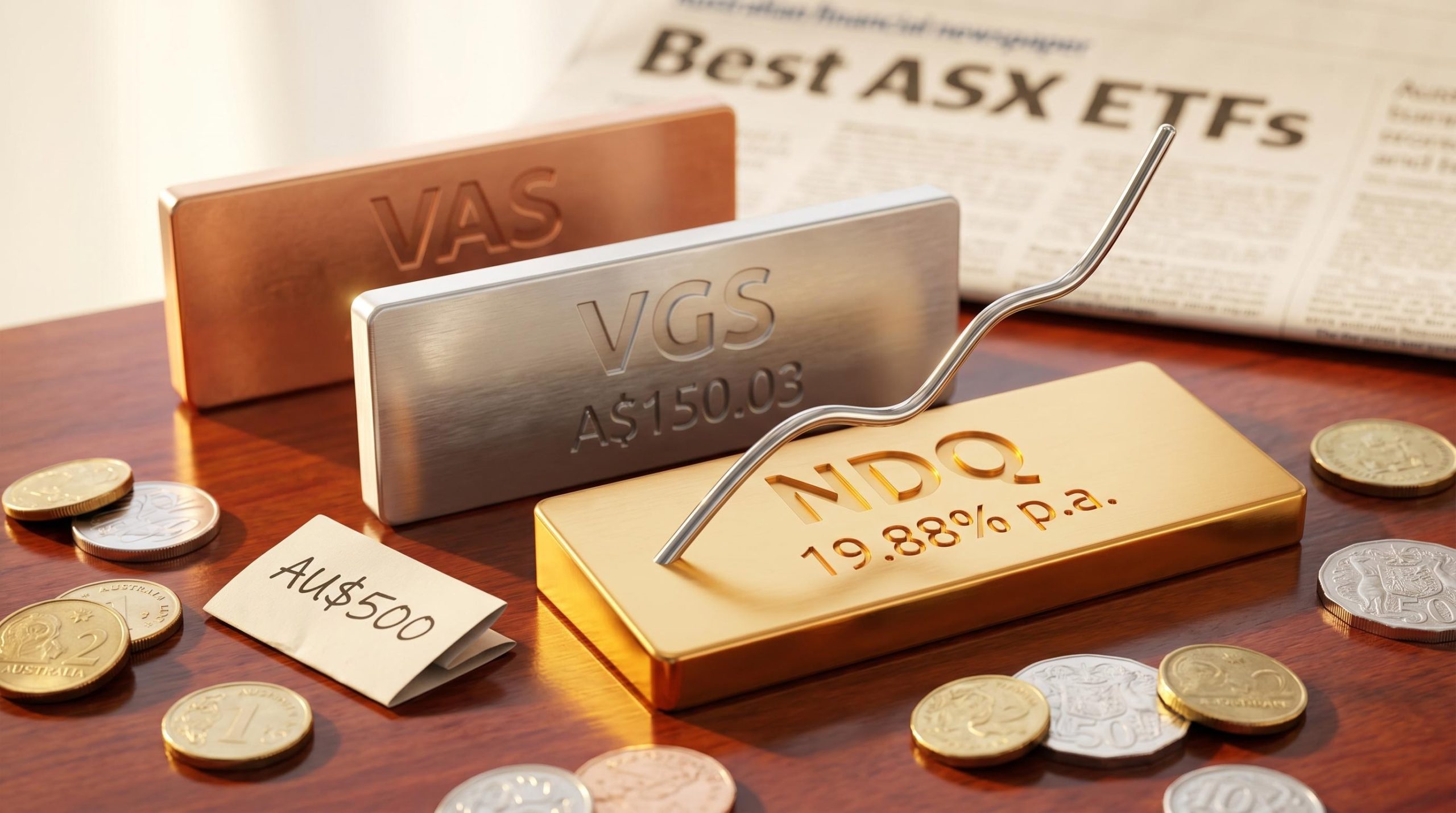
Most Australians assume investing requires thousands of dollars and hours of research. Yet a single ASX-listed ETF purchase worth AU$500 can deliver exposure to hundreds of companies across multiple continents in one transaction. That assumption, that small capital cannot build anything meaningful, is the first barrier worth dismantling.
With global equity markets swinging through a volatile April 2026 and passive index investing continuing to gain traction, the ASX ETF market offers diversified entry points accessible to first-time investors at lower capital thresholds than ever. Three ETFs appear consistently in beginner portfolio discussions: Vanguard MSCI Index International Shares ETF (VGS), Vanguard Australian Shares Index ETF (VAS), and BetaShares Nasdaq 100 ETF (NDQ). What follows is a practical breakdown of what each offers, how the three complement one another, and how to think about deploying AU$500 across them as a starting portfolio.
Why AU$500 on the ASX can do more than most beginners expect
The instinct that AU$500 is too little to invest meaningfully is understandable but outdated. A single ETF purchase provides instant access to a diversified basket of securities, removing the need to evaluate and select individual stocks. The ASX’s ETF ecosystem allows small-parcel investors to access institutional-grade diversification at retail cost, a structural advantage that did not exist a decade ago.
AU$500 is better understood as a psychological and practical threshold than a limitation. It is enough to buy units in any of the three ETFs covered here, and each unit purchased carries exposure to dozens, hundreds, or thousands of underlying companies.
What a single ETF purchase typically gives an investor:
- Instant diversification across multiple companies and sectors
- Transparent index tracking with publicly available methodology
- Low ongoing management costs relative to active funds
- Liquidity through ASX trading hours
ETFs are available through standard ASX brokerage platforms, making the access process straightforward. One consideration at small parcel sizes: brokerage fees take a proportionally larger bite from a AU$500 purchase than from a AU$5,000 one. Investors should account for this when calculating their effective entry cost.
ETF structure and tax treatment on the ASX are more nuanced than they first appear: assets are held in a legally separate unit trust with an independent custodian, CGT discounts apply after a 12-month holding period, and the gap between a 0.04% passive MER and a 1.0% active fund fee compounds into a material difference over a decade.
The case for passive index investing in 2026
April 2026 delivered a reminder of why passive, diversified exposure appeals. Global equities swung through sharp monthly moves, with broad international indices recovering from a March 2026 dip. In that environment, investors who held diversified index positions absorbed the volatility without needing to make active timing decisions. The case for passive investing rests on a simple premise: most active managers underperform their benchmark index over time, and low-cost index ETFs capture the market return by design.
The SPIVA Australia Scorecard, published by S&P Dow Jones Indices, tracks the proportion of actively managed Australian funds that underperform their benchmark index across one, three, five, and ten-year horizons, providing the most widely cited quantitative evidence for the structural advantage of passive index investing over active management in the Australian market.
When big ASX news breaks, our subscribers know first
VAS: the domestic foundation every Australian portfolio should consider
VAS is not the exciting option in this trio. That is precisely what makes it worth understanding first.
The fund tracks the S&P/ASX 300 Index, providing exposure to the broad Australian equity market in a single holding. Its composition spans the largest companies on the ASX: major banks, resources businesses, healthcare firms, and retailers. For a beginner investor, VAS removes the need to evaluate individual Australian stocks while delivering participation in the domestic economy’s growth.
The leading Australian share ETFs, including VAS, A200, IOZ, STW, and MVW, track different indices and carry meaningfully different liquidity profiles; on a A$50,000 holding the annual MER difference between the cheapest and VAS is just A$15, making bid-ask spread and index breadth more decisive factors than the fee alone.
Sectors represented in VAS include:
- Financials (major banks and insurers)
- Materials (mining and resources)
- Healthcare
- Consumer staples and discretionary
- Real estate and industrials
The income from a AU$500 starting position will be modest. VAS distributes dividends from its underlying holdings, and those distributions grow incrementally as an investor adds to their position over time.
Tax efficiency note for Australian investors: Income distributed by VAS may include franking credits, a tax treatment advantage specific to Australian-domiciled investors. Franking credits reflect corporate tax already paid on company profits, and they can reduce an investor’s personal tax liability or generate a refund. International ETFs like VGS and NDQ cannot replicate this benefit. Investors should consider their personal tax situation, ideally with a qualified adviser, when weighing domestic versus international allocation.
The ATO guidance on dividend imputation and franking credits explains how corporate tax already paid on company profits flows through to resident shareholders as a tax offset, reducing personal tax liability or generating a refund, a structural advantage that makes domestic ETFs like VAS particularly tax-efficient for Australian investors relative to their international counterparts.
In April 2026, VAS gained approximately +1.46%, a modest return relative to international peers but consistent with the domestic market’s steadier profile.
| Attribute | Detail |
|---|---|
| Index tracked | S&P/ASX 300 |
| Geographic focus | Australia |
| Sector concentration | Broad domestic (financials and materials heavy) |
| Income characteristic | Franked dividend distributions |
| Suits investor type | Those seeking low-cost domestic equity exposure with tax-efficient income |
VGS: instant exposure to the world’s biggest companies without leaving the ASX
Australian investors use global brands daily, from Apple devices to Microsoft software to Nestlé products, yet buying shares in these companies directly through overseas exchanges requires international brokerage access and currency conversion. VGS resolves this gap cleanly.
The fund tracks the MSCI World ex-Australia Index, covering large and mid-cap equities across 22 developed markets. Approximately 70% of the index is weighted toward the United States, but VGS is broadly diversified across sectors. It is not a technology-only vehicle, a distinction worth making clearly against NDQ.
Where VAS addresses the domestic side of a portfolio, VGS addresses the concentration risk inherent in the Australian market. The ASX is heavily weighted toward banking and mining. An investor holding only VAS carries meaningful sector concentration risk. VGS provides the geographic and sectoral counterweight.
Index concentration risk at the global level mirrors the domestic problem: five mega-cap US stocks controlled approximately 23% of the broad US market index as of mid-April 2026, meaning even a broadly diversified fund like VGS carries meaningful exposure to a small cluster of technology names whose performance drove over 70% of Q1 2026 losses before engineering more than half of April’s recovery.
As of 1 May 2026, the VGS unit price sat at approximately A$150.03 (Stockinvest.us). Over the longer term, the fund has delivered approximately 12.76% per annum over five years and approximately 13.26% per annum over ten years, according to financial commentary, though these figures have not been independently verified and should be treated directionally. In April 2026, VGS gained approximately +5.3%, outperforming VAS as US large-cap equities recovered.
Stockinvest.us rated VGS a Buy Candidate as of 1 May 2026 with a score of 2.135, though the three-month price forecast pointed modestly downward, with a 90% probability range of A$138.09 to A$149.03. The signal is cautiously positive rather than strongly bullish.
| Attribute | Detail |
|---|---|
| Index tracked | MSCI World ex-Australia |
| Geographic focus | 22 developed markets |
| Approximate US weighting | ~70% |
| Sector concentration | Broad and diversified |
| Suits investor type | Those seeking passive, globally diversified exposure |
Who VGS suits best
VGS fits investors seeking passive, broadly diversified international exposure with no desire to make active sector bets. It is a single-ticket solution to global equity participation.
One practical consideration: at approximately A$150 per unit, a AU$500 allocation covers roughly three units after brokerage. That matters for portfolio construction planning, particularly for investors considering a split across multiple ETFs.
NDQ: the growth accelerator for investors with patience and conviction
If VAS is the foundation and VGS is the broadening layer, NDQ is the growth engine. It also carries the highest concentration risk of the three, and that trade-off deserves equal attention.
NDQ tracks the Nasdaq 100 Index, covering 100 of the largest non-financial companies listed on the Nasdaq exchange. The thematic exposure is weighted heavily toward artificial intelligence, cloud computing, digital advertising, software, and semiconductor manufacturing. These are structural growth themes, not speculative bets, but they come packaged with meaningful short-term volatility.
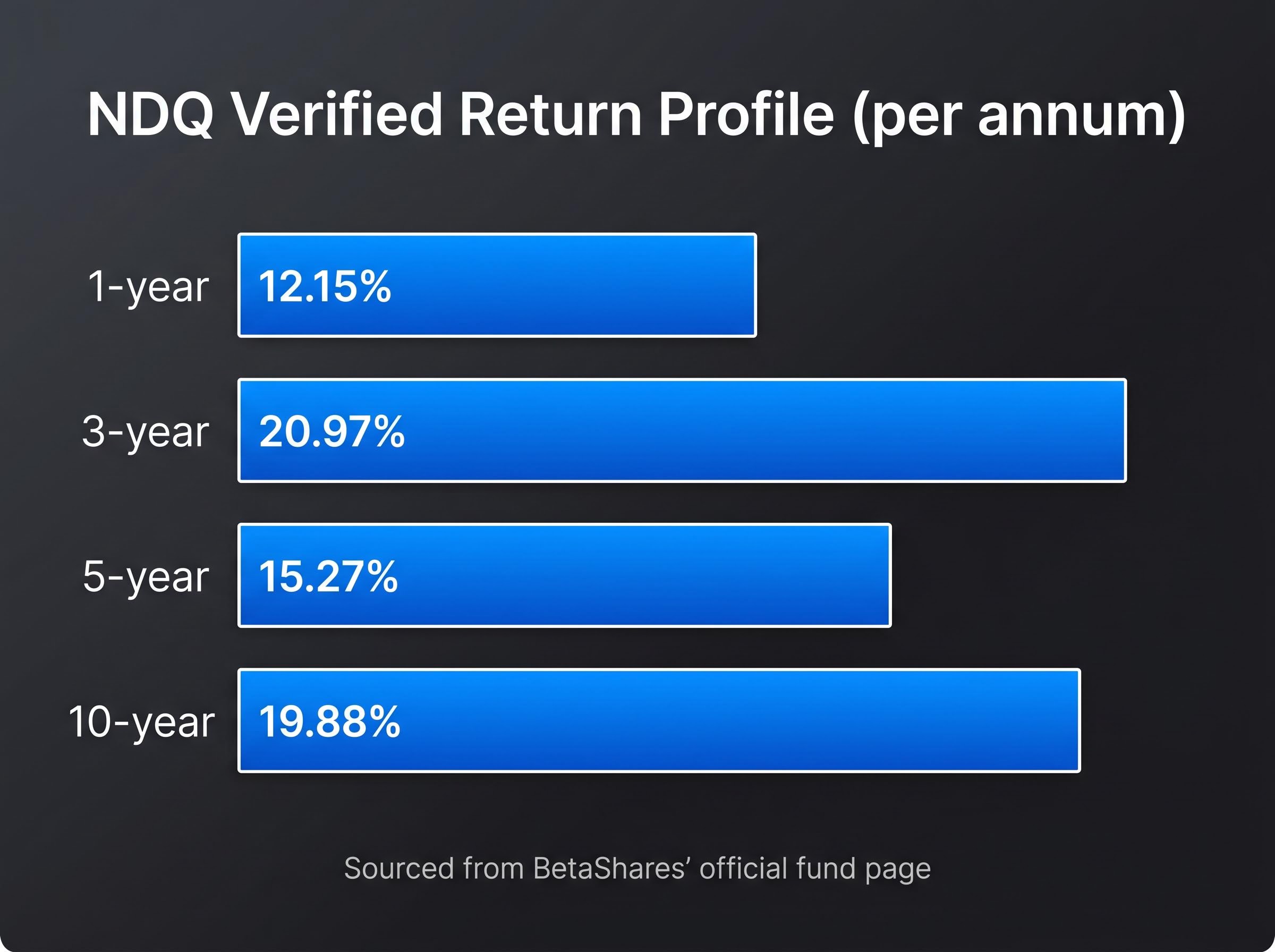
The fund’s verified long-term returns, sourced from BetaShares’ official fund page, are the strongest quantitative case in this guide.
| Period | Return (p.a.) | Confidence |
|---|---|---|
| 1-year | 12.15% | High (verified) |
| 3-year | 20.97% | High (verified) |
| 5-year | 15.27% | High (verified) |
| 10-year | 19.88% | High (verified) |
19.88% per annum over ten years. That figure, verified via BetaShares’ official fund page, represents one of the strongest long-term return profiles available through an ASX-listed ETF. Past performance does not guarantee future results, but the track record reflects a decade of structural growth in global technology adoption.
As of 1 May 2026, NDQ’s unit price was A$56.58, its management expense ratio (MER) was 0.48% per annum, and funds under management stood at approximately A$8.12 billion. Sentiment indicators from Stockinvest.us and TradingView showed strong buy signals from moving averages as of early May 2026.
NDQ is not a standalone portfolio for beginners. It is a concentrated growth complement to broader holdings like VGS and VAS.
The volatility trade-off
NDQ carries higher short-term price swings than VGS or VAS, particularly during sentiment shifts toward or away from growth equities. A March 2026 dip followed by a sharp April 2026 recovery illustrates the pattern.
The technology themes driving NDQ, including AI, semiconductors, and cloud infrastructure, are structural rather than cyclical. But realising those returns requires patience. Fool.com.au has framed NDQ as a minimum ten-year hold, and that horizon is worth internalising before allocating capital. These statements are speculative and subject to change based on market developments and company performance.
How ETF diversification actually works and why it matters for small investors
A beginner investor faces a paralysing question: which company should receive their money? Diversification through ETFs reframes the question entirely. Instead of picking the right company, the investor buys a slice of many companies and lets the collective performance do the work.
In plain terms, diversification means spreading capital across many assets so that poor performance in one does not disproportionately damage the whole.
How an ETF distributes an investment:
- The investor buys units of the ETF on the ASX, just like buying shares in a single company.
- The fund holds the underlying securities that make up its target index, purchasing and rebalancing them to match the index composition.
- The investor’s returns reflect the collective performance of all those underlying holdings, weighted according to the index methodology.
The Australian share market’s concentration in banking and materials creates a specific problem. An investor holding only domestic equities carries meaningful sector concentration risk. Adding VGS addresses that gap by spreading exposure across 22 developed markets and multiple sectors. Adding NDQ layers on targeted growth exposure.
The practical difference at AU$500 is material:
- An individual stock purchase at AU$500 delivers exposure to one company, in one sector, in one country.
- An ETF purchase at AU$500 delivers exposure to hundreds or thousands of companies, across multiple sectors and geographies.
Even at the smallest starting capital, a three-ETF combination of VGS, VAS, and NDQ covers thousands of companies across Australian, developed international, and Nasdaq-listed markets.
Building a AU$500 starting portfolio: how VGS, VAS, and NDQ work together
Understanding each ETF individually is the first step. Seeing them as an integrated system is where the portfolio takes shape.
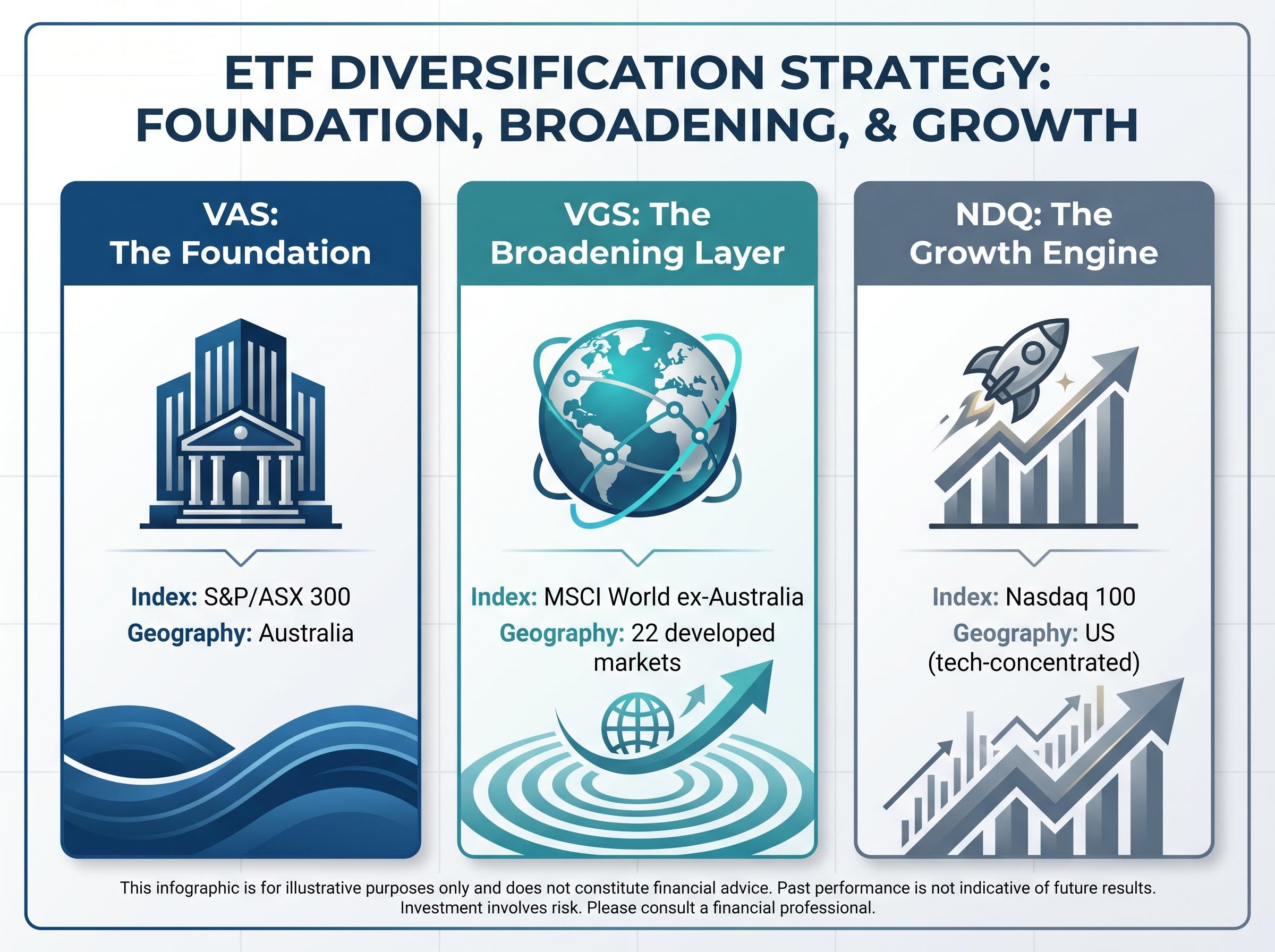
VAS provides the domestic foundation and franking credit income. VGS delivers broad international exposure across developed markets. NDQ adds concentrated growth exposure to global technology leaders. The three are complementary rather than competing.
At AU$500, investors may find their capital limits them to one or two ETFs initially, and that is a starting point, not a constraint. Consider the unit prices: VGS sits at approximately A$150.03, NDQ at A$56.58, and VAS pricing should be verified directly via Vanguard Australia’s website.
A worked example: roughly three units of NDQ at A$56.58 each totals approximately A$170, leaving room for one unit of VGS at approximately A$150 and a small buffer for brokerage. Alternatively, an investor might begin with a single ETF and add the others as they make subsequent contributions.
| ETF | Index | Geographic Focus | Sector Profile | Approx. Unit Price (May 2026) |
|---|---|---|---|---|
| VAS | S&P/ASX 300 | Australia | Broad domestic (financials/materials heavy) | Verify via Vanguard Australia |
| VGS | MSCI World ex-Australia | 22 developed markets | Broad and diversified | ~A$150.03 |
| NDQ | Nasdaq 100 | US (tech-concentrated) | Technology and growth | A$56.58 |
Brokerage costs matter at small parcel sizes. A $5-$10 brokerage fee on a AU$500 purchase represents 1-2% of the total investment, a meaningful drag that investors should factor into any allocation decision.
Three questions to ask before allocating:
- What is the intended investment horizon? NDQ’s volatility profile suits longer timeframes (ten years or more), while VAS and VGS are appropriate across a broader range of horizons.
- How much short-term price volatility is tolerable? If a 10-15% drawdown would prompt a sell decision, a heavier weighting toward VAS and VGS may be more appropriate.
- Is there existing domestic equity exposure elsewhere (for example, through superannuation)? If so, a larger international allocation through VGS or NDQ may better complement the overall position.
The starting point matters less than the habit of starting
AU$500 is a genuinely viable starting point for ASX ETF investing, not a compromise position. VAS provides domestic income and franking credit efficiency. VGS delivers international breadth across 22 developed markets. NDQ offers long-term exposure to global technology growth, backed by a verified ten-year return of 19.88% per annum.
The compounding benefit of ETF investing accrues over time, and the habit of contributing regularly matters more than the size of the initial position. Small, consistent additions to a diversified ETF portfolio build wealth in a way that waiting for a “better” entry point rarely does.
Before investing, verify current ETF prices and MER figures directly via the official Vanguard Australia and BetaShares websites. Investors with questions about franking credits or tax treatment should consider consulting a qualified financial adviser.
Investors wanting to understand how capital is sorting across regions and sectors right now will find our full explainer on global capital flows in 2026 a useful next step, covering the SOXX ETF’s record 40.4% April gain, the structural headwinds facing European equity segments, and the AI infrastructure investment cycle projected at A$630-700 billion that is reshaping where international indices like VGS draw their returns.
This article is for informational purposes only and should not be considered financial advice. Investors should conduct their own research and consult with financial professionals before making investment decisions. Past performance does not guarantee future results.