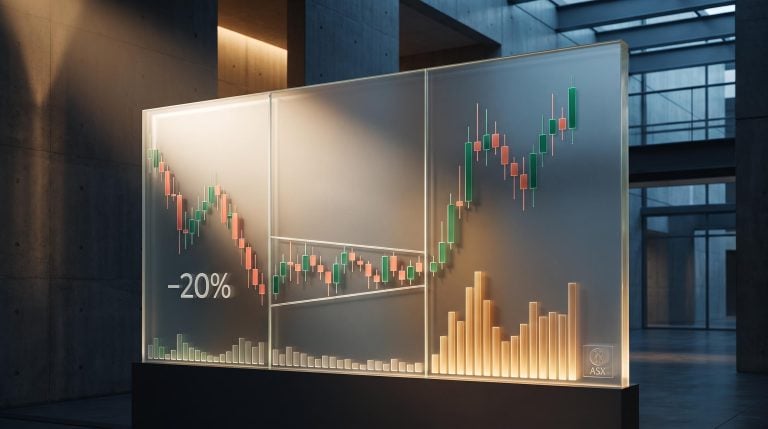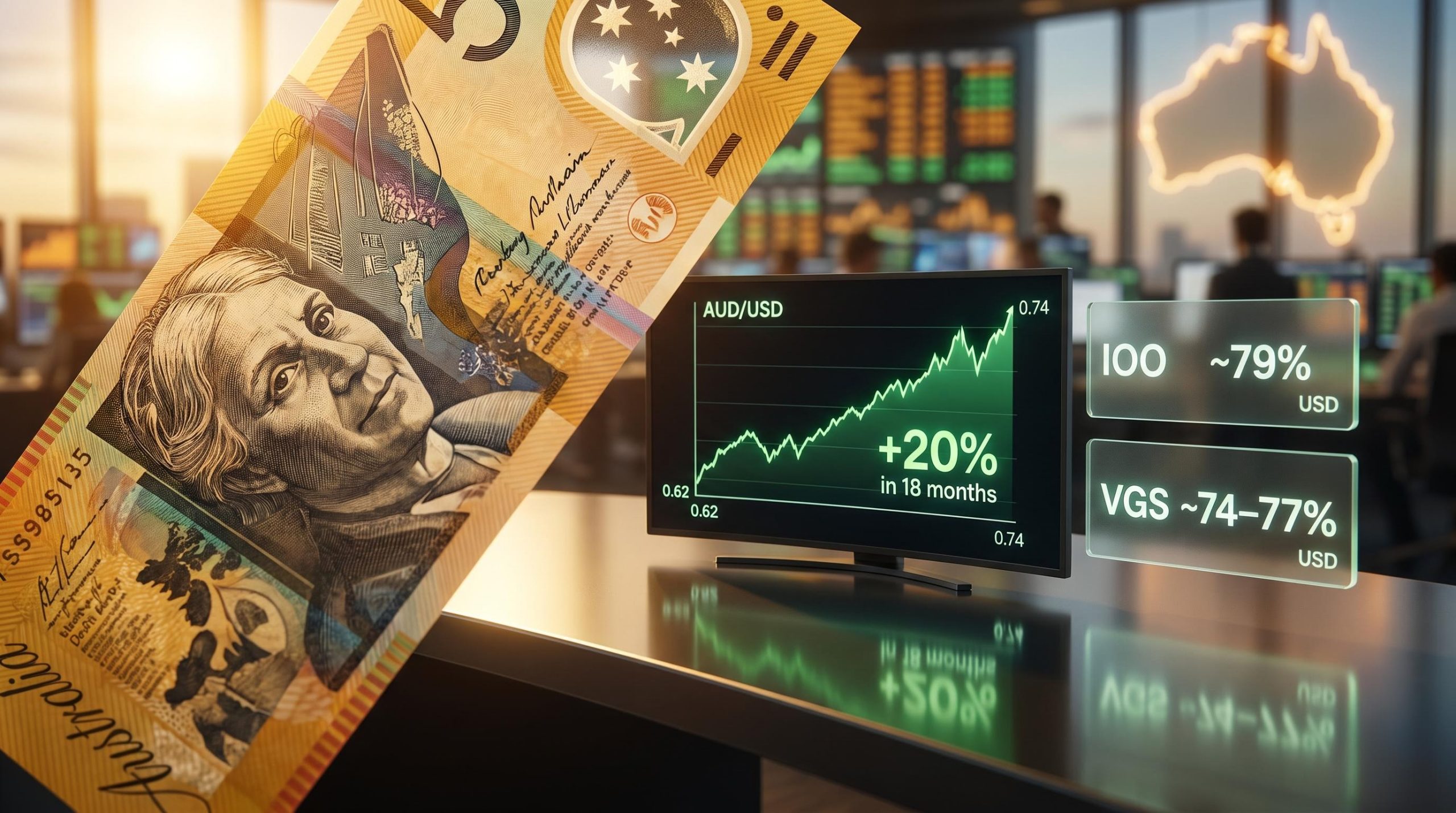
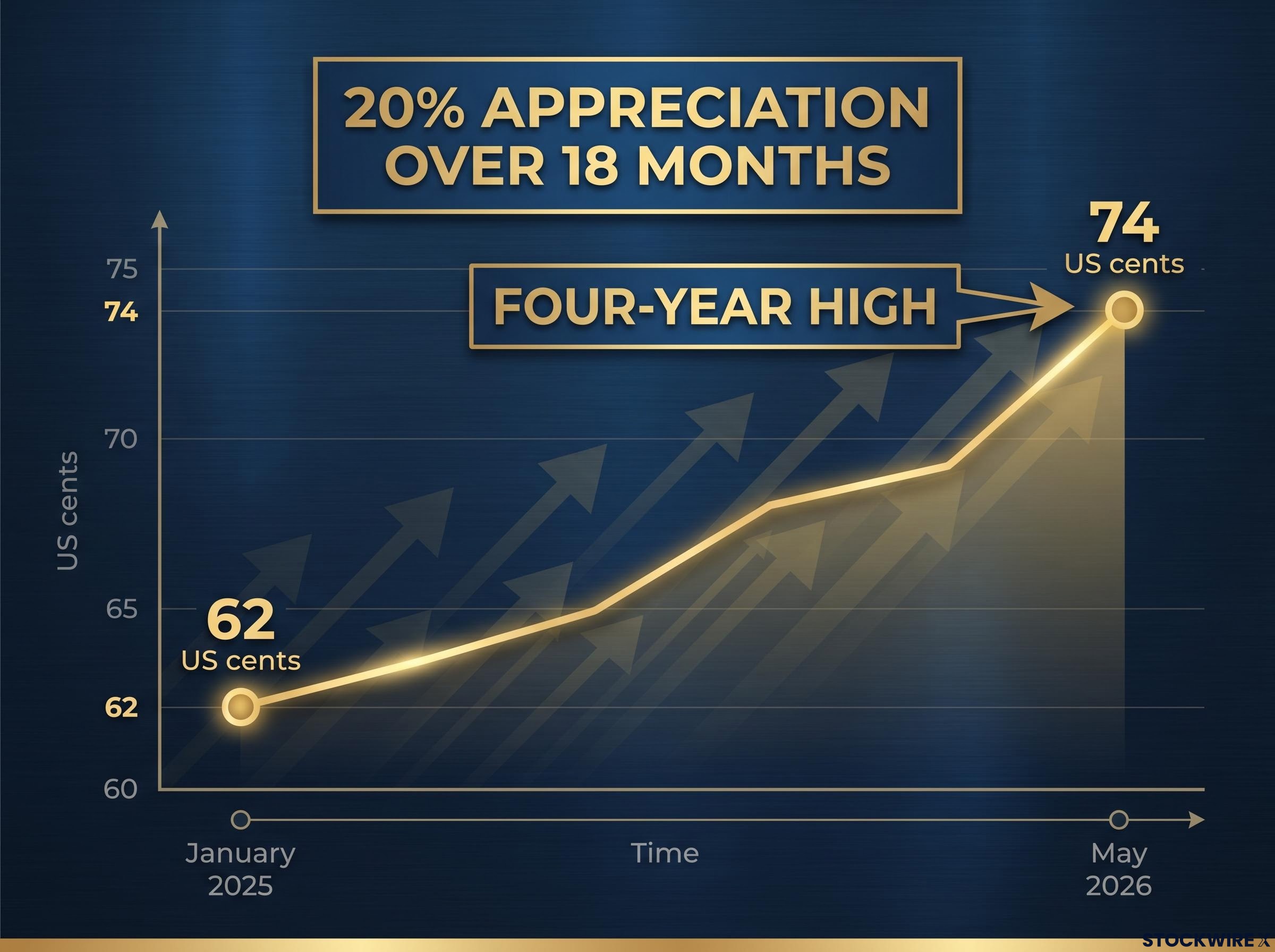
Starting from January 2025, the Australian dollar was trading at roughly 62 US cents. Over the following 18 months, it pushed steadily higher, reaching approximately 74 US cents by May 2026, a level not seen in four years. That is an appreciation of approximately 20% in roughly 18 months, and it has quietly rewritten what Australian investors actually earned from their international ETFs, regardless of how US or global sharemarkets performed over the same window.
If you hold international equity ETFs on the ASX, currency is not background noise. It is a direct variable in what your returns convert to in Australian dollars. The size and speed of this move make it genuinely consequential, particularly for the large cohort of Australian retail investors who moved heavily into US equity ETFs in recent years, attracted by years of the S&P 500 outpacing the ASX by a considerable margin.
Here is what is actually driving the move, what it has done to your international ETF returns, and how to think about your exposure from here.
Why the Australian dollar is at its highest level in four years
The headline number is stark. The AUD has moved from a starting point of approximately 62 US cents in early 2025 to reach roughly 74 US cents by May 2026, its highest level in four years.
The Australian dollar appreciated approximately 20% against the US dollar between January 2025 and May 2026, reaching a four-year high.
No single factor explains the move. Three structural forces have converged, each reinforcing the others:
The USD and AUD relationship is structurally inverse: when the US dollar strengthens on the back of elevated Treasury yields or Federal Reserve tightening, the AUD tends to fall through two distinct channels, a yield differential that diverts global capital toward USD assets and reduced demand for commodities priced in US dollars.
- US dollar weakness: The greenback has faced sustained selling pressure since early 2025, with markets pricing in US rate cuts, growing unease over American fiscal settings, and a general pullback from USD-denominated assets amid geopolitical tension. This is the broadest factor, but it is better understood as a floor beneath the AUD rather than the whole story.
- Australia’s relative interest-rate outlook: Australia’s cash rate is expected to fall more slowly than US rates, creating a yield advantage that draws global capital. Even small differences in expected rates can trigger large foreign exchange moves, given the daily volume traded in currency markets.
- Structural commodity demand: Demand for Australian metals and minerals has been bolstered by two powerful, long-running forces: the global shift toward renewable energy and the rapid expansion of AI infrastructure. Because overseas purchasers typically settle these transactions in Australian dollars, that buying creates ongoing, structural support for the currency.
The Resources and Energy Quarterly for June 2026, published by Australia’s Office of the Chief Economist, forecasts sustained export demand for critical minerals including lithium and copper, linking that demand directly to clean energy technologies, transport electrification, and data centre construction.
What matters here is the convergence. A weakening USD alone would not have pushed the AUD this far. A yield advantage alone would not have sustained it. Commodity demand alone would not have accelerated it. The three forces operating together tell you this is not a short-term speculative spike but something more durable, and that distinction shapes how likely the trend is to reverse quickly.
When big ASX news breaks, our subscribers know first
How exchange rates quietly reshape international ETF returns
When you buy an international equity ETF on the ASX, you are making two bets, whether you realise it or not. The first is on how the underlying shares perform in their local currency. The second is on how the exchange rate between that currency and the Australian dollar moves over the same period.
Most investors focus entirely on the first bet. They check how US equities performed, see a gain, and assume their ETF delivered something similar. The currency layer is where that assumption breaks.
The maths behind the currency drag
Say US shares rise 10% in US dollar terms over a year. If the AUD also appreciates 10% against the USD over that same period, those US dollar gains buy fewer Australian dollars when converted. The result: your return in AUD terms is close to zero, despite the US market posting a solid year.
| Scenario | US equity gain (USD) | AUD/USD move | Approximate AUD return |
|---|---|---|---|
| A: AUD flat | +10% | No change | ~10% |
| B: AUD rises 10% | +10% | +10% appreciation | ~0% |
This is not a theoretical risk. With the AUD climbing approximately 20% since early 2025, the currency conversion layer has been one of the largest single influences on what Australian holders of unhedged US equity ETFs actually received in AUD terms.
If you checked your US ETF position in USD and felt comfortable with the return, you may have experienced a very different outcome in Australian dollar terms. The gap between those two numbers is entirely the currency’s doing.
The two ETFs where this currency effect is most visible
Two of the most widely held unhedged international equity ETFs on the ASX are the iShares Global 100 ETF (ASX: IOO) and the Vanguard MSCI Index International Shares ETF (ASX: VGS). If you hold either, the AUD’s move has been directly relevant to your returns.
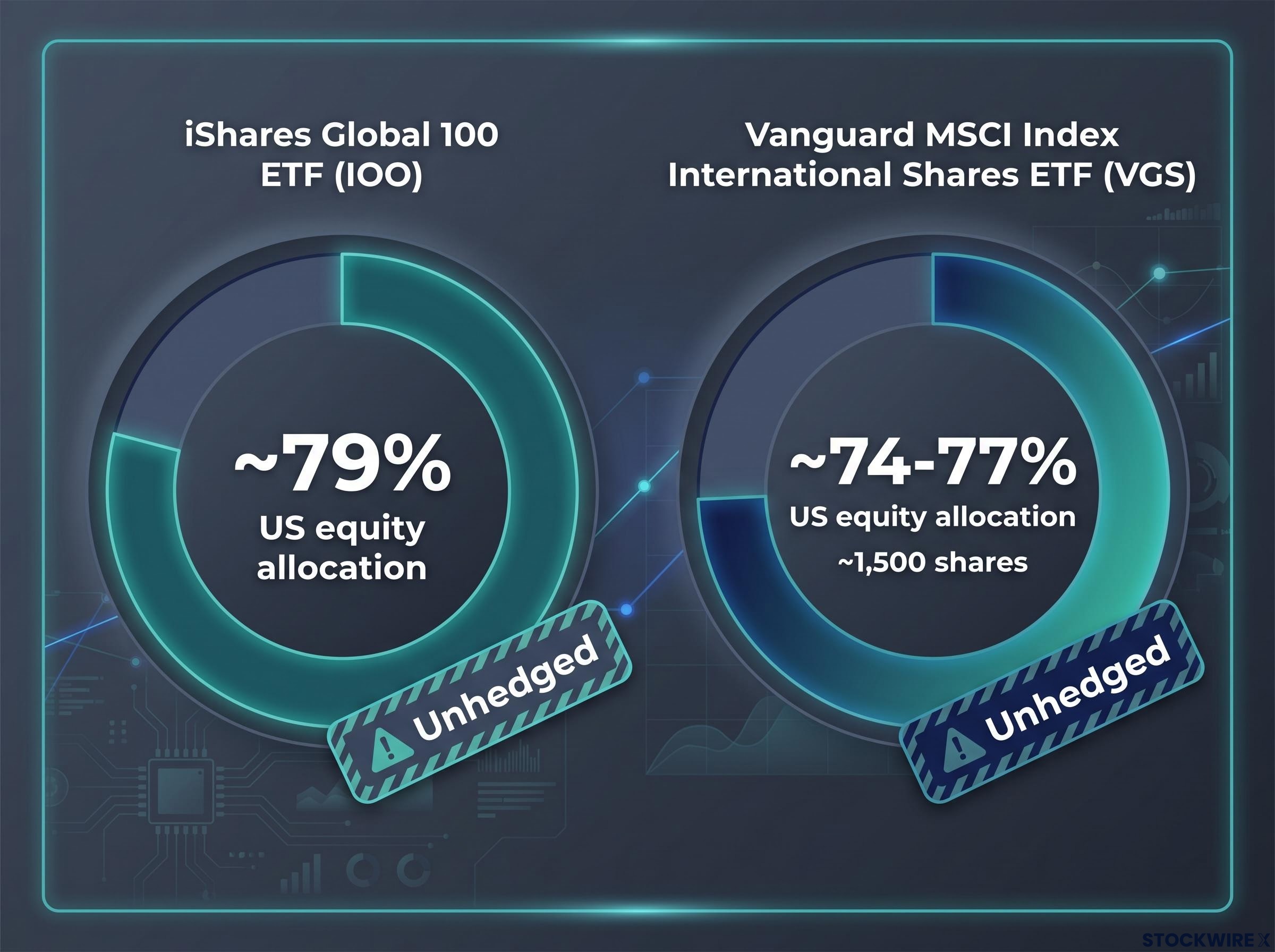
IOO follows the S&P Global 100 (Net) Index and allocates close to 79% of its assets to US-listed equities. VGS holds a portfolio of approximately 1,500 shares across developed markets outside Australia, with US equities accounting for roughly 74-77% of the fund.
| Fund (ASX code) | Approximate US equity allocation | Currency hedging |
|---|---|---|
| iShares Global 100 ETF (IOO) | ~79% | Unhedged |
| Vanguard MSCI Index International Shares ETF (VGS) | ~74-77% | Unhedged |
Because the overwhelming majority of both funds’ underlying assets are denominated in US dollars, the AUD’s approximately 20% appreciation against the USD has acted as a direct headwind to the AUD returns delivered to Australian holders.
Years of the S&P 500 delivering stronger returns than the ASX drew substantial retail capital into both of these products. That is precisely the cohort now most exposed to this currency dynamic. For investors who hold IOO or VGS specifically, the AUD’s move from 62 to 74 US cents has likely been the single largest determinant of whether their unhedged international equity allocation added to or subtracted from their portfolio’s AUD return over the past 18 months.
The scale of that cohort is significant: international ETF inflows hit $17.3 billion in net flows through October 2025, compared with $10.6 billion into Australian equity ETFs over the same period, confirming that the pivot toward global equities among Australian retail investors was structural rather than speculative.
What hedged ETFs do differently, and why it matters right now
Currency-hedged international ETFs use financial instruments, typically forward contracts (agreements to exchange currencies at a pre-agreed rate on a future date), to lock in exchange rates and strip out the day-to-day movement of the AUD against foreign currencies. The underlying equity performance passes through to you without the currency conversion layer reshaping the outcome.
The practical difference becomes visible when you compare hedged and unhedged outcomes across different currency environments:
- When the AUD is appreciating (like now): Unhedged investors see foreign gains compressed because those USD returns buy fewer AUD on conversion. Hedged investors preserve more of the underlying equity gain.
- When the AUD is falling: Unhedged funds benefit because foreign currency gains are amplified when converted into a weaker AUD. Hedged investors miss that upside entirely.
- Over the long run: The hedge itself carries an ongoing cost, typically small, that acts as a slight drag on performance. Hedging reduces volatility; it does not guarantee higher returns.
This distribution season, the combination of a falling US dollar and a rising Australian dollar has been the key factor driving higher payouts from currency-hedged ETFs compared with their unhedged equivalents.
That distribution difference gives you a concrete, current-day illustration. If you hold a hedged version of an international equity strategy and an unhedged version side by side, the income difference this season is measurable. It is not a theoretical outcome on a product fact sheet. It is real dollars.
The scale of that difference becomes concrete when you look at specific fund pairs: hedged vs unhedged ETF returns over the year to May 2026 diverged by as much as 13 percentage points on identical underlying holdings, a gap produced entirely by AUD/USD appreciation rather than any difference in fund management or portfolio construction.
Understanding where your distributions are coming from, and specifically how much of the difference is currency rather than equity performance, helps you assess whether your current allocation reflects a deliberate currency view or an accidental one.
How to think about currency exposure in your portfolio
Predicting where the AUD will be in six or twelve months is extremely difficult. Restructuring your portfolio purely around a currency forecast is a risky strategy, and one that even professional FX traders get wrong regularly. A more disciplined approach focuses on making your currency exposure a conscious decision rather than an inherited one.
- Audit your international ETFs. Check whether each fund is hedged or unhedged. Look at how much of the portfolio sits in US dollars versus other currencies. Many investors hold these funds without ever having actively decided on their currency exposure.
- Match hedging to your time horizon. If you are investing over decades, you may be comfortable accepting currency volatility in exchange for simplicity and the natural diversification that comes with holding foreign currencies. If you are drawing income now, or investing over a shorter window, some hedged exposure may reduce the impact of large FX swings on your near-term returns and distributions.
- Remember that hedging cuts both ways. When the AUD eventually falls, and currencies are cyclical, unhedged funds will benefit. Hedged funds will miss that tailwind.
The case for holding both hedged and unhedged exposure
A blend of hedged and unhedged international ETFs removes the need to predict the AUD’s direction. You participate in some of the upside when the AUD falls (through your unhedged holdings) and retain some protection when it rises (through your hedged holdings).
Your Australian equities already provide natural AUD exposure, so a partial hedge in the international sleeve of your portfolio may be sufficient. The point is not to optimise for a single FX scenario. It is to build a portfolio that can deliver a reasonable outcome across multiple scenarios.
Investors wanting to extend this thinking beyond currency hedging decisions will find our comprehensive walkthrough of de-dollarisation positioning for Australian investors useful, covering how a structurally weaker USD reshapes the case for gold ETFs, hard currencies, and uncorrelated assets within an ASX-based portfolio.
The practical implication is straightforward: knowing what currency exposure you carry, and why, is a prerequisite for making any informed judgement about how to respond to a move as significant as the AUD’s current run.
What the AUD’s four-year high signals about investing beyond the sharemarket ticker
The AUD’s move from approximately 62 to approximately 74 US cents has demonstrated something that many investors overlook. Commodity cycles, central bank policy differentials, and geopolitical capital flows can be as consequential to what you actually earn as whether the underlying equities gained or fell. Three independent forces, USD weakness, Australia’s relative rate advantage, and structural commodity demand from the green energy and AI transitions, converged to produce a 20% currency shift that reshaped returns for an entire category of ASX-listed ETFs.
For ASX investors holding international equity ETFs, the exchange rate can be one of the most consequential drivers of what those investments actually deliver in AUD terms.
Currency awareness is not an advanced skill reserved for professional fund managers. It is a baseline competency for anyone holding international ETFs. The current environment has made this visible in a way that a decade of gradual market movements did not. Structural commodity demand from the green energy and AI transitions provides an ongoing support mechanism for the AUD that is worth factoring into your thinking, not as a directional forecast, but as a reason to make your currency exposure deliberate rather than inherited.
This article is for informational purposes only and should not be considered financial advice. Investors should conduct their own research and consult with financial professionals before making investment decisions. Past performance does not guarantee future results.