One stock’s short interest climbed 5.41 percentage points in a single month after its own quarterly report was quietly withdrawn. That is the signal short sellers had been waiting for.
As of 4 May 2026, the most shorted stocks on the ASX include some of Australia’s best-known names alongside a uranium miner that has become a case study in how disclosure failures accelerate short positions. ASIC short position data, published with a T+4 reporting lag, captures a market in which professional short sellers are actively repositioning across energy, uranium, consumer, and healthcare sectors. What follows is a ranked list of the ten most shorted ASX stocks by short interest percentage, an examination of what is driving the heaviest positions, and a worked example of how integrity events create a distinct and identifiable short-selling pattern.
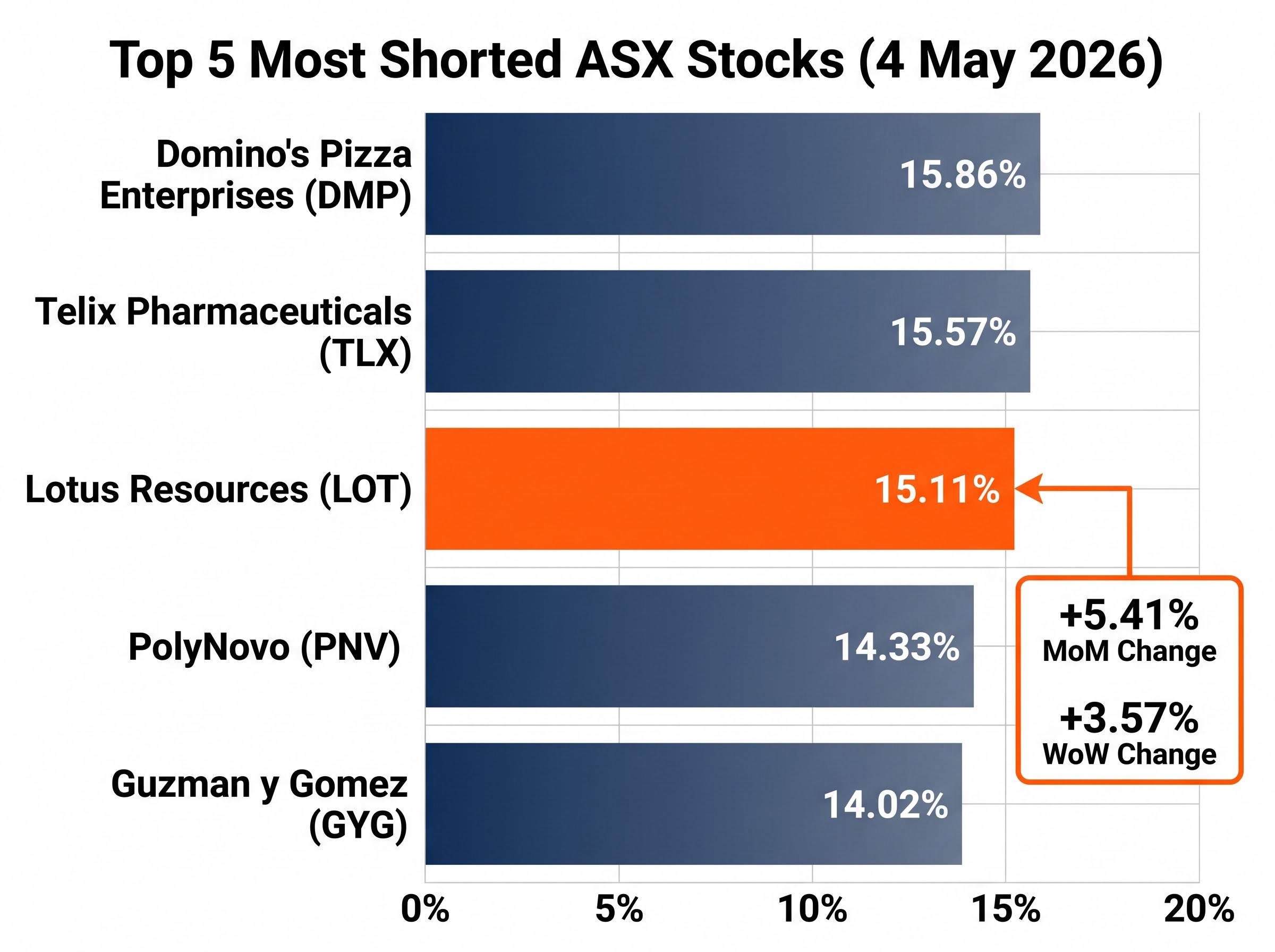
The 10 most shorted ASX stocks as of 4 May 2026
ASIC’s aggregated short position reports carry a four-trading-day lag, meaning the figures below reflect positions as they stood on 4 May 2026. The directional changes, week-on-week and month-on-month, reveal where short sellers are adding conviction and where they are covering.
The prior week’s short position data, published on 4 May and reflecting positions as of 28 April, showed Telix Pharmaceuticals leading all ASX names at 16.10% short interest while Lotus Resources sat at 11.54%, a figure that would more than triple in the following week once the 30 April retraction event was captured in the next release cycle.
| Stock | ASX Code | Short Interest % | Week-on-Week Change | Month-on-Month Change |
|---|---|---|---|---|
| Domino’s Pizza Enterprises | DMP | 15.86% | +0.38% | +0.53% |
| Telix Pharmaceuticals | TLX | 15.57% | -0.53% | +0.97% |
| Lotus Resources | LOT | 15.11% | +3.57% | +5.41% |
| PolyNovo | PNV | 14.33% | +0.04% | +0.34% |
| Guzman y Gomez | GYG | 14.02% | +1.94% | +0.36% |
| Boss Energy | BOE | 13.38% | +1.86% | +1.57% |
| Treasury Wine Estates | TWE | 12.48% | -0.76% | — |
| Zip Co | ZIP | 11.90% | +0.14% | +0.74% |
| Droneshield | DRO | 10.81% | -0.58% | — |
| Flight Centre | FLT | 10.70% | -0.98% | -1.30% |
Domino’s holds the top position on sustained consumer spending weakness and margin pressure. Telix Pharmaceuticals sits second, shorted primarily on valuation concerns amid its rapid growth phase. But the standout name is Lotus Resources, where a 3.57 percentage point week-on-week surge tells a different story entirely.
When big ASX news breaks, our subscribers know first
Why Lotus Resources became the most watched short on the ASX
The 5.41 percentage point monthly increase in Lotus Resources short interest is the largest move among the top ten. It did not appear from nowhere.
The retraction and what it told the market
Approximately one month before the 4 May data snapshot, LOT’s short interest already sat at roughly 9.7%, elevated but not exceptional for a uranium developer navigating a mine restart. Short sellers had been building positions throughout 2026 on concerns about operational execution at the Kayelekera uranium mine in Malawi.
The pre-collapse short interest signal in Lotus Resources was detectable in the weeks before the 30 April retraction announcement, with institutional sellers lifting positions from roughly 9.7% toward 11.5% while the company was still reporting normal operational progress, a pattern that a parallel analysis of the same period tracked in real time.
Then came 30 April 2026. Lotus Resources disclosed that it had retracted previously reported mined grade, milled grade, and recovery figures from its December 2025 quarterly report. The company attributed the withdrawal to inconsistencies in laboratory sampling and assaying at Kayelekera. The market had priced in a smoother and faster restart; the retraction told investors that the operational data underpinning those expectations could not be relied upon.
LOT shares fell approximately 22% on the day. The cumulative decline from the March quarter update reached approximately 39.4%.
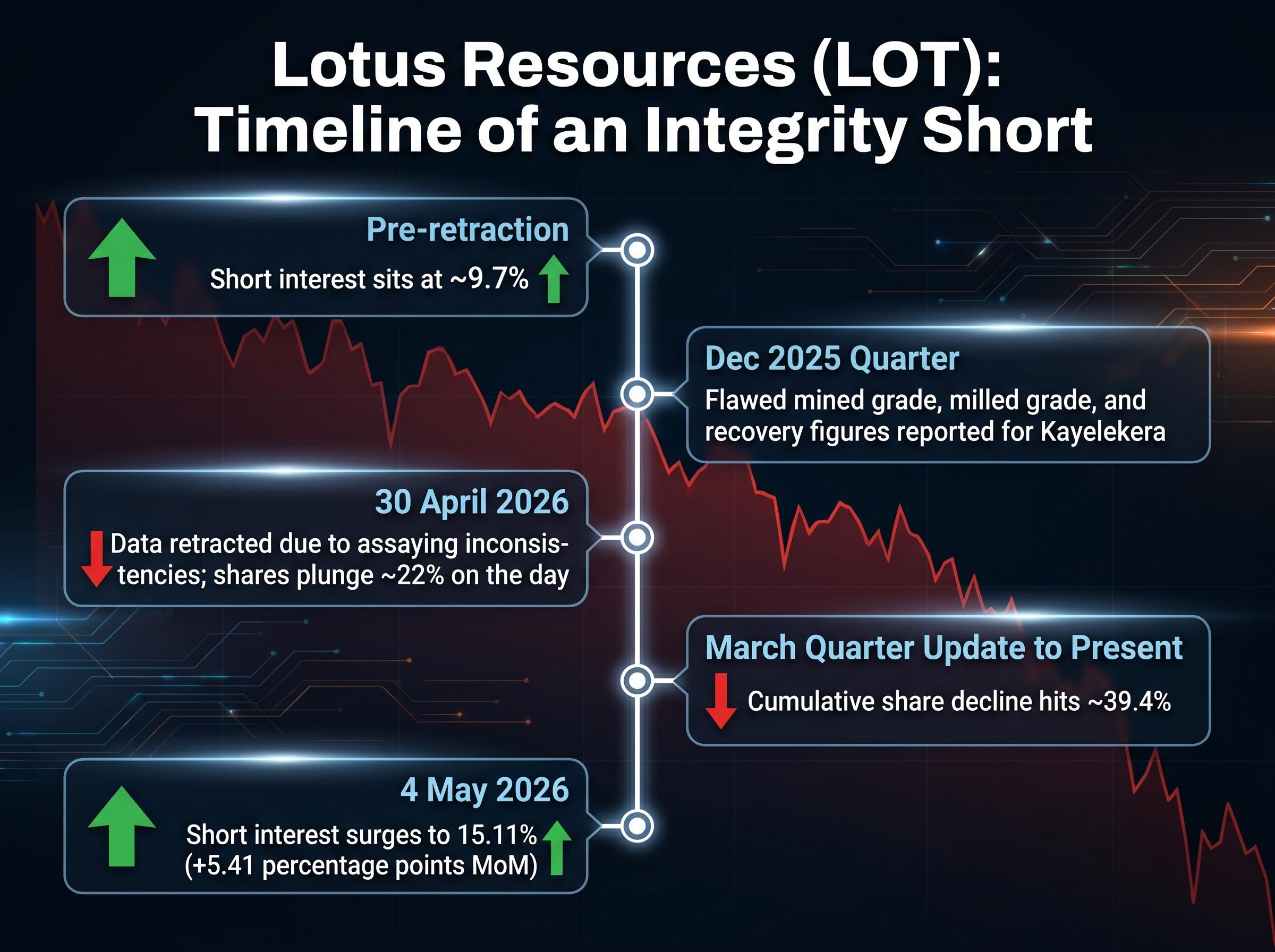
How short interest built before and after the announcement
The pre-retraction trajectory was steady, rising from roughly 9.7% toward 11.5% as operational scepticism grew. The post-announcement acceleration was sharp: a 3.57 percentage point week-on-week jump as short sellers who already held positions added to them once the disclosure failure was confirmed. This pattern, sometimes described as conviction layering, distinguishes integrity-driven shorts from opportunistic ones.
Lotus Resources short interest surged from approximately 9.7% to 15.11% in one month, a 5.41 percentage point increase, the largest monthly move among the top ten most shorted stocks.
Understanding what short sellers actually do when data integrity fails
Short selling involves borrowing shares from an existing holder, selling them on market, and aiming to repurchase them later at a lower price. The profit, if the trade works, comes from the difference between the sale price and the lower repurchase price. It is a directional bet that a stock will decline.
ASX short selling mechanics operate under a covered-short framework in which naked short selling is prohibited, and every on-market short sale must be reported to ASIC regardless of size, a granularity requirement that exceeds equivalent disclosure rules in the US and UK.
Not all short positions carry the same thesis. Two broad categories help investors interpret what a high short interest figure actually signals:
Fundamental shorts (valuation, earnings, sector headwinds):
- Driven by a view that the stock is overpriced relative to earnings or peers
- Often sector-wide, applied across multiple names facing similar conditions
- Tend to build gradually and unwind gradually
- Examples: consumer discretionary names shorted on spending downturn expectations
Integrity shorts (data restatement, disclosure failure, assaying inconsistency):
- Triggered by a specific event that undermines confidence in the company’s reported data
- Tend to produce faster and larger short interest builds than valuation-based positions
- Company-specific rather than sector-wide; peer producers in the same sector may not be targeted
- A data retraction does not just change one number. It changes the reliability of every number the company has previously reported.
The distinction matters. A valuation short may resolve as earnings improve. An integrity short persists until confidence in management disclosure is restored, a process that typically requires independent verification, not just management reassurance.
ASX Listing Rule 3.1 requires listed companies to immediately disclose information that a reasonable person would expect to have a material effect on share price. The retraction of previously reported production metrics sits squarely within this obligation.
How ASIC short position data reaches investors
ASIC publishes aggregated short position reports with a T+4 reporting delay. By the time retail investors see a short interest surge in published ASIC data, the initial trade has already been executed four trading days earlier. The reports are aggregated, meaning they show total short positions by stock but do not identify individual short sellers. Raw data is available via ASIC’s daily aggregate files.
This lag has a practical implication: monitoring ASX company announcements directly remains more timely than waiting for short position data to reveal a shift that has already occurred.
Boss Energy and the comparable overhang pattern
Boss Energy sits sixth on the most-shorted list at 13.38% as of 4 May 2026, with short interest rising 1.86 percentage points week-on-week and 1.57 percentage points month-on-month. The trajectory is accelerating.
The catalyst was an April 2026 production update that triggered an approximately 14% share price decline. Where Lotus Resources faced a data retraction, Boss Energy faced a production guidance downgrade. The nature of the credibility event differs, but the market impact follows a recognisable pattern.
Source commentary has explicitly compared the two situations, describing BOE as creating a “similarly difficult overhang” to LOT. Three shared characteristics make the comparison instructive:
- Both operate in the uranium sector, where production timelines carry outsized investor expectations
- Both experienced an operational credibility event that triggered a material single-day share price decline
- Both saw short interest accelerate well above sector peers in the weeks following the event
Source commentary describes Boss Energy as creating a “similarly difficult overhang” to Lotus Resources, suggesting short sellers are applying a coherent operational credibility thesis across the uranium sector.
When two companies in the same sector attract elevated and accelerating short interest following separate but structurally similar events, it suggests short sellers are testing a sector-level thesis about operational delivery risk, not simply reacting to isolated news.
Where short interest is rising and falling across the broader ASX
The uranium sector attracted the most dramatic short interest moves in the week to 4 May, but the activity extended well beyond resources.
Rising short interest appeared across multiple sectors:
- Energy: Beach Energy (BPT) rose 3.80 percentage points to 8.69%; Woodside and Origin Energy also saw additions
- Lithium: PMET Resources, PLS Group, and Core Lithium all attracted new short positions
- Copper: Sandfire Resources and Firefly Metals saw short interest climb
- Gold: Genesis Minerals (GMD) rose 2.46 percentage points to 5.39%; Evolution Mining also increased
- Funds management: Pinnacle Investment Management, Hub24, and Generation Development Group all saw short additions
A common thread connects many of these names: recent earnings downgrades. Accent Group fell approximately 12.9% on 4 May. G8 Education (GEM) fell approximately 31% on 29 April, with its short interest rising 1.77 percentage points to 5.17% (a monthly increase of 2.72 percentage points). Bank of Queensland fell approximately 9% on 22 April. Generation Development Group dropped approximately 22% on 22 April.
The breadth of short interest additions across unrelated sectors suggests professional short sellers are responding to a broader earnings downgrade cycle, not just uranium-specific risks.
The covered shorts: where short sellers are exiting
The most notable cover was IDP Education (IEL), where short interest fell 4.47 percentage points in one week to 4.25%, with a monthly decline of 5.47 percentage points. The unusual feature: no market-sensitive announcement accompanied the unwind, suggesting position management rather than a catalyst-driven cover. IEL shares were down approximately 51% year-to-date, contextualising the cover as potential profit-taking.
Other meaningful covers included Flight Centre (down 0.98 percentage points to 10.70%), Treasury Wine Estates (down 0.76 percentage points to 12.48%), Cochlear (down 0.60 percentage points to 4.06%), and Droneshield (down 0.58 percentage points to 10.81%). Covered positions in heavily shorted stocks can signal short sellers locking in profits or anticipating a recovery catalyst.
What the Lotus Resources signal means for investors watching the short list
The pattern this data reveals is specific: short interest builds driven by integrity events, such as data retractions, assaying failures, and disclosure inconsistencies, tend to be faster, larger, and more persistent than those driven by valuation alone. Lotus Resources is the clearest current example, but Boss Energy confirms the pattern is not isolated.
Investors assessing any heavily shorted stock can apply a three-part checklist:
- What is the nature of the short thesis? Is it fundamental (valuation, earnings, sector headwind), operational (guidance miss, production delay), or integrity-based (data retraction, disclosure failure)? Integrity-driven shorts carry the most persistent risk.
- Is short interest accelerating or stable? A stock at 15% short interest and rising tells a different story from one at 15% and flat. LOT’s 5.41 percentage point monthly surge signals active conviction; Flight Centre’s 1.30 percentage point monthly decline signals a position unwinding.
- Has management responded with specific remediation detail? Independent assay review outcomes, laboratory control statements, and reconciliation process updates would signal that remediation is underway. As of May 2026, this detail remains publicly absent for Lotus Resources.
A data retraction does not just change one number. It changes the reliability of every number the company has previously reported.
Reading the short list as a forward indicator, not a verdict
Short interest data, particularly when viewed through the lens of the underlying catalyst, is a forward indicator of where professional risk capital is concentrating. It is not a guarantee of further price decline. High short interest also creates conditions for sharp upward moves when sentiment shifts, as the IDP Education cover illustrates. The same data can point to downside risk and upside volatility depending on how positions unwind.
ASIC short data carries a T+4 lag. For investors tracking potential integrity events in their own portfolios, direct monitoring of ASX company announcements, particularly quarterly report amendments, operational updates, and guidance revisions, remains the most timely tool available. The short interest print confirms what has already happened; the announcements page signals what may come next.
This article is for informational purposes only and should not be considered financial advice. Investors should conduct their own research and consult with financial professionals before making investment decisions.