Most investors can recite a stock’s price-to-earnings ratio before they can say whether the company behind it holds more assets than it owes in debt. That gap is precisely what a balance sheet closes. For Australian retail investors analysing ASX-listed companies, the balance sheet is the single most important financial statement for understanding what a business is actually worth, independent of what the market prices it at on any given trading day. With ASX corporate filings freely accessible through the ASX Announcements Platform, the raw material for this analysis is already available to every investor. This guide walks through every section of a balance sheet, explains three derived ratios that convert raw figures into investment signals, and grounds each concept in real ASX company examples so the framework is immediately applicable to due diligence.
What a balance sheet actually tells you (and what it doesn’t)
The most common misunderstanding about a balance sheet is treating it like a moving picture of the business. It is not. A balance sheet is a snapshot at a single point in time, capturing what a company owns and what it owes on one specific date. That distinction matters because a strong snapshot can mask a deteriorating trend, and a weak one can obscure a recovery already underway.
The question a balance sheet answers is straightforward: what does this company own, and what does it owe? It cannot, on its own, answer whether the company is generating cash or burning through it. That requires the cash flow statement. Getting this boundary right from the start prevents the most common investor error: drawing conclusions about a company’s health from one figure on one date.
Every balance sheet is governed by one equation:
Assets = Liabilities + Equity
In plain terms: everything a company owns is funded either by money it owes to others (liabilities) or money that belongs to shareholders (equity). The two sides must always balance.
In Australia, balance sheet presentation follows AASB 101 (Presentation of Financial Statements), which aligns with international IFRS standards. ASX-listed companies publish balance sheets in both annual reports and half-year reports, all freely accessible via the ASX Announcements Platform.
The AASB 101 presentation requirements mandate the minimum structure and content of general-purpose financial statements for Australian entities, establishing the classification rules that determine which assets and liabilities are presented as current versus non-current on any ASX balance sheet.
When big ASX news breaks, our subscribers know first
The three sections of a balance sheet, explained from the ground up
A balance sheet organises information into five categories, grouped under three broad headings. The following table provides a reference map before examining each layer in detail.
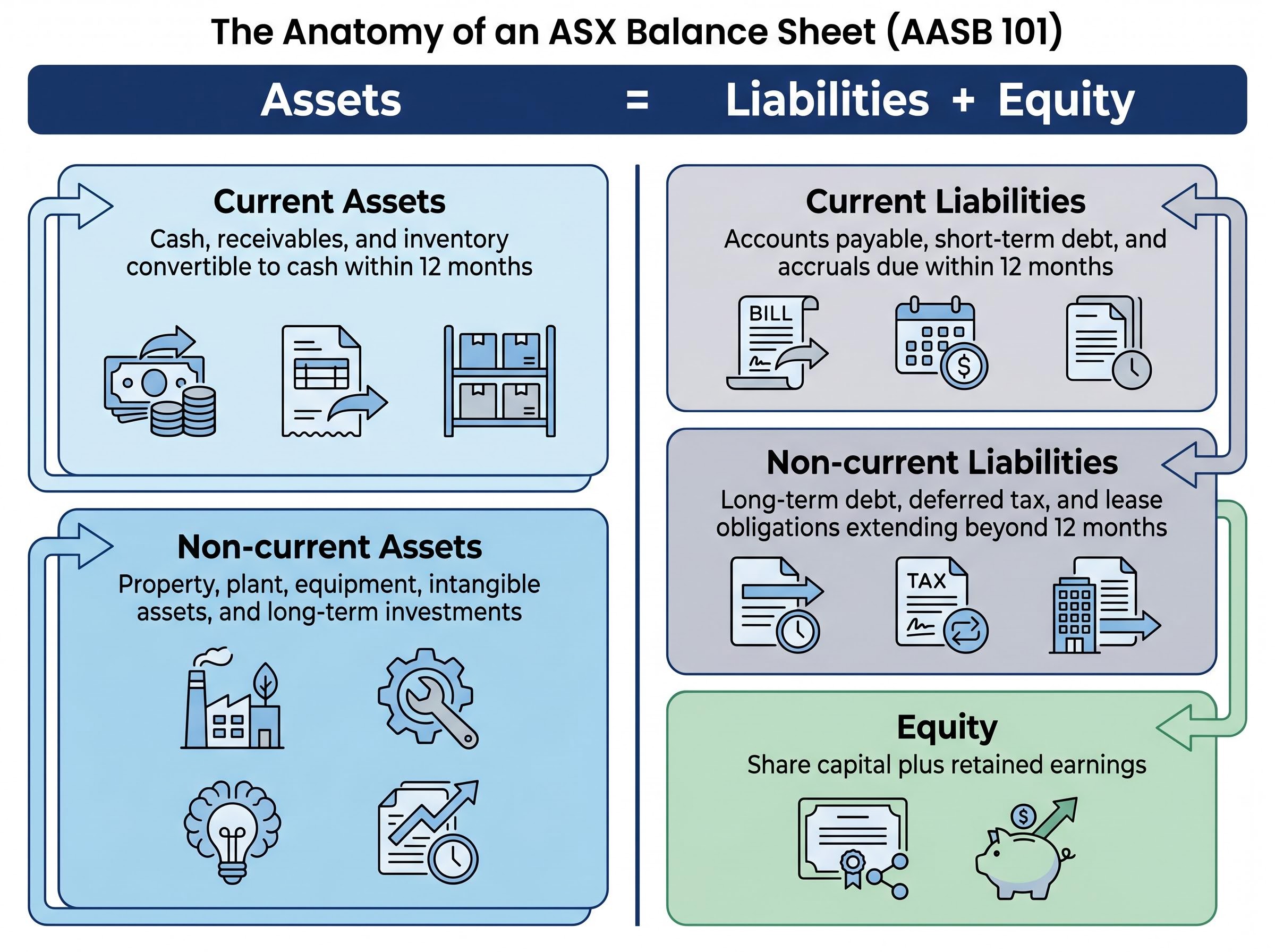
| Section | What it contains |
|---|---|
| Current assets | Cash, receivables, and inventory convertible to cash within 12 months |
| Non-current assets | Property, plant, equipment, intangible assets, and long-term investments |
| Current liabilities | Accounts payable, short-term debt, and accruals due within 12 months |
| Non-current liabilities | Long-term debt, deferred tax, and lease obligations extending beyond 12 months |
| Equity | Share capital plus retained earnings: the residual value belonging to shareholders |
Assets: what the company owns
Current assets sit at the top of the balance sheet and include cash and equivalents, trade receivables (money owed to the company by customers), and inventory. These are items convertible to cash within 12 months, and their total is the first input for calculating liquidity.
Non-current assets appear below. For a company like BHP Group (ASX: BHP), this category is dominated by property, plant, and equipment, the mining infrastructure that generates revenue over decades. Intangible assets and goodwill also sit here, particularly for acquisitive companies, and warrant separate scrutiny because they can be written down if an acquisition fails to deliver expected value.
Liabilities and equity: what the company owes and who owns the rest
Current liabilities mirror current assets in their 12-month threshold. They include accounts payable, short-term debt, and accrued expenses. Non-current liabilities cover long-term debt and lease obligations. Under AASB 16, lease liabilities now appear on the balance sheet for retail and infrastructure companies, a change that can materially inflate apparent leverage for businesses that lease rather than own premises.
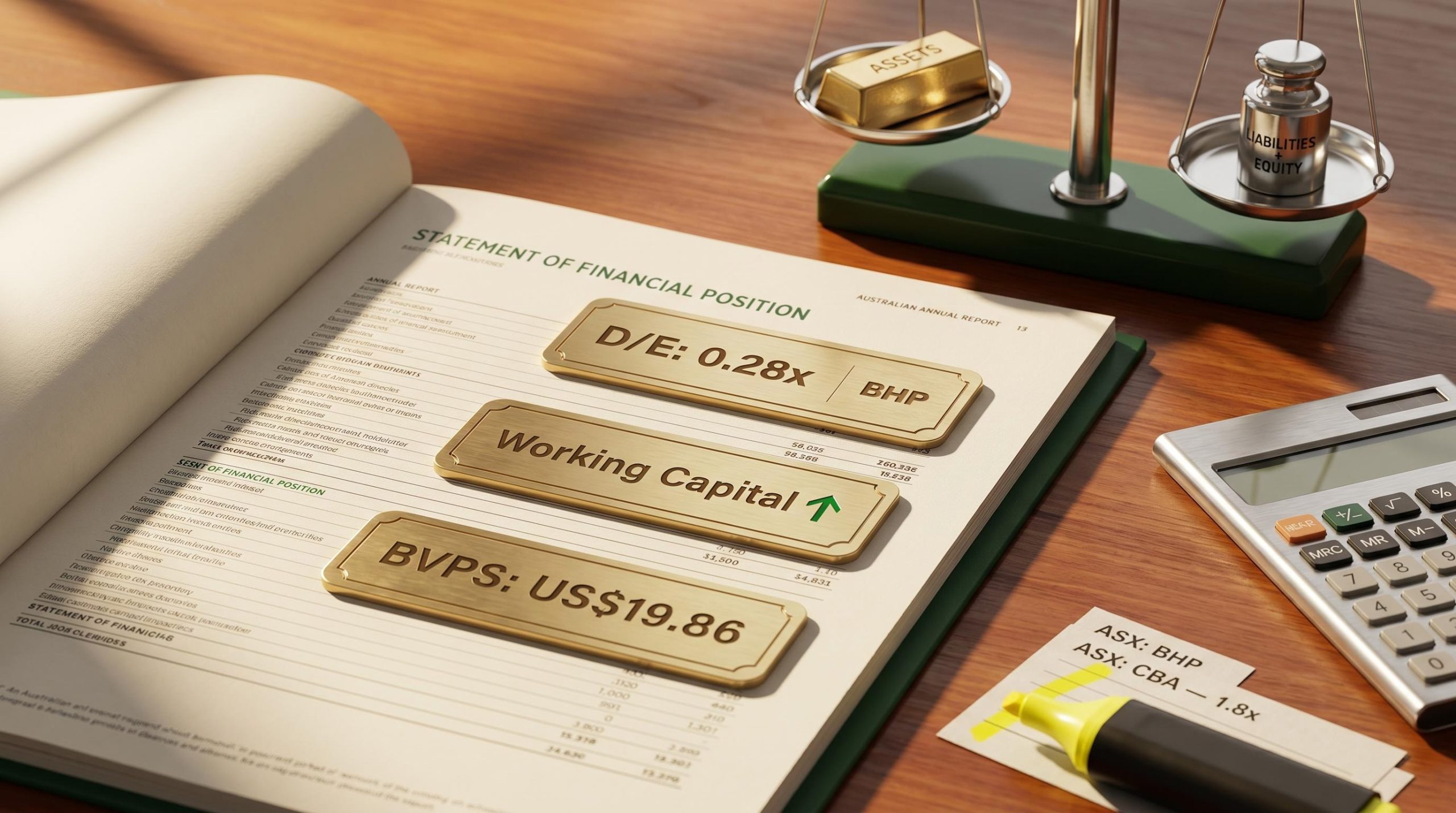
Equity is what remains after subtracting total liabilities from total assets. Its two primary components are share capital (the money raised by issuing shares) and retained earnings (the accumulated record of profits reinvested in the business rather than paid as dividends). BHP’s FY2024 balance sheet illustrates this structure clearly: approximately US$9.1 billion in net debt alongside a debt-to-equity ratio of approximately 0.28x, reflecting a well-capitalised equity position relative to the mining sector.
Three ratios that turn raw balance sheet figures into investment signals
Reading a balance sheet is one skill. Using it is another. Three calculations convert line items into numbers that can be compared across time, across peers, and across sectors.
- Working Capital = Current Assets minus Current Liabilities
- Debt-to-Equity (D/E) = Total Debt divided by Total Equity
- Book Value Per Share (BVPS) = Total Equity divided by Shares Outstanding
Working capital measures short-term liquidity. A positive result means the company can cover its near-term obligations from near-term assets. A negative result signals potential strain. Pilbara Minerals (ASX: PLS) illustrated this directly in its 1H FY2025 half-year report, where working capital moved into negative territory following the lithium price crash, a real-world consequence of deteriorating short-term liquidity in a commodity downturn.
The debt-to-equity ratio measures financial leverage, but the number means nothing without sector context. What counts as healthy varies significantly:
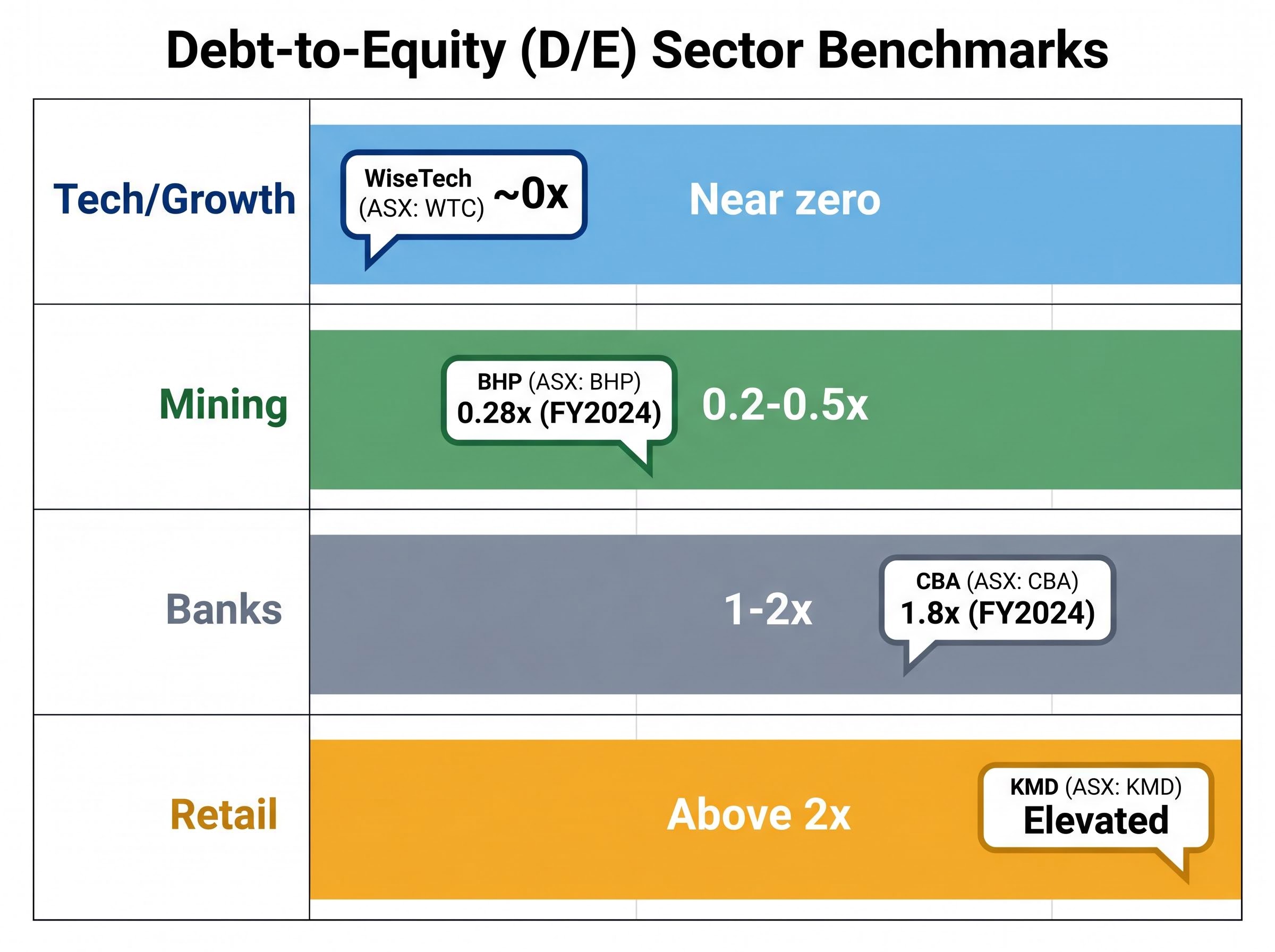
Sector D/E benchmarks (approximate):
– Mining: 0.2-0.5x considered healthy – Banks: 1-2x is the structural norm (leverage is inherent to the business model) – Retail: above 2x warrants scrutiny – Tech/Growth: typically near zero net debt (e.g., WiseTech Global, ASX: WTC, which maintains a cash-rich, near-zero net debt position)
Book value per share compares the accounting value of shareholder equity to the number of shares outstanding. BHP’s FY2024 BVPS of approximately US$19.86 provides a reference point for investors comparing the company’s book value against its market price, a signal of potential over- or under-valuation relative to net asset backing.
Reading ASX balance sheets across different sectors
The same debt-to-equity ratio can signal strength in one industry and distress in another. Applying a single universal benchmark across sectors leads to systematically wrong conclusions.
BHP carries a D/E of approximately 0.28x, which positions it at the lower end of the mining sector’s healthy range. Commonwealth Bank (ASX: CBA) reported a D/E of approximately 1.8x in FY2024, a figure that would alarm a mining investor but is entirely consistent with regulated banking norms, where deposits fund lending activity and leverage is built into the business model.
Kathmandu Holdings (ASX: KMD) presents a different picture. Its elevated D/E for a discretionary retail business compounds operational risk in a sector where inventory buildups and seasonal cash flow swings already create pressure. Analysts have flagged inventory accumulation and declining working capital as specific risk factors.
Mining companies in a deleveraging phase illustrate why trend analysis over 3-5 years is necessary. A single filing can capture a company mid-cycle, obscuring whether leverage is rising or falling. The direction of travel matters more than any single data point.
Pre-revenue ASX companies, particularly in biotech, require a different balance sheet emphasis: cash runway analysis, derived from Appendix 4C quarterly reports, replaces working capital as the primary liquidity signal when a company has no operating income to offset its cash burn.
The RBA Financial Stability Review (April 2025) described corporate leverage across the ASX as “moderate,” with net debt-to-EBITDA below 3x characterised as healthy for the broader market.
The RBA Financial Stability Review from April 2025 assessed the corporate sector’s overall resilience, characterising net debt-to-EBITDA below 3x as consistent with moderate leverage across the broader Australian market, a benchmark that contextualises individual ASX company readings within the wider economy.
| Company | Sector | Approx. D/E (FY2024) | Working capital | Key takeaway |
|---|---|---|---|---|
| BHP | Mining | 0.28x | Positive | Low leverage; benchmark for mining balance sheet health |
| CBA | Banking | 1.8x | Structural | Leverage consistent with regulated banking norms |
| WiseTech | Technology | ~0x | Positive | Cash-rich; near-zero net debt typical of high-growth tech |
| KMD | Retail | Elevated | Declining | Leverage compounds seasonal and inventory-driven risk |
Practical workflow for accessing and analysing real ASX balance sheets
A framework only becomes useful when it translates into a repeatable process. The following steps convert a balance sheet read from an abstract exercise into something an investor could complete tonight for any ASX-listed company.
- Access the filing. Go to the ASX Announcements Platform. Search by company ticker (e.g., “BHP”). Download the latest annual report or half-year report in PDF or Excel format.
- Locate the balance sheet. In the financial statements section, find the “Statement of Financial Position” (the formal name for the balance sheet under Australian standards).
- Identify the five categories. Separate current assets from non-current assets, current liabilities from non-current liabilities, and note total equity.
- Calculate working capital. Subtract current liabilities from current assets. A positive result indicates the company can cover near-term obligations.
- Calculate D/E and BVPS. Use the formulas from the ratios section above, and benchmark the results against sector norms.
- Compare across at least three reporting periods. A single filing is a snapshot. Three consecutive periods reveal a trend.
- Cross-reference with the cash flow statement. A balance sheet that looks strong alongside deteriorating operating cash flow is a warning sign, not a reassurance. This cross-reference discipline separates thorough analysis from surface-level reads.
Several free and low-cost tools support this process at different levels of experience:
Free tools:
- ASX Announcements Platform: Primary source; search by ticker; download reports in PDF or Excel
- CommSec Share Platform: Auto-pulls balance sheets and ratios including D/E and working capital with historical trends; free for CBA customers
- ASX Investor App: Beta launched approximately March 2025; mobile balance sheet viewer with alerts
Paid or freemium tools:
- Morningstar Australia: Free basic tier; approximately $29/month premium for ASX screener with peer comparisons and 10-year historical data
ASIC MoneySmart guidance recommends assessing D/E below 2x, checking working capital positivity, and comparing across 3-5 year trends to avoid snapshot analysis errors.
Five mistakes that trip up ASX investors reading balance sheets
- Relying on a single snapshot. This is the most frequently cited error across Australian investor education sources. A balance sheet at one point in time can be misleading without context. A mining company midway through a deleveraging phase looks materially different filing to filing. ASIC MoneySmart and ASX webinar content consistently push a minimum three-period comparison rule before drawing any conclusion.
ASIC MoneySmart warns against “snapshot analysis,” recommending investors compare balance sheets across 3-5 years and against sector peers before making investment decisions.
- Ignoring sector context. Applying a universal D/E threshold without adjusting for industry norms leads to opposite errors simultaneously: dismissing a bank as over-leveraged when it is not, and excusing a retailer’s debt load because a miner carries similar headline numbers. A D/E of 1.8x is healthy for CBA and potentially distressing for a discretionary retailer.
- Missing off-balance sheet obligations. Under AASB 16, lease obligations now sit on the balance sheet, but many investors still focus on headline debt figures without scrutinising lease liabilities. For retail and infrastructure companies, this omission can materially understate true leverage. CommSec’s “Balance Sheet Red Flags” guide (2024-2025) specifically flags off-balance sheet items as a common blind spot.
- Ignoring the cash flow statement. A balance sheet that looks strong is only half the picture. If operating cash flow is deteriorating, those assets may not be generating the liquidity the headline figures suggest. The balance sheet and cash flow statement should always be read together.
- Reacting emotionally to a single weak reading. Panic-selling triggered by one poor balance sheet result, without cross-referencing cash flow or placing the figures in sector context, is a documented behavioural pattern among Australian retail investors. Betashares and AMP investor education content published in 2025 flagged this specifically as a risk during periods of elevated market volatility.
A balance sheet is the start of due diligence, not the end
The balance sheet is one leg of a three-part analytical foundation. It must be read alongside the income statement and the cash flow statement to form a complete view of any company. Alone, it answers what a business owns and owes. Combined with cash flow, it reveals whether those assets are generating real liquidity.
Three ratios, working capital, debt-to-equity, and book value per share, are the practical output of every balance sheet read. Each should be benchmarked against sector norms, not universal thresholds, and tracked across at least three consecutive reporting periods before informing a decision.
Book value per share becomes a more complex signal when price discovery on the ASX is increasingly driven by passive ETF flows rather than fundamental analysis, a dynamic the RBA Financial Stability Review has formally identified as a systemic amplifier capable of pushing market prices away from underlying balance sheet values for extended periods.
The ASX Announcements Platform is the primary source. ASIC MoneySmart and ASX Investor Resources provide accessible starting points for continued learning. Building the habit of opening an annual report, locating the Statement of Financial Position, and running three calculations is the single most effective step an Australian retail investor can take to move beyond price-based analysis toward genuine due diligence.
For investors who have developed balance sheet literacy and are now considering whether to use leverage to increase their ASX exposure, our dedicated guide to margin lending costs examines current variable rates above 10% per annum, the mechanical trigger conditions for margin calls, and the structural suitability criteria that ASIC-regulated lenders are required to apply before approving a leveraged position.
This article is for informational purposes only and should not be considered financial advice. Investors should conduct their own research and consult with financial professionals before making investment decisions.