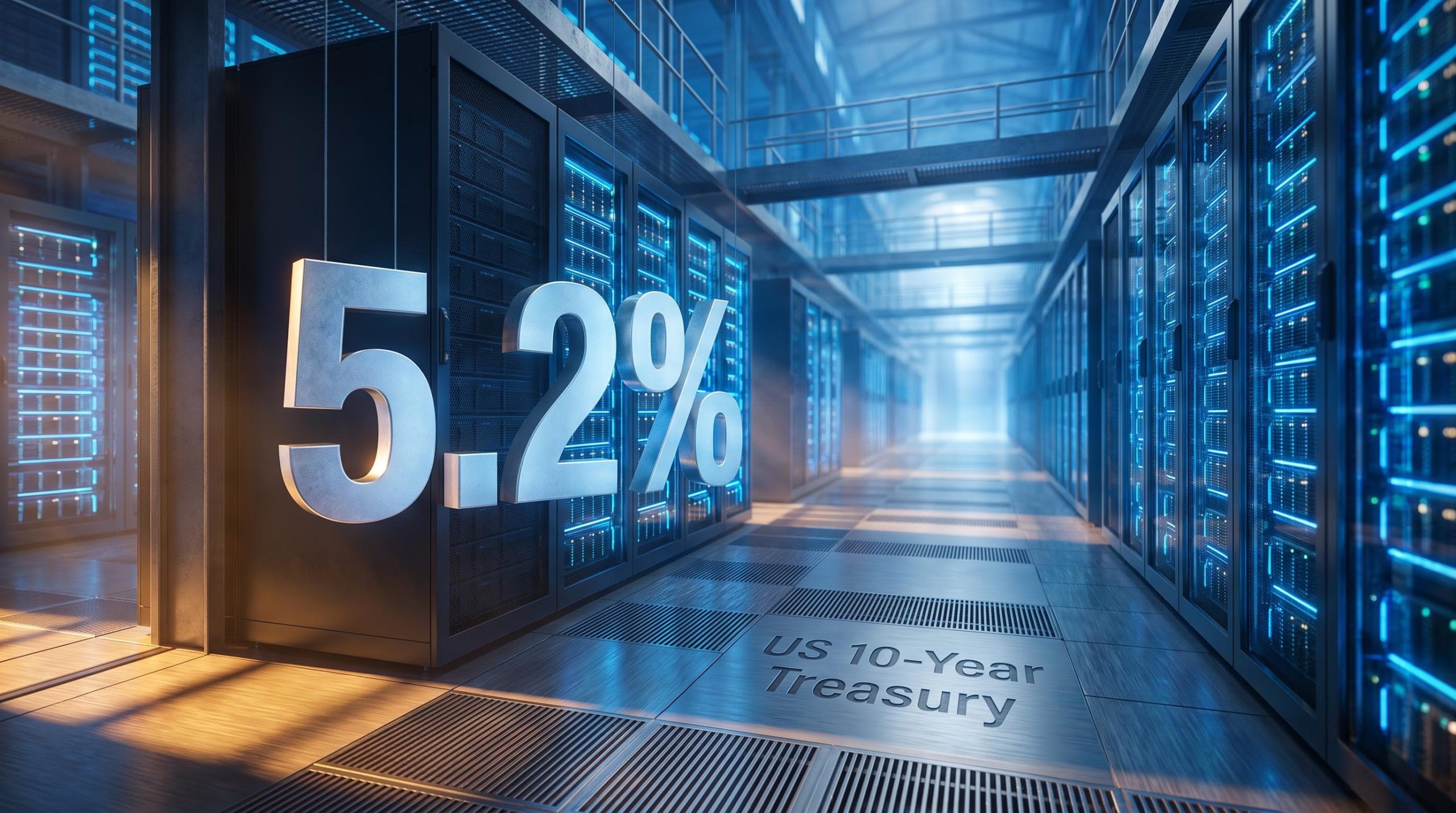
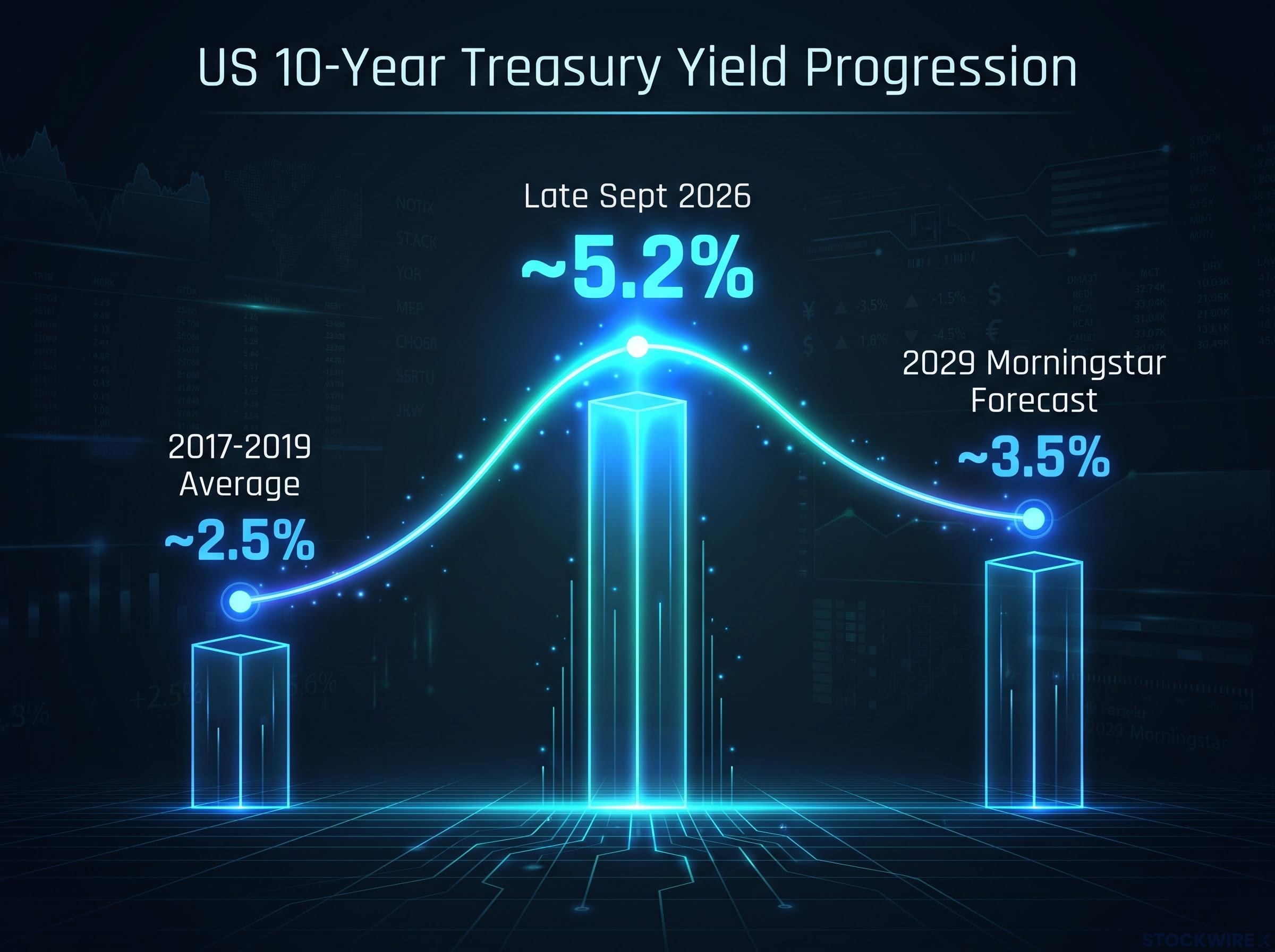
The US 10-year Treasury yield sits a little above 5.2% in late September 2026, more than double the roughly 2.5% average of 2017 to 2019. The explanation you hear most often is that inflation has been sticky. According to Morningstar’s US economics team, led by Preston Caldwell, that framing misses the dominant force at work.
Caldwell’s argument is that the artificial intelligence investment boom is functioning as a demand shock large enough to keep interest rates structurally elevated, and that most investors have not yet priced in what happens when that boom eventually slows. The link between AI investment and interest rates matters directly to you if you hold bonds, carry a mortgage, own equities with AI exposure, or are simply waiting for the Federal Reserve to cut.
What follows maps the mechanism clearly, so you can assess Morningstar’s 3.5% yield forecast for 2029 on its own terms and judge which of your holdings are most exposed to the trajectory either way.
Why the Fed is not fighting inflation, it is fighting AI spending
Start with what the Federal Reserve is actually trying to do. Its job is not to hit a particular interest rate or to defend a particular asset class. Its job is to keep the economy’s output roughly in line with its potential, the level of production the economy can sustain without generating excess demand.
Now add AI into that picture. When technology firms pour money into data centres and chips, they are demanding a lot of capital. In the language of the IS-LM framework Caldwell uses, that pushes the investment demand curve to the right: firms want to invest more at every level of interest rate. When investment demand rises like that, the equilibrium rate that balances the economy has to rise too.
Here is the part that reframes the whole debate. The Fed does not accommodate that surge in demand by letting the economy run hot. It leans against it by keeping rates high enough to hold output near potential. That is why Caldwell describes AI as a demand shock rather than an inflation shock: the Fed is offsetting it, not feeding it.
Morningstar’s core claim: without the AI investment boom, interest rates would likely have declined much closer to pre-pandemic levels.
The practical read for you is uncomfortable. If the Fed is primarily responding to AI investment demand rather than sticky prices, the timeline for rate cuts is tied to the AI spending cycle, not to the next inflation report. If you are positioned for imminent, inflation-driven cuts, you may be watching the wrong signal.
The two channels pushing investment demand higher
The demand shock arrives through two channels. The first is direct: the large-scale build-out of data centres, semiconductor fabrication, and cloud infrastructure. This is capital being committed at scale, and it competes with everyone else for financing.
The second is quieter but compounds the effect. Rising valuations in AI-exposed equities create a wealth effect, meaning households that feel richer on paper spend more. That extra consumption adds to aggregate demand on top of the capex, giving the Fed even more reason to hold rates firm.
When big ASX news breaks, our subscribers know first
What AI investment actually is and why it behaves differently from past tech cycles
You already know AI spending is enormous. The property that makes this cycle unusual is not the size alone, it is the concentration.
AI-related capital expenditure in this context means data centres, semiconductor fabrication, cloud infrastructure, and the supply chains feeding all of it. According to Morningstar, this single category has been the only source of growth in US private fixed investment during 2025 and 2026. Every other category has been shrinking.
Federal Reserve data on AI investment confirms that data centre and semiconductor capex have become the dominant category within US private fixed investment, providing a direct empirical foundation for the crowding-out dynamic Morningstar’s analysis describes.
That is a genuine crowding-out dynamic. One slice of private investment is displacing all the others, in the same way economists usually describe government borrowing squeezing out private spending.
| Investment category | 2025-2026 trend | Key driver |
|---|---|---|
| AI and technology | Growth | Data centre and semiconductor capex |
| Residential housing | Contraction | Elevated mortgage rates |
| Commercial real estate | Contraction | High cap rates and refinancing costs |
| Other non-tech private investment | Contraction | High borrowing costs |
Here is the distinction that ties it together. AI is a demand story right now, not yet a supply story. A supply story would show up as higher productivity, meaning more output per worker, which would lift the economy’s potential and ease the pressure. Morningstar’s assessment is that this uplift has not yet registered in aggregate productivity figures as of late 2026.
Economists give three reasons the payoff has not appeared:
- Diffusion and adoption lags: firms have to redesign workflows and retrain staff before gains show up in national statistics, as happened with electrification and the internet.
- Measurement problems: official data struggles to capture intangible gains like faster coding or better recommendations that are not directly priced.
- Short-run adjustment costs: integration, training, and duplicative systems show up as cost and investment first, offsetting efficiency gains at the firm level.
The read for you is direct. Because AI is currently raising demand rather than lifting productivity, it is raising the cost of capital for everyone outside the AI supply chain. If you are in housing, small business lending, or non-tech fixed income, you are bearing that cost right now.
Who is already paying the price while AI builds out
Move from the macro picture to the sectors where you actually live. The transmission runs straight through that 5.2% 10-year yield.
- Housing: the 10-year yield feeds directly into 30-year mortgage rates, locking existing homeowners into low-rate loans and suppressing new construction, especially at the starter-home end.
- Commercial real estate: higher long yields mean higher cap rates and lower valuations, with expensive refinancing compounding weakness already present from remote work and e-commerce.
- Small business: credit costs rise on spreads over the risk-free rate, leaving smaller non-tech firms at a clear disadvantage to large AI-adjacent peers.
The mortgage rate mechanics tying the 10-year yield to your monthly payment mean that a yield shift from 5.2% toward 3.5% would reduce the cost of a $400,000 30-year loan by tens of thousands of dollars in total interest, making the AI spending cycle directly relevant to every prospective homebuyer tracking rate movements.
Each of these is a real decision someone is delaying. The homeowner who will not move because it means giving up a cheap mortgage. The landlord facing a refinancing cliff on an office building worth less than it was. The owner-operator who shelves a purchase because the loan no longer makes the numbers work.
The uneven credit landscape for small and mid-size businesses
Small firms borrow at a spread over the risk-free rate, so when the 10-year sits near 5.2%, both bank and non-bank credit gets materially more expensive. That spread amplifies the yield effect rather than cushioning it.
The asymmetry is the sharpest part. Large firms inside the AI supply chain can tap cheap equity financing off buoyant valuations, while small non-tech firms face tight, costly credit. The same investment wave that funds the giants is squeezing the businesses standing next to them.
According to Morningstar’s framing, this pressure lasts as long as AI capex stays intense, with relief expected as yields drift toward roughly 3.5%. If you are a homeowner waiting to move, a small business owner weighing an investment, or an investor holding non-tech commercial property, the AI boom is the proximate reason your financing environment is this tight, and relief depends on when AI spending moderates, not on inflation.
Morningstar’s 3.5% forecast for 2029 and where other institutions disagree
Treat Morningstar’s number as a conditional argument, not a prediction. The forecast is that the 10-year yield falls from around 5.2% today to roughly 3.5% by 2029, with the deceleration of AI spending as the primary driver. The forecast only arrives if that spending actually slows as assumed.
Major bank desks broadly accept that AI is contributing to elevated rates. Goldman Sachs and JPMorgan agree the capex cycle lifts investment demand and can raise the neutral real rate. Where they part company with Caldwell is on weight: they place AI alongside fiscal deficits, higher term premia, and resilient consumption rather than treating it as the dominant force.
The distinction has teeth. Bank research warns that even after AI investment normalises, structural fiscal conditions and term premia could keep long rates above 3.5% for the rest of the decade.
Fiscal deficit pressure on long yields is the competing force Goldman Sachs and JPMorgan emphasise: at a 4% average interest rate on $40 trillion in debt, the annual US interest bill approaches $1.6 trillion, a structural overhang that could keep 10-year yields above 3.5% even after AI capex moderates.
There is also a separate factor pushing on rates right now. The US-Iran conflict and the associated energy price shock are identified as a significant concurrent driver, distinct from the AI demand shock, and one expected to subside on its own timeline.
| Institution | Primary rate driver identified | 10-year yield view for 2029 | Key caveat |
|---|---|---|---|
| Morningstar | AI capex demand shock | Approximately 3.5% | AI spending must decelerate as projected |
| Major banks (Goldman Sachs, JPMorgan) | AI plus fiscal deficits plus term premia | Potentially above 3.5% | Structural fiscal conditions may delay the decline |
| CBO and IMF | Demographics, deficits, global savings | No specific target stated | AI acknowledged but not the dominant driver |
Morningstar’s view: current rate levels are too restrictive for much of the broader economy, but that reality has been obscured by the AI investment boom’s upward pressure on rates.
This disagreement is not academic for you. If the banks are right and deficits keep long rates elevated through the decade, then your fixed income re-entry timing, your mortgage refinancing window, and the valuation assumptions baked into your equities all shift. Weigh Caldwell’s pointed view against the broader consensus before you act on any single one.
What could derail the AI spending cycle, and what it means for rates when it does
The 3.5% forecast is a best-case, soft-landing path. The AI-rate relationship cuts both ways, and the real question is not whether rates fall but through what conditions.
- Controlled deceleration (base case): AI investment moderates gradually, investment demand eases, and yields drift down toward 3.5% without a rupture.
- Overinvestment bubble correction: if AI use-cases fail to produce the expected cash flows, stranded capital and sharp equity write-downs could collapse investment demand quickly, dropping yields fast but through a downturn rather than a soft landing. The parallel is the late-1990s telecom and dot-com overbuild.
- Energy shock and stagflation: AI workloads are energy-intensive, and a geopolitical energy shock or grid bottleneck could keep inflation elevated even as capex slows, forcing the Fed to choose between higher inflation and recessionary rate settings.
Historical tech overbuild cycles provide a concrete reference point here: the 1990s fibre-optic buildout destroyed roughly $5 trillion in equity value before the surviving infrastructure became the backbone of cloud computing, a pattern that shapes how seriously to treat the overinvestment bubble scenario in the AI context.
Morningstar notes that a speculative bubble could actually push rates higher in the near term before a sharper fall, which is a different path to the same destination.
Financial-stability bodies including the Bank for International Settlements have signalled that concentrated exposures to AI-related firms could amplify any correction.
There is a timing risk sitting over all of it. If AI investment decelerates fast and the Fed is slow to cut, it could deepen a downturn. If it cuts too early while AI demand is still running, it could reignite inflation.
The read for you is that the same yield decline can arrive as a gift or as a warning. If AI unwinds disorderly rather than moderating, rates fall sooner but through conditions that damage the very positions meant to benefit from lower rates.
What the AI-rate relationship means for your portfolio positioning now
The core decision facing you is one of timing. When you re-enter fixed income, when you refinance a mortgage, and when you reallocate equity exposure all depend on reading the AI spending cycle, not just the next inflation print or Fed meeting.
Morningstar’s framework points to three variables worth monitoring:
- The pace of AI capex announcements from major cloud and semiconductor firms.
- How the Fed frames investment demand versus inflation in its statements.
- Any sign of a demand shortfall in AI use-case monetisation, meaning the point at which spending outruns the cash it generates.
Watching capital expenditure guidance from Microsoft, Amazon, Alphabet, and the major chip firms is now as much a rate signal as watching monthly payrolls or the inflation data. Those spending decisions are what will move yields over the medium term.
If the Morningstar base case plays out, the implications differ by sector:
- Housing: the refinancing window opens across 2027 to 2029 as yields ease toward 3.5%.
- Fixed income: extending duration becomes more attractive as yields approach a peak near 5.2%, since locking in higher yields pays off if rates then fall.
- Equities: AI-adjacent firms priced for endless capex may face a re-rating if investment decelerates.
Keep the caveat in view. Caldwell’s position is more pointed than the institutional consensus, so weight it alongside the bank and CBO views rather than treating it as settled.
This article is for informational purposes only and should not be considered financial advice. Investors should conduct their own research and consult with financial professionals before making investment decisions. Past performance does not guarantee future results, and these projections are speculative and subject to change based on market developments.
When AI stops being the rate story
The durable takeaway is this: elevated rates, on Morningstar’s reading, are not the new normal. They are the price of financing a once-in-a-generation technology build-out, and the end condition is AI spending normalising rather than inflation solving itself.
That gives you a clean projected path to hold in mind: roughly 5.2% in late 2026 easing toward 3.5% by 2029 if AI capex decelerates as the base case assumes. It also comes with an honest asterisk. Whether the landing point is 3.5% or something higher depends on fiscal deficits and term premia that sit entirely outside the AI story, which is exactly where Goldman Sachs and JPMorgan expect the friction.
Carry forward the framework, not the forecast. If you can connect AI capex news to rate signals, you hold a meaningful edge over investors still reading this environment as a purely inflation-driven story, and you will know what to watch each time the major tech firms revise their build plans.
For readers wanting to see how the rate and energy pressures translate into actual corporate results, our full explainer on US consumer demand contraction examines how Whirlpool’s North American operating profit collapsed 96% in Q1 2026, with McDonald’s and Shake Shack earnings confirming a widening income fault line across the sector.