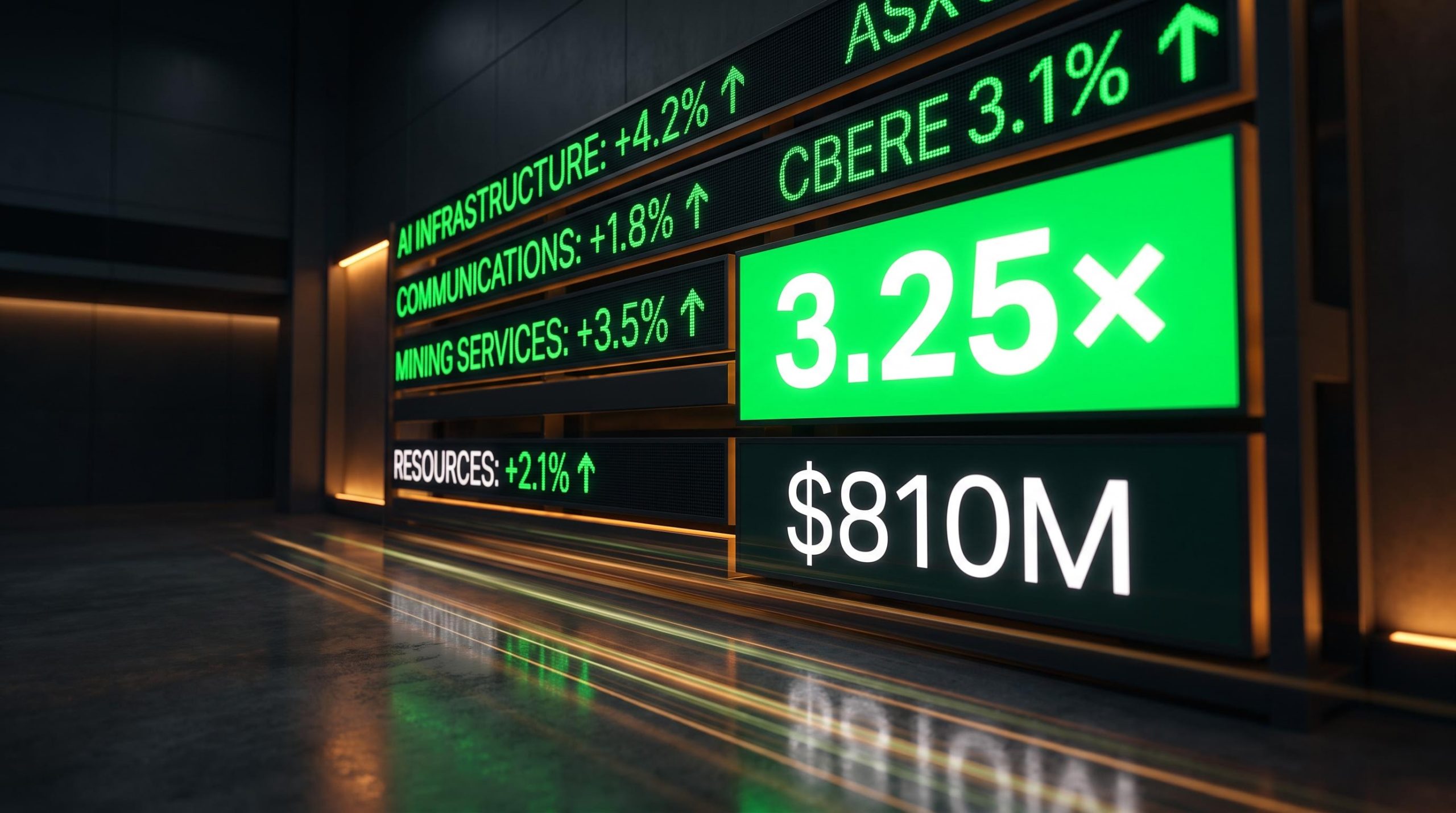
Four ASX-listed companies delivered materially better outlooks, and none of them shared a sector. A GPU-backed infrastructure player lifted its FY27 revenue guidance toward $810 million, a communications company projected its first-half profit to more than double, and a mining services firm ran a retail share offer so far past its target it closed at 3.25 times the amount sought.
That is not the profile of a quiet Monday on the ASX.
When earnings upgrades and an oversubscribed capital raise land across artificial intelligence infrastructure, conflict-zone defence demand, and mining services, the co-occurrence tells investors something the individual announcements do not. Capital is moving toward small-caps with identifiable catalysts, and it is moving from both corporate and retail sources at once.
What follows here is a briefing on each announcement from recent months, what the numbers actually say, and where the source figures conflict enough that you should verify before acting. The aim is to save you from parsing four separate ASX disclosures and to give you a single read on what the day signalled about Australian small-cap earnings momentum.
Megaport’s AI infrastructure pivot just reshaped its revenue profile
Megaport has committed to a near-tenfold jump in capital spending to build out AI infrastructure, and the guidance lift that comes with it now redefines what kind of business this is by revenue.
The company’s Latitude.sh subsidiary, the vehicle for its GPU-backed compute and inference business, has signed contracted AI infrastructure deals with U.S.-based technology providers running AI workloads. Those contracts give Megaport forward revenue visibility, and that visibility is what underwrites a substantial FY27 guidance upgrade.
Here is where transparency matters. The company’s own ASX announcements and the secondary research coverage do not agree on the headline figures, so both are laid out below rather than reconciled artificially.
| Metric | Original ASX Source | Research Layer Source |
|---|---|---|
| Total contract value | ≈$978.6 million | US$359.4 million (≈$506.2 million) |
| FY27 revenue guidance | $720m to $810m | $620m to $730m |
| FY27 EBITDA margin | Not specified | 38% to 40% |
| FY27 capex | Not specified | $1.28bn to $1.38bn |
Whichever contract figure is correct, the direction is the same: this is a structural shift toward AI infrastructure, not an extension of the legacy network business.
Megaport’s investor financial reporting provides the primary source for reconciling the contract value and FY27 revenue guidance figures, which differ materially between the company’s ASX disclosures and secondary research coverage.
UBS retains a buy rating and has raised its 12-month price target to $24.20.
UBS on the contracts The broker describes the AI infrastructure contracts secured earlier in 2026 as “transformative” for Megaport’s role in AI workloads, framing them as a structural change in the company’s revenue profile.
What the guidance numbers mean in practice
The research-layer guidance implies year-on-year revenue growth of 99% to 134%. That is not a number the company reaches by trading well; it requires deploying the committed capex, switching on GPUs that are currently idle, and ramping the Latitude.sh contracts on schedule.
The scale of the bet is visible on the balance sheet. FY27 capex guidance of $1.28 billion to $1.38 billion follows just $152.6 million in FY26, and Megaport had already paid $54.3 million for GPUs not yet generating revenue. At full run-rate, annualised recurring revenue is targeted at US$91.7 million (≈$129.2 million) by the end of Q3 FY27, against a GPU payback target of 16 to 22 months.
For you as an investor, the compute revenue band of $305 million to $405 million is the tell. A range that wide is management signalling how uncertain deployment timing remains, and the idle GPUs confirm the company is betting AI demand holds for at least two to three years before the payback thesis is proven.
When big ASX news breaks, our subscribers know first
Codan’s conflict-zone windfall puts first-half profit on track to more than double
Codan has guided first-half FY27 net profit after tax to exceed $160 million, up from $71.2 million in the prior comparable period. That implies profit growth of more than 125% year-on-year in a single half.
The company attributes the uplift to a single factor: elevated demand for its specialised communications technology from conflict zones.
Geopolitical investment risk has moved well beyond macro commentary at the institutional level: KKR’s appointment of General David Petraeus as a full deal-level partner reflects a judgment that conflict-driven demand, precisely the mechanism Codan is benefiting from, now requires permanent analytical infrastructure rather than periodic scenario work.
One caveat matters before you weigh that number. The guidance figure, the prior baseline, and the conflict-zone attribution all come exclusively from Codan’s own ASX disclosures. No independent analyst or defence-sector commentary is available in the research to corroborate the demand mechanism or test its durability.
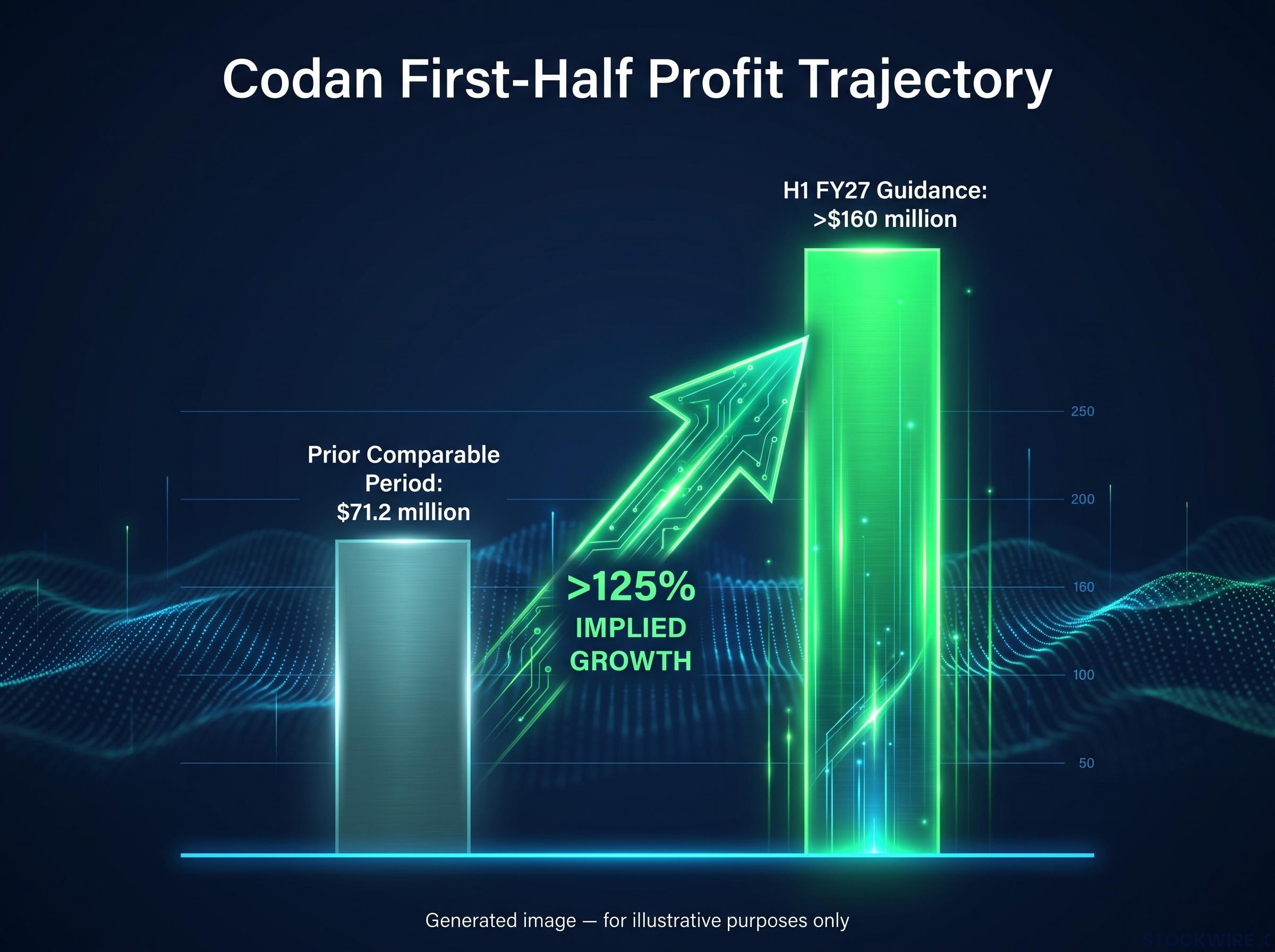
- H1 FY27 NPAT guidance: more than $160 million
- Prior comparable period: $71.2 million
- Implied growth: more than 125% year-on-year
- Source caveat: ASX company announcements only; no corroborating research data
The scale of the upgrade is exceptional by any measure. But a first-half profit projection driven by conflict-zone demand tells you that Codan’s near-term revenue is tied to geopolitical conditions that are inherently unpredictable. That makes sustainability, not the headline number, the question worth asking, and it is worth considering whether consensus estimates have absorbed both the upside and the structural volatility of that revenue source.
GR Engineering’s oversubscribed SPP signals retail demand for ASX mining services
GR Engineering Services asked its retail shareholders for $10 million. They offered $32.5 million.
The oversubscription in one figure $32.5 million in applications against a $10 million target, an oversubscription of 3.25 times.
The share purchase plan (SPP) formed part of a combined raise of approximately $100 million alongside an institutional placement. Eligible Australian and New Zealand shareholders could apply for up to $30,000 of new shares each, and the weight of applications means those who applied face pro-rata scale-backs and partial return of funds.
Here is the timeline for shareholders checking their own positions:
- SPP opened: 2 September 2026
- SPP closed: 23 September 2026
- Shares allotted: 30 September 2026
The oversubscription figures come from GR Engineering’s ASX announcements; the research layer confirmed the roughly $100 million combined raise but did not report the SPP-specific outcome.
An SPP that pulls in 3.25 times its target tells you retail investors in Australian mining services are confident enough in the near-term outlook to apply well above their likely allocation. That is a measurable sentiment indicator, and a useful one at a time when many resources-adjacent equities are navigating commodity cycle uncertainty. If you applied at the full $30,000, expect a reduced allocation and money back.
Small-cap price swings in mining services and resources-adjacent equities frequently reflect thin order books rather than changes in underlying business quality, a distinction that matters for investors trying to read the GR Engineering SPP result as a signal about sector fundamentals rather than a function of retail liquidity and sentiment.
Tungsten Mining secures $200 million indicative financing as junior miners attract project capital
The fourth signal of the day came from the earliest-stage story. Tungsten Mining secured indicative funding terms covering approximately $200 million for project development.
That figure adds a resources dimension to a day otherwise dominated by infrastructure and services capital flows, and it points to a broader pattern: specialist or institutional lenders willing to commit sizeable capital to junior resource projects.
The information limits here are real and worth stating plainly.
- Indicative project financing: approximately $200 million
- Project stage: development
- Announcement date: 28 September 2026
- Source caveat: ASX company announcements only; no data on counterparties, terms, or conditions precedent
An indicative $200 million financing at the project-development stage tells you lenders are prepared to back tungsten extraction ahead of proven cashflow, a materially different risk profile from the contracted-revenue stories at Megaport and Codan. For investors in junior mining or battery-critical minerals, that is a meaningful milestone. The caveat is equally important: indicative terms are not binding commitments, so read the announcement as directional rather than conclusive.
What a three-sector upgrade day tells ASX small-cap investors about current market conditions
Four different sector stories printed positive across recent months, and the co-occurrence is itself the data point. AI infrastructure, conflict-zone defence demand, mining services equity appetite, and junior resource financing do not usually move together, and their alignment says capital is rotating toward small-caps with identifiable catalysts.
What separates them is risk profile, and that is what you should hold onto:
ASX small-cap investing disciplines developed by practitioners who have compounded at 20% annualised include writing down explicit thesis invalidation criteria before entry, a habit that becomes particularly valuable when a position like Megaport carries capex uncertainty wide enough to produce a revenue guidance range spanning more than $100 million.
- Megaport: contracted revenue visibility, but the story is execution-dependent on very large committed capex, and its own figures are subject to source conflicts.
- Codan: a profit uplift exceeding 125% year-on-year, but geopolitically contingent and sourced solely from company disclosures.
- GR Engineering: a 3.25 times oversubscribed SPP, which is a retail sentiment signal rather than an earnings upgrade in itself.
- Tungsten Mining: an indicative $200 million financing, the earliest-stage story with the least confirmed information.
The read is that a positive headline from one of these names is not read-through to the others. The catalysts differ, the risk differs, and the confirmation quality differs.
Two figures in particular warrant verification before you act on them: Megaport’s contract value and its FY27 revenue guidance both differ materially between the ASX announcement and secondary coverage. Check the official ASX filings first.
This article is for informational purposes only and should not be considered financial advice. Investors should conduct their own research and consult with financial professionals before making investment decisions.
Past performance does not guarantee future results, and the guidance figures cited here are forward-looking targets subject to market conditions and execution risk. Several are drawn from company disclosures without independent corroboration, so treat them as directional rather than settled fact.