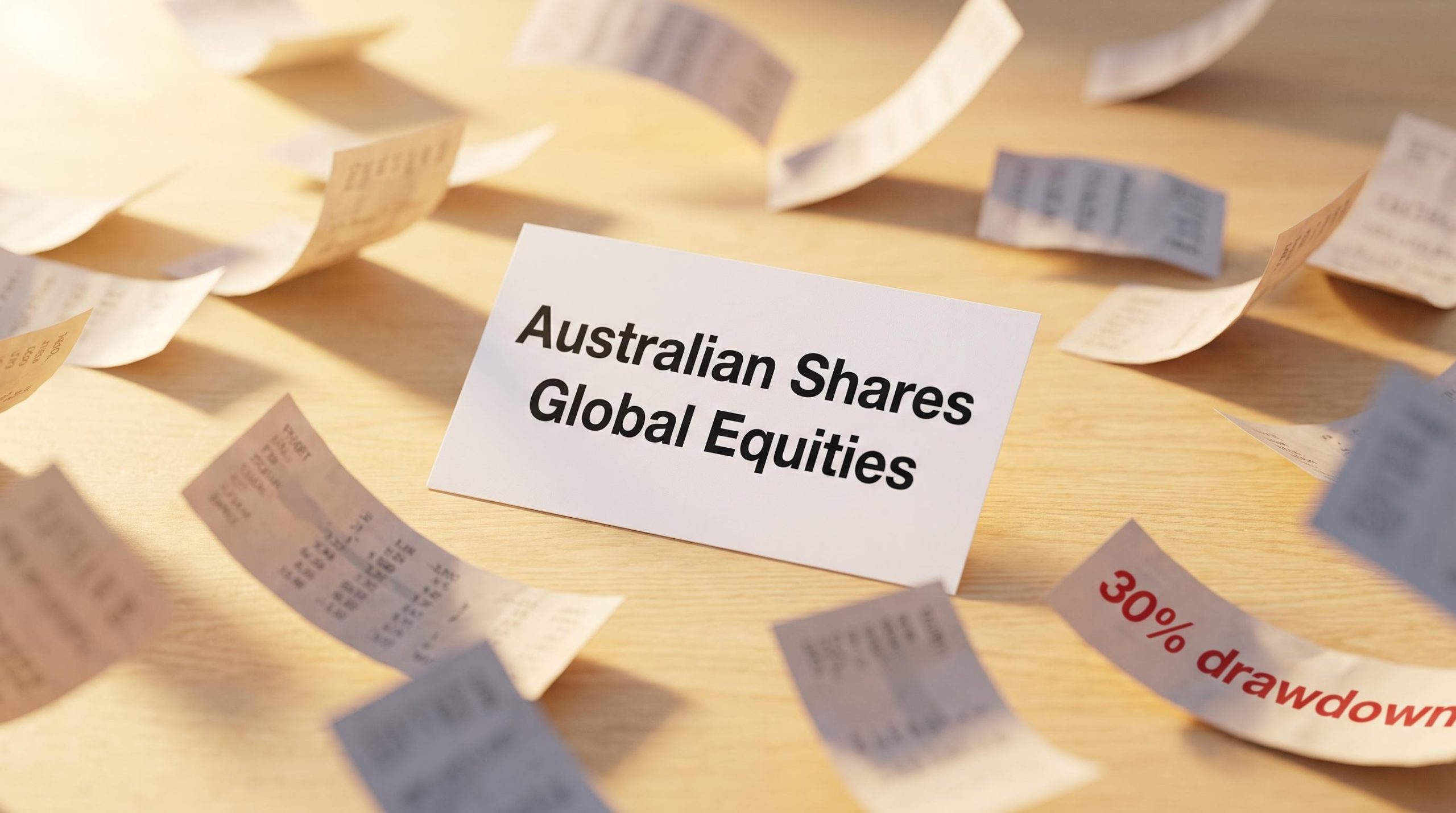
You started investing six months ago. You did the reading, listened to the podcasts, and now you own eight different ETFs, one US stock you bought on a whim, and a growing sense that you have no idea what your portfolio is actually doing.
Here is the paradox nobody warns you about: the more you researched, the more products you added, and the more confused you got. More effort produced less coherence, not more.
This is not a rare failing. It is one of the most common patterns in Australian retail investing. One podcast host accumulated seven ETFs and an individual stock within five months of starting, and advisers routinely meet clients who arrive holding 27, 30, even 40 separate funds.
So this is not about embarrassment. It is about mechanics.
After reading this, you will be able to look at your own holdings and tell the difference between a portfolio that is genuinely diversified and one that is simply crowded. You will also have a clear map for simplifying it without starting from scratch.
The pattern that turns a simple plan into a complicated mess
The accumulation almost always starts the same way, and it feels entirely reasonable at each step.
You learn about a new theme or product. Video games, artificial intelligence, infrastructure, gold, income. It sounds compelling, the recent performance looks strong, so you add it. Then you learn about the next thing, and you add that too.
Here is the behavioural loop, step by step:
- You learn about a new theme, sector, or product and find it genuinely interesting.
- You see performance data that makes the idea feel timely and validated.
- You add the position, usually a small allocation, because adding it feels like progress.
- You move on to the next idea and repeat the sequence.
That last step is the trap. Each new holding gets evaluated against how interesting it is, not against what you already own.
Behavioural researchers call this action bias: the pull to do something, because doing something feels like doing something useful. In investing, buying a new fund scratches that itch. It feels proactive. It rarely is.
What makes this so persistent is that the underlying instinct is sound. You learn, then you apply what you learned. The problem is direction, not intelligence. You are applying a learning instinct to a portfolio that needed an editing instinct.
The real example makes it concrete. The podcast host mentioned above ran a satellite budget of roughly $200 a month, spread across rotating thematic and leveraged ETFs, with no framework for when to enter or exit any of them. A separate $200 went into Eli Lilly, an exploratory single-stock position added without a clear thesis, before the host concluded that real conviction should come before capital.
None of those decisions were stupid in isolation. Together, they built a portfolio nobody had actually designed.
Glen Hare of advisory firm Fox and Hare reports regularly meeting new clients who arrive holding 27, 30, or up to 40 separate ETFs. That is not a diversified portfolio. That is a collection of individual decisions that were never checked against each other.
If you have ever added a holding because it sounded interesting rather than because it filled a genuine gap, you are inside this pattern right now. Recognising the mechanism is the whole point, because you cannot interrupt a habit you have not named. Investors who catch it early stop a manageable eight-fund portfolio from quietly becoming an unmanageable thirty.
When big ASX news breaks, our subscribers know first
Why owning more ETFs does not mean you own more diversification
Now for the comfortable assumption that needs dismantling: that ten funds must be safer than three.
Diversification is not measured by the number of holdings you own. It is measured by the number of genuinely independent risk factors those holdings contain. Two funds that rise and fall together are, for risk purposes, closer to one fund than two.
Australia’s ETF market has grown to roughly $330 billion in funds under management, with 2.69 million investors now holding at least one fund, and understanding how ETFs work in Australia, including cost structures, tax treatment, and the legal separation of fund assets, sets the foundation for diagnosing the overlap problems described above.
Consider what happens under the bonnet. A global developed-markets ETF, a US broad-market ETF, and a Nasdaq-focused ETF can all count Apple, Microsoft, Alphabet, and Amazon among their largest positions. Buy all three and you have not spread your risk. You have bought the same handful of American technology companies three times, at slightly different weightings.
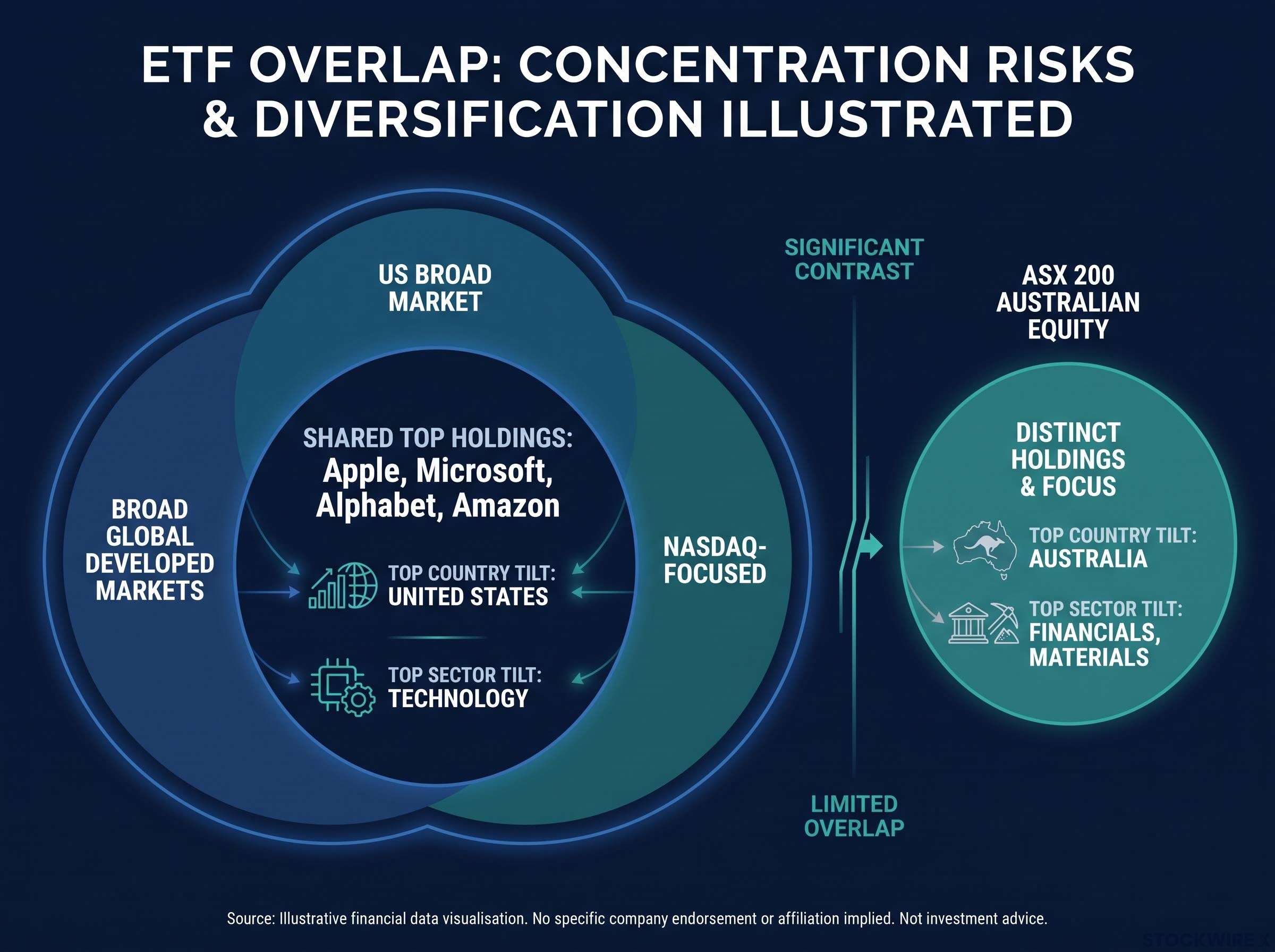
The same holds at home. Broad Australian equity ETFs tracking the ASX 200 hold almost the identical basket of large caps. Stack several ASX-focused funds together and you are replicating the same names with marginally different fees, not adding anything new.
The table below shows how quickly the overlap stacks up across combinations beginners commonly hold.
| ETF type | Broad exposure | Top country tilt | Top sector tilt | Overlaps a core global ETF? |
|---|---|---|---|---|
| Broad global developed markets | Global large caps | United States | Technology | Is the core |
| US broad market | US large caps | United States | Technology | Heavily |
| Nasdaq-focused | US mega-cap tech | United States | Technology | Heavily |
| ASX 200 Australian equity | Australian large caps | Australia | Financials, materials | Minimally |
Notice the pattern. Three of those four funds are concentrated in one country and one currency. An investor holding several global and US ETFs plus a couple of US-centric thematic funds can end up with almost all their equity risk riding on the American economy and the US dollar, despite owning what looks like a broad spread.
ETF overlap across VGS, IVV and NDQ is one of the most common concentration traps in Australian retail portfolios, with all three funds placing the same US mega-cap technology companies, including Nvidia, Apple, and Microsoft, simultaneously at the top of every allocation.
Real diversification, advisers consistently argue, is measured across countries, sectors, investment styles, and asset classes. Not across the number of line items on your holdings statement.
The diworsification trap in practice
There is a name for adding holdings that increase complexity without reducing risk: diworsification. More funds, more admin, more decisions, and no meaningful improvement in your actual exposure, because the underlying holdings are replicated rather than varied.
Picture a portfolio holding BGBL (a broad global ETF), a US-focused fund, and a Nasdaq thematic ETF at the same time. A large slice of that combined portfolio ends up sitting in the same five US technology giants. On paper it reads as three diversified positions. In practice it is one concentrated bet wearing three tickers.
The problem compounds when you bolt thematic satellites on top. A dedicated tech or innovation fund does not offset that concentration. It amplifies it.
So before you add your next ETF, try this test. Name one specific risk factor it introduces that your current holdings do not already cover. If you cannot name it, the new fund is not diversification. It is duplication.
The specific risks of adding leveraged ETFs before you have a stable core
Some products do not just duplicate your risk. They mechanically work against the long-term horizon most beginners actually have. Leveraged ETFs are the clearest example, and to see why, you have to understand how they are built.
A leveraged ETF is designed to deliver a multiple, often two times, of an index’s daily move. Not the index’s long-term return. The daily one. That distinction is where the trouble hides.
Here are the three structural differences from a plain index fund:
- Daily rebalancing. The fund resets its leverage every single day to maintain the target multiple, which means it compounds daily results rather than tracking the index over time.
- Volatility decay. Because of that daily compounding, choppy markets erode the fund’s value. An index can finish flat over several months while the leveraged version finishes down.
- Fee structure. Leverage is built using derivatives and swaps, which carry higher management costs plus counterparty and financing risk that plain index ETFs do not.
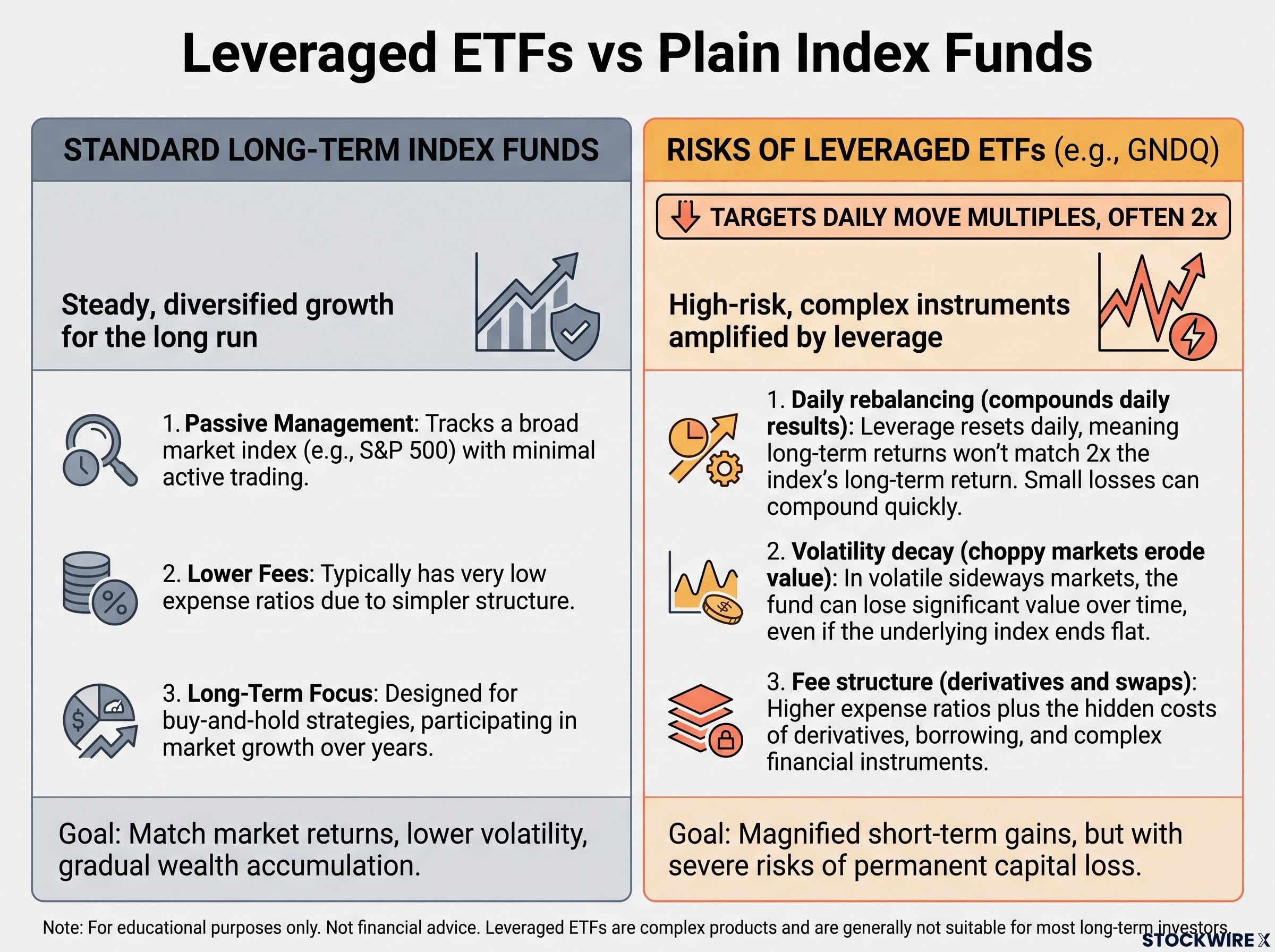
Volatility decay is the part that catches people out. You might reasonably expect a two-times fund to return roughly double the index over a year. In a volatile market, it may deliver far less, or even a loss, while the index itself is barely changed. The daily reset means the maths does not work the intuitive way.
Volatility drag is the structural mechanism behind this erosion: because a leveraged ETF resets its exposure to the target multiple at the end of every trading day, percentage losses require proportionally larger gains to recover the following day, and a choppy market can leave the fund below its entry price even when the underlying index finishes flat.
This is where the mismatch becomes clear.
The product disclosure statements and target market determinations for geared ETFs such as GNDQ, a leveraged Nasdaq 100 fund, typically describe them as suitable for investors who understand leverage, can actively monitor their positions, hold a high risk tolerance, and have short investment horizons.
That description is the opposite of the long-term, set-and-forget approach most beginners intend to run. A product built for active daily traders is being held for years by people who log in twice a month.
A common version of this mistake is holding both a leveraged and an unleveraged fund tracking the same index at once. It usually happens by accident: you add the geared version without removing the original. Now you are paying higher fees for a product actively working against your holding period.
If that describes your portfolio right now, you are paying more, in both fees and complexity, for an exposure that fights your own timeframe rather than serving it.
Thematic satellites as pseudo-core holdings
Thematic ETFs carry a different but related danger. They start as small tactical positions and quietly grow into de facto core holdings.
Take AINF, an infrastructure-focused fund. Held at a small weight, it is a considered tilt. Let it swell to a large chunk of your portfolio, and you have embedded a single-theme bet. If interest rates rise and pressure infrastructure valuations, the very thesis behind the fund is under attack, and nothing else in the portfolio softens the drawdown.
Advisers broadly agree on the guardrail: satellites should be capped at no more than 5-10% of the total portfolio, limited to one or two clearly understood themes, and added only once a stable core is in place.
The practical test is blunt. If you cannot explain what a holding does, why it belongs in your portfolio, and what would make you sell it, it should not be there.
What a simpler portfolio actually looks like, and how to get there from here
So what does a portfolio you can actually understand look like? Think of it as a short progression, not a menu that demands another round of deliberation.
| Structure | Number of core holdings | Asset classes covered | Best suited for |
|---|---|---|---|
| One-fund core | 1 | Shares and bonds blended at a set risk level | Beginners who want zero ongoing decisions |
| Two-fund core | 2 | Australian and global equities | Most Australian beginners with a long horizon |
| Three-fund core | 3 | Australian equities, global equities, defensive assets | Investors wanting a lever to dial down risk |
The two-fund core is the natural anchor for most Australian beginners. One broad Australian shares ETF, tracking the ASX 200 or the total market, plus one broad global developed-markets ETF. That gives you a clean domestic and international split, minimal overlap, and simple rebalancing rules like 40/60 or 30/70.
Building a core ASX ETF portfolio around a small number of low-cost funds, such as A200 for domestic exposure and VGS for international developed markets, gives beginners a clean structural anchor before any satellite position is considered.
The three-fund version simply adds a defensive asset, a bond or cash-like ETF, as a single lever for adjusting portfolio risk without dragging in thematic complexity.
Worried about holding several funds from the same manager? That concern is largely misplaced. An ETF is a distinct legal entity from the manager that runs it, and the underlying securities sit with a third-party custodian, usually a large investment bank. This is structurally different from bank deposit concentration, where guarantee thresholds genuinely reward spreading money across institutions.
If your portfolio is already overcrowded, you do not need to sell everything and start again. Work through this reset in order.
- Write down a target allocation first, for example 70% growth equities and 30% defensive. This becomes the benchmark every holding is judged against.
- Choose one to three broad, low-cost core ETFs covering Australian shares, global shares, and optionally bonds.
- Evaluate each existing holding against that core. If it overlaps heavily and adds no new risk factor, consolidate it. If it is leveraged or highly thematic, cap it hard or remove it from your long-term holdings.
- Commit to a fixed rebalancing schedule, once or twice a year, rather than tinkering every time a new product launches or a headline lands.
- Redirect your attention to your savings rate and time in the market, the two levers that actually build wealth, rather than collecting more tickers.
For satellites, keep the discipline tight:
- No more than 5-10% of the total portfolio in any single satellite.
- One or two satellites maximum.
- Core first, always. Only add a satellite once you can articulate the specific job it does.
There is a reassuring backdrop to all this. The Computershare ETF Insights report for 2024 suggests the average investor holds somewhere between 1.7 and 2.1 ETFs (a figure flagged as unverified, so treat it as directional rather than precise). If accurate, it points to simplicity being the real-world norm, not the exception.
The deeper point is behavioural. You do not need a bigger portfolio to build wealth. You need one you will hold through a 30% drawdown without panic-selling, and simplicity is the structural feature that makes calm behaviour far more likely.
The simplest portfolio is often the one that actually gets held
Pull the threads together and a single principle emerges. Complexity is rarely a sign of sophistication. More often it is a sign of thinking that never quite finished, a series of additions that were never edited back down.
A portfolio you understand completely, and can hold without anxiety when markets fall, beats one with superior diversification on paper that you cannot emotionally sustain. Theoretical risk metrics do not matter if you sell in a panic.
There is real-world weight behind that idea. Stockspot, a robo-adviser building simple, managed ETF portfolios, has grown to roughly $1.5 billion in assets under management as at September 2026, serving around 14,000 clients as at July 2024. A large and growing cohort of Australians has found perfectly adequate long-term exposure through simplicity rather than DIY complexity.
The practical question is not how many ETFs you should eventually own. It is this.
Would you keep buying the portfolio you hold right now, every month, straight through a 30% market downturn? If the answer is no, the problem is not your nerve. It is your portfolio.
If, having read all this, you still feel the itch to add just one more fund, treat that urge itself as the signal. The pattern from the opening has not yet been interrupted. The investor who holds three funds confidently through a bear market will almost always outrun the one who dumps eight overlapping funds in a panic.
This article is for informational purposes only and should not be considered financial advice. Investors should conduct their own research and consult with financial professionals before making investment decisions. Past performance does not guarantee future results.