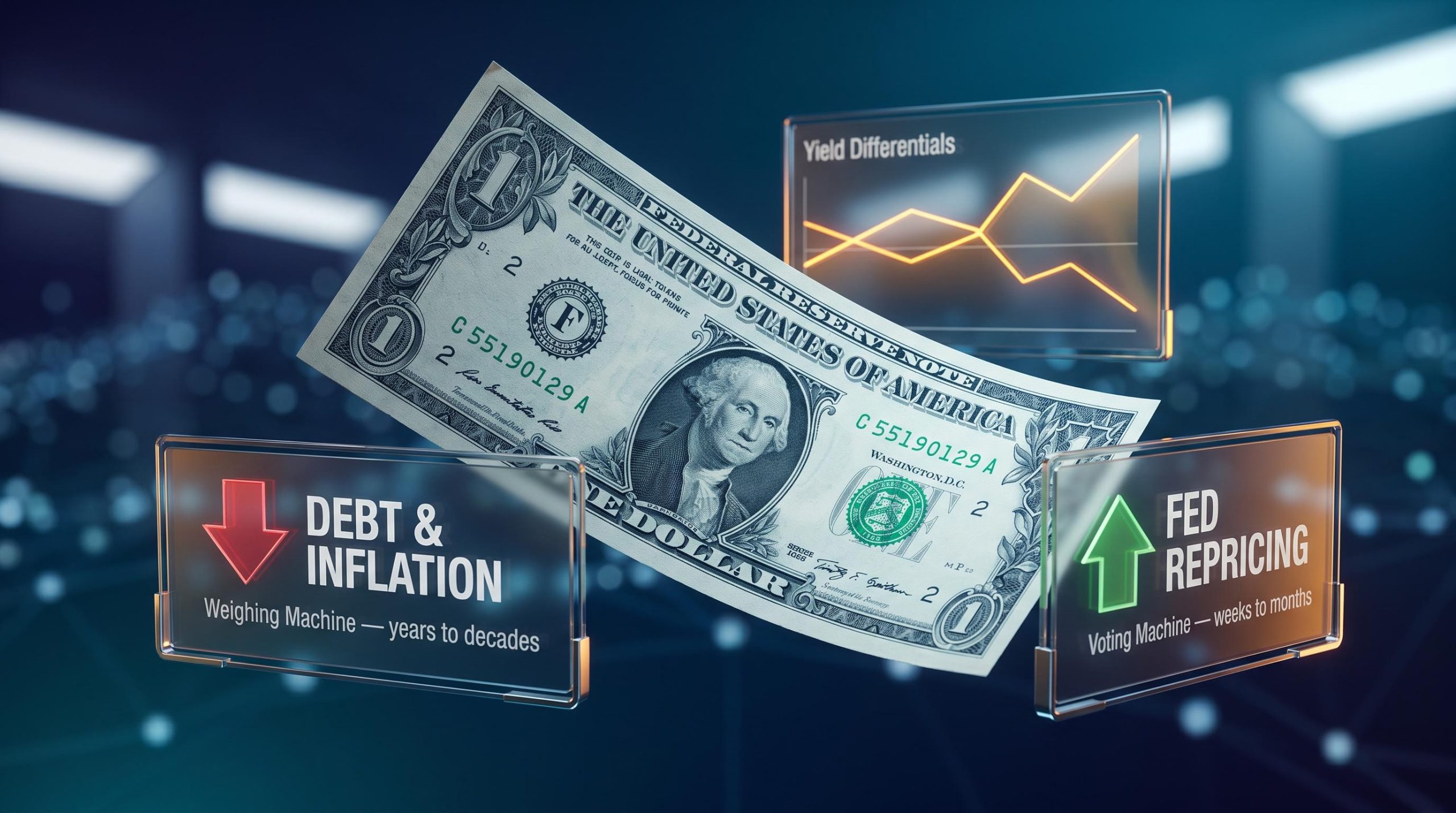
Most of the commentary you encounter about the dollar points to two culprits: the national debt and inflation. Both are real forces. Neither is the most meaningful short-term driver of where the dollar actually goes.
That gap between what most people watch and what actually moves the currency is the subject of a framework Ken Fisher, Founder, Executive Chairman, and Co-Chief Investment Officer of Fisher Investments, laid out in commentary published 7 August 2026. Fisher applied Benjamin Graham’s famous voting-machine versus weighing-machine concept, originally developed for equities, directly to currency markets. The result is a model that explains why the dollar so often does the opposite of what fiscal headlines suggest it should.
Here is the framework for separating the forces that move the dollar over weeks and months from the fundamentals that govern it over years and decades, and for knowing which one you are looking at the next time a headline lands.
The dollar as a popularity contest, not an accounting ledger
Graham’s distinction is simple. In the short run, the stock market is a voting machine: it reflects who is popular, what story is winning, and where the crowd wants to be. In the long run, it is a weighing machine: it measures actual earnings, actual growth, and actual value. Fisher’s insight, articulated in his June 2026 commentary (published 7 August 2026), is that currency markets work the same way.
Over weeks and months, the dollar reflects popular opinion, expectations, and market mood far more than it reflects concrete fiscal arithmetic. This is not just Fisher’s interpretation. It has academic backing in a body of research known as the Meese-Rogoff puzzle, which found that near-term exchange-rate movements are notoriously difficult to explain with macro fundamentals alone. Currency markets are, in the short run, a popularity contest.
If you have been trying to predict where the dollar goes next quarter by watching debt figures and CPI prints, you have been using the wrong instrument entirely. Here is the contrast:
- What most investors watch: National debt levels, official inflation data, trade balance reports, government spending totals
- What actually moves the dollar short term: Fed policy expectations, yield differential repricing, risk appetite shifts, narrative changes about US growth, macro data surprises that alter the policy outlook
That gap explains why the dollar so often seems to ignore the headline you just read.
When big ASX news breaks, our subscribers know first
What sentiment actually looks like in FX markets
If the dollar is a popularity contest in the short run, the next question is obvious: what does popularity actually look like in currency markets? It runs through four specific channels, and each one is worth understanding on its own terms.
- Fed policy expectations and yield differentials. Markets repricing the Federal Reserve toward a “higher for longer” stance, and the widening of US yield premiums over other major economies, have been consistently cited as primary drivers of recent dollar performance. The key distinction: it is the repricing of expected future policy, not the current rate itself, that moves the currency.
- Safe-haven demand. Periods of geopolitical tension, including Middle East conflict and shipping disruption risks, push global capital into the dollar as a safe-haven asset. When risk appetite improves, that capital rotates out, even when US fundamentals have not changed at all.
- Narrative shifts about US assets. Institutional commentary has identified “American exceptionalism” and the AI boom as short-term dollar support mechanisms. When the prevailing story is that US growth and innovation are outperforming, capital flows into US assets, and the dollar strengthens before any data confirms the underlying dynamic.
- Macro data surprises. An unexpected decline in consumer confidence, for example, can push the dollar lower as traders reassess growth and Fed policy trajectories, without any change in the underlying economic fundamentals.
The June 2026 FOMC meeting is a precise illustration of the voting machine at work: the Fed’s language shift, specifically the removal of wording that had left room for earlier cuts, repriced cut timelines more forcefully than any actual rate decision would have, and pushed the DXY back above 100 before a single underlying fundamental had changed.
The repricing of Fed policy expectations has been more important for the dollar than any specific data print. What markets anticipate the Fed will do matters more than what the Fed has already done.
What this tells you is that the same economic conditions can produce opposite dollar moves depending on the story the market is telling itself about the future. Monitoring the narrative is as important as monitoring the data.
Why debt and inflation move the dollar less than you think
Neither debt nor inflation is irrelevant. Both matter. But the way they matter is not the way most commentary implies, and the distinction is worth getting right.
The debt misconception
The US has carried high and rising public debt for years. Across that same period, the dollar has seen both strong rallies and sharp declines. If the mechanical model (“more debt equals weaker dollar”) were correct, that pattern could not exist.
The debt-to-GDP ratio crossing 100% in March 2026 generated significant commentary, but with interest payments at roughly 18.5% of US tax revenue and 10-year Treasury yields well below their long-run average, the market signal embedded in bond prices directly contradicts the narrative that a fiscal crisis is imminent.
As Fisher noted directly in his commentary: the actual debt stock and prevailing inflation rate carry less weight in determining dollar strength than the anxiety and perception surrounding them. Investor sentiment about those conditions is the more potent short-term force. Two identical fiscal profiles can produce very different currency outcomes depending on whether the prevailing narrative is “manageable deficits in a stable system” or “looming fiscal crisis with policy uncertainty.” The debt level is the same in both scenarios. The dollar outcome is opposite.
What changes FX outcomes is not the debt stock itself but how investor perception of that debt shifts the expected policy path. Institutional FX research in 2026 cites rate differentials and asset demand as primary drivers, not the debt stock, in current commentary.
The inflation transmission chain
The causal sequence runs through a specific chain: inflation expectations shift (for example, because oil prices fall), then the anticipated Fed response adjusts, then yield spread repricing occurs, and then the dollar moves. Official CPI data can lag this entire chain, meaning the dollar may have already moved before the inflation number is published.
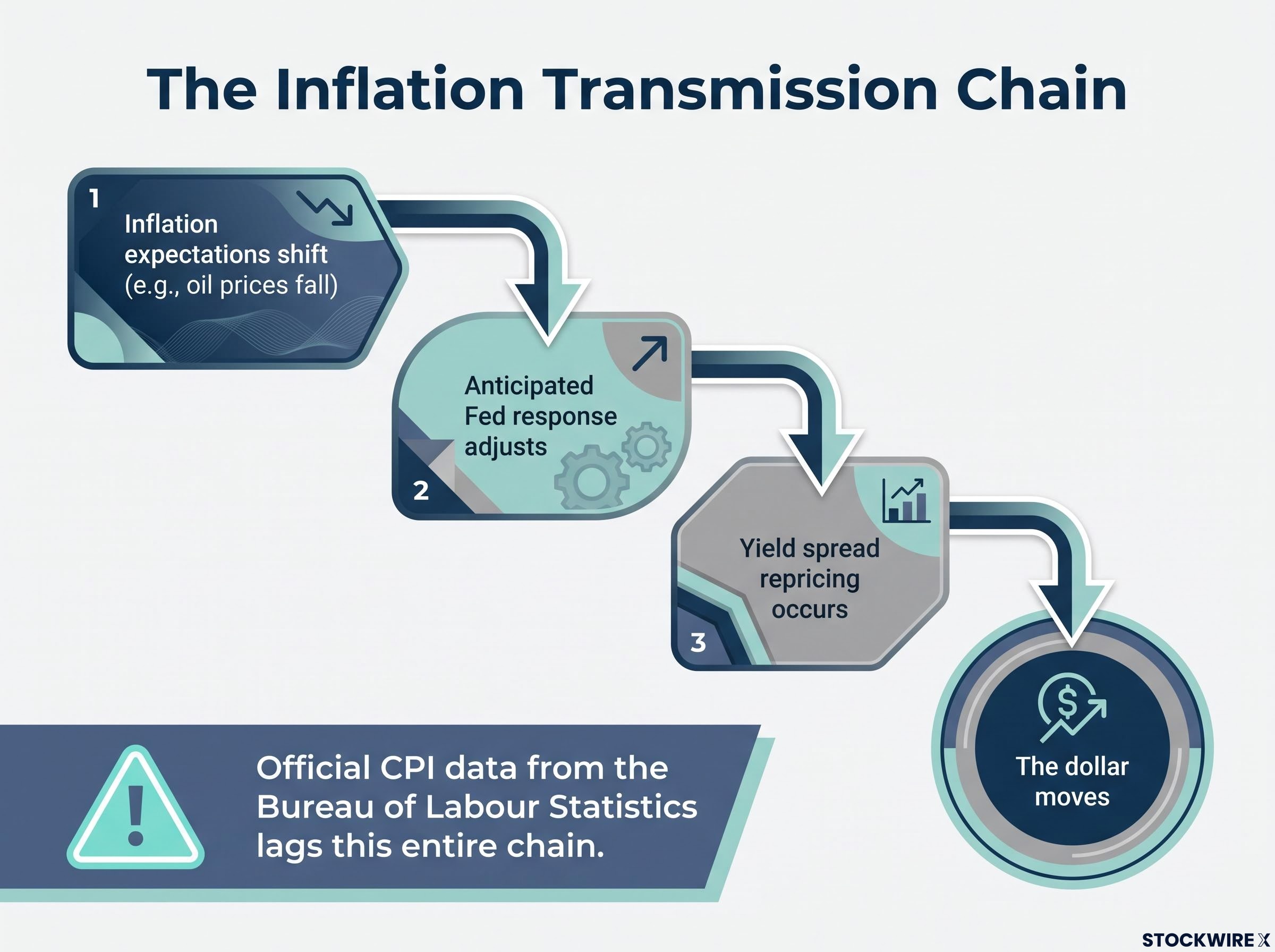
This is why a falling oil price can weaken the dollar before any official data registers lower inflation. Traders reprice the Fed’s likely response to lower inflation expectations, yield spreads narrow, and the dollar adjusts, all before the Bureau of Labour Statistics publishes anything.
For you, this means that when a headline warns that rising US debt will weaken the dollar, the relevant question is not whether the debt is large. It is whether that debt narrative is changing how investors expect the Fed to respond and whether it is shifting the prevailing story about US institutional credibility.
Politics, presidential patterns, and the sentiment amplifier
Fisher identified an observational pattern worth knowing about, with an important caveat worth knowing equally well.
According to Ken Fisher’s August 2026 commentary, Republican administrations have historically shown a preference for a softer dollar and have tended to see one materialise, especially across the opening half of their terms, whereas Democratic administrations have generally leaned toward a stronger currency.
That is an interesting observation. It is not, however, a robust empirical law. Proving a causal party-label effect requires controlling for global cycles, Fed policy, oil shocks, and other confounders that the current evidence does not resolve. Fisher presented this as an established observation about how markets sometimes appear to align with administrations’ perceived currency preferences, not as a trading rule.
The plausible mechanism that makes the pattern intelligible is itself a voting-machine effect. Markets price in anticipated policy preferences (on trade, fiscal stance, regulation, and foreign policy) before concrete policy is enacted. Those expectations can shift the dollar early in an administration, regardless of whether the policy ultimately materialises.
What institutional FX research emphasises is policy stance rather than party label:
- Not the primary driver: Which party holds the White House
- The actual mechanism: What policy signals the administration sends about trade openness, spending, currency tolerance, and regulation, and how global investors read those signals in real time
Changes in rate-cut expectations, trade restrictions, or fiscal stimulus programmes are cited as FX catalysts regardless of which party sponsors them. The voting machine responds to anticipated policy, not party affiliation.
The practical implication: when a new administration takes office, the useful FX question is not “which party won” but “what policy signals is this administration sending about trade, spending, and currency tolerance, and how are global investors reading those signals right now.”
Where fundamentals eventually take over
The voting machine does not run forever. Over years and decades, the weighing machine takes over, and the dollar reflects genuine economic conditions rather than shifting narratives.
Major institutional research highlights the long-run anchors: real interest-rate differentials, productivity growth, institutional quality, and current-account balances. Countries with persistently higher inflation and weaker institutions tend to see their currencies depreciate over time. Countries with stronger growth and deep, liquid capital markets tend to sustain stronger currencies.
The US dollar’s reserve-currency status is the most durable expression of the weighing machine at work. That status rests on decades of demonstrated institutional credibility, deep capital markets, and economic scale. Safe-haven flows during crises repeatedly underscore that long-term trust in US institutions remains intact even when short-term narratives turn pessimistic. This is a structural global role sustained by fundamentals, not by any particular year’s sentiment cycle.
The structural headwind beneath the current sentiment cycle received a concrete data point on 30 June 2026, when the OMFIF survey recorded the first instance on record of sovereign dollar-reduction intent outnumbering dollar-increase intent among the 90 central banks and sovereign institutions surveyed, a shift that operates on the weighing machine’s timescale rather than the voting machine’s.
Fisher made the point directly: fundamentals absolutely matter, but they operate over horizons that typically exceed most investors’ attention spans. That mismatch is why short-term sentiment appears to dominate the news cycle and why the voting machine gets most of the airtime.
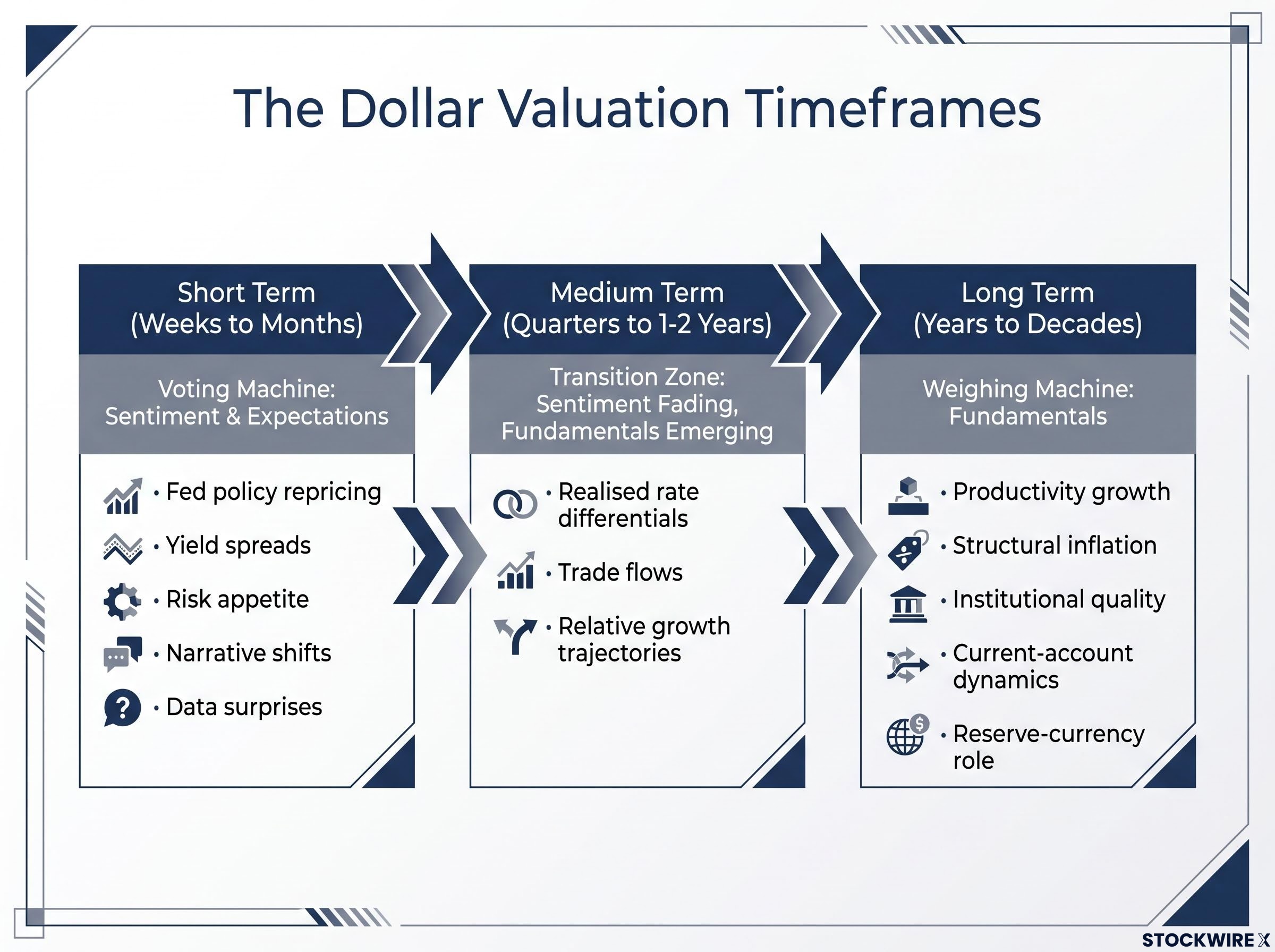
| Timeframe | Primary Driver | Key Variables |
|---|---|---|
| Short term (weeks to months) | Voting machine: sentiment and expectations | Fed policy repricing, yield spreads, risk appetite, narrative shifts, data surprises |
| Medium term (quarters to 1-2 years) | Transition zone: sentiment fading, fundamentals emerging | Realised rate differentials, trade flows, relative growth trajectories |
| Long term (years to decades) | Weighing machine: fundamentals | Productivity growth, structural inflation, institutional quality, current-account dynamics, reserve-currency role |
For you, this means that when short-term sentiment drives a sharp dollar move, the relevant question is whether the underlying fundamentals, productivity, institutional credibility, capital-market depth, have actually changed. If they have not, the weighing machine will eventually pull the dollar back toward where those fundamentals point.
A working framework for reading dollar news without being misled
The Fisher-Graham framework converts into a set of diagnostic questions you can apply the next time a dollar headline lands:
- Is this a sentiment shift or a fundamental change? Most headlines describe sentiment shifts (a change in expectations, a new narrative, a data surprise). Fewer describe genuine fundamental changes (a structural shift in productivity, a permanent loss of institutional credibility). Knowing which one you are reading determines how much weight to give it.
- What is the transmission path to the dollar? Trace the causal chain. Does this event change Fed policy expectations? Does it alter yield spreads? Does it shift risk appetite? If you cannot identify the specific channel, the headline may not move the dollar at all.
- Has the underlying fundamental changed, or only the narrative around it? The same debt level reads as bullish or bearish for the dollar depending on the surrounding story. The same inflation print can strengthen or weaken the currency depending on what it implies for the Fed’s next move.
- Is this a political signal or a policy signal? When political headlines dominate dollar commentary, the useful question is about specific policy signals (trade, fiscal, regulatory) and global investor confidence, not party affiliation.
- Which machine is running right now? The voting machine determines where the dollar goes next month. The weighing machine determines where it goes over the next decade. Both deserve your attention, but they require different analytical tools and different time horizons.
Tracking how major institutions and media describe the US story (“exceptional growth,” “policy uncertainty,” “AI boom”) is a legitimate and actionable part of FX interpretation, because those narratives move capital flows before data confirms them. Narrative monitoring is not speculation. It is recognising how the voting machine works.
This article is for informational purposes only and should not be considered financial advice. Investors should conduct their own research and consult with financial professionals before making investment decisions.
What the two machines tell you that most dollar commentary misses
The dollar’s short-term and long-term behaviour are governed by genuinely different forces. Conflating them is where most analytical errors begin. Debt and inflation headlines will continue to dominate dollar commentary, but you now have the framework to place those headlines in the right causal slot: are they changing sentiment and expectations (voting machine), or are they signalling a genuine shift in underlying economic fundamentals (weighing machine)?
As US fiscal and political discussions continue through the current cycle, the Fisher-Graham framework provides a durable interpretive lens. Administrations will change, data environments will shift, and narratives will rotate. The two machines will keep running on their separate clocks. The question worth asking every time is which one is moving the dollar right now.