Most new investors spend weeks deciding whether to invest, then freeze when asked a harder question: which share, exactly, and what happens if it falls?
Deciding to invest is step one. The decisions that follow, selecting specific companies, setting position sizes, and knowing when to cut a loss, are where most beginners either build lasting habits or make costly early mistakes. For Australian investors entering the ASX, these practical questions have practical answers.
This guide walks through the full decision chain for picking shares: how to evaluate companies based on future prospects rather than past price charts, why low-priced shares are a trap for beginners, what it realistically costs to start, and how stop-loss orders protect a portfolio from single-stock disasters. Each section builds toward a reusable six-step checklist that applies to every stock purchase.
Build your stock selection around what the business will do next, not what its share price did last
The first instinct most new investors follow is to pull up a share price chart, look for something that has been going up, and buy it. It feels logical. It is also one of the least reliable ways to pick stocks.
Historical financial performance and prior achievements may indicate business stability, but the market is not paying for what a company has already done. It is pricing what the company will earn next.
The mechanics of how markets set prices clarify why backward-looking charts are such an unreliable selection tool: limit orders sitting in the order book contribute to price discovery before any trade executes, meaning the price a buyer sees already reflects the collective forward expectations of every participant who has placed an order.
Anticipated future performance is considered the primary driver of share price movements over time, according to guidance from MoneySmart and ASIC. Past results may signal stability, but forward earnings expectations are what move share prices.
This means the most useful question is not “has this share gone up?” but “will this business earn more in the future?” To answer that, evaluate any company through four forward-looking lenses:
- Is the industry growing? A company in a shrinking market has to fight harder just to stand still.
- Does the company have a durable competitive advantage? Look for a strong brand, proprietary technology, a cost position competitors cannot replicate, network effects, or regulatory protection.
- Are there identifiable growth drivers? New markets, new products, or acquisitions that could expand revenue over the next three to five years.
- Will demand for its products or services persist? A business selling something people need in five years is worth more than one riding a temporary trend.
Start with industries already familiar to the investor. Existing sector knowledge makes it far easier to judge whether a company has genuine prospects or is simply telling a good story. Company annual reports and half-yearly financial results statements, available free via the ASX website, are the primary source material for this kind of evaluation.
When big ASX news breaks, our subscribers know first
Three financial metrics that tell you whether a business is worth its asking price
Understanding the business is the first filter. The second is checking whether the market is pricing it sensibly. Three specific metrics, all available in company filings on the ASX website, can answer that question in under ten minutes.
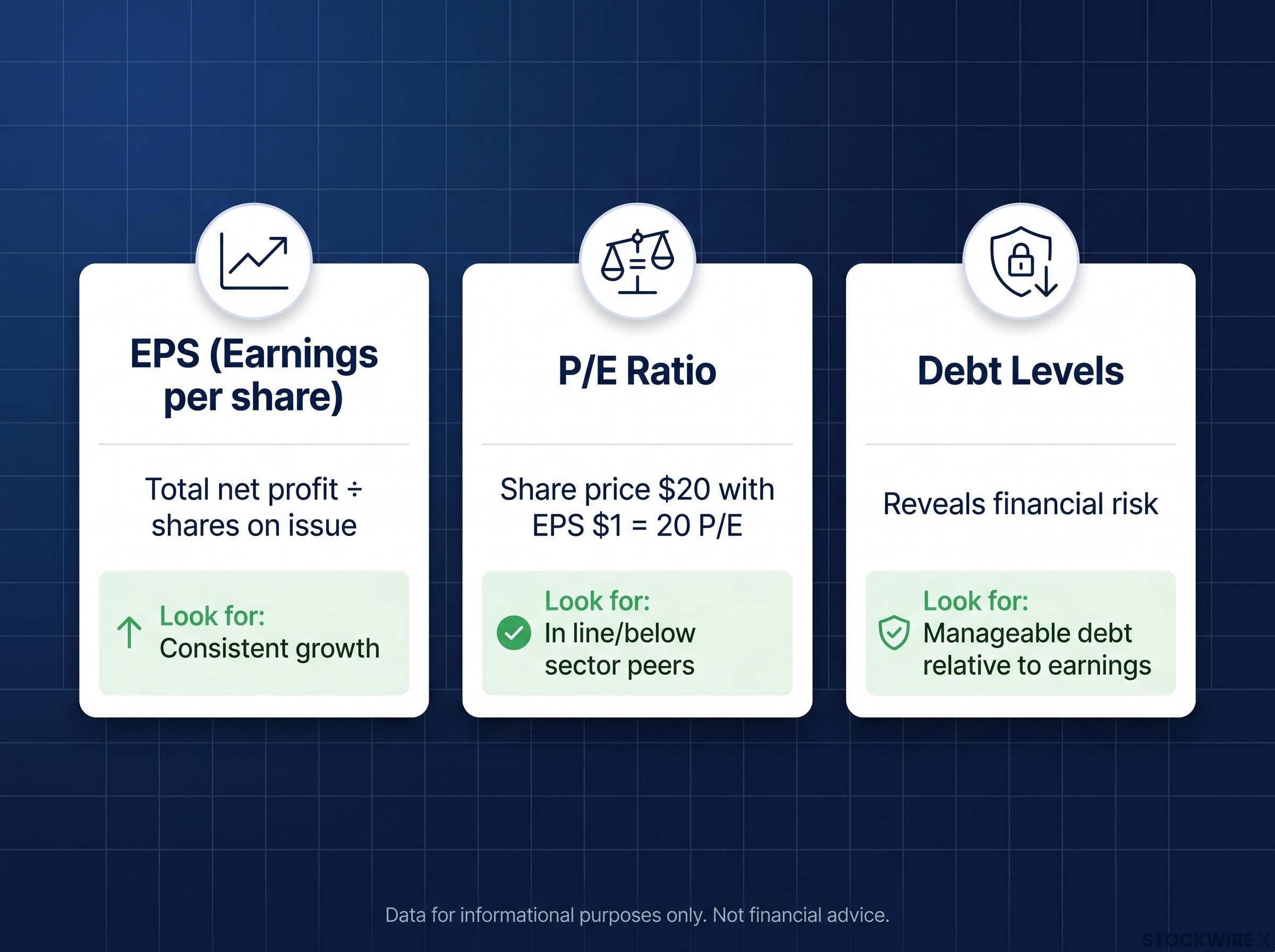
Earnings per share (EPS) measures the profit attributable to each individual share. It is calculated by dividing total net profit by the number of shares on issue. Consistent EPS growth over several reporting periods is a positive signal, suggesting the company is translating revenue into increasing profit for shareholders.
Price-to-earnings ratio (P/E) shows how much investors are paying for each dollar of earnings. A share trading at $20 with an EPS of $1 has a P/E of 20. The figure means little on its own; it becomes useful when compared against sector peers. A tech company with a P/E of 30 might be fairly valued relative to its competitors, while a bank at the same level could signal overpricing.
Debt levels reveal how much financial risk the company carries. High debt amplifies losses in downturns and can restrict a company’s ability to invest in growth. Income statements and balance sheets, both available through ASX filings, are the primary sources for all three figures.
| Metric | What it measures | Where to find it | Favourable signal | Caution |
|---|---|---|---|---|
| EPS | Profit per share | Income statement (ASX filings) | Consistent growth over multiple periods | A single strong quarter may not indicate a trend |
| P/E ratio | Price paid per dollar of earnings | Share price ÷ EPS | In line with or below sector peers | A low P/E can signal risk, not a bargain |
| Debt levels | Financial leverage and risk | Balance sheet (ASX filings) | Manageable debt relative to earnings | High debt amplifies losses in downturns |
Reading the numbers in context, not in isolation
No single metric tells the full story. A high P/E may be justified if the company has credible growth expectations supported by expanding revenue and new market entry. A low P/E can reflect deteriorating prospects rather than a buying opportunity.
All three metrics should be read together and alongside the qualitative business assessment from the previous section. Management outlook statements and analyst research, where available, add context that raw numbers alone cannot provide.
For investors who want to go deeper on the financials once the three core metrics are familiar, our full explainer on reading earnings reports covers non-GAAP adjustments that inflate headline EPS, the cash flow cross-check that most retail investors skip, and the earnings call signals that reveal management confidence before it shows up in reported numbers.
Why penny stocks are a trap for new investors, and what “cheap” really means
A share priced at $0.20 feels affordable. Buying 5,000 of them for $1,000 feels like getting more for less. The logic is intuitive, and it is wrong.
A low share price does not mean a stock is cheap. What determines a company’s size and value is its market capitalisation (the share price multiplied by the total number of shares on issue), not the price of a single share. Buying 5,000 shares at $0.20 each for $1,000 is not inherently better value than buying 15-20 shares priced at approximately $60 each for the same outlay.
MoneySmart guidance is clear on this point: the quantity of shares held matters less than the extent to which each share increases in value.
Penny stocks, typically priced at around 10-20 cents per share, carry a set of structural risks that make them particularly dangerous for beginners:
- Thin liquidity: Low trading volumes make it difficult to sell without moving the price against the seller.
- Limited financial disclosure: Smaller companies often provide less detailed reporting, making due diligence harder.
- Higher failure rates: Many penny stock companies are early-stage businesses with unproven models and material risk of total capital loss.
- Susceptibility to promotional campaigns: Low-priced shares are more easily influenced by hype and coordinated promotion.
- Total loss risk: Small, unstable companies can and do go to zero, taking an investor’s entire position with them.
MoneySmart and other investor-protection bodies consistently warn that speculative, thinly traded shares are high risk and unsuitable as core holdings for new investors. Treat them accordingly.
The common investing mistakes that cost Australian beginners the most capital are rarely failures of stock selection: they include over-reliance on social media tips as entry signals, paying excessive fees on small trades, and taking on leveraged products such as CFDs before a solid foundation in direct equities is established.
What it actually costs to start investing in Australia, and why fees change everything
Before placing a first order, the practical numbers matter. Minimum investment thresholds and brokerage fees shape how much of each dollar actually reaches the market.
Australian investors have several entry points, arranged here from lowest to highest threshold:
The ASX guidance on getting started with share investing outlines the minimum marketable parcel rule and explains how to access company announcements, making it the foundational reference for any Australian investor building their first research process.
- CommSec Pocket: from $50, with access to 10 themed ETFs including top 200 companies.
- CommSec Aussie Shares: $500 minimum for the first trade, with access to over 2,000 Australian shares and ETFs. Smaller top-ups are permitted for subsequent investments.
- ASX minimum marketable parcel: $500, the standard minimum transaction size on the exchange.
- ASX recommended starting amount: $2,000, the general recommendation for beginning share investing.
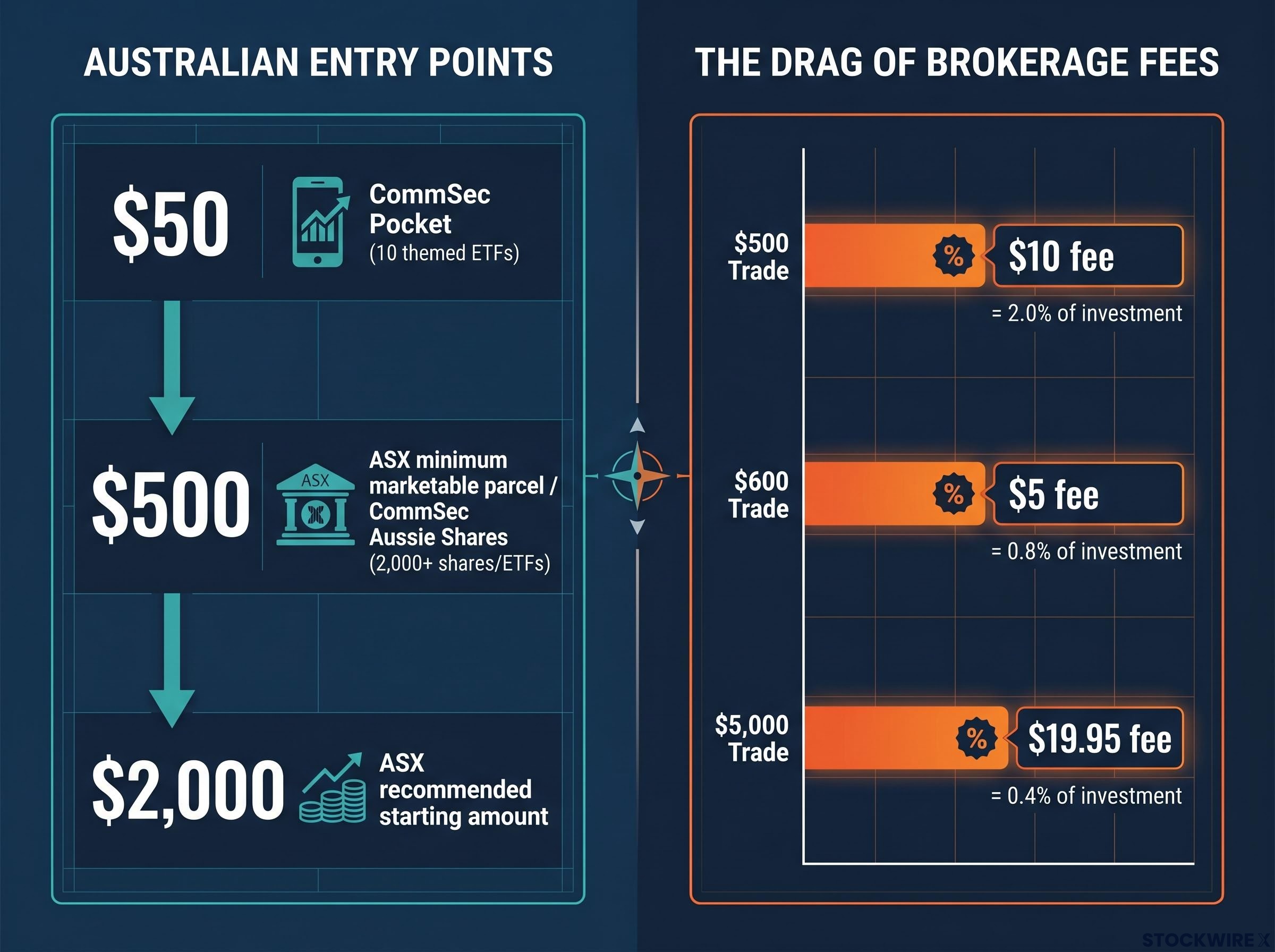
The real cost, however, is not just the minimum. Brokerage fees eat into returns, and they bite hardest on small trades.
| Trade size | Brokerage fee example | Fee as % of investment | Practical implication |
|---|---|---|---|
| $500 | $10 | 2.0% | The share must rise 2% just to break even on the buy side alone |
| $600 | $5 | 0.8% | Lower-cost broker reduces drag materially on smaller trades |
| $5,000 | $19.95 | 0.4% | Fee drag becomes manageable at larger trade sizes |
Many Australian platforms now offer low or zero commissions, though foreign exchange spreads and minimum fees may still apply depending on the broker and market. Fees apply on both the buy and the sell, meaning the share price needs to move further than most beginners expect before a profit materialises.
When starting with small amounts, the practical approach is to favour low-cost diversified index ETFs held for the long term rather than frequent trading in individual stocks. Avoid over-trading out of boredom or fear of missing out. Each unnecessary trade is a fee paid for no additional return.
Diversification and position sizing: how to build a portfolio that survives one bad pick
Picking good stocks is half the skill. The other half is structuring the portfolio so that one bad pick does not undo everything else.
Diversification is the structural defence. Holding a mix of companies across different sectors reduces the impact of any single holding failing. Position sizing is the mechanism that translates diversification into practice. Three principles form the foundation:
- Hold a mix of companies and sectors rather than concentrating in one or two names.
- Cap position size per holding so that no single stock represents an outsized fraction of total capital.
- Blend individual shares with index ETFs to reduce company-specific risk. ASX-listed ETFs covering the top 200 Australian companies or broad international indices are commonly used as the core of a diversified starter portfolio.
ASX-listed index ETFs have grown from under $70 billion in funds under management in 2020 to over $330 billion by end-2025, with passive index products charging management fees as low as 0.07%, making them a structurally lower-cost alternative to both active stock picking and actively managed funds for investors building a diversified core.
ASIC and MoneySmart guidance explicitly recommends considering each stock not just on its own merits but as part of overall portfolio and asset allocation. This is a structural habit, not a one-off decision.
A practical starting point for position limits
A common approach is to cap any single stock at 5-10% of total portfolio value, though the appropriate limit depends on the investor’s total capital, risk tolerance, and the specific risk profile of the company.
Speculative or illiquid stocks, including penny stocks, warrant a smaller allocation than large, established ASX-listed companies. A $50,000 portfolio with 10% in a speculative micro-cap has $5,000 at elevated risk of total loss. The same portfolio with 3% in that position limits the damage to $1,500. The stock selection might be identical; the position sizing determines whether a failure is a setback or a disaster.
Stop-loss orders: the one rule that keeps a bad trade from becoming a portfolio disaster
The most dangerous thing a new investor can do with a falling share is hold it out of hope. Hope is not a risk management strategy. A stop-loss is.
A stop-loss is an automatic sell order triggered when a share falls to a pre-set price. Its purpose is straightforward: keeping small losses from becoming large ones without requiring the investor to watch prices every day.
Selling decisions carry equal weight to buying decisions in determining overall portfolio outcomes. Failing to limit losses in a single holding risks offsetting gains made across the rest of the portfolio.
MoneySmart suggests a threshold of approximately 15% below the buy price as a practical starting point for individual company holdings. More broadly, a range of 10-20% is commonly used depending on the volatility of the share and the investor’s risk appetite.
Applying a stop-loss is a three-step process:
- Decide the maximum acceptable loss before buying. Set the percentage threshold based on the share’s volatility and the investor’s risk tolerance.
- Enter the stop-loss order with the broker immediately after buying. Do not defer this step.
- Apply the rule consistently without overriding it. A stop-loss that gets cancelled whenever it feels uncomfortable provides zero protection.
The benefit is mechanical discipline. The stop-loss removes emotion and “hope” from sell decisions and prevents a single failing position from wiping out gains made elsewhere in the portfolio.
When stop-losses are less effective
In fast-moving or thinly traded markets, a stop-loss may execute at a price worse than expected. This is known as slippage, and it is particularly common for small-cap or illiquid shares where there may not be a buyer at the exact stop-loss price.
For long-term investors holding high-quality, financially stable companies, a strict mechanical stop-loss may be less necessary than for speculative or concentrated positions. A 15% dip in a well-capitalised blue chip during a broad market sell-off is a different situation from a 15% decline in a speculative micro-cap with deteriorating fundamentals. Context matters, but for beginners, the discipline of having a stop-loss at all is more valuable than debating the perfect threshold.
Your six-step checklist before you buy any share on the ASX
Every section of this guide builds toward a single reusable process. Before buying any share, work through these six steps in order:
- Confirm the share fits the plan. Does this investment match stated goals, time horizon, and risk tolerance?
- Understand the business. How does it make money? Is demand for its products durable? What is its competitive position and industry outlook?
- Scan the financials. Review EPS trends, P/E ratio relative to sector peers, and debt levels using ASX filings.
- Assess risk. Consider company size, liquidity, valuation stretch, and whether the price reflects realistic growth expectations.
- Decide position size and set stop-loss level before placing the order. Cap the position at a sensible fraction of total portfolio value and pre-set the maximum acceptable loss.
- Execute, then review periodically. Avoid daily monitoring and constant tinkering. Review holdings and overall allocation at least annually, or after major life changes.
Discipline at steps five and six carries equal weight to getting steps one through four right. Many investors who select good companies still lose money because they over-concentrate, fail to set a stop-loss, or trade too frequently.
For new investors, combining a few carefully selected individual shares with low-cost index ETFs, and applying consistent position size limits and stop-loss rules, is a more reliable path to building wealth than frequent trading or speculative stock picking.
The investor who picks well and protects gains builds wealth; the one who picks well but holds losers too long often does not
This guide has covered two halves of the same skill set: selecting shares on future business merit, and protecting the portfolio with position limits and stop-loss discipline. Neither half works well without the other.
The learning curve is real but manageable. Start with a small number of well-understood companies alongside diversified ETFs. Apply the six-step checklist consistently. Review at least annually. These habits, formed in the first few trades, are the ones that compound over time.
For readers ready to move from research to execution, the practical next steps are clear. Open a brokerage account, with CommSec Pocket (from $50) and CommSec Aussie Shares (from $500) offering low-threshold entry points for Australian investors. Familiarise yourself with the ASX website and company filings, the primary research tools for individual stock analysis. Then make a first investment decision using the checklist.
This article is for informational purposes only and should not be considered financial advice. Investors should conduct their own research and consult with financial professionals before making investment decisions. Readers with complex financial situations should consider consulting a licensed financial adviser.