The US dollar is the official currency of one country that accounts for roughly 10% of world trade. Yet it sits on one side of nearly nine in every ten currency transactions on earth. That gap between America’s share of global commerce and the dollar’s share of global finance is one of the most consequential asymmetries in modern markets.
The disproportion is not accidental, and it is not purely political. It is the product of a specific historical moment, a set of institutional advantages that compound over time, and ongoing policy decisions made in Washington that ripple through every financial market on the planet. If you hold international equities, commodity-linked assets, or emerging market exposure of any kind, the dollar’s movements are already shaping your returns, whether you track them or not.
Here is the foundation you need to read dollar-related headlines with genuine comprehension rather than vague familiarity: why the dollar dominates, what moves its value, and what that means for your own investment decisions across multiple asset classes.
One currency, one world: what the dollar actually does
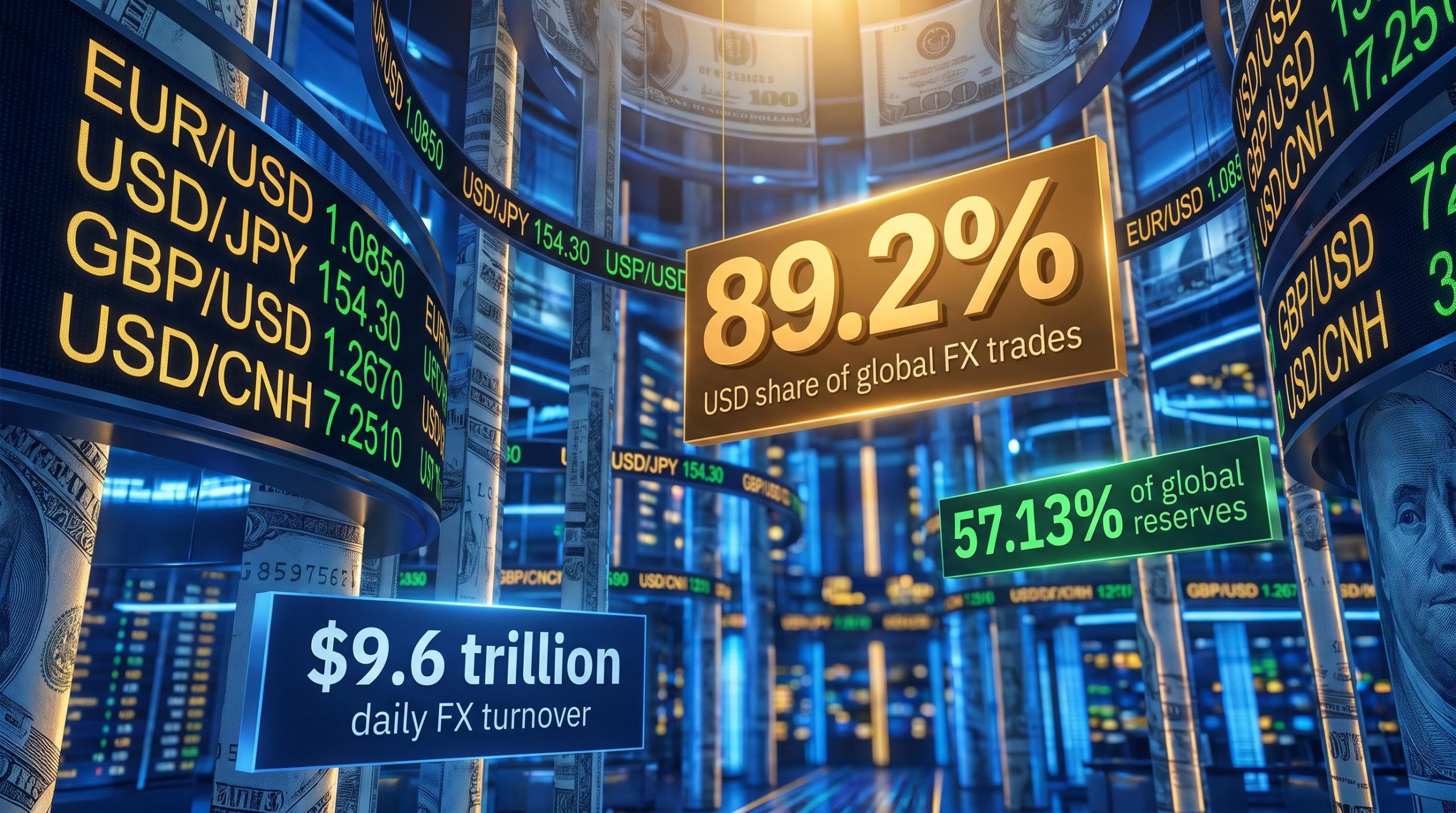
The numbers feel almost absurd at first glance. According to the BIS Triennial Central Bank Survey published in April 2025, the dollar appeared on one side of 89.2% of all foreign exchange trades globally, in a market that now turns over $9.6 trillion every single day.
The BIS Triennial Central Bank Survey confirms that global FX market turnover reached $9.6 trillion per day in April 2025, with the US dollar appearing on one side of 89.2% of all trades, a scale of dominance that no other currency comes close to matching.
89.2% of all global FX transactions involve the US dollar on one side of the trade. — BIS Triennial Central Bank Survey, April 2025
But each of those figures reflects a specific job the dollar performs. It operates simultaneously in three roles across international finance: as a unit of account (the currency in which prices are quoted), a medium of exchange (the currency in which transactions settle), and a store of value (the currency in which central banks hold reserves against future crises). That triple function is what separates the dollar from every other currency on earth.
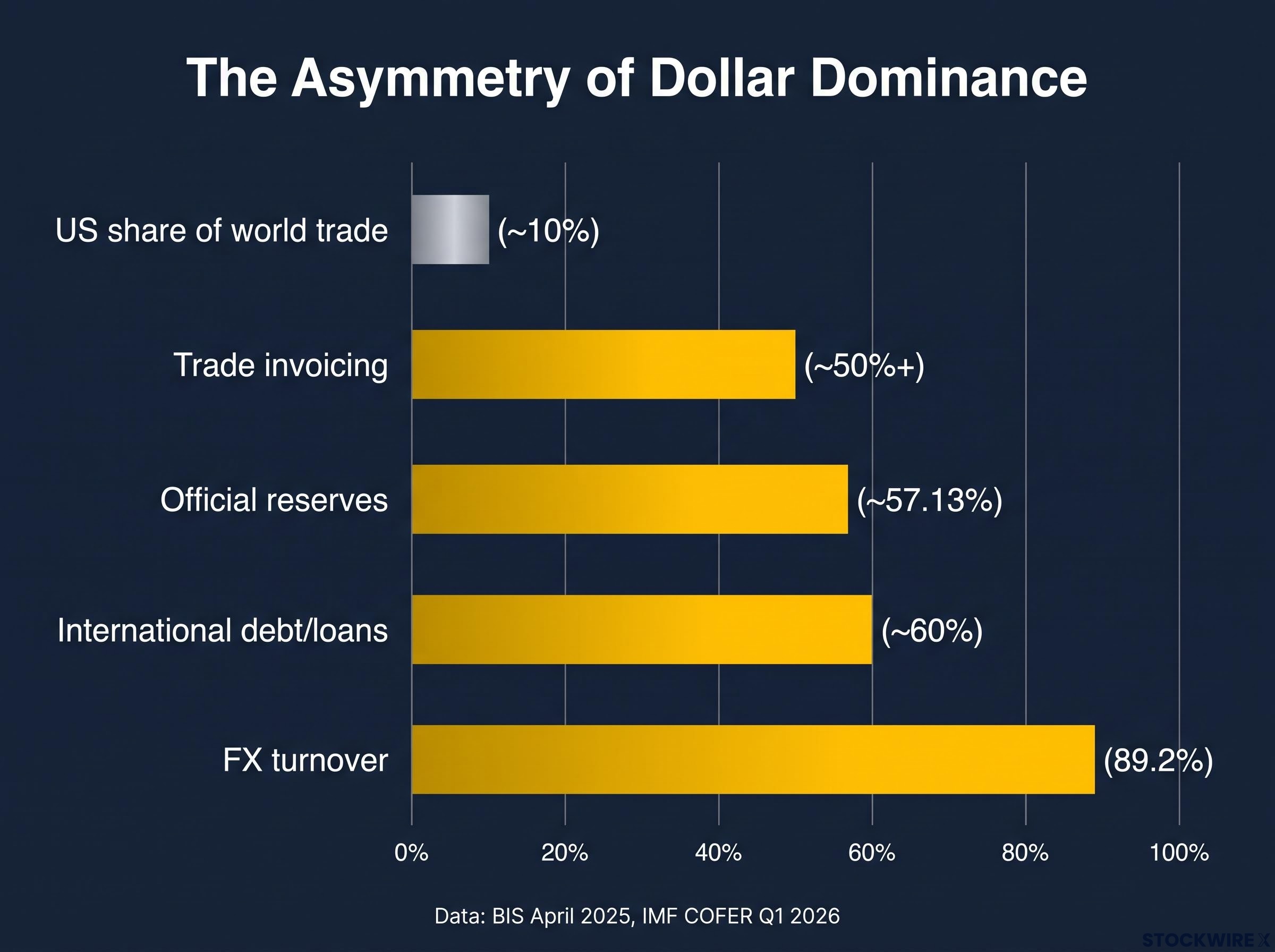
| Domain | USD share | Source |
|---|---|---|
| FX turnover | 89.2% | BIS, April 2025 |
| Official reserves | ~57.13% | IMF COFER, Q1 2026 |
| Trade invoicing | ~50%+ | IMF/BIS estimates |
| International debt/loans | ~60% | BIS/Fed analysis |
| US share of world trade | ~10% | Standard trade data |
Central banks hold dollar-denominated assets, primarily US Treasuries, as reserves precisely because they need a liquid, trusted asset to manage their own exchange rates and absorb shocks. The euro, the next largest reserve currency, sits at approximately 20.03% of global reserves, less than half the dollar’s share. Around 60% of international debt securities and cross-border loans are denominated in dollars.
What all of this means for you is direct: any shift in the dollar’s value or the Federal Reserve’s policy stance does not stay inside the US economy. It is immediately transmitted to every trading partner, every central bank reserve manager, and every borrower holding dollar-denominated debt anywhere on earth.
When big ASX news breaks, our subscribers know first
How the dollar became the world’s anchor currency
Reserve currency status is not permanent. Before the dollar, the British pound sterling held that position for the better part of a century, backed by the depth of London’s capital markets and the reach of the British Empire. Understanding that the pound was once where the dollar is now tells you something important: dominance is earned, maintained, and theoretically losable.
Three moments created the architecture you see today:
- The pound sterling era (pre-1944): Britain’s global trade network and financial infrastructure made the pound the default currency of international commerce through the 19th and early 20th centuries.
- Bretton Woods (1944): At the Bretton Woods Conference, Allied nations designed a postwar monetary system that formally anchored the world to the dollar, pegged to gold at $35 per ounce. Other major currencies pegged to the dollar. The arrangement reflected America’s economic dominance, its large gold holdings, and its intact industrial base after the war.
- The Nixon shock (1971): The US suspended gold convertibility, ending the fixed-rate gold standard and moving to a fiat currency regime, one backed by institutional trust rather than a physical commodity.
The moment the rules changed
1971 should, in theory, have ended dollar dominance. The gold anchor was gone. Any country could have argued the system needed resetting.
It did not happen because by then the world was already too deeply embedded in dollar infrastructure to easily switch. US financial markets were (and remain) deep, liquid, and open to global investors. Property rights and contract enforcement were comparatively strong. The network effects of dollar usage across trade contracts, reserve management, and derivatives markets had accumulated over decades.
That is the key insight from this history: the dollar did not need the gold peg to remain dominant because the institutional depth and network effects had already made switching prohibitively expensive. That dynamic still shapes your financial world today, and it is also why replacing the dollar is harder than critics of dollar dominance often suggest.
What actually moves the dollar’s value
You have probably heard the association: the Fed raises rates, the dollar strengthens. That relationship is real, but understanding why it exists gives you a genuinely useful framework rather than a vague heuristic.
The Federal Reserve, created in 1913, is the US central bank. It was established by Congress with a dual mandate: to keep prices stable and to support maximum employment across the economy. Its stated long-run inflation target is 2%, which remains in effect as of 2026. To pursue both objectives, the Fed’s principal instrument is the federal funds rate, the overnight rate at which commercial banks borrow from one another, which in turn shapes borrowing costs throughout the broader economy.
The Fed’s dual mandate framework, as interpreted by the Federal Open Market Committee, treats the 2% inflation target as a long-run symmetric goal, meaning the Fed responds to sustained deviations above and below that level rather than treating it as a hard ceiling.
The rate differential: why global capital follows the Fed
The mechanism is interest-rate differentials. When the Fed raises rates, dollar-denominated assets (Treasuries, deposits, corporate bonds) offer higher yields relative to assets denominated in euros, yen, or other currencies. Global investors seeking the best available return move capital into dollar assets, increasing demand for dollars and pushing the currency up.
The mechanism works through bond yields: when the Fed raises its target rate, yields on newly issued Treasuries rise to reflect the higher rate environment, making dollar-denominated assets more attractive relative to lower-yielding foreign alternatives and pulling capital toward the US.
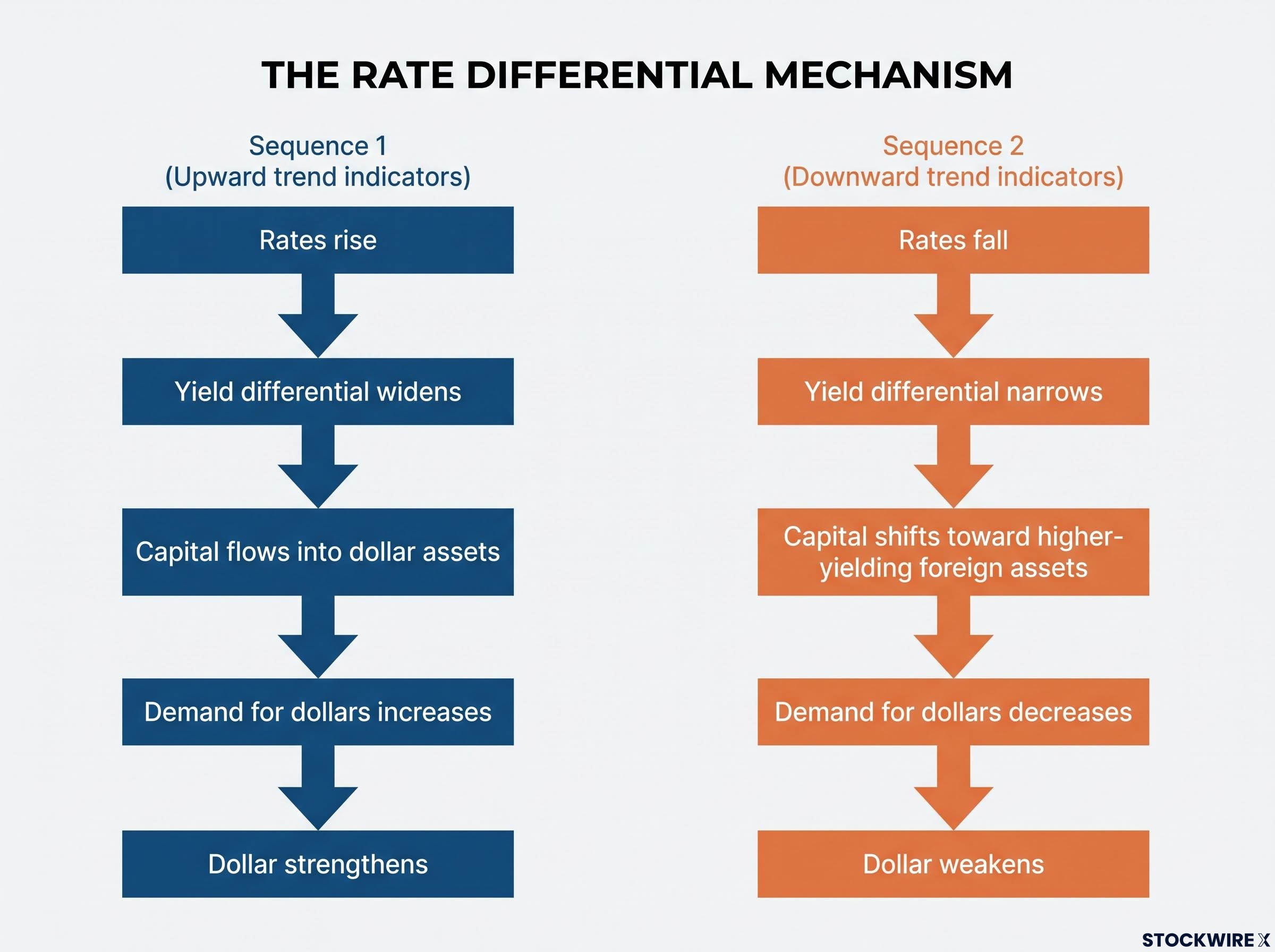
The logic works symmetrically in both directions:
- Rates rise: Yield differential widens → capital flows into dollar assets → demand for dollars increases → dollar strengthens.
- Rates fall: Yield differential narrows → capital shifts toward higher-yielding foreign assets → demand for dollars decreases → dollar weakens.
When the Fed raises rates while the European Central Bank or Bank of Japan holds steady, global investors do not just notice. They move capital at scale, and that capital movement is what you see reflected in headlines about a “surging dollar” or a “weakening greenback.”
This is why Fed meeting coverage is not background noise if you hold international assets, commodities, or fixed income. It is directly actionable context for your portfolio.
What dollar moves mean for your investments
The dollar’s movements reach your portfolio through at least three channels simultaneously, and most globally diversified investors are exposed to all of them whether they have been tracking the connection or not.
- International equities and bonds: When the dollar strengthens, the dollar value of your foreign-currency gains shrinks when translated back. A 10% return on a European stock fund can compress significantly if the euro has weakened against the dollar over the same period. When the dollar weakens, the reverse applies: your foreign returns get a tailwind.
- Commodities: Major commodities, including oil, gold, and agricultural products, are quoted and settled predominantly in dollars on global markets. A stronger dollar makes them more expensive for buyers in other currencies, which tends to suppress demand and put downward pressure on prices. A weaker dollar makes commodities cheaper for non-US buyers, often supporting higher prices.
Emerging markets: the hidden dollar exposure
- Emerging market debt: Many EM governments and corporations borrow in dollars because dollar debt markets offer lower interest rates and deeper liquidity. When the dollar strengthens, the local-currency cost of servicing that debt rises, straining balance sheets, increasing default risk, and pressuring EM exchange rates.
The practical implication is that a reader with even a standard globally diversified portfolio is already exposed to dollar movements through multiple channels at once. Dollar literacy is not an advanced topic reserved for currency traders. It is a baseline competency for anyone investing beyond their home market.
For investors wanting a worked example of how dollar moves translate into portfolio outcomes, our full explainer on currency hedging in international ETFs shows how a 20% AUD appreciation since January 2025 erased double-digit returns for Australian holders of unhedged global funds, with a practical framework for making hedging a deliberate portfolio decision.
This article is for informational purposes only and should not be considered financial advice. Investors should conduct their own research and consult with financial professionals before making investment decisions.
How the Fed’s balance sheet tools shape the dollar
Interest rates have a floor. When the federal funds rate is already near zero and credit markets have seized up, the Fed cannot cut rates further to stimulate the economy. That is where its balance sheet tools come in, and understanding them gives you the ability to read a second, equally important set of policy signals.
Quantitative easing (QE) is a policy tool reserved for severe disruptions, when credit markets have frozen and conventional rate cuts can no longer do the work. Rather than simply adjusting borrowing costs, the Fed purchases large volumes of government bonds and other securities directly, pumping money into the financial system, pushing long-term yields lower, and encouraging lending and investment. The scale of the purchases distinguishes it from ordinary open-market operations. The 2008 Global Financial Crisis was the defining real-world test of QE in practice.
Quantitative tightening (QT) operates in the opposite direction. Once conditions stabilise, the Fed can wind down its holdings by letting bonds reach maturity without replacing them, or by selling assets back into the market, reducing the money supply and withdrawing the stimulus that QE injected.
| Dimension | Quantitative easing (QE) | Quantitative tightening (QT) |
|---|---|---|
| Mechanism | Large-scale bond purchases | Allowing bonds to mature or selling assets |
| Balance sheet effect | Expands | Shrinks |
| Typical dollar impact | Dollar-negative (more supply, lower yields) | Dollar-supportive (less supply, tighter conditions) |
| Primary market signal | Crisis response, easing cycle | Normalisation, tightening cycle |
Important: These are general tendencies, not mechanical certainties. Growth expectations, inflation, and global risk sentiment also influence outcomes. Do not treat QE as an automatic dollar sell signal or QT as an automatic buy signal.
When you see a headline about the Fed “expanding its balance sheet” or “allowing bonds to roll off,” you now have the framework to translate that into likely dollar direction and what it means for your international or commodity holdings.
Real yields, which strip out inflation expectations from nominal Treasury yields, add a second layer of signal to Fed watching: when real yields rise to multi-year highs, as they did under incoming Fed Chair Kevin Warsh in mid-2026, the tightening effect on risk assets goes beyond what the nominal rate alone captures.
These statements are speculative and subject to change based on market developments and company performance.
Will anything replace the dollar?
De-dollarisation is a genuine and frequently discussed concern, not a fringe theory. The euro, China’s renminbi, multi-currency baskets, and digital alternatives have all been proposed as successors or partial replacements. The question deserves a serious answer, and the data provides one.
The latest available figures tell a clear story. The dollar’s share of global FX reserves sits at approximately 57.13% (IMF COFER, Q1 2026). Its share of FX turnover is 89.2% (BIS, April 2025). The euro, the closest rival, holds roughly 20.03% of reserves. No other currency comes close on both measures simultaneously.
The de-dollarisation timeline matters here: a significant portion of the measured decline in the dollar’s reserve share since 2001 is a statistical artefact caused by exchange-rate valuation effects rather than active portfolio decisions by central banks, a distinction that changes how bearish the headline figures actually look.
The most-cited alternatives each face specific obstacles:
- Euro: Deep capital markets but fragmented fiscal governance across the eurozone limits its reserve appeal.
- Renminbi: China’s capital controls and limited currency convertibility prevent the renminbi from functioning as a freely tradable reserve asset at scale.
- Digital or multi-currency baskets: Conceptually interesting but lack the institutional infrastructure, legal frameworks, and transaction volumes needed to compete with the dollar’s existing network.
Broader consensus from BIS and Federal Reserve analysis: No alternative currently matches the combined scale, liquidity, openness, and institutional credibility of US markets. Absent major and persistent shocks that both undermine trust in the dollar and simultaneously boost a rival, the dollar is likely to remain the primary international currency for the foreseeable future.
The gap between 57% in reserves and 89% in FX turnover tells you something precise: even as some central banks have modestly diversified away from dollar reserves, actual transaction usage has barely shifted. The dollar’s operational grip on global finance is more durable than the reserves headline alone suggests.
For your portfolio, genuine de-dollarisation would have profound implications for US borrowing costs, commodity prices, and EM currencies. But the timeline and probability remain low based on current data, making it a risk worth monitoring rather than positioning around aggressively.
Building your dollar literacy into a durable framework
The through-line across everything covered here is straightforward. The dollar’s dominance is structural, built on network effects, institutional depth, and reserve inertia that accumulated over eight decades. Its value is driven by policy signals, specifically interest rates, QE, and QT. And its movements transmit directly through your international equities, commodity-linked holdings, and emerging market allocations.
The question you should now be asking, every time the Fed acts, is: what does this mean for the dollar, and what does that dollar move mean for my specific holdings across those three channels?
Dollar literacy is not a one-time acquisition. The data sources referenced throughout this article are updated regularly, and tracking them is how you monitor whether the structural picture is shifting:
- What is the Fed’s current rate direction and balance sheet posture? This tells you where dollar momentum is likely heading.
- How is the dollar responding relative to major peers? This tells you whether the market agrees with the policy signal or sees something else.
- Are BIS and COFER data showing any shift in the structural picture? The BIS Triennial Survey (next after April 2025) and IMF COFER data (updated quarterly) are the two primary sources for monitoring whether the dollar’s foundational role is genuinely eroding or holding firm.
A reader who tracks those three variables has a simple but genuinely sophisticated framework for understanding one of the most consequential forces in global investing. That is not a specialist skill for currency traders. It is a foundational competency for any investor with exposure beyond their home market.