The person managing your retirement savings is almost certainly not thinking about your retirement. Not because they are negligent or indifferent, but because nothing in their compensation structure, their performance reviews, or their career incentives requires them to.
There is a gap between what most investors assume their fund manager optimises for (your goals) and what the manager is actually measured on, paid for, and professionally rewarded for: benchmark-relative performance, asset retention, and peer-group rankings. The mechanisms are specific: fees linked to assets under management (AUM), bonuses tied to tracking error and excess return, and career survival determined by short-term performance tables. This is a design problem, not a character problem.
Here is the framework for understanding how those incentives work, where they create misalignment with your actual financial objectives, and how to evaluate whether any active fund’s structure is working for you or against you. By the end, you will be able to open a fund’s disclosure documents and diagnose, in minutes, whose goals the manager is really serving.
The pay structure that makes benchmarks more important than you are
Most fund managers earn a management fee calculated as a percentage of AUM. That means fee revenue scales directly with the assets they retain. Growing the pool and keeping it intact is the primary financial lever available to them, before any question of performance enters the picture.
On top of that base fee, most managers receive performance-based bonuses. These are tied to quantifiable, auditable metrics: excess return versus a benchmark index, information ratio (a measure of risk-adjusted outperformance relative to the benchmark), or peer-group ranking. What these bonuses are not tied to is whether your income needs were met, whether your drawdown tolerance was respected, or whether your capital was preserved on the timeline you care about.
These are not incidental design choices. They are rational responses to a real problem: when a manager oversees thousands of client relationships simultaneously, the compensation system needs simple, verifiable rules. Benchmarks provide those rules. Your personal goals do not.
Beyond the formal contract, managers also face implicit incentives from the flow of investor money. Research on mutual fund incentives identifies a convex flow-performance relationship: strong recent performance attracts disproportionately large inflows, while underperformance triggers sharp outflows. That asymmetry means a manager’s income is maximised by not falling behind the benchmark, because falling behind costs assets, and assets are the fee base. Your actual financial objectives are never part of that optimisation function.
Fund metrics for retail investors carry a further hidden problem: performance figures are reported gross of individual tax circumstances, so the headline return was never actually available to any individual investor in the first place, which means the benchmark comparison most investors rely on is built on a number they never received.
A typical fund manager’s incentive structure breaks down into three components:
- AUM-linked base fee: revenue scales directly with assets retained, making asset gathering and retention the dominant financial priority
- Benchmark-relative performance bonus: tied to excess return, information ratio, or peer ranking over 1-year and 3-year windows
- Implicit career and flow incentives: investor capital chases recent outperformers and exits underperformers, creating career risk from short-term benchmark deviation
Performance-based bonuses are tied to verifiable financial outcomes, specifically benchmark-relative return metrics, not to whether any individual client’s goals were met.
When big ASX news breaks, our subscribers know first
What a benchmark actually is (and what it cannot tell you)
From the outside, a benchmark looks like a neutral yardstick: a number you compare your fund’s return against to see whether it did well or badly. That framing is incomplete, and the incompleteness matters.
A benchmark is a basket of securities, weighted according to rules such as market capitalisation or style definitions, that represents a segment of the market. It serves three formal functions: it provides a common reference for comparing manager performance, it controls for the general market conditions that affect all portfolios equally, and it sets risk limits, including maximum allowable tracking error.
What a benchmark does not encode is anything about you. It does not reflect your need for stable retirement income, your tolerance for drawdowns, your tax situation, or your spending horizon. Goals-based investment managers explicitly contrast this with traditional benchmark-driven management: where traditional managers focus on market-relative returns, goals-based managers design portfolios around client-specific objectives such as income, capital preservation, and time-linked spending needs.
Benchmark selection is more consequential than most investors realise because the index embedded in a fund’s Product Disclosure Statement is the mechanism that converts returns into performance fee revenue, meaning a misaligned benchmark can reward risk-bearing rather than genuine manager skill.
| What benchmarks measure | What benchmarks do not measure |
|---|---|
| Relative performance versus a market segment | Whether your income needs are being met |
| Risk-adjusted return within a defined universe | Whether your drawdown tolerance is respected |
| Tracking error (deviation from index) | Your tax situation or spending timeline |
| Manager skill relative to passive exposure | Any personal financial objective whatsoever |
Tracking error as a professional risk constraint
Tracking error is the standard deviation of a portfolio’s returns relative to its benchmark. In simpler terms, it measures how much the fund’s performance wanders from the index it is compared against. A low tracking error means the fund is moving closely in step with the benchmark. A high one means the manager is making meaningfully different bets.
Institutional mandates typically specify a maximum allowable tracking error, capping how far the manager can deviate from the index. Public pension plans explicitly link bonus eligibility to beating a policy benchmark over 1-year and 3-year periods, and exceeding those tracking error limits can trigger client dissatisfaction, redemptions, and bonus penalties, even when the deviation was in your interest.
That makes the benchmark function less like a yardstick and more like a leash. A manager who deviates too far from the index in pursuit of your stated objectives is taking on measurable career risk with every percentage point of divergence.
Index hugging and mandate drift: rational behaviour in an irrational system
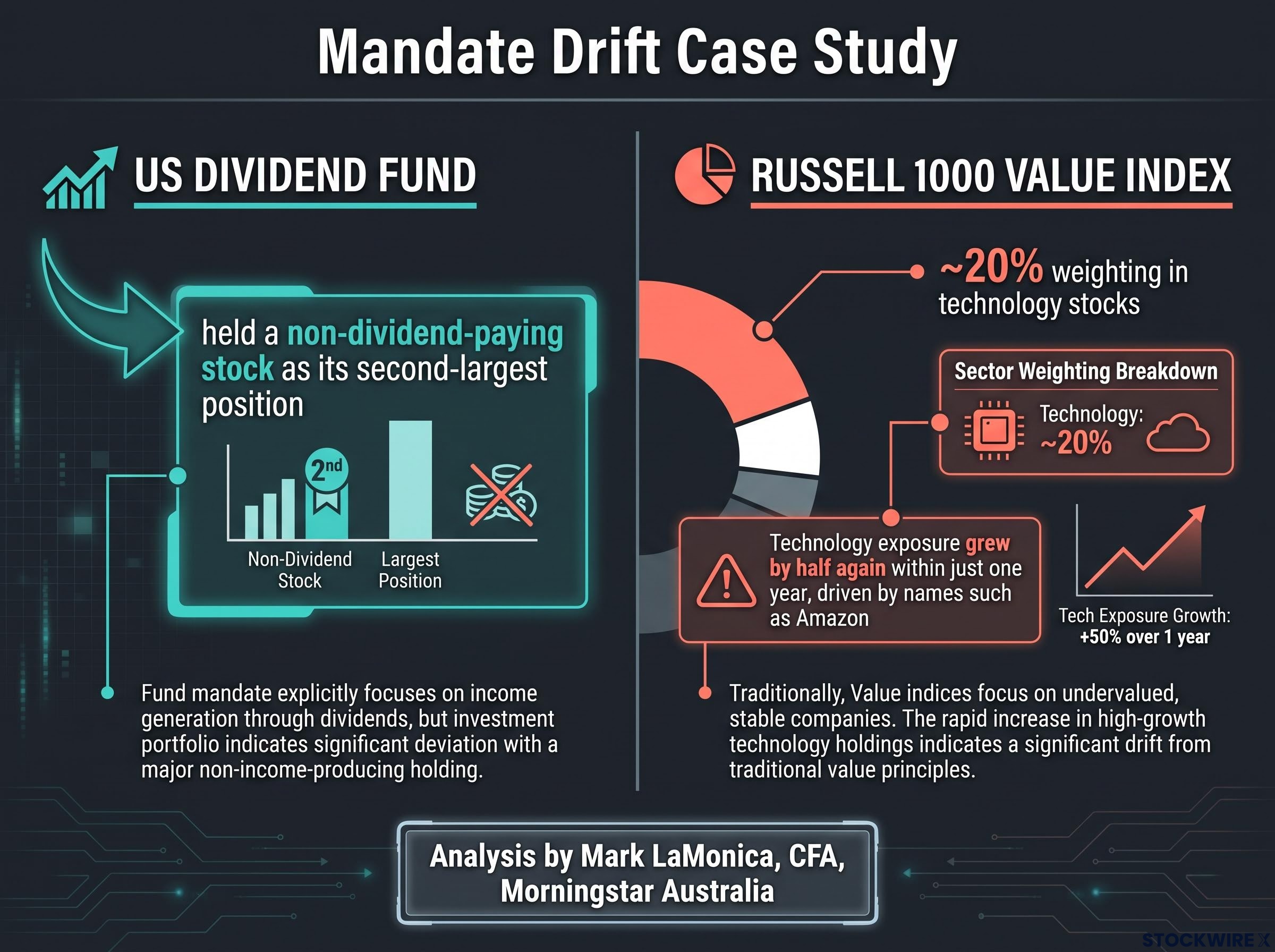
Consider this real-world case. A US-based dividend fund held a non-dividend-paying stock as its second-largest position. The portfolio manager’s rationale had nothing to do with generating income for shareholders. The stock was in the benchmark, and performance against that benchmark was what determined the fund’s ranking, the manager’s bonus, and whether investor capital stayed or left.
According to analysis by Mark LaMonica, CFA, Director of Personal Finance at Morningstar Australia, a US dividend fund portfolio manager justified holding a non-dividend-paying stock as the fund’s second-largest position on the basis of benchmark alignment, not income generation.
The absurdity sharpens when you look at the benchmark itself. The Russell 1000 Value Index, a common benchmark for value and dividend-oriented strategies, held a roughly 20% weighting in technology stocks at the time of this analysis. That technology exposure had grown by half again within just one year, driven by the addition of names such as Amazon to the index. A fund measured against this benchmark faced structural pressure to hold technology names, regardless of whether its mandate said “value” or “dividend income.”
This is not a failure of individual judgement. It is the system working exactly as designed. When an index reconstitutes (periodically adding and removing securities based on size, liquidity, or style metrics), funds tied to it through tracking error constraints or career pressure are effectively forced to follow. The manager is not responding to your goals; they are responding to the moving target defined by the index and the career risk attached to deviating from it.
Structural limits on active funds compound the benchmark incentive problem: regulatory position caps under the Investment Company Act of 1940 prevent most funds from matching benchmark weights when single index constituents exceed 6-7% of index weight, making underperformance a mathematical near-certainty in concentrated markets regardless of manager decisions.
The outputs are predictable:
- Index hugging: holding most of the benchmark’s major constituents and avoiding large sector or style tilts, even when conviction points elsewhere
- Style drift: a “value” fund gradually owning more growth or momentum names as the index definition evolves
- Mandate drift: a dividend fund holding non-dividend stocks because they have become large benchmark constituents, directly conflicting with the fund’s original purpose
If you own a “value” or “dividend income” fund, the index it is benchmarked against may have already drifted far from the strategy you thought you were buying, and you would have received no notification of this change.
How investor behaviour co-creates the problem
Here is the counterintuitive turn. You are not a passive victim of this incentive structure. Investors, collectively, are active co-producers of it.
The mechanism is straightforward. Money rushes toward recent top performers and exits recent underperformers. Academic research on fund flows identifies the convex flow-performance relationship as a primary driver of the short-termism and benchmark fixation that characterises the professional fund management industry. When capital consistently follows recent performance tables, managers who slip behind their peers or their index, even briefly, face redemptions and falling fee income.
Sirri and Tufano’s research on fund flows established the empirical foundation for this asymmetry, showing that investors allocate capital to recent top performers far more aggressively than they withdraw it from underperformers, creating the structural pressure on managers to avoid short-term benchmark deviation at almost any cost.
That creates an asymmetry with real consequences. Fund managers pursuing long-term, high-conviction approaches, whether genuine value investing, concentrated portfolios, or income-first mandates, must weather stretches of benchmark-relative weakness while institutional support remains limited. Their index-hugging peers, meanwhile, face far less business risk by staying close to the peer-group median, even when their absolute returns are ordinary.
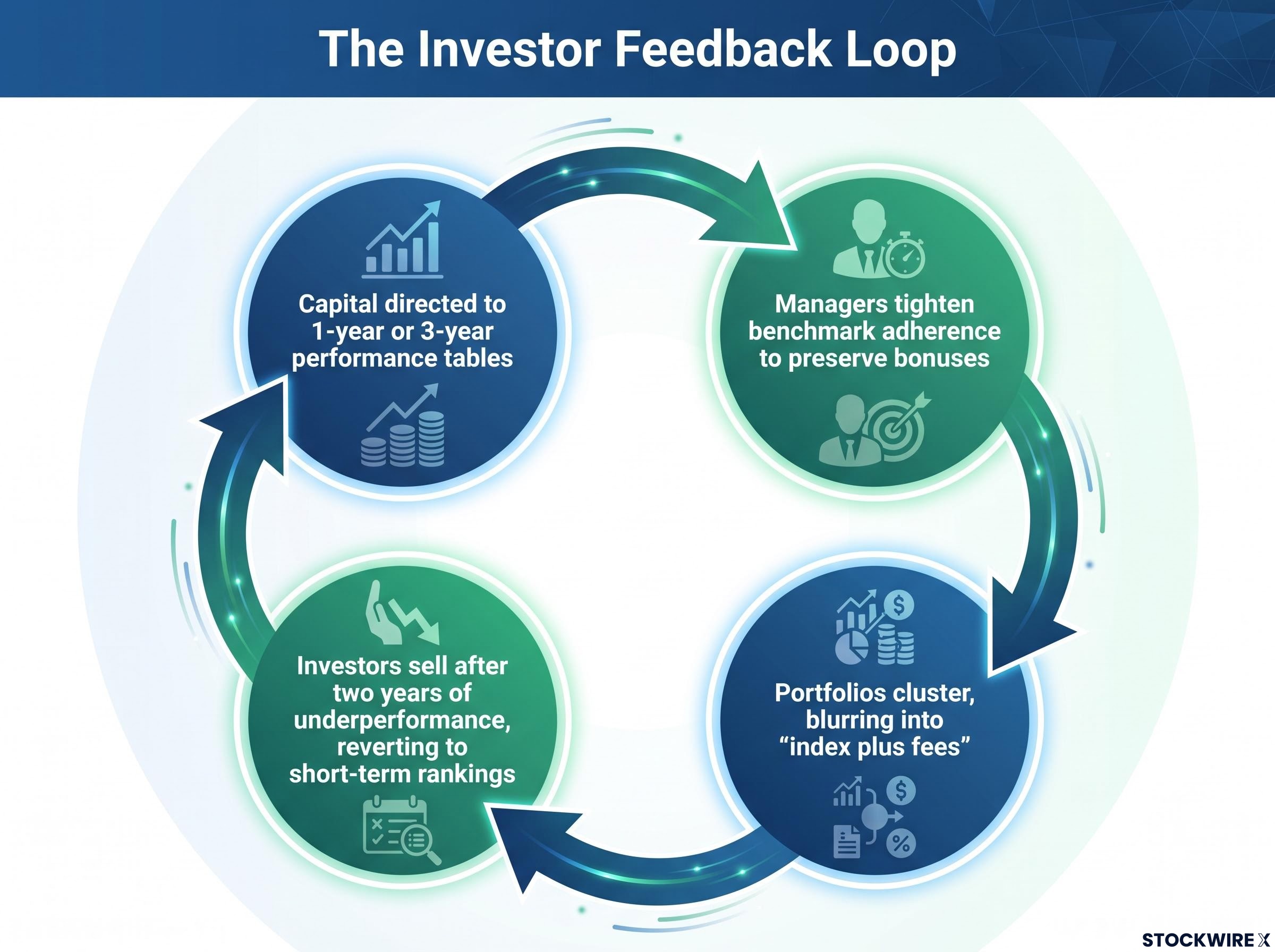
The feedback loop in four steps
The reinforcement cycle is specific and sequential:
- You direct capital toward funds with strong recent benchmark-relative records. Whatever topped the 1-year or 3-year performance table receives the new money.
- Managers tighten their benchmark adherence to protect against outflows and preserve bonus eligibility. Straying from the index becomes a career liability.
- Portfolios cluster around their benchmarks. Genuine active positions diminish. Active management blurs into “index plus fees.”
- You notice the fund looks much like the index, begin questioning active fees, yet revert to the same short-term relative performance rankings when selecting a replacement. The cycle begins again.
Every time you sell a fund after two years of underperformance and move to last year’s top performer, you personally tighten the incentive structure that prevents managers from taking the long-term, conviction-based positions that might actually serve your goals. The industry’s reliance on simple, easily verifiable rules (benchmarks, short-term performance, AUM-based fees) is partly a response to how you choose and evaluate funds.
What to actually look for when evaluating an active fund
This is not a buyer’s guide. It is an evaluative toolkit: four questions that a sophisticated analyst would already be asking, applied to any fund you own or are considering.
- What index is this fund measured against, and does that index actually match the fund’s stated mandate? The Russell 1000 Value Index example is instructive. A “value” benchmark carrying 20% technology weighting that doubled in a single year tells you the benchmark and the mandate have diverged. If the benchmark does not reflect the strategy you thought you were buying, the manager’s performance against it tells you very little about whether the fund is doing what you need.
- How much freedom does the manager have to deviate from the benchmark? Managers with fewer tracking error constraints and greater benchmark independence are empirically associated with better performance outcomes when genuine active management is incentivised. But that flexibility means accepting periods where the fund trails its benchmark. Your question is not just “Can I tolerate tracking error?” but “Do I care more about my long-term goals or about short-term relative rankings?”
- What is the capital and compensation structure? Open-ended retail funds with daily liquidity and bonus plans tied to 1-3 year benchmark performance are under maximum short-term pressure. Structures that explicitly try to redirect manager focus, such as incentive schemes designed around long-term fund performance or outcome-aligned metrics, exist and are growing. Look for them.
- Is the manager goals-based or benchmark-based? This is the most important diagnostic question.
| Dimension | Goals-based management | Benchmark-based management |
|---|---|---|
| How success is defined | Meeting client objectives (income, capital preservation, target wealth at a date) | Beating a benchmark index within risk constraints |
| What the portfolio is built around | Client-specific spending needs and risk tolerance | Benchmark sector and security weights |
| What the manager is paid for | Outcome delivery relative to stated client goals | Excess return and information ratio versus benchmark |
| What you receive | A portfolio designed around your situation | Market-rate returns with professional oversight |
You should be able to open any fund’s Product Disclosure Statement or Key Investor Information Document and identify, within two minutes, which of these two models the manager is actually operating under. If you cannot, the fund’s disclosure is not doing its job.
Choosing the right model for your actual situation
Now that you understand the structural logic, the question is not whether active management is good or bad. That framing misses the point entirely. The question is whether the specific structure you are paying for is aligned with the goals you actually hold.
Benchmark-driven management is not inherently problematic. For some investors, it is precisely the right tool:
- Fit for purpose: if your goal is market-rate returns with professional oversight and you do not have idiosyncratic income, drawdown, or timeline requirements, benchmark-driven management does exactly what it is designed to do.
- Structurally misaligned: if you have specific income needs, capital preservation targets, or time-linked spending objectives, a manager whose bonuses, career survival, and portfolio construction are all oriented around a benchmark index is optimising for a goal that is not yours.
Structures that explicitly try to align manager focus with client outcomes (incentive schemes tied to long-term fund performance, outcome-aligned metrics, and goals-based portfolio construction) exist and are growing. But they require you to ask better questions to find them.
For investors ready to apply a structured process to any fund currently in their portfolio, our dedicated guide to managed fund due diligence covers PDS review, manager verification, and red flag screening with worked steps and a replicable framework applicable to any asset class.
The pace at which the industry’s incentive architecture changes depends entirely on how quickly investors change the way they evaluate funds. Each time you select a fund on the basis of its 3-year benchmark ranking rather than asking whether its structure matches your objectives, you strengthen the conditions that make benchmark hugging the rational choice for managers.
This article is for informational purposes only and should not be considered financial advice. Investors should conduct their own research and consult with financial professionals before making investment decisions.