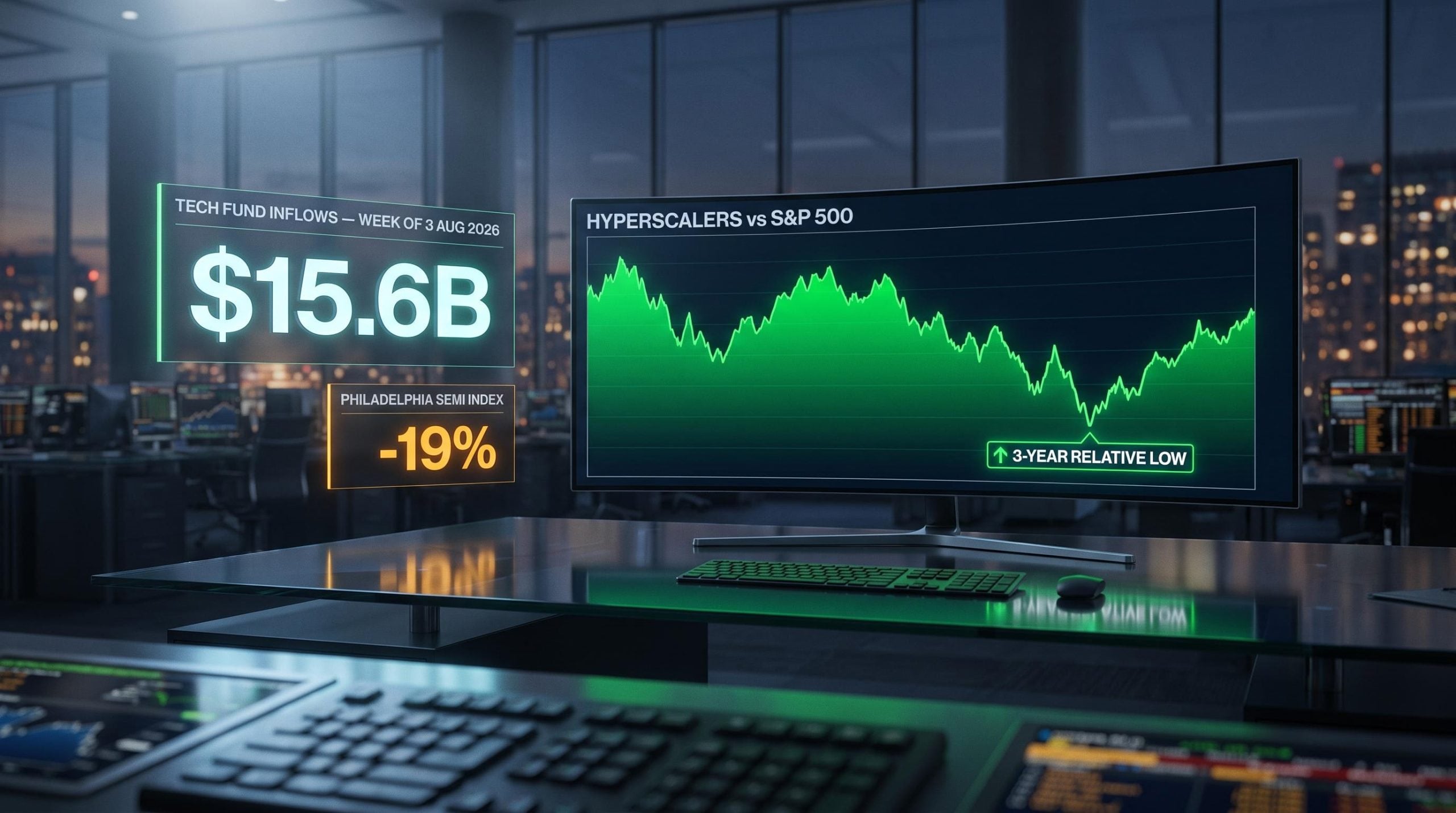
Hyperscaler stocks have retreated to a three-year relative performance low against the S&P 500. That is not a throwaway statistic. It is the kind of signal that institutional strategy desks build trade recommendations around, and on 3 August 2026, one of them did exactly that.
Deutsche Bank’s strategy team, led by Parag Thatte, released a note contending that the technology rotation trade has only just begun its next leg. The timing matters: Deutsche Bank published the note during a week that saw $15.6 billion pour into technology-focused funds, coinciding with the tail end of one of the most severe sector-specific selloffs megacap tech had experienced in years. A three-year relative trough meeting a surge of fresh capital is a juxtaposition that demands closer examination, not a headline to scroll past.
Here is what Deutsche Bank’s framework actually says, where the risk sits, and what to watch before acting on this trade. This is a decision-support read for investors weighing re-entry, not a recommendation to chase.
Why hyperscalers look cheap right now, at least on one important measure
Hyperscalers’ performance relative to the S&P 500 has fallen to its lowest level in three years. That is the foundation of Deutsche Bank’s call, and it is worth sitting with the number before moving on.
A three-year relative trough is not the kind of underperformance that shows up every quarter. For businesses with the structural growth profile of the largest U.S. cloud and AI infrastructure providers, it signals that the gap between price action and underlying fundamentals has widened to an unusual degree. Parag Thatte’s team does not argue that something has fundamentally improved inside these companies. The thesis is simpler: the discount has become wide enough that mean reversion alone justifies re-examination.
Deutsche Bank characterises the current level as a valuation reset, not a structural breakdown.
That distinction matters in practical terms. A structural breakdown would imply deteriorating demand, competitive displacement, or a permanent repricing of growth expectations. A valuation reset implies the market has over-corrected on sentiment, and that a reversion toward fair relative value carries asymmetric upside from here. Historically, mean-reversion trades from relative troughs of this depth have offered more favourable risk-reward setups than entries at fair value or above.
The empirical literature on mean reversion in stock prices establishes that equity valuations tend to revert toward historical averages over multi-year horizons, which is the foundational logic underpinning any trade built around a three-year relative performance trough.
When big ASX news breaks, our subscribers know first
The selloff that set up the signal
The three-year trough did not materialise gradually. It crystallised through a steep, sector-concentrated decline affecting megacap technology and semiconductor stocks that played out from early June 2026 through to late July 2026.
The sector rotation that accelerated through June 2026 provides the immediate backdrop for the three-year trough: the Nasdaq fell roughly 1% on 10 June while the Dow rose 0.2%, a single-session divergence that illustrates the concentrated institutional exit from AI and megacap technology that preceded the Deutsche Bank mean-reversion call.
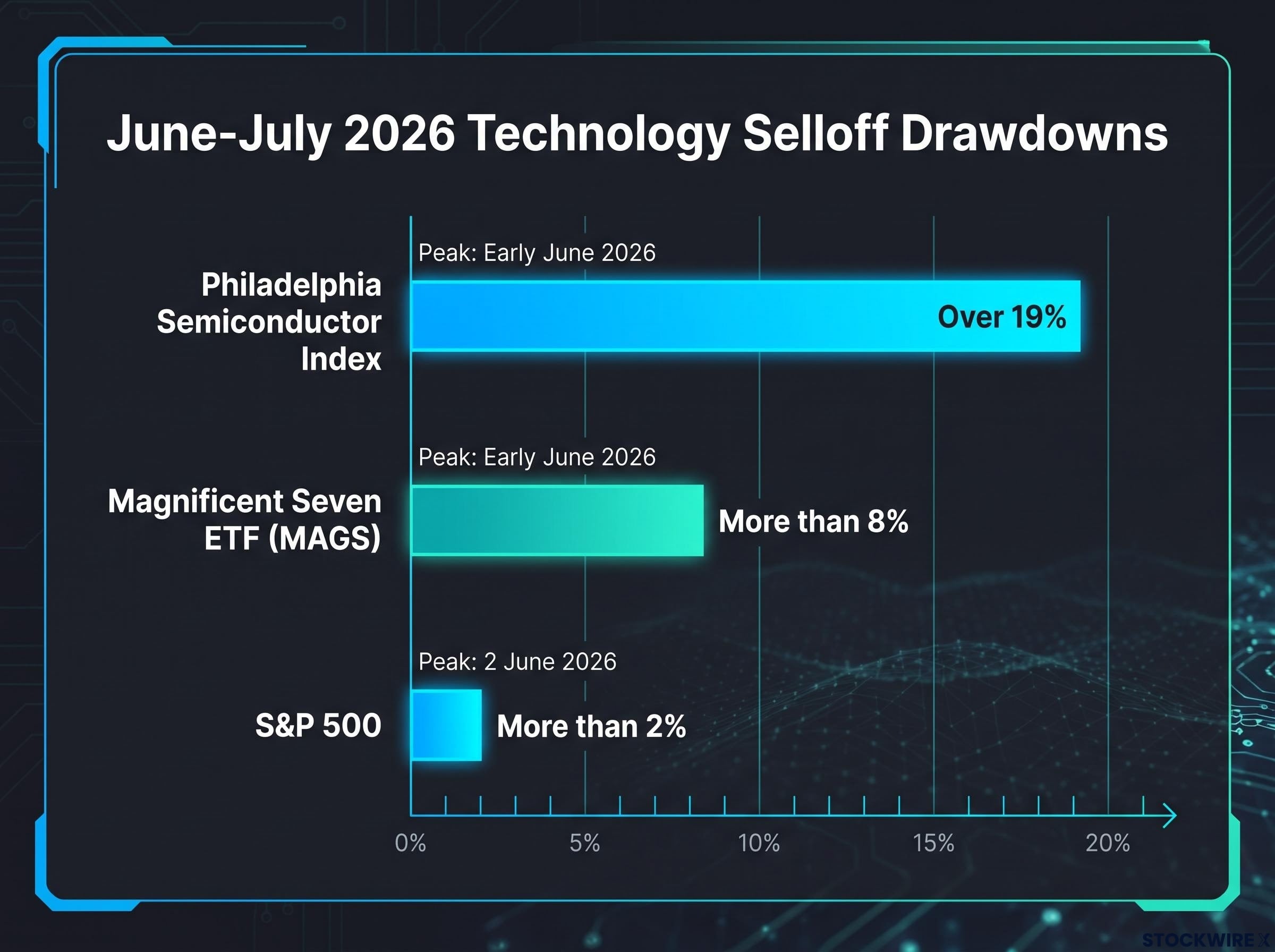
| Asset / Index | Peak Period | Drawdown |
|---|---|---|
| Magnificent Seven ETF (MAGS) | Early June 2026 | More than 8% |
| Philadelphia Semiconductor Index | Early June 2026 | Over 19% |
| S&P 500 | 2 June 2026 | More than 2% |
The gap between those figures is the important part. A 19% semiconductor drawdown alongside a 2% broader index decline is the fingerprint of a sector-specific repricing, not a market-wide risk event. Speaking to Reuters in late July 2026, Mark Hackett, Chief Market Strategist at Nationwide, noted that the broader market had held its ground throughout the concentrated technology pullback, a combination he viewed as a healthy development rather than a warning sign (Reuters, 29 July 2026).
That framing connects directly to the Deutsche Bank thesis. A broad risk-off event would weaken the case for re-entry; a concentrated rotation is exactly the type of setup that creates the relative performance troughs mean-reversion traders look for. The selloff did not damage the structural case. It created the entry point.
What $15.6 billion in a single week tells investors about the rotation
In the week prior to 3 August 2026, technology-focused funds attracted $15.6 billion in capital inflows (Deutsche Bank, 3 August 2026).
That figure is significant enough to notice. Capital of that magnitude flowing into a sector that just experienced its worst concentrated drawdown of the year suggests that institutional and retail investors are treating the selloff as an opportunity rather than a warning.
Deutsche Bank interprets the inflow as evidence that a sustained rotation back into technology is beginning, not that it has concluded. This is a deliberate framing choice. The bank is not claiming the trade is confirmed; it is arguing the opening move has been made.
The necessary qualifier: one week of inflows, no matter how large, is a data point, not a trend. Fund flows of this magnitude at a relative trough tend to mark the early phase of a multi-week or multi-month realignment, but “tend to” is not “always do.” What would confirm the signal is a continuation of inflows across subsequent weeks. What would challenge it is a sharp reversal to outflows. That makes fund flow persistence one of the most important variables to track from here, something you can monitor in real time through weekly reporting.
Fund flow data from earlier in 2026 adds context to the $15.6 billion technology inflow figure: a prior surge in tech fund flows in May 2026 pushed Bank of America’s Bull and Bear Indicator to 8.0 and activated a contrarian sell signal, a precedent that underscores why single-week inflow magnitude alone is insufficient to confirm a sustained rotation.
Understanding hyperscalers’ structural position in the AI and cloud cycle
Not all technology stocks carry the same risk-reward profile during a rotation. To evaluate the Deutsche Bank call properly, you need to understand why hyperscalers occupy a distinct position within the broader sector.
Hyperscalers are the largest U.S. cloud and AI infrastructure providers. They are the companies that own and operate the physical data-centre capacity, cloud computing platforms, and AI compute workloads that the rest of the technology ecosystem runs on. They are infrastructure owners, not just software sellers.
The AI investment boom has pushed US IT spending to 4.9% of GDP in Q1 2026, surpassing both the dot-com peak and the cloud buildout peak, a scale of capital commitment that gives the hyperscaler infrastructure thesis a macroeconomic foundation beyond any single institutional call.
Three structural characteristics set them apart:
- Recurring enterprise revenue: Their business models are built on long-term contracts with enterprise customers, providing revenue visibility that persists through market corrections.
- AI infrastructure ownership: They own the compute layer of the AI cycle, meaning their exposure is to infrastructure demand rather than application-level sentiment.
- Data-centre demand exposure: They are the primary beneficiaries of rising demand for digital infrastructure, the same demand that drives data-centre construction and power consumption growth.
Deutsche Bank’s broader research reinforces this. The bank’s analysts are constructive on data-centre REITs including Digital Realty and Equinix, citing “meaningfully higher demand for digital infrastructure over time.” That is corroborating evidence from within the same institution: the structural demand thesis that underpins the hyperscaler call is also driving their view on the physical infrastructure layer.
Understanding this distinction matters because it tells you why Deutsche Bank treats a relative trough in hyperscalers differently from one in, say, high-multiple growth software. The infrastructure layer has a fundamentally different revenue and demand profile.
Where Deutsche Bank’s own research introduces caution
The bullish case built across the preceding sections is real. So are the complications.
Deutsche Bank’s own analysis reportedly shows that hyperscalers’ combined capital expenditure is outstripping operating cash flow, with free cash flow potentially turning negative by late 2026 (this figure has not been independently confirmed and should be treated as indicative rather than verified). If accurate, it means the companies at the centre of the AI infrastructure buildout may be spending faster than they are generating cash, a dynamic that can persist for a time but eventually demands monetisation or correction.
Separately, Deutsche Bank has reportedly been exploring hedges for its own growing data-centre exposure tied to hyperscalers, including potential short baskets of AI-related stocks and synthetic risk-transfer structures (this has also not been independently confirmed).
Deutsche Bank’s posture is simultaneously constructive on re-entry and actively managing its own downside exposure to the same theme.
That duality is not a contradiction. It is the hallmark of a sophisticated two-sided thesis. The bank is not saying “buy hyperscalers and walk away.” It is saying the risk-reward at this relative trough favours re-entry, while acknowledging that the capital intensity of the AI buildout creates a genuine tail risk that warrants hedging. For you as an investor, this means treating the call as an asymmetric opportunity with explicit conditions, not a directional green light.
This article is for informational purposes only and should not be considered financial advice. Investors should conduct their own research and consult with financial professionals before making investment decisions.
Four variables to watch before committing to the rotation trade
The Deutsche Bank framework gives you something more useful than a one-time call. It gives you a set of variables you can track week by week:
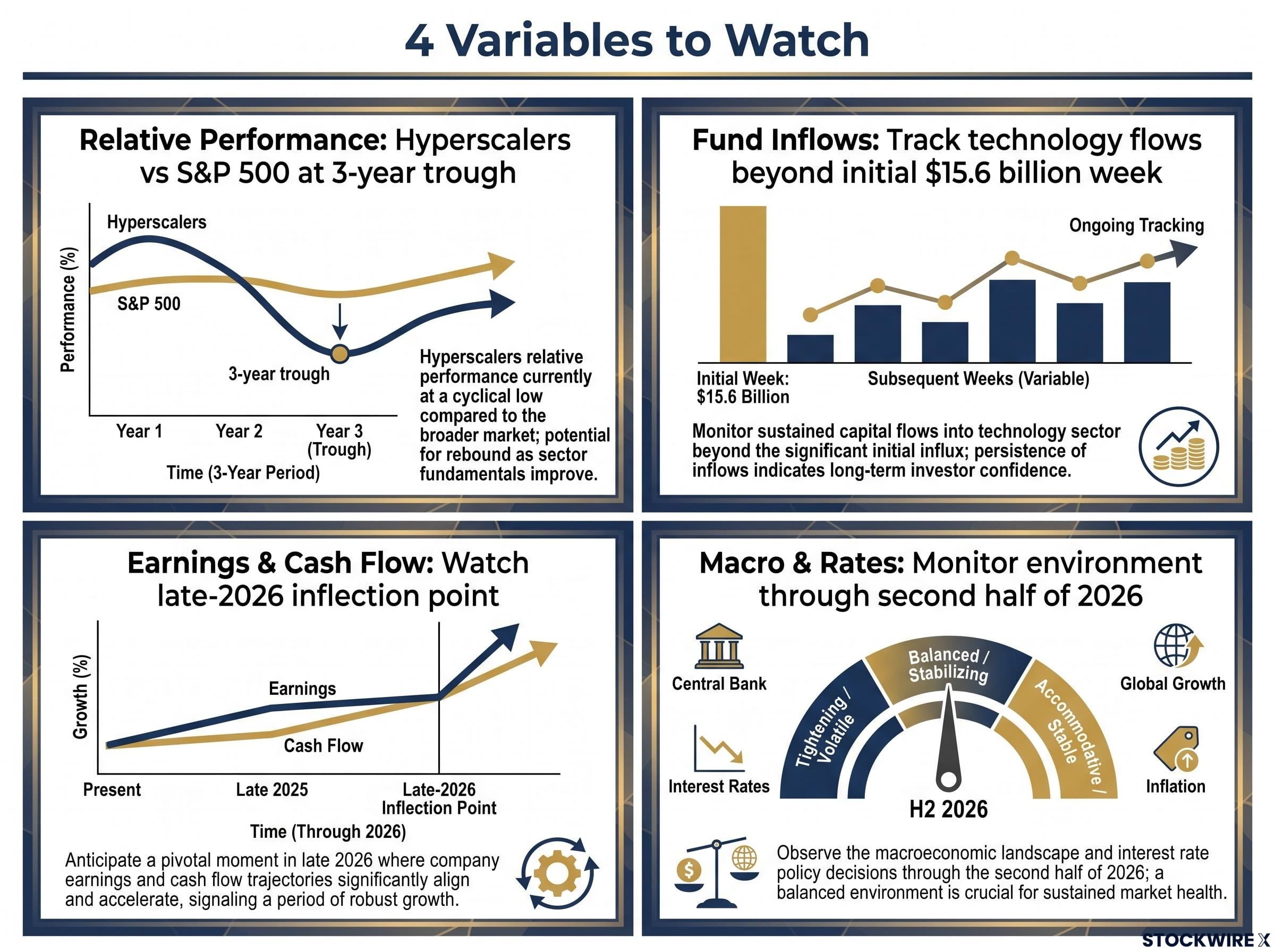
- Relative performance of hyperscalers versus the S&P 500. Sustained outperformance from the current three-year trough confirms the mean-reversion thesis. Continued underperformance challenges it and suggests the repricing may be structural rather than cyclical.
- Persistence of technology fund inflows beyond the initial $15.6 billion week. Multi-week continuation of flows into tech and AI-linked strategies confirms that real capital is backing the rotation. A reversal to outflows challenges the thesis and suggests the initial week was a one-off rather than the start of a trend.
- Hyperscaler earnings and free cash flow trends. The late-2026 inflection point flagged by Deutsche Bank research is the near-term marker. Evidence that AI capex is translating into monetisable cloud and AI services revenue confirms the growth story. Evidence of capital destruction, where spending persistently outpaces revenue generation, challenges it.
- Macro environment and rate expectations. Stability in the broader rate and risk environment supports rotation into large-cap growth. A macro shock, even one unrelated to hyperscaler fundamentals, can interrupt sector positioning and should be monitored through the second half of 2026.
These four variables convert the Deutsche Bank call from something you accept or reject into something you actively monitor as conditions evolve.
What the Deutsche Bank call actually means for investors positioning now
Three pillars support the case: a three-year relative performance trough that is historically significant, $15.6 billion in single-week technology fund inflows suggesting real capital is beginning to move, and a structural demand backdrop anchored in AI infrastructure and cloud computing that differentiates hyperscalers from the broader tech complex.
Two counterweights complicate it: credible (though unverified) concerns about capital expenditure outstripping cash flow by late 2026, and Deutsche Bank’s own reported hedging activity against the very theme it is recommending.
Market leadership rotation carries a longer-cycle dimension that complicates the mean-reversion framing: valuation spreads between US Tech and international developed markets are near multi-decade extremes, and historical concentration episodes such as the Nifty Fifty and TMT bubble each saw dominant cohorts underperform for a full decade after peak concentration, a base rate worth holding alongside Deutsche Bank’s near-term thesis.
What Parag Thatte’s team published on 3 August 2026 is a specific, testable thesis. It says the conditions for mean reversion in hyperscaler relative performance are in place and that early capital flows support the trade. It does not say the trade is risk-free, and the bank’s own internal posture confirms that distinction.
The quality of the entry depends entirely on what happens next with the four signpost variables. Relative performance, flow persistence, cash flow trends, and the macro backdrop will collectively confirm or challenge the thesis over coming weeks. That is where your attention belongs now: not on whether to act today, but on what the evidence tells you next week, and the week after that.
Past performance does not guarantee future results. Financial projections are subject to market conditions and various risk factors.