Warren Buffett has rarely expressed regret about the bad investments he made. His bigger regrets are about the great businesses he understood, admired, and never bought. Amazon is one of them. Google is another. Walmart is a third. The common thread: he did the analysis, grasped the economics, and still did not act.
Most investors spend their energy worrying about one type of mistake: buying something that goes wrong. But two of the most damaging investing mistakes sit at opposite extremes. One is doing nothing when you should act. The other is acting constantly when you should do nothing. Both destroy compounding. Both stem from the same underlying failure.
This piece works through both failure modes, names the mechanism behind each, and gives you a practical framework for diagnosing which one you are actually guilty of. After reading it, the distinction between patience and paralysis, and between activity and productivity, will be a usable tool rather than a vague aspiration.
The mistakes you never see on your portfolio statement
There is a category of investing error that never appears in your records. No failed trade shows up. No loss is booked. No red line materialises on a chart. That invisibility is precisely what makes it dangerous.
Buffett calls these errors of omission, as distinct from errors of commission. An error of commission is a bad investment you made. An error of omission is a great investment you understood and still did not make. He has stated publicly that these missed opportunities represent his costliest errors across his career, describing the hesitation behind them as a form of inaction he deeply regrets.
Buffett on his biggest mistakes: He has likened his hesitation on great businesses to “sucking my thumb,” noting that errors of omission are “by far” the most costly mistakes in his career (Berkshire Hathaway shareholder meeting comments).
The pattern is not a single lapse. It is a recurring behaviour across decades of otherwise extraordinary judgement:
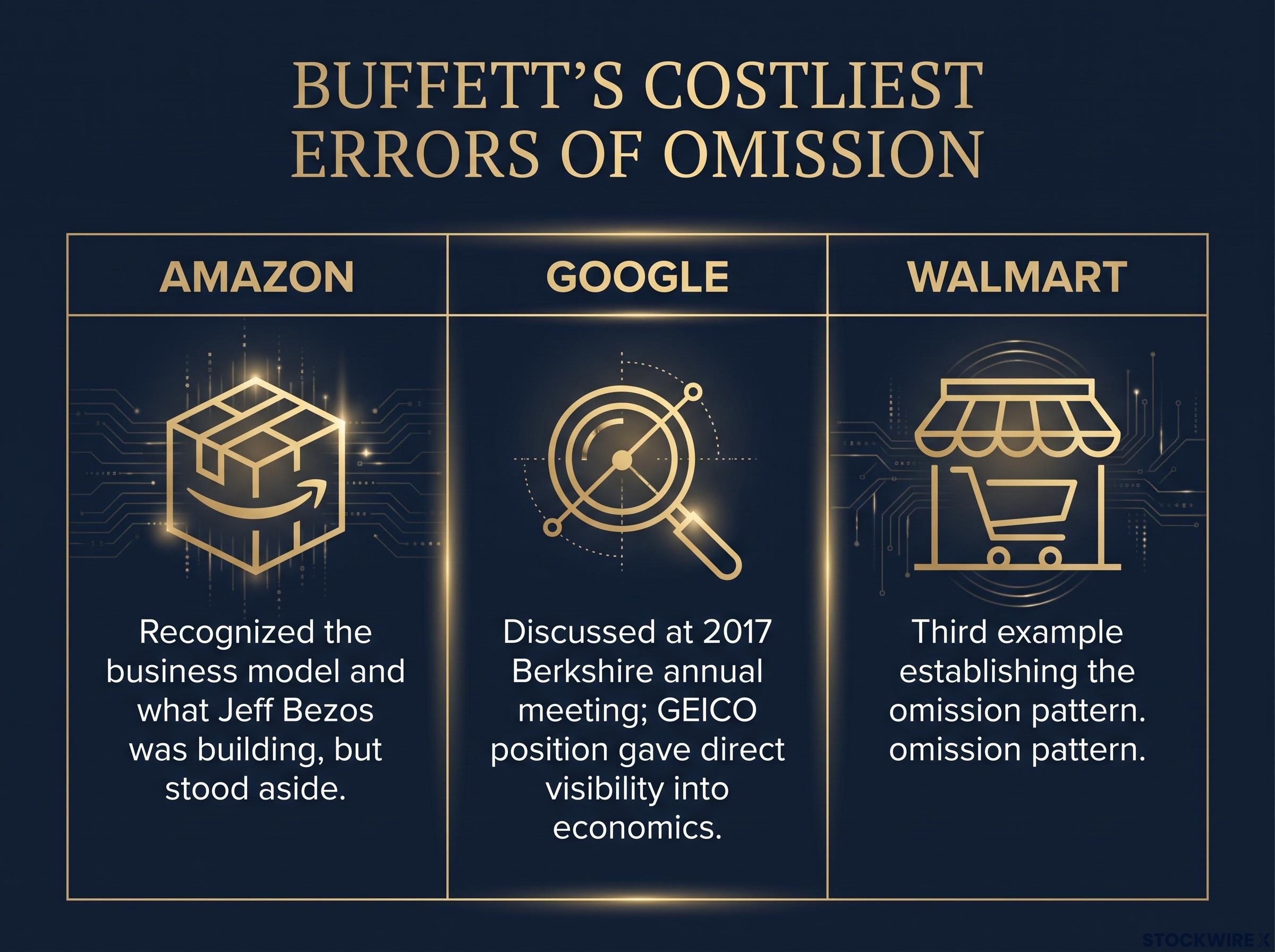
- Amazon: Buffett recognised the power of the business model, grasped what Jeff Bezos was building, and still stood aside as one of the century’s greatest wealth-creation stories unfolded without him. This was not a research failure; it was a conviction failure.
- Google: Discussed at the 2017 Berkshire annual meeting, where Buffett noted that Berkshire’s position as a GEICO advertiser gave him direct visibility into Google’s economics. He understood the business and still did not act.
- Walmart: Cited alongside the others as a third example, establishing that the omission pattern was not isolated but structural.
The mechanism is straightforward. When you understand a business, believe the price is attractive, and still do not invest, compounding begins accruing to someone else while you wait. If you have ever told yourself that you will revisit a business you already researched once the situation becomes clearer or the valuation looks more comfortable, you have experienced this failure mode firsthand. The cost was real even though it never showed up as a loss.
When big ASX news breaks, our subscribers know first
Why high-quality businesses rarely offer a second invitation
The reason omission errors are so costly is not just that you missed a good entry. It is that the window for high-quality businesses tends to close permanently. The longer a quality business compounds without you, the higher the effective entry hurdle becomes, because the market prices in the progress you were waiting to confirm.
This is the structural problem with waiting for certainty. By the time additional confirmation arrives, the share price already reflects it. Certainty and opportunity cost move in opposite directions: as one rises, the other rises with it. For high-quality businesses, the “perfect entry point” is often an illusion that never materialises.
Buffett’s pattern of missed opportunities sits alongside a broader principle: genuine buying opportunities are so rare that the patient capital strategy that built Berkshire treats years of deliberate inaction as the default state, with aggressive deployment reserved for the few moments when price and conviction align simultaneously.
Patience with a trigger vs. indefinite deferral
There is a distinction here that matters enormously for your decision-making: patient waiting and indefinite deferral are not the same behaviour, even though they feel identical from the inside.
Patience is a genuine virtue in investing, but it is not the same thing as paralysis. The two can look identical from the outside, yet one produces action at the right moment and the other produces nothing.
Patient waiting is a decision. It has a defined trigger: a specific price level, a specific event, or a specific condition that, when met, produces action. Indefinite deferral is the absence of a decision. It accumulates justifications for continued inaction without ever specifying what would cause action.
Here is a one-sentence test you can apply before your next delayed decision: if you cannot state in one sentence what specific condition you are waiting for, you are deferring, not being patient.
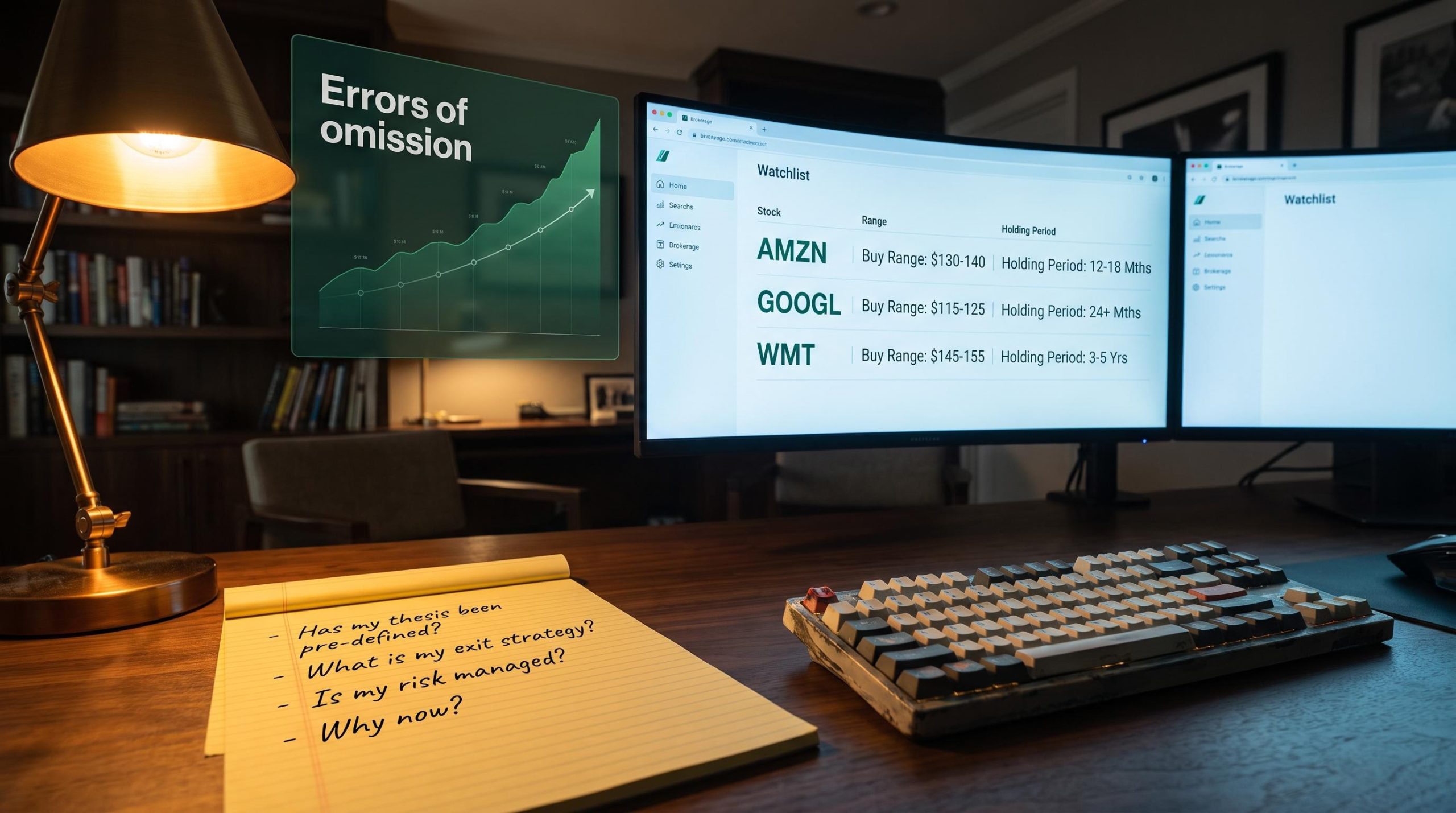
To make this operational, your watchlist needs to function as ready-to-execute infrastructure rather than a passive observation list. Each entry should answer four questions before a stock qualifies for inclusion:
- What is my thesis? A pre-defined view of why this business is worth owning.
- What is my buy range? A specific price band where the thesis offers attractive value.
- What is my “no buy above X” level? The price above which the risk-reward no longer justifies action.
- What is my expected holding period? Whether this is a multi-year compounder or a shorter-duration position, defined in advance.
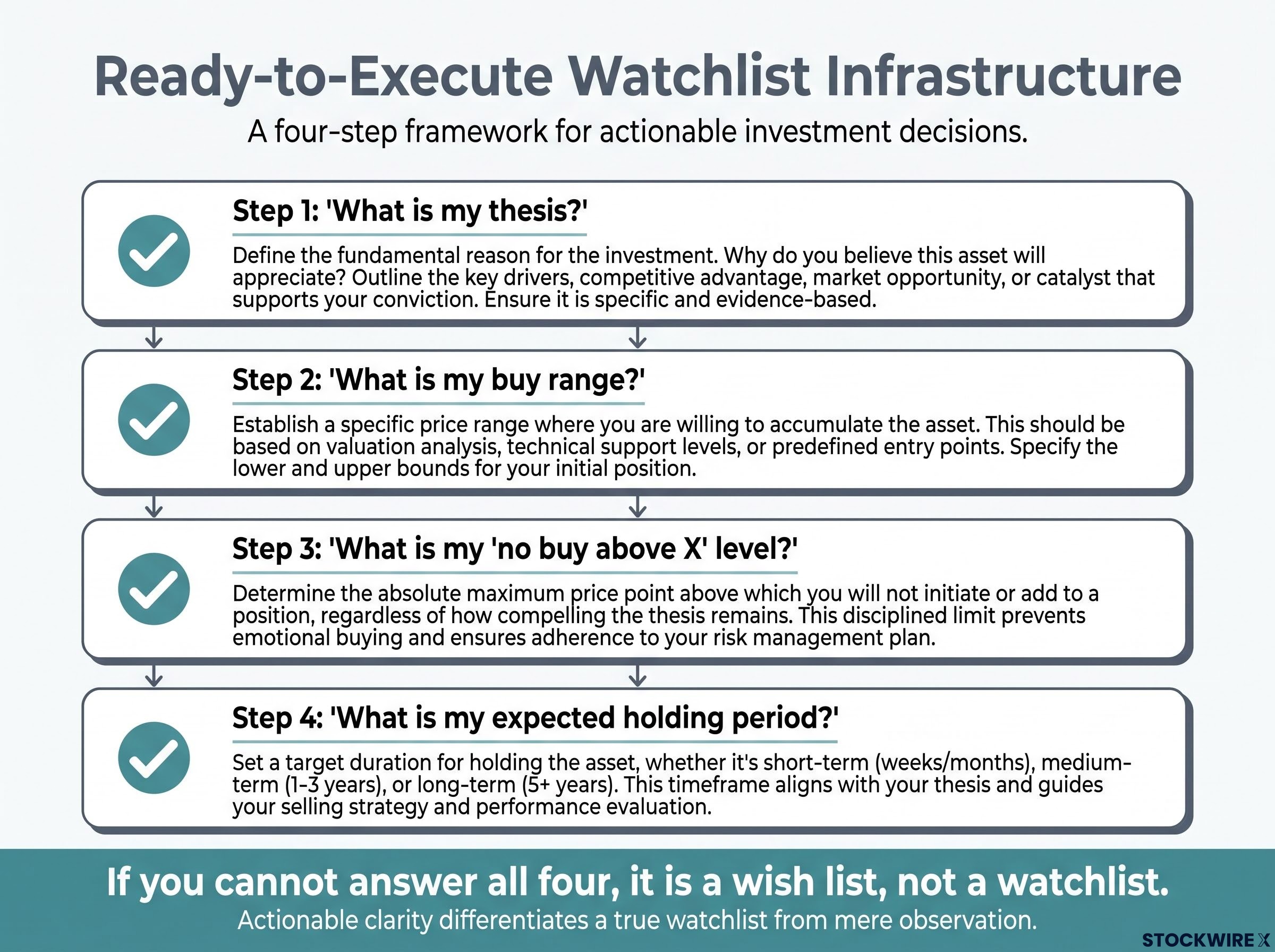
If you cannot answer all four, the stock is not on your watchlist. It is on your wish list. The difference matters because one produces action when conditions are met, and the other produces indefinite waiting.
The opposite trap: when activity becomes the mistake
If the previous section made you feel validated because you think of yourself as a patient, deliberate investor, this section is for you. Because the mirror-image failure is just as common, and patient investors are equally prone to it once they start monitoring positions.
Frequent trading is typically a drag on returns, not an enhancement. Many investors make the mistake of equating a busy portfolio with a well-managed one. The costs of over-trading compound quietly across four categories:
- Direct transaction costs: Commissions, spreads, and execution slippage eat into returns on every trade, regardless of whether the trade is profitable.
- Tax drag: Short-term capital gains are treated less favourably than long-term gains in most jurisdictions, meaning frequent trading increases the tax burden on the same underlying returns.
- Lost compounding: Every exit and re-entry breaks the compounding chain. The interruption itself has a cost, even if you re-enter at a similar price.
- Behavioural errors from noise: Frequent price monitoring increases the probability of reacting to irrelevant information rather than genuine changes in your thesis.
The no-called-strike advantage: Investing is structurally unique because inaction carries no penalty. You can pass on every opportunity indefinitely with no consequence. Over-trading systematically surrenders this advantage by treating every price movement as a reason to act.
The urge to “do something” in response to price movement is not a signal to act. It is a symptom of discomfort with inaction. Distinguishing between the two is the core skill here. Checking prices daily is acceptable if most checks result in no trade. The question is not “what is happening?” but “has my underlying thesis changed?”
Two opposite behaviours, one shared failure
Here is where the two failure modes connect. They are not separate problems requiring separate solutions. They are mirror-image expressions of the same underlying misalignment: the gap between your analytical work and your willingness to act on it with proportional conviction.
The behavioural architecture that keeps investors inactive during paper losses is the same architecture that must be redirected to overcome omission errors; in both cases, discomfort with the current state, not analytical failure, drives the decision that damages long-term compounding.
Omission is analysis without action when conditions are met. Over-trading is action without sufficient analytical conviction to justify it. One is knowing and not doing. The other is doing without sufficient knowing.
This matters practically because an investor who fixes only one side of the problem has not addressed the root cause. You can build a disciplined watchlist to combat omission errors, but if the same misalignment between conviction and action drives you to trade existing positions on noise, the fix is incomplete.
The conviction-action alignment concept works like this: when your conviction and your action are calibrated to each other, the frequency and timing of your trades follows naturally from the analysis rather than from emotional or behavioural pressure. You trade when your analysis tells you to, not when the market’s price movements make you uncomfortable.
| Attribute | Error of omission | Over-trading |
|---|---|---|
| Trigger for the behaviour | Discomfort with uncertainty; waiting for confirmation that never arrives | Discomfort with inaction; treating price movement as a signal to act |
| The cost it produces | Lost compounding on a business you understood | Transaction costs, tax drag, and broken compounding chains |
| How it feels in the moment | Feels like prudence and discipline | Feels like engaged, productive portfolio management |
| Diagnostic question to ask | Can I state in one sentence the specific condition I am waiting for? | Has my underlying thesis changed, or only the price? |
The single diagnostic question that applies to both sides: is the level of action you are about to take proportional to the level of conviction your analysis has produced?
A pre-commitment framework for staying in the middle ground
The practical resolution to both failure modes is a pre-commitment framework: decisions made in advance, before the emotional pressure of a live market moment arrives. These checklists work not because they always produce the right answer, but because they force you to have an answer before acting. That eliminates the most expensive decisions of all: the ones made without any deliberate reasoning.
Before initiating a new position
- Has my thesis been pre-defined?
- Has my buy range been pre-defined?
- Has my expected holding period been pre-defined?
- Am I acting because pre-set conditions are met, or because I feel pressure to “do something”?
Before choosing not to act on a researched idea
- What specific condition am I waiting for? State it in one sentence. If you cannot, you are deferring, not waiting.
- What is the estimated opportunity cost of further delay?
- Is this patient waiting with a defined trigger, or indefinite deferral?
Before selling or adjusting an existing position
- Has the underlying thesis changed, or only the price?
- Would I buy this business today at this price if I did not already own it?
- Am I responding to a genuine thesis change or to noise?
The value here is in preparation. Print these questions, save them, or keep them wherever you check your portfolio. They are most useful in the seconds before you open your brokerage app, not after you have already placed the trade.
This article is for informational purposes only and should not be considered financial advice. Investors should conduct their own research and consult with financial professionals before making investment decisions.
What calibrated conviction actually looks like in practice
An investor who has calibrated conviction and action does not look busy. They trade infrequently, but each trade reflects a high-confidence decision backed by pre-defined reasoning. Their watchlist functions as ready-to-execute infrastructure, not a folder of interesting names. Their portfolio monitoring updates conviction rather than trading activity. Most sessions end with no action at all, and that is the intended outcome.
The evidence consistently points toward the same long-term approach: locate businesses of genuine quality, acquire them when the price offers a real margin of safety, and then allow compounding to run across years or even decades without unnecessary interruption. The discipline of deliberate inaction is simultaneously the most difficult and most financially rewarding behaviour you can adopt.
For investors wanting to see the patient waiting principle operating at institutional scale, our full explainer on Berkshire’s cash accumulation strategy details how Greg Abel has maintained a $397 billion defensive posture while waiting for valuation conditions that justify deployment.
The Buffett asymmetry: The investor who built one of history’s greatest investment records regards the opportunities he passed on, rather than the positions he lost money on, as his most painful errors. That tells you something important about where the real risk in your portfolio actually sits.
Conviction, not frequency, is the measure of investment discipline
Both doing nothing and doing too much are symptoms of the same failure: a misalignment between analysis and conviction-led action. The investor who understands this has a durable advantage regardless of market conditions, because the framework applies whether markets are calm, volatile, or somewhere in between.
The pre-commitment checklists from the previous section are most useful when prepared before the pressure of a live decision arrives. Save them for the moment you need them, not the moment after.
Your next investment decision is the first opportunity to apply this standard. The measure is not perfection. It is proportionality: whether the level of action you take matches the level of conviction your analysis has produced.
For readers wanting to apply conviction-action alignment to real portfolio decisions, our dedicated guide to the expectations gap framework examines how crowded consensus trades price in outcomes before they occur, making omission errors costliest precisely when market confidence is highest.
—