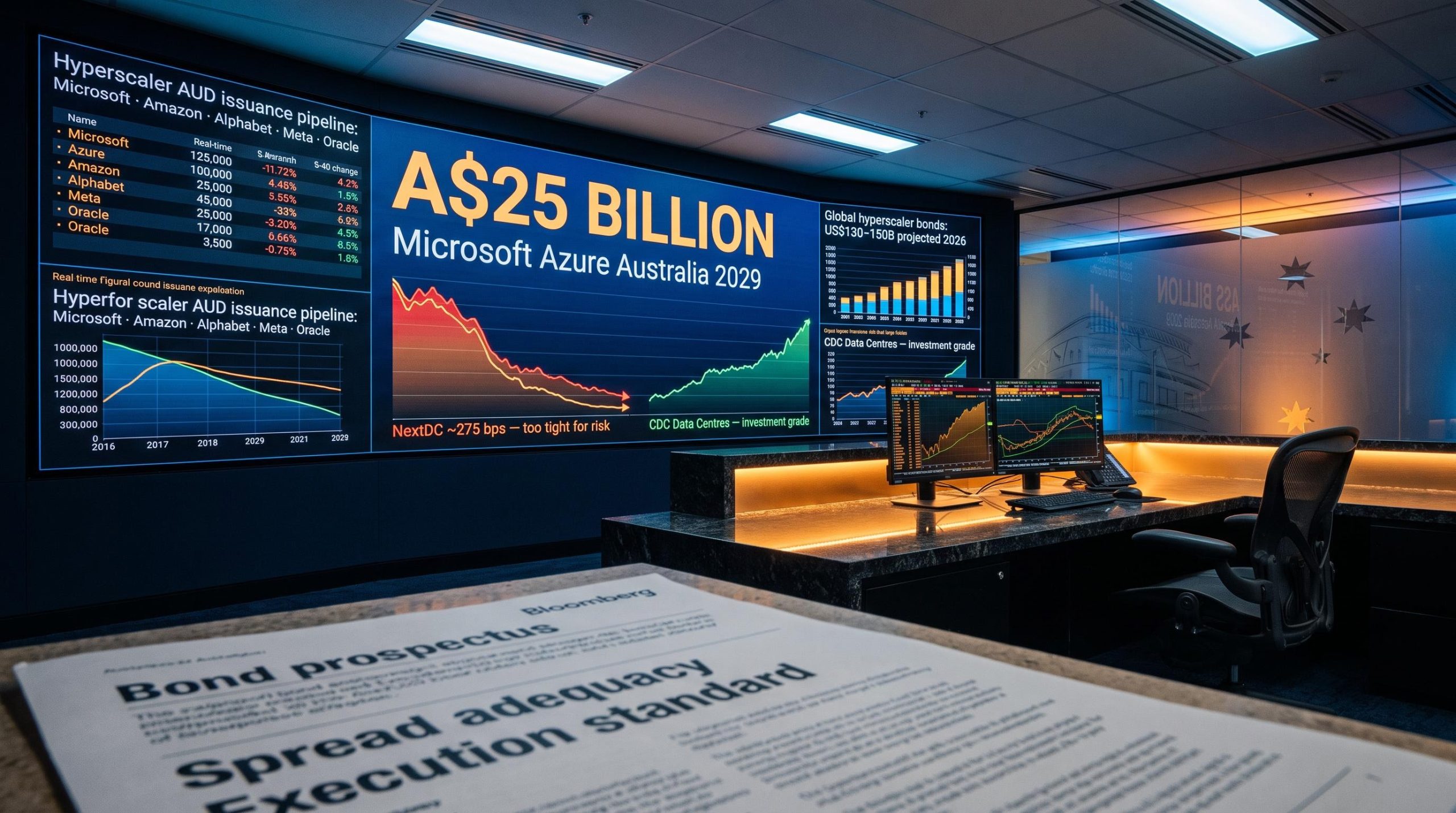
Billions of dollars in AI infrastructure investment have already been committed to Australian soil, yet the AUD bond market has barely registered the shift. Microsoft’s announced A$25 billion commitment to expand Azure supercomputing in Australia by 2029, the largest single tech investment in Australian history, requires a capital structure that has not yet arrived in domestic fixed income markets. That gap is closing.
AUD-denominated AI bonds currently consist of two domestic data-centre operators, NextDC and CDC Data Centres, with spreads already drawing scrutiny from credit professionals. Global hyperscalers, including Microsoft, Amazon, Alphabet/Google, Meta and Oracle, are widely expected to enter the AUD market. When they do, the investment-grade universe will expand materially, but it will also introduce execution and credit-cycle risks most Australian fixed income investors have not yet had to navigate.
Here is a practical framework for assessing AI-linked AUD bonds before the hyperscalers arrive, covering current value, execution traps to watch for, the structural lessons from credit cycles past, and the specific conditions under which participation makes sense.
The AUD AI bond market as it stands today
The current AI bond landscape in Australian dollars looks small. Two names, two different risk profiles, and one already assessed as mispriced. That is worth understanding before the market gets any larger.
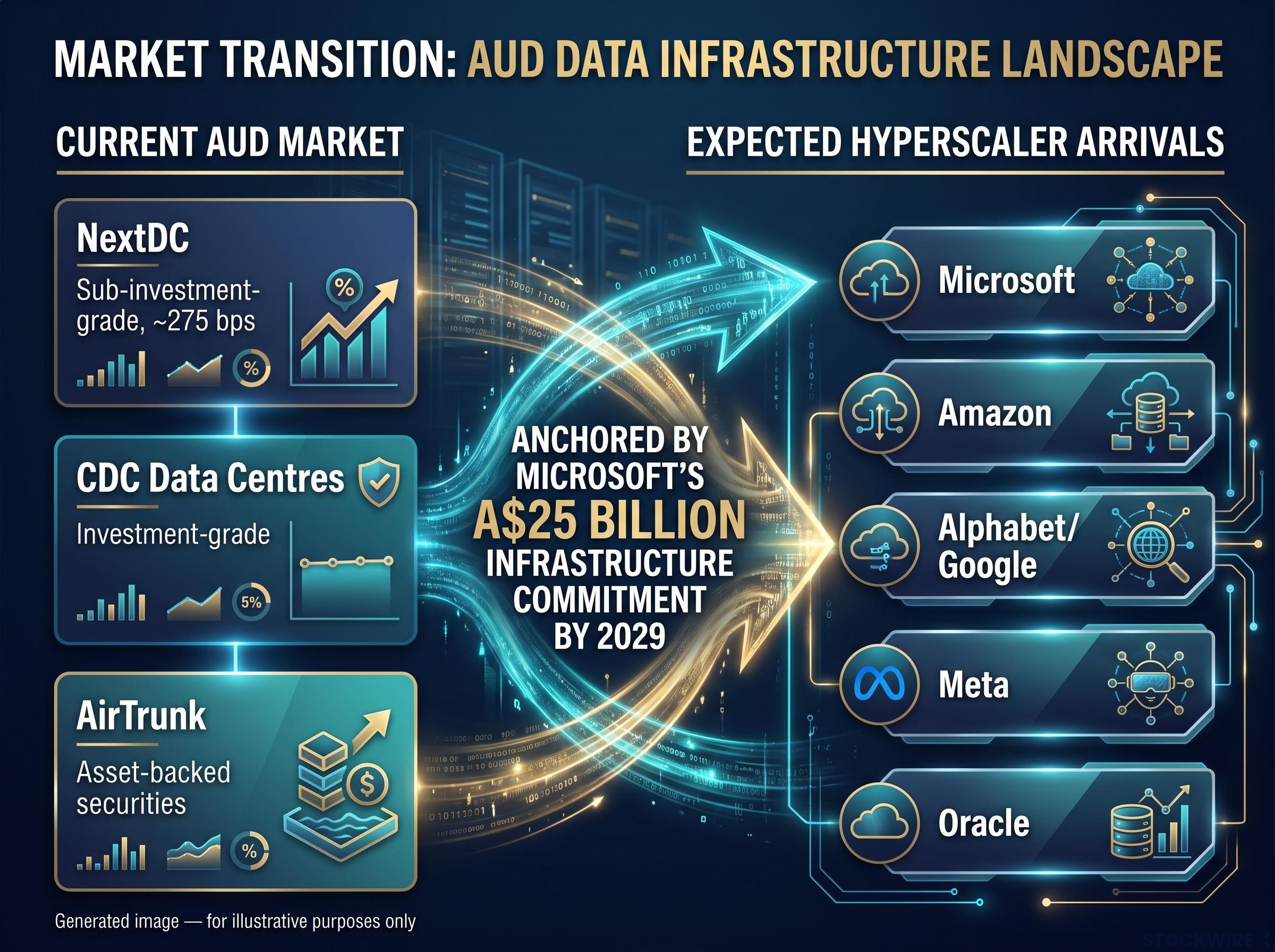
NextDC (ASX: NXT), the ASX-listed data-centre developer, is the most visible AI-related corporate bond issuer in AUD. It has issued subordinated notes, debt that sits below senior bonds in the repayment queue if things go wrong, with an indicative credit margin of approximately 275 basis points over benchmark. NextDC is sub-investment-grade, placing it firmly in high-yield territory. Phil Strano of Yarra Capital Management assesses those notes as not offering enough spread for their risk: they trade expensive relative to the speculative-grade rating and the sector’s anticipated spread trajectory.
CDC Data Centres, a privately held operator with a large government and enterprise client base, sits in a materially different position. CDC carries an investment-grade rating, issued subordinated AUD bonds in the first half of 2026, and was marketing new senior AUD bonds at the time of writing. Strano’s assessment is that CDC offers better value and better downside protection, reflecting its higher rating, more conservative leverage and stronger capital structure ranking.
| Issuer | Rating category | Typical AUD structure | Indicative margin | Assessment |
|---|---|---|---|---|
| NextDC | Sub-investment-grade | Subordinated | ~275 bps | Too tight for risk |
| CDC Data Centres | Investment-grade | Senior and subordinated | Not publicly disclosed | Better value and downside protection |
The spread difference between those two names is not just a number. It tells you that the domestic AI bond market has already produced one name trading expensive for its risk, and identifying that distinction early is exactly the skill you need before the next wave of issuance arrives.
What is forming behind the first wave
Beyond NextDC and CDC, AirTrunk and other developers are preparing asset-backed bond structures referencing long-term hyperscaler leases, a second layer of AI-linked AUD issuance. These asset-backed securities (ABS), bonds backed by specific revenue streams such as rental payments from hyperscaler tenants, add another dimension to the opportunity set. The market may be quiet today, but the pipeline is building.
When big ASX news breaks, our subscribers know first
Why global hyperscalers are pointing at the AUD market
To date, no hyperscaler has tapped the Australian dollar bond market. That is about to change, and the structural logic makes the outcome difficult to avoid.
Australian banks and syndicate desks are actively courting US tech issuers, positioning AUD as a funding-diversification currency alongside USD, EUR and GBP. Australia’s AI investment backdrop makes the pitch straightforward: when a company has committed A$25 billion to build physical infrastructure in a country, the question of whether it will eventually tap local-currency markets for funding diversification answers itself.
The scale of the opportunity is anchored in structural context: AUD bond market growth has accelerated sharply, with A$186 billion in new issuance recorded in just the first five months of 2026, a 29% increase on the prior year, as offshore investors consistently take 40-50% of each new deal and the market now ranks third or fourth globally by size.
Microsoft’s A$25 billion commitment to expand Azure AI supercomputing and cloud infrastructure in Australia by 2029 is described as the largest single tech investment commitment in the country to date. It anchors the real-economy pull drawing bond market activity toward Australian dollars.
Globally, hyperscaler bond issuance exceeded US$100 billion in 2025 and is projected to reach US$130-150 billion in 2026 as data-centre build-outs accelerate. The expected issuer cohort for AUD includes:
- Microsoft
- Amazon
- Alphabet/Google
- Meta
- Oracle
- Adjacent AI platforms, including specialised GPU capacity providers and large data-centre landlords
For your fixed income portfolio, the arrival of these names would add globally recognised, large and liquid investment-grade benchmark lines to a domestic corporate bond market currently dominated by banks, utilities and financials. That is a material improvement in the opportunity set, but only if you are prepared to evaluate the terms on which they arrive.
How same-day execution leaves AUD debut investors exposed
In Australia, a company issuing AUD bonds for the first time is conventionally expected to conduct a multi-day domestic investor roadshow before launch. Fund managers, superannuation funds and institutional investors meet the issuer, review strategy and financials, and provide feedback that calibrates spread and size to local demand. This is not a regulatory requirement. It is a deeply established market norm, and it consistently delivers tighter spreads, broader domestic participation and more stable secondary performance.
Hyperscalers are unlikely to follow this convention. Large US tech treasuries are accustomed to tapping multiple markets rapidly, and reports suggest they are reluctant to commit the time necessary for a proper Australian market debut. Same-day execution, announcing and pricing a deal within hours, is the likely approach.
Verizon’s AUD subordinated issue in March 2026 shows exactly what happens when that convention is skipped. Verizon, a BBB-minus rated US telecommunications company, had been absent from the AUD market for an extended period, effectively making it a re-entry issuer. It chose same-day announcement and pricing without conducting a standard roadshow.
The 2031 subordinated bonds were priced at a spread of roughly 40 basis points above comparable AusNet 2030 subordinated paper, yet that concession proved insufficient to sustain demand, with the bonds continuing to widen once secondary trading began.
The majority of domestic Australian investors did not participate. That is the clearest possible signal that pricing and information access were considered inadequate.
Three signals tell you a debut AUD deal is being executed without proper market preparation:
- Same-day announcement and pricing, with no lead time for independent credit work
- Absence of multi-day roadshow disclosure or domestic institutional engagement
- Limited domestic institutional allocations disclosed after pricing
If a BBB-minus telco could not bring domestic investors along by skipping the roadshow and still suffered secondary widening, a debut hyperscaler pricing the same way will face the same dynamic regardless of how recognisable its name is. Brand recognition is not a substitute for spread adequacy, and the Verizon precedent gives you a concrete benchmark for what happens when an issuer assumes otherwise.
What AI bonds actually are, and why the credit risk is different here
Before assessing any specific offering, you need to understand what you are actually buying when you buy an AI bond, because the label creates a misleading association with AI as a growth theme.
AI bonds are debt instruments raised to finance AI infrastructure build-out: data centres, high-performance compute clusters (banks of specialised processors called GPUs), networking, power systems and cloud platforms. They are not equity in AI companies. They are not instruments linked to AI revenues. They are fixed income securities issued by companies that are building the physical layer beneath the AI economy.
Three distinctions separate AI bonds from AI equities:
- What you own: A bond is a claim on repayment of principal and interest. You do not participate in upside if the issuer’s AI business succeeds beyond expectations. You participate in downside if it fails.
- How you get paid: Coupons are fixed or floating-rate payments. Your return is determined by the spread at purchase, not by revenue growth or product adoption.
- What risks apply: The primary risks are credit deterioration, rating downgrades and spread widening, not the competitive or adoption risks that drive equity valuations.
The largest hyperscalers have shifted from funding AI capital expenditure primarily through internal cash flows to issuing very large volumes of public bond market debt. This is not opportunistic borrowing. It is structural, driven by the sheer scale of required investment: collectively in the hundreds of billions, with build-out timelines extending across multiple years and uncertain long-run monetisation.
The hyperscaler capex funding shift is measurable: Goldman Sachs data shows external sources funded approximately 26% of hyperscaler capex in 2025, with that share projected to reach 33-35% by 2027, and AI capital expenditure is on track to consume roughly 94% of operating cash flow across the sector in 2026, compared with a historical average near 40%.
Why brand name is not a substitute for spread discipline
That structural point matters for your assessment. Microsoft, Amazon, Alphabet and Meta carry strong investment-grade ratings today. But a strong rating reflects current balance sheet conditions, not a guarantee about where credit quality will sit in three to five years after sustained heavy capital expenditure. Understanding that an AI bond is a claim on a capital-intensive, long-duration infrastructure build, not a share in AI upside, reframes every spread and structure decision you will face.
How ratings migrated in past infrastructure cycles and what that means for hyperscalers now
The strongest argument for spread discipline comes not from theory but from history. European telecoms in the early 2000s followed a trajectory that AI infrastructure issuers could replicate.
European telcos entered the 3G and fibre build-out era rated around AA. They were perceived as strategically important, quasi-utility businesses with durable cash flows. Investors lent at tight spreads based on that perception. The companies then invested heavily in network infrastructure, with capital intensity that consumed cash flow and pushed leverage higher. Returns proved slower to materialise than expected. Competition remained fierce. Over the subsequent years, average sector ratings migrated from approximately AA to BBB, leaving investors holding lower-quality paper than they had bought, at spreads that no longer compensated for the actual risk.
How the same logic applies to AI infrastructure debt today
The structural parallels are direct.
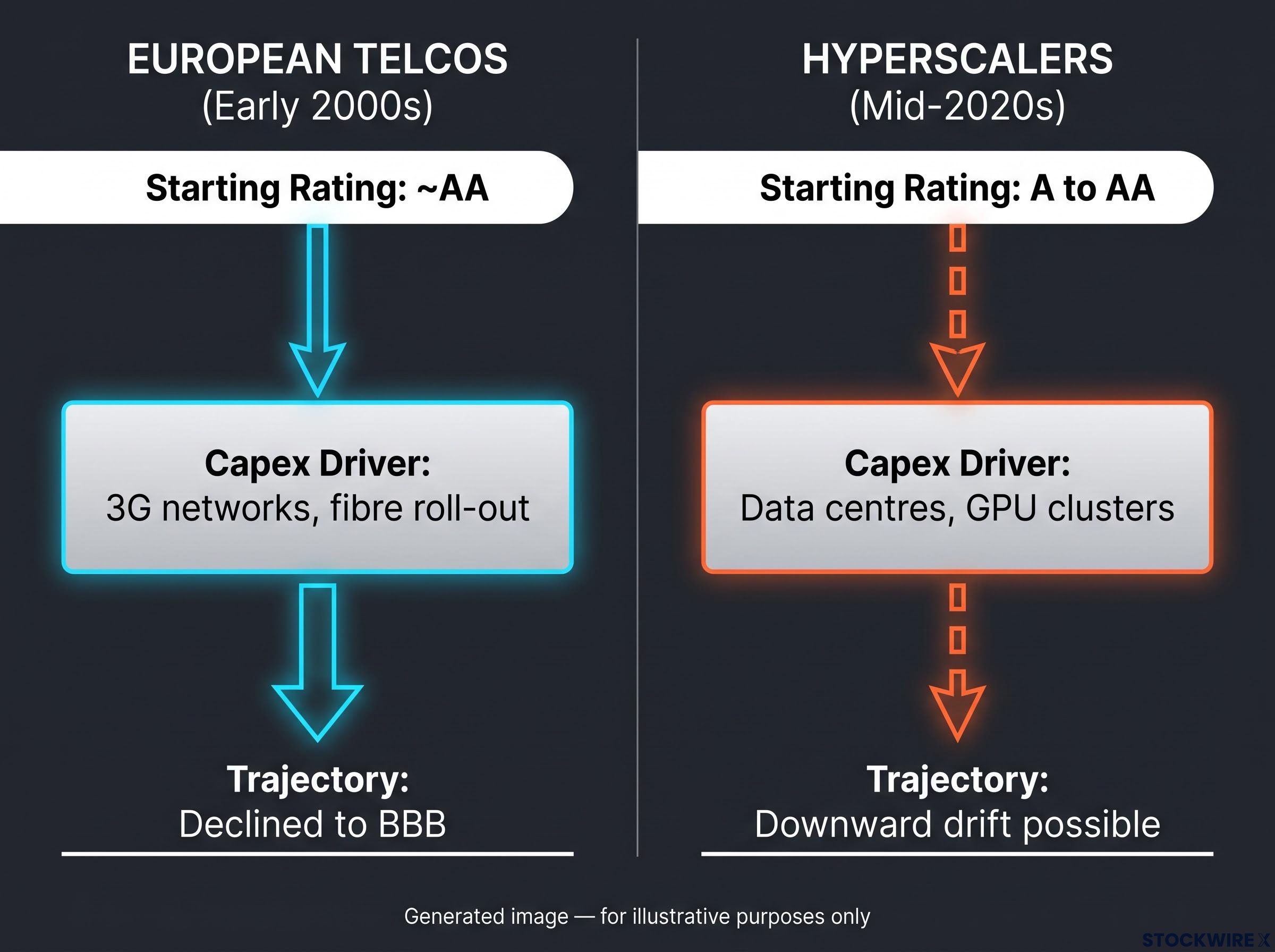
| European telcos, early 2000s | Hyperscalers, mid-2020s | |
|---|---|---|
| Starting rating | ~AA | A to AA |
| Capex driver | 3G networks, fibre roll-out | Data centres, GPU clusters, AI infrastructure |
| Monetisation certainty | Taken for granted; proved slower to arrive | Widely assumed; not yet proven at scale |
| Observed or expected ratings trajectory | Declined from AA to BBB over the cycle | Comparable downward drift possible if returns fall short |
Hyperscalers today enjoy strong investment-grade ratings and are seen as systemically important. But they are committing to enormous, multi-year AI and data-centre capital expenditure, collectively in the hundreds of billions, with uncertain long-run monetisation timelines and ongoing competitive pressure. If returns under-deliver or competition forces continuous reinvestment, leverage and ratings could drift lower.
Phil Strano’s stated investment approach at Yarra Capital Management addresses this directly: buy AI-linked bonds only where spreads compensate for anticipated credit deterioration, not just the issuer’s present rating. Anchoring your spread requirement to a hyperscaler’s current AA or A rating, without pricing in the realistic possibility that sustained capex erodes credit quality over the life of the bond, is the same mistake early European telco bondholders made.
The Oracle case provides a live illustration of hyperscaler credit deterioration in action: S&P downgraded Oracle to BBB-minus in July 2026, citing US$55 billion in fiscal 2026 capex, negative free cash flow, and leverage heading toward the mid-4x range, precisely the trajectory the European telco analogy anticipates for names currently rated A or AA.
A practical checklist for assessing any new AI-linked AUD bond
The analytical argument above converts into five assessment dimensions you can apply the next time a deal lands in your inbox.
- Credit quality and rating trajectory. Look beyond the current rating. What are the issuer’s leverage levels, capex plans and realistic downgrade scenarios over a 3-5 year horizon? NextDC’s sub-investment-grade subordinated margin of approximately 275 basis points was assessed as insufficient for the risk it carries. Starting with trajectory rather than label is the first filter.
- Capital structure position. Senior bonds repay before subordinated bonds if things go wrong. CDC’s investment-grade senior paper provides meaningfully better downside protection than NextDC’s subordinated notes. For core portfolio holdings, senior investment-grade AI-linked bonds are generally a more defensive way to access the theme.
- Spread adequacy relative to future credit quality. Does the offered margin reflect where the issuer’s credit quality may sit in three to five years, including possible downgrades? Or does it reflect only today’s rating? If the latter, the spread is likely insufficient.
- Execution process. Was there a proper multi-day roadshow, or was it a same-day deal? The Verizon precedent shows that same-day execution without domestic investor engagement can result in poor secondary performance regardless of the new-issue concession. If the execution does not give you adequate information access, it is rational to sit out and wait for secondary levels.
- Portfolio concentration and timing in the supply cycle. Is this early in a supply wave that may push spreads wider as more names arrive? How concentrated would your portfolio become in AI-linked names? Early deals in a supply wave often reprice once subsequent issuance arrives and resets benchmarks.
Having this checklist before the deal lands is what separates an investor who can act with confidence from one who defaults to brand recognition under time pressure.
When direct bond selection may not be the right approach
For many Australian retail and self-directed investors, the complexity of real-time credit assessment for AI-linked issuers makes direct bond selection impractical. Accessing AI-linked credit through an actively managed investment-grade bond fund offers a practical alternative.
Yarra Capital’s Enhanced and Higher Income Funds target income returns in the 6.5%-7.5% per annum range, drawn from broadly diversified portfolios of investment-grade securities, offering a reference point for what well-constructed active alternatives can currently deliver.
Active managers with dedicated credit research teams can rotate between hyperscaler, utility, ABS and hybrid exposures as spreads shift, without requiring you to evaluate each individual deal on a compressed timeline.
How to position before the hyperscaler wave lands
The opportunity here is genuine. Hyperscaler AUD issuance would add globally recognised, large and liquid investment-grade benchmark lines to a domestic corporate bond market currently dominated by banks, utilities and financials. For Australian fixed income investors, that is a material improvement in the opportunity set.
But the decisive factor is not whether you recognise the names on the front cover of the prospectus. It is whether the terms meet two conditions:
- Spread adequacy: the offered margin prices in realistic rating trajectory over the life of the bond, not just the issuer’s current label
- Execution standard: either a proper multi-day roadshow process, or a same-day deal that compensates with a meaningful new-issue concession and adequate information disclosure
- Condition to avoid: participation based on brand recognition alone, without spread discipline or independent credit work
Phil Strano’s framing at Yarra Capital Management is worth anchoring to: spread preparation now will matter more than brand recognition when these names arrive. The investors who build their analytical framework before the first hyperscaler deal is announced will be the ones positioned to capture the opportunity without absorbing the risks that come with it.
Australian dollar bond markets have yet to price in the AI-related spread pressure already visible in global credit, though analysts expect local spreads to align with international benchmarks as issuance grows. Existing holders of domestic AI bonds, particularly higher-beta names such as NextDC, should be prepared for repricing as larger, more liquid hyperscaler benchmark lines arrive and reset relative value. Australia’s real-economy AI investment backdrop, anchored by Microsoft’s A$25 billion commitment, makes hyperscaler AUD issuance a near-term structural expectation rather than speculation. The preparation window is open. It will not stay open indefinitely.
For investors wanting to understand the broader credit environment driving institutional capital toward AI debt, our dedicated guide to AI debt market risks covers the US$15 trillion corporate refinancing wall expected between 2026 and 2028 and the hidden leverage mechanisms that amplify downside risk in lower-rated AI-linked issuers.
This article is for informational purposes only and should not be considered financial advice. Investors should conduct their own research and consult with financial professionals before making investment decisions. Past performance does not guarantee future results. Financial projections are subject to market conditions and various risk factors.