
Drexel MXene licence gives ECT global commercial rights beyond defence
Environmental Clean Technologies (ASX: ECT) has announced that Xenica, Inc., a wholly owned subsidiary of its acquisition target Xenica Pty Ltd, has secured a worldwide, non-exclusive Drexel University licence to make, use, import and sell MXenes for specified commercial use. The Drexel MXene licence extends Xenica’s market rights from defence into a broad range of industrial applications.
MXenes were discovered at Drexel in 2011, and Drexel holds key foundational patents covering MXene compositions. Until now, Xenica’s licensed market rights covered military and defence-related end uses under the MXene Inc. sublicence (refer to ASX announcement 14 September 2026).
Everything is subject to completion of the Xenica acquisition, which is expected over the coming weeks.
Faldi Ismail, Executive Chairman
“The Drexel Licence is a significant milestone for ECT. It substantially expands the commercial MXene rights available to our platform, taking us from defence into a broad range of industrial applications.”
The headline points from the announcement:
- Global rights: a worldwide, non-exclusive licence from Drexel University
- Defence strategy unchanged: defence remains the initial priority
- Industrial markets opened: energy storage, industrial coatings and PFAS water filtration among them
- Focus moves to execution: repeatable production, validation and customer qualification
When big ASX news breaks, our subscribers know first
Industrial markets now within reach
Defence remains ECT’s initial market, where procurement is performance-led and ECT is seeking to establish a U.S. source of MXene. With the Drexel licence, the opportunity no longer ends at defence.
Licensed commercial applications
Licensed commercial applications include:
- Energy storage: supercapacitors and fast-charging batteries
- Industrial coatings and composites: other than electromagnetic interference shielding applications
- PFAS water filtration: described as a natural fit with ECT’s existing PFAS destruction platform
- Other applications: further commercial uses covered by the licence
Each is a potential opportunity for ECT to supply MXene materials to product manufacturers, formulators and industrial partners, subject to product performance, qualification and commercial agreements. The licence allows ECT to pursue multiple customer and product development programs while defence remains the first priority.
What MXenes are and why the rights matter
MXenes are advanced two-dimensional materials. In energy storage, their conductivity and surface area are being researched for use in electrodes and conductive additives.
Foundational patent access matters because ECT can now pursue customer engagement, product development and partnerships across a much wider range of licensed applications without negotiating separate access to the same Drexel patent rights for each opportunity.
ECT’s assembled MXene commercialisation platform
The licence marks ECT’s shift from acquiring technology to assembling the components of a commercial manufacturing business. On completion of the Xenica acquisition (expected over the coming weeks), the platform will comprise the following elements.
| Requirement | ECT’s position | Source date | Status |
|---|---|---|---|
| Production technology | Exclusive Rice University FJH licence to produce MXenes and two-dimensional amorphous carbon | 4 August 2026 | n/a |
| Manufacturing infrastructure | Access to Metallium Ltd’s (ASX: MTM) commissioned Gator Point FJH reactor under the R&D and Engineering Agreement | 4 August 2026 | n/a |
| Precursor supply | Initial defence-friendly MAX Phase precursor secured | 19 August 2026 | n/a |
| Defence-market rights | Military end-use sublicence from MXene Inc. | 14 September 2026 | n/a |
| Broader commercial rights | Drexel University Licence | This announcement | n/a |
| Product qualification | First MXene produced; repeatability, validation and sampling to follow | 9 October 2026 | n/a |
Executive Chairman Faldi Ismail said: “We are not starting from scratch. In three months we have brought together exclusive production technology, access to a commissioned U.S. reactor, precursor supply and licensed market access…”
The Drexel licence and the MXene Inc. sublicence together give Xenica licensed market access across defence and a broad range of commercial applications. The licence is non-exclusive and does not by itself provide freedom to operate across every MXene application.
The defence market rights secured under the MXene Inc. sublicence sit alongside the Drexel licence, with US policy deadlines on covered materials favouring domestically produced MXenes in military supply chains.
Some applications remain outside both arrangements, notably non-military electromagnetic interference shielding, antennas and infrared shielding. What remains to be demonstrated is commercial readiness: producing MXenes to customer specification, repeatably and economically at scale.
Key licence terms
- Worldwide and non-exclusive
- Excludes applications in electromagnetic interference shielding, dialysis, biosignal electrodes, antennas, infrared shielding and military end use
- Military end use is addressed under the separate MXene Inc. sublicence
- Continues until expiration of the patent rights
- Drexel will be entitled to a royalty on future sales
The other excluded applications are not covered by the licence, and are covered by the MXene Inc. sublicence only to the extent they are military end uses.
What happens next for ECT
ECT’s pathway from licensed rights to commercial sales follows a defined sequence:
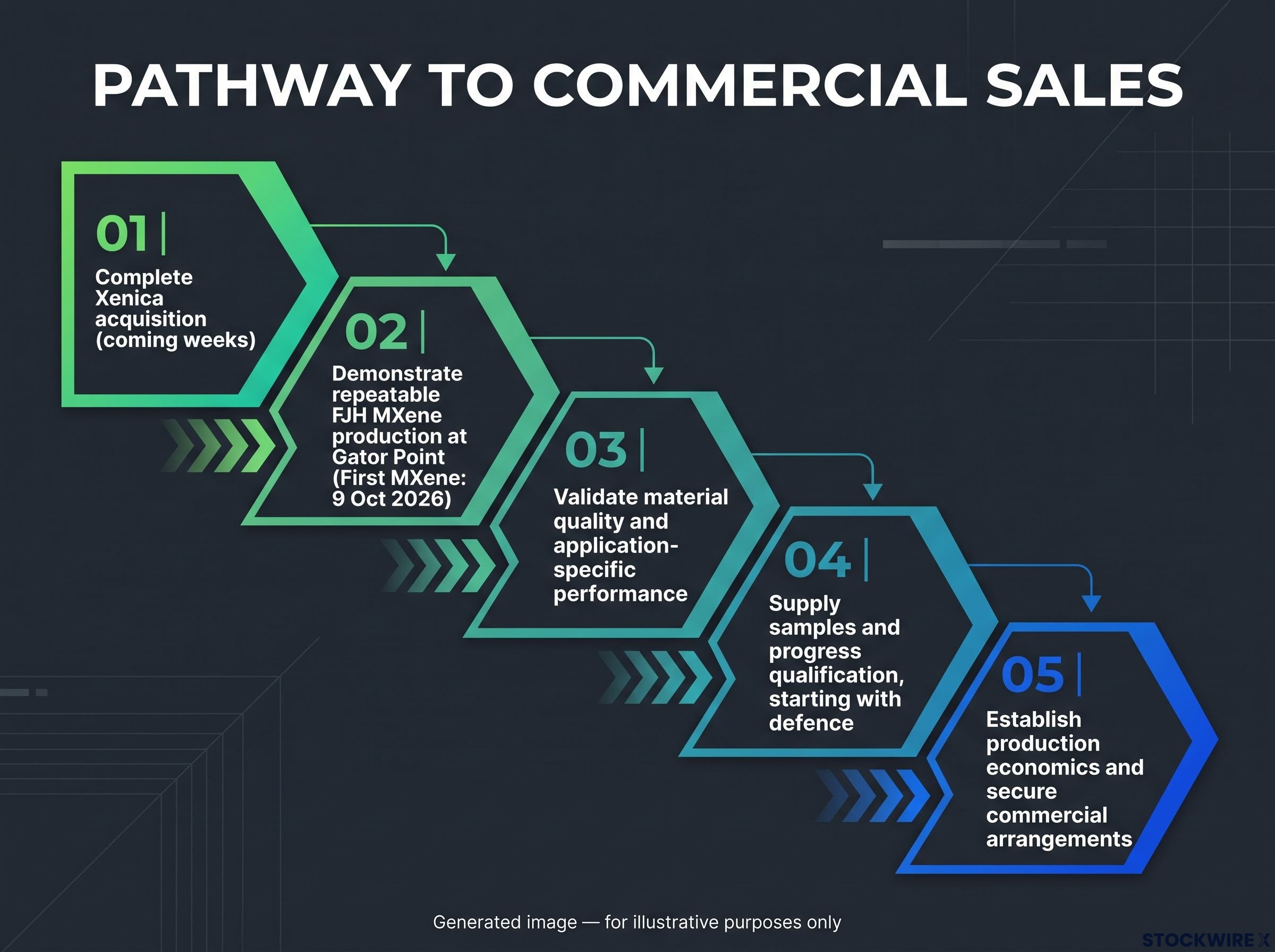
- Complete the Xenica acquisition, expected over the coming weeks.
- Demonstrate repeatable FJH MXene production with improving yield and consistency at Gator Point (first MXene produced, refer to ASX announcement 9 October 2026).
- Validate material quality and application-specific performance through independent characterisation.
- Supply samples and progress customer qualification, starting with defence customers.
- Establish production economics and secure commercial arrangements with customers and partners.
Gator Point reactor access is the practical bridge between licensed rights and product, with early test work producing 250g of MXenes in 30 to 90 minutes against less than 100g over days using conventional etching.
Defence remains the first commercialisation priority, and ECT’s near-term defence milestones are unchanged. Industrial programs will not need to wait until defence is fully commercialised: different markets require different product grades and functional characteristics, and ECT intends to progress selected opportunities in parallel as production capability develops.
Any revenue remains subject to successful scale-up, material meeting customer specifications, customer qualification and commercial agreements.
Don’t Miss the Next Advanced Materials Breakout
Join 20,000+ investors getting FREE breaking ASX news delivered within minutes of release, complete with in-depth analysis. Click the “Free Alerts” button at Big News Blast to be first to know when market-moving announcements land, and stay ahead of the market.