

ECT fast-tracks MXenes production through Metallium reactor deal
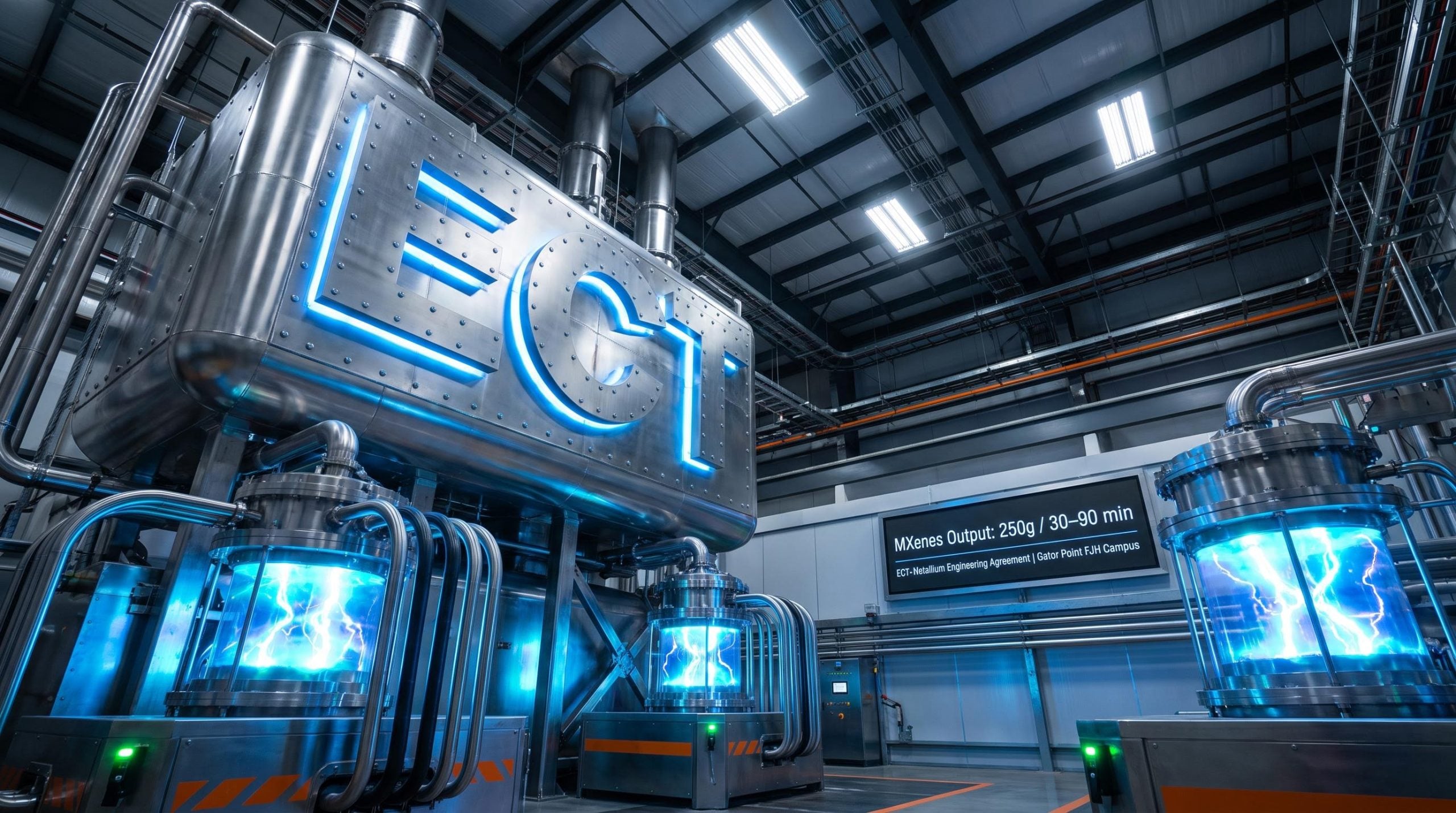
Environmental Clean Technologies Limited (ASX: ECT) has signed a binding 12-month research and development and engineering agreement with Metallium Ltd (ASX: MTM) to fast-track development of its MXenes production technology at Metallium’s commissioned “Gator Point” Flash Joule Heating facility in Chambers County, Texas.
The Engineering Agreement, combined with the separately announced acquisition of Xenica Materials Pty Ltd and its exclusive licence from Rice University, is intended to give ECT both the exclusive commercial rights and the operating platform required to accelerate commercial development of its FJH MXenes technology.
For investors, the arrangement is designed to de-risk and fast-track a capital-light path into an emerging advanced-materials market, using proven infrastructure rather than funding a reactor build from the ground up.
When big ASX news breaks, our subscribers know first
What the Metallium agreement delivers
Under the Engineering Agreement, ECT will establish a working space at Metallium’s Gator Point Facility. Metallium will provide research, development and engineering services alongside controlled access to its proprietary reactor technology for ECT’s FJH MXenes production and PFAS remediation programmes.
ECT’s PFAS remediation programme runs alongside the MXenes work at Gator Point, with laboratory results from the REM technology already demonstrating defluorination efficiencies above 96% and temperatures exceeding 1,000 degrees Celsius achieved within 60 seconds.
The strategic logic centres on speed and cost avoidance. By accessing established industrial infrastructure, ECT eliminates the substantial time and capital investment otherwise required to develop an equivalent reactor platform independently.
Gator Point is Metallium’s first commercial FJH Technology Campus, where reactor operations have been successfully commissioned, validated and are already supporting deployment of Metallium’s proprietary FJH platform for critical metal recovery.
| Term | Detail |
|---|---|
| Upfront fee | US$500,000 |
| Quarterly operational service & facility access fee | US$225,000 (for the Term) |
| Options to Metallium (subject to shareholder approval) | 20 million ECT options, exercise price $0.18, expiring 12 months |
| MXenes produced | Owned by ECT |
| Improvements to Metallium technology/reactor | Owned by Metallium |
| Term | 12 months, with good-faith negotiation toward a long-term commercial-licence agreement |
Executive Chairman Faldi Ismail
“This agreement with Metallium allows us to fast-track our MXenes strategy on established operating infrastructure. Partnering with an operator that has successfully developed and scaled a proprietary Flash Joule Heating reactor platform, allows us to materially de-risk the validation of FJH for MXenes production, while staying true to ECT’s capital-light model. This gives us immediate access to Metallium’s established FJH reactor infrastructure and engineering capability and bypasses the time, capital and execution risk that designing, building and commissioning our own reactor would otherwise demand.”
What are MXenes, and why they matter
MXenes are a distinct, high-performance class of advanced material that have attracted growing attention across multiple industrial sectors. Their appeal lies in a combination of properties that make them candidates for demanding technical applications.
Potential uses include:
- Electromagnetic shielding, including radar and infrared-absorbing materials
- Advanced sensing
- High-performance and next-generation batteries
- Water treatment
- Next-generation electronics
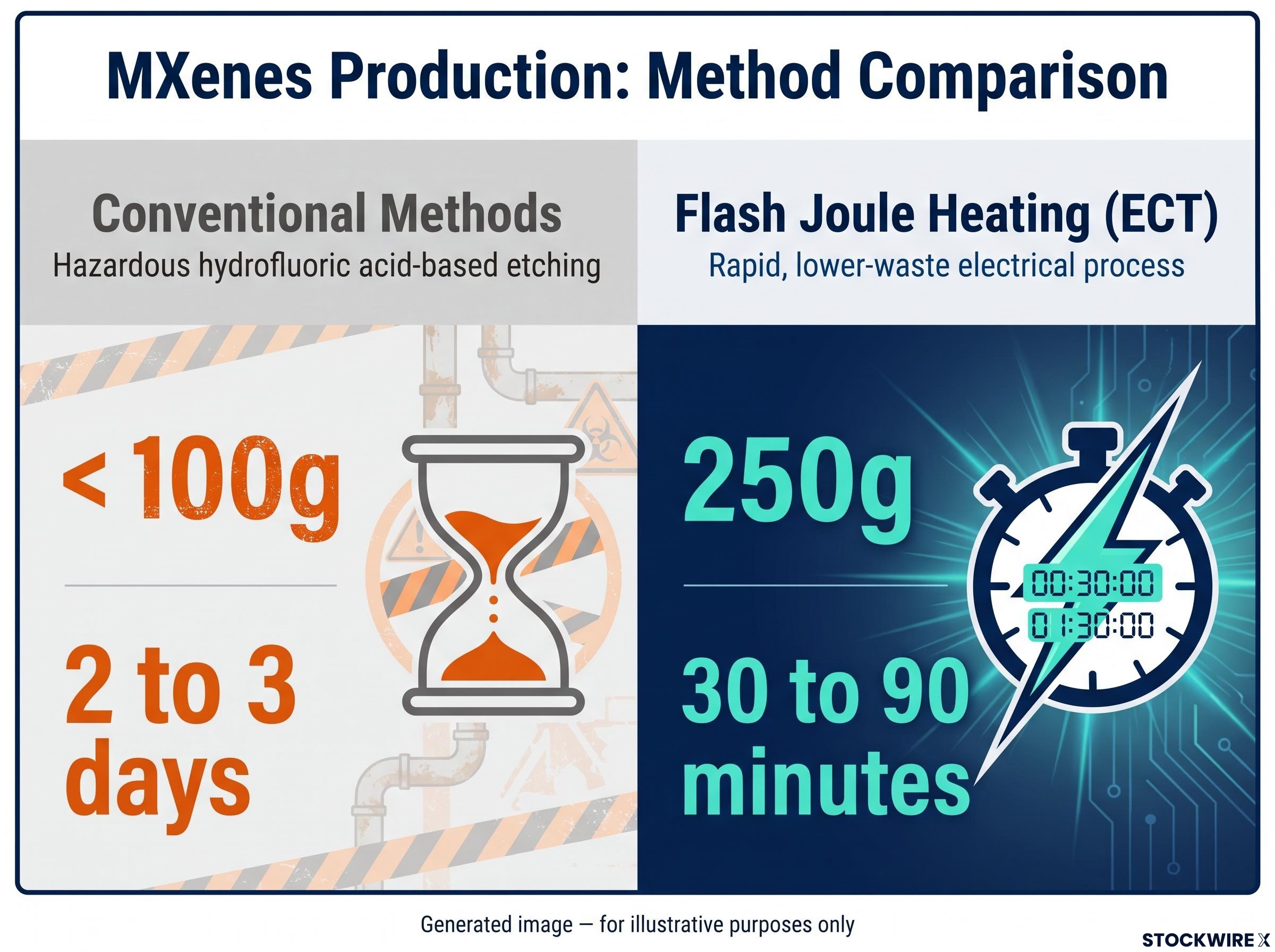
For over a decade, much of that potential has gone largely unrealised. The industry’s reliance on hazardous, slow and costly hydrofluoric acid-based etching has confined production to small scales.
Flash Joule Heating replaces chemical etching with a rapid, lower-waste electrical process. According to ECT, this has the potential to materially reduce the cost and time of production, and could unlock economically scalable output.
The investor takeaway is clear: ECT is targeting a production bottleneck that has long held back a promising material class.
Early validation shows a step-change in speed
Initial test work on the reactor has provided early evidence supporting the thesis. According to ECT, 250g of MXenes were produced in 30 to 90 minutes, compared with less than 100g over 2 to 3 days for conventional methods.
ECT believes the existing reactor design provides a pathway for larger-scale production, subject to ongoing development and validation. The result has not yet been proven at commercial scale.
Metallium Managing Director & CEO Michael Walshe
“We are pleased to support ECT in advancing the commercial development of its MXene technology using Metallium’s proprietary Flash Joule Heating platform. Since licensing the technology from Rice University, Metallium has invested significantly in engineering and commercialisation, transforming the original laboratory-scale process into a proprietary, significantly scaled-up reactor platform capable of supporting multiple commercial applications.
“MXenes represent one of the most exciting emerging advanced materials, with potential applications across defence, advanced electronics, next-generation batteries, sensors and water treatment. Conventional production methods remain slow, hazardous and difficult to scale, and we believe our proprietary Flash Joule Heating platform has the potential to provide a step-change in manufacturing efficiency and scalability. We look forward to working closely with ECT as it progresses its programme.”
The investment case: capital-light entry into advanced materials
The transaction combines exclusive commercial rights, to be secured via the proposed Xenica acquisition, with immediate access to a proven, commissioned reactor platform. Together, these are positioned to create an accelerated and de-risked path into MXenes production.
Central to the approach is ECT’s capital-light model. By leveraging Metallium’s existing infrastructure, ECT avoids the need to fund, build and commission its own reactor.
Metallium’s operational track record provides a measure of validation for the platform:
- Exclusive Rice University FJH licence obtained in May 2024
- 12-hour continuous single-reactor campaign completed in May 2026
- Three FJH units operated concurrently at 83% availability and approximately 100% utilisation during active operation
What comes next
The Engineering Agreement runs for a 12-month Term. During this period, ECT and Metallium will negotiate in good faith with a view to entering a potential long-term collaboration and licence agreement to utilise Metallium’s technology and reactor systems.
Shareholder approval is required for the issuance of the 20 million ECT options to Metallium, a near-term item for investors to monitor.
The programme also targets PFAS remediation technology alongside MXenes, broadening the potential application of the reactor access.
With validation work now underway, the next objective is to demonstrate a pathway toward larger-scale production.
For investors exploring how the FJH platform performs against regulatory benchmarks, our deep-dive into ECT’s EPA submission and pilot system performance covers the independent test results across approximately 40 PFAS types and details the 22kW pilot system that operates at 18 times the power of the original laboratory prototype.
Don’t Miss the Next Advanced Materials Breakout
Big News Blast delivers FREE breaking ASX news directly to your inbox within minutes of release, complete with in-depth analysis already done. Join 20,000+ investors who stay ahead of the market across Tech, Healthcare, Manufacturing and more. Click the “Free Alerts” button at StockWire X to start receiving alerts the moment news breaks.