
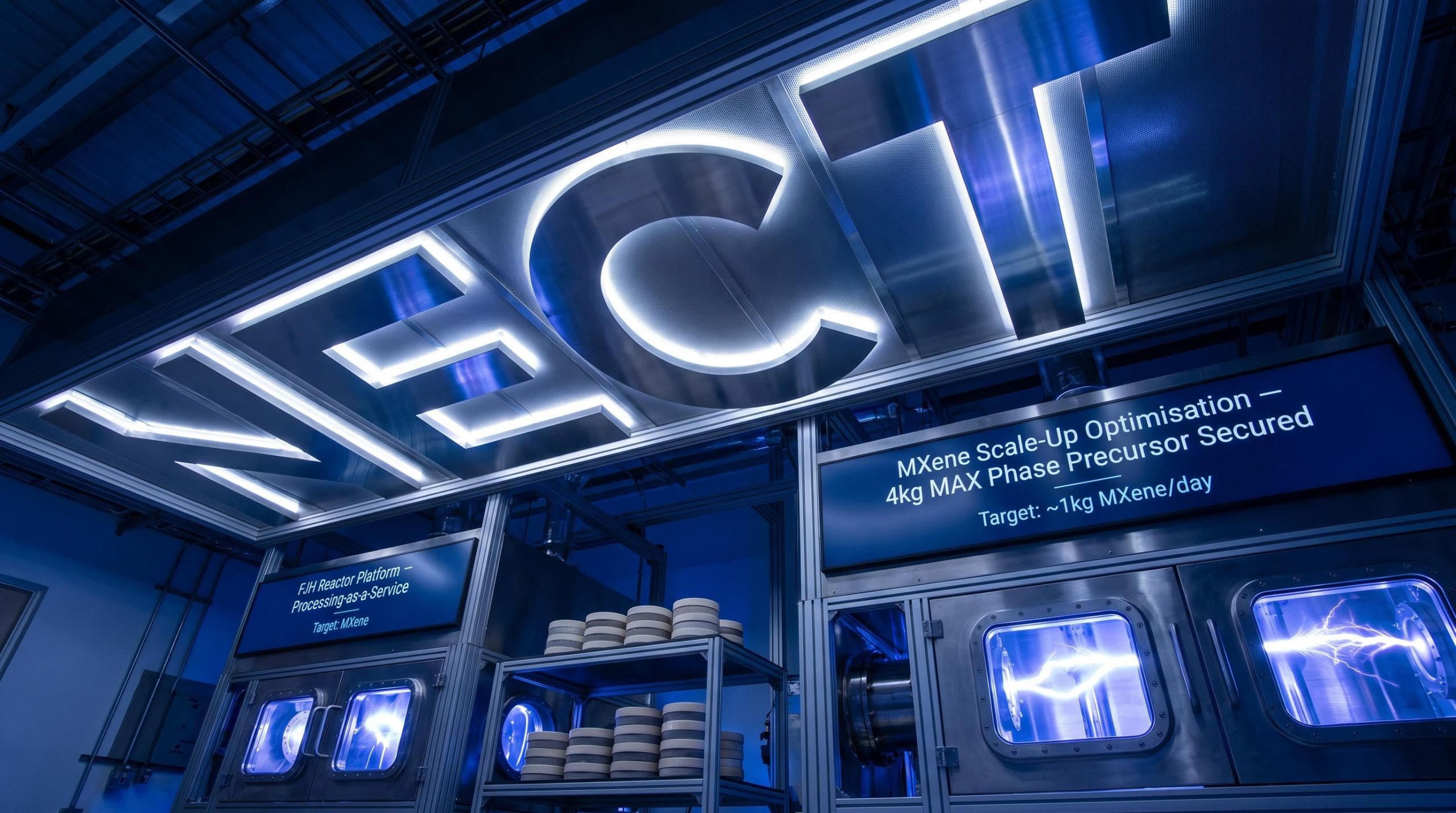
ECT secures MAX phase feedstock to launch MXene scale-up with Metallium
Environmental Clean Technologies Limited (ASX: ECT) has secured an initial 4kg supply of MAX phase precursor material, commencing scale-up optimisation testing of its Flash Joule Heating (FJH) MXene production process. The 19 August 2026 announcement marks the practical starting point for the company’s next production phase.
The testing is being conducted with Metallium Limited (ASX: MTM) at its Gator Point Technology Campus in Chambers County, Texas, pursuant to the engineering agreement announced on 4 August 2026.
The Metallium engineering agreement covers a binding 12-month term and includes an upfront US$500,000 fee plus quarterly facility access charges, with Metallium’s Gator Point site already demonstrating 83% reactor availability across a prior continuous campaign.
Securing feedstock is the gating step that unlocks the programme. With dedicated precursor material now in hand, ECT can move into a structured campaign of repeated production rather than waiting on supply lead times.
When big ASX news breaks, our subscribers know first
Supply secured — the numbers behind the deal
The initial precursor package was secured on specific commercial terms, with sourcing shaped by ECT’s defence ambitions. The key details are set out below.
-
Initial supply: 4kg of MAX phase precursor
-
Delivered cost: US$3,475 per kilogram
-
Sufficient for approximately 15–40 production runs through the initial phase
-
Sourced with ECT’s target military end-use applications in mind, with source and specification requirements for defence applications forming part of the supplier selection criteria
ECT is progressing discussions with additional parties with a view to diversifying and expanding its precursor supply relationships as the programme scales up. Precursor supply is the largest single input to MXene production, and the company describes a secure, well-priced supply base as a necessary foundation for its commercialisation strategy.
Justin Sharp, Chief Scientist and CTO
“Securing the MAX phase feedstock lets us move straight into scaleup optimisation with Metallium, without the lead time that would normally come with commissioning new reactor capacity. This is a meaningful step up from the feasibility work we completed earlier this year. Metallium’s decision to dedicate reactors to this program, combined with the process models they’ve already built up through their own operational campaigns, means we can move at a pace that isn’t typical for this industry, and without ECT having to fund or build that reactor infrastructure ourselves.”
Programme structure and the capital-light model
The mechanics of the Metallium arrangement give ECT access to a commissioned reactor platform without the capital burden of building one. The near-term programme rests on the following elements.
-
Feedstock is processed at Metallium’s Gator Point campus in Chambers County, Texas.
-
ECT retains ownership of all MXene products generated, while Metallium provides its FJH reactor infrastructure and engineering support on a processing-as-a-service basis.
-
The programme targets a near-term production capability of approximately 1kg of MXene per day once fully optimised.
-
First synthesis runs are expected to commence by October 2026.
For investors, the significance lies in speed and risk. Immediate access to a commissioned and validated reactor platform removes the time, capital and execution risk of developing equivalent capability independently, consistent with ECT’s capital-light commercialisation model.
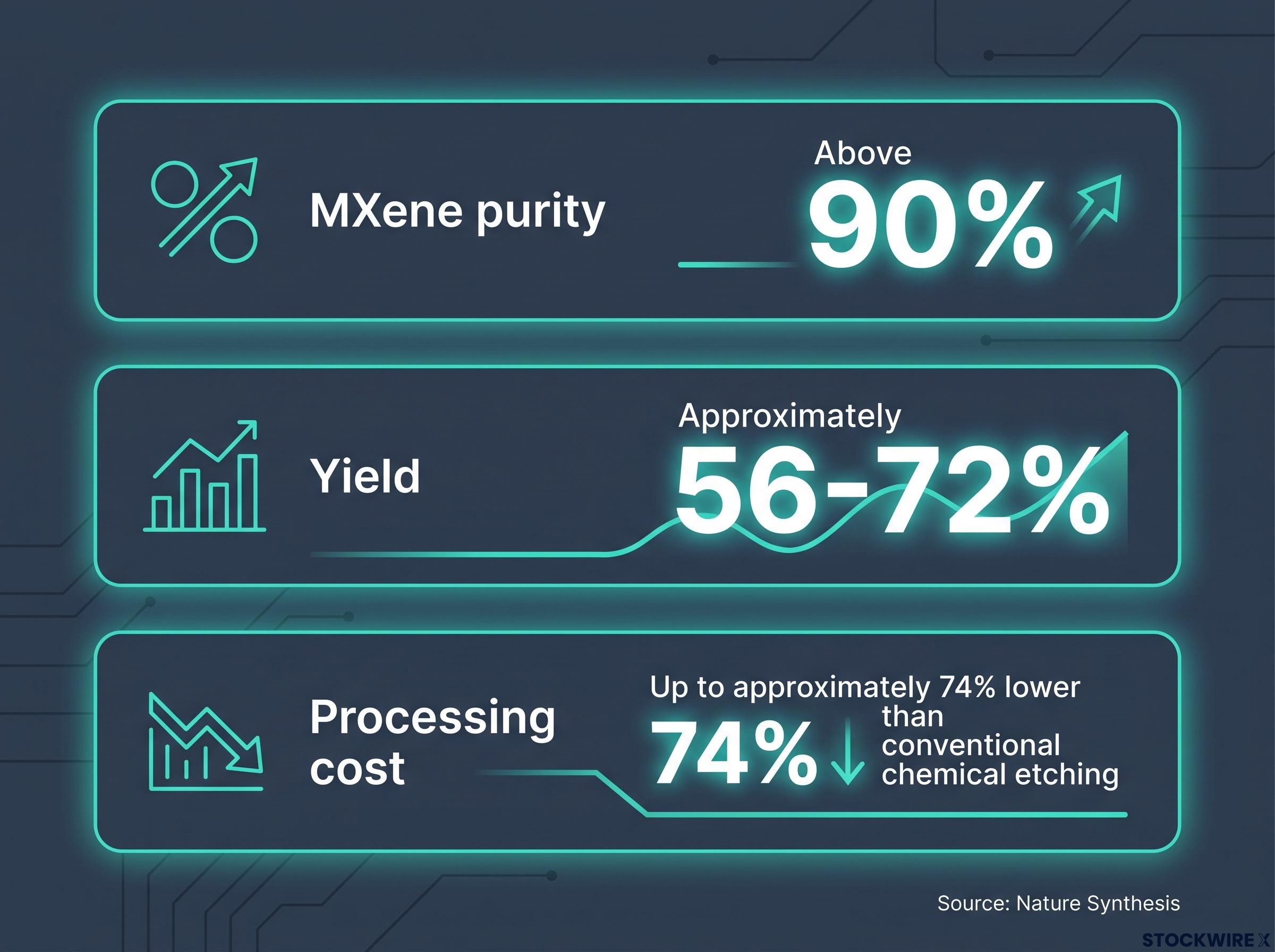
Published research supporting the FJH pathway points to meaningful advantages over conventional methods, as summarised below.
| Metric | FJH Pathway Result | Source |
|---|---|---|
| MXene purity | Above 90% | Nature Synthesis |
| Yield | Approximately 56–72% | Nature Synthesis |
| Processing cost | Up to approximately 74% lower than conventional chemical etching | Nature Synthesis |
What are MXenes — and why they matter to investors
MAX phase is the layered ceramic precursor from which MXenes are made. It is the essential input to the process, which is why securing supply is treated as the gating step for the programme to advance.
MXenes combine high conductivity with light weight, corrosion resistance, and the ability to be processed onto complex surfaces. These properties make them well suited to electromagnetic interference (EMI) shielding and defence applications.
A further attribute is tunability. According to Sharp, MXenes can be tailored across a range of properties, “which is what gives them relevance across defence, electronics and other advanced materials markets, not just one application.”
For investors, ECT frames the market’s current modest size as a supply-side constraint rather than limited demand. For more than a decade the market has been constrained not by appetite for the material but by the industry’s inability to manufacture it economically at scale, which the company sees as a structural opportunity for FJH.
Commercial opportunity and next steps
The pathway to commercialisation runs through defence, though several conditions remain outstanding. The key considerations are set out below.
-
Defence remains ECT’s initial target market.
-
MXene production is protected by various patents, and Xenica is progressing discussions to obtain a licence to enable production of MXenes for military end use, per the 4 August 2026 announcement.
The Xenica acquisition and A$12M raise announced on 4 August 2026 established the IP foundation for this programme, securing an exclusive Rice University Flash Joule Heating licence that underpins ECT’s right to produce MXenes commercially.
-
Once scaled batches have been optimised, ECT intends to work with the US Army to validate MXene quality against defence-grade requirements. This engagement has not yet been formalised, and there is no assurance validation will proceed on the timeframe or terms currently anticipated.
-
Completion of the Xenica acquisition remains subject to shareholder approval, which is expected to be sought at a shareholder meeting in or around October 2026.
With the FJH production route, access to a commissioned commercial reactor platform and precursor supply now secured, ECT is assembling each of the elements required to address the industry’s production constraint.
Don’t Miss the Next Advanced Materials Breakthrough
Big News Blast delivers FREE breaking ASX news straight to your inbox within minutes of release, complete with in-depth analysis already done for you. Join 20,000+ investors staying ahead of the market and never miss a beat. Click the “Free Alerts” button at Big News Blast to start receiving alerts the moment news breaks.