

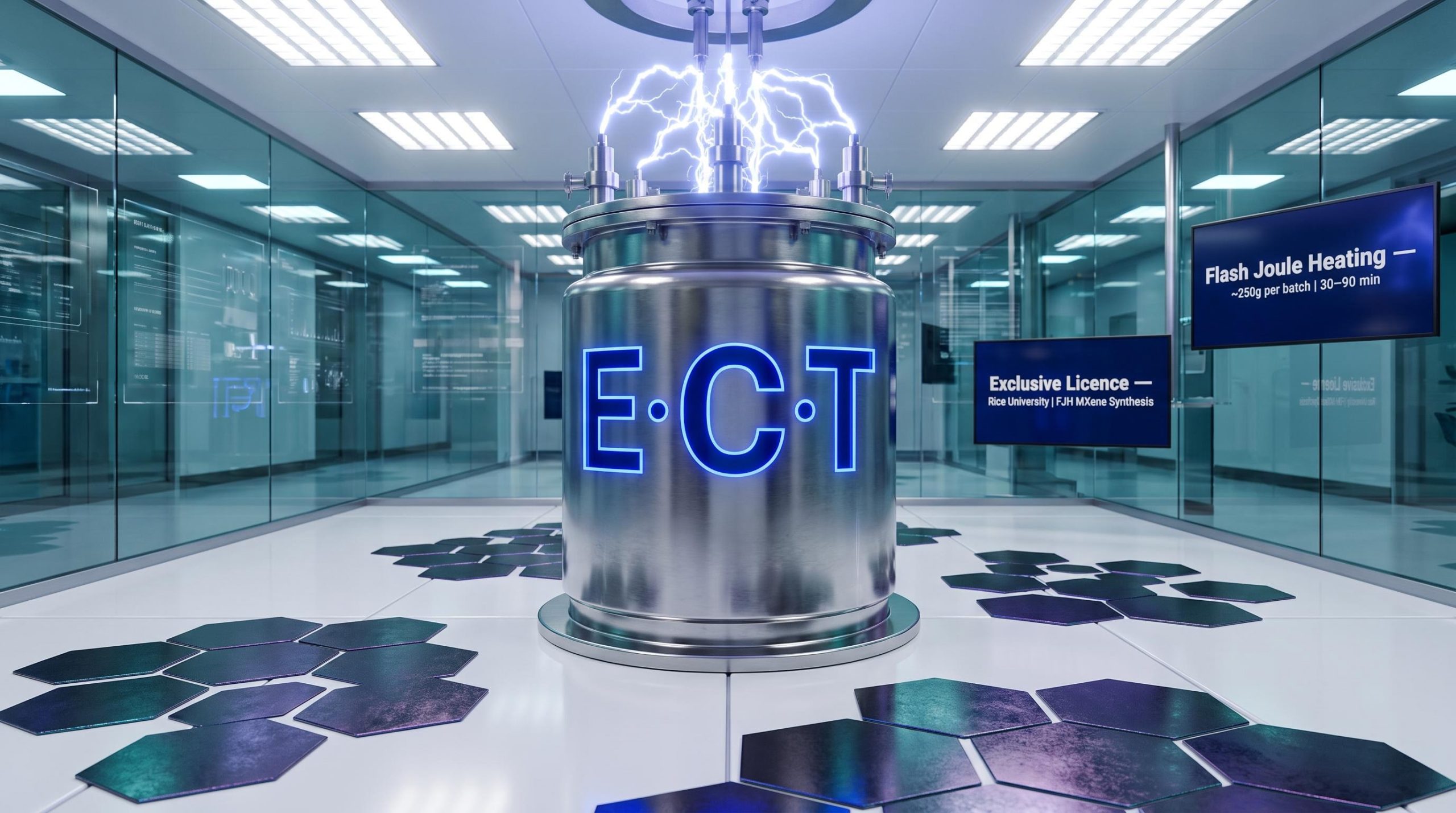
ECT outlines path to commercial-grade MXenes through Xenica acquisition and $12M raise
In its August 2026 investor presentation, Environmental Clean Technologies (ASX:ECT) detailed a strategy to acquire 100% of Xenica Materials and enter commercial-scale MXene production. The presentation outlined the proposed acquisition of Xenica for 60 million ECT shares, subject to shareholder approval, alongside firm commitments to raise A$12.0 million.
Xenica holds an exclusive licence from Rice University to use Rice’s patented Flash Joule Heating (FJH) technology for the synthesis of MXenes and 2D amorphous carbon. Management framed the move as positioning ECT to unlock a supply-constrained, high-value next-generation materials market, where demand exists today but scalable production has been the constraint.
When big ASX news breaks, our subscribers know first
What ECT is acquiring and how it’s structured
The presentation detailed ECT’s proposed acquisition of 100% of Xenica Materials Pty Ltd in exchange for 60 million ECT shares, subject to a six-month voluntary escrow and shareholder approval. The core asset is Xenica’s exclusive licence from Rice University to use Rice’s patented Flash Joule Heating (FJH) technology for the synthesis of MXenes and 2D amorphous carbon, along with its precursor MAX phases.
MXenes were discovered and patented by Drexel University, which holds various patents over the material. Xenica has identified military end use as a key market target and is in advanced discussions to secure a sub-licence enabling production for that end use. Management noted this sub-licence remains in discussion, not secured.
The 60 million consideration shares issued to the vendor are separate from the 100 million placement shares to be issued under the capital raise.
| Acquisition Consideration | Escrow Terms | Capital Raise | Use of Funds |
|---|---|---|---|
| 60M ordinary shares | 6-month escrow from issue; subject to shareholder approval | $12M placement; 100M shares at $0.12/share | FJH for MXenes; FJH for PFAS remediation and COLDry; working capital |
What are MXenes, and why supply — not demand — is the bottleneck
A tunable 2D nanomaterial
MXenes are 2D nanomaterials derived from a MAX phase precursor, first discovered at Drexel University in 2011. Their defining feature is tunability: the atomic composition can be customised, offering a rare combination of properties within a single material family. They can be deployed as an ink, film, powder or coating, or combined with other materials.
Key properties highlighted in the presentation include:
- High electrical conductivity, ideal for electronics and energy storage
- Hydrophilicity, enabling filters, membranes and pollutant removal
- Thermal conductivity, valuable for heat management in electronics
- Low infrared emissivity, effective at masking heat signatures
The commercial bottleneck
Demand signals already exist through patents, agency funding and corporate programmes. Supply, however, has been constrained by legacy production methods that are costly, slow and hazardous. As the presentation put it, the current bottleneck is production, not utility.
The strategic implication is that a company achieving cost-effective, commercially scalable production could expand the market’s size rather than simply capturing existing demand, since today’s forecasts are built on today’s supply constraints.
| Metric | CVD | Hydrofluoric Acid | Fluoride-Free | FJH |
|---|---|---|---|---|
| Output per batch | <0.1 g | 10–100 g | 1–10 g | ~250 g |
| Time per batch | ~15 mins–2 hrs | ~48–72 hrs | ~12–24 hrs | 30–90 mins |
| Scalable | ✗ | – | – | ✓ |
| Safe & non-toxic | – | ✗ | ✗ | ✓ |
| Cost-effective | ✗ | ✗ | – | ✓ |
The FJH output-per-batch figure is based on initial test work using Metallium Ltd’s test reactor on a limited precursor supply (Jose et al. 2025; Xu et al. 2026). The presentation cited a selling price of US$100+/g for high-quality US-produced Ti₃C₂Tₓ powder, with FJH claimed to reduce processing costs by ~80% versus incumbent methods, and results validated by independent third parties.
How FJH works and why defence is the first target market
Flash Joule Heating explained
The presentation described the FJH process in three stages:
- A high-current electrical pulse heats the MAX phase.
- Temperatures rise hundreds of degrees in seconds, rapidly reaching ~1,500°C.
- Rapid synthesis follows, eliminating the need for toxic chemicals.
The process was framed as “Faster | Lower energy | Cheaper,” delivering a 30–90 minute processing time. As a proof point that the pathway scales, the presentation referenced Universal Matter, a Rice University / Tour Lab spin-out backed by Westlake Corp, which uses the same FJH platform to produce turbostratic graphene at industrial scale.
Defence as first commercial market
Management identified defence as the first target commercial market, citing premium, price-inelastic demand. The radar-absorbing materials market is expected to reach US$4.3bn by 2033, of which defence represents approximately 47%.
A one-micron-thin MXene coating was described as delivering EMI shielding, infrared camouflage and thermal management together, applicable to almost any surface. The presentation noted that bulk purchase orders from US DoW contractors already exist, indicating contracted rather than hypothetical demand. Production for military end use remains subject to the Drexel sub-licence currently in discussion.
The assembled path to first product
The presentation framed ECT’s positioning as an assembled path combining intellectual property, manufacturing access and scale into a practical route to first product.
- Rice University licence [SECURED] — exclusive licence to FJH MXene synthesis, the foundation of the production pathway.
- Metallium R&D and engineering agreement [SECURED] — a 12-month R&D and engineering agreement with Metallium Limited (ASX:MTM), providing access to the permitted Gator Point FJH facility under a capital-light model. The presentation noted validated 250g batches in 30–90 minutes based on third-party facility data.
- Drexel sub-licence [IN DISCUSSION] — the route to the military demand channel, not yet secured.
Strategic positioning
“ECT: the assembled path to first product.”
Broader market opportunity and ECT’s portfolio
Markets beyond defence
Beyond defence, the presentation identified civilian applications where adoption is gated by scalable supply rather than demand. These include consumer electronics (Samsung, LG and Murata have explored MXene electrodes), energy storage (over US$40m of US Department of Energy funding since 2023), medical and bioelectronics, and industrial filtration.
Medium-term addressable markets cited include EMI shielding at US$8.7bn (2026), PFAS treatment at US$3.0bn (2026), supercapacitors at US$1.4bn (2025), and flexible sensors at US$6.5bn (2024). These are third-party estimates, with methodologies that vary across sources.
A growing technology portfolio
The MXene licence adds to ECT’s existing pipeline:
- MXenes via FJH [NEW] — exclusive licence to synthesise MXenes and 2D amorphous carbon, following completion of the Xenica acquisition.
- REM [IN TESTING] — Rapid Electrothermal Mineralisation, licensed to destroy PFAS in soil and granular activated carbon.
- COLDry [IN REVIEW] — drying and pelletising technology progressing through commercialisation review.
Funding, use of proceeds and post-raise ownership
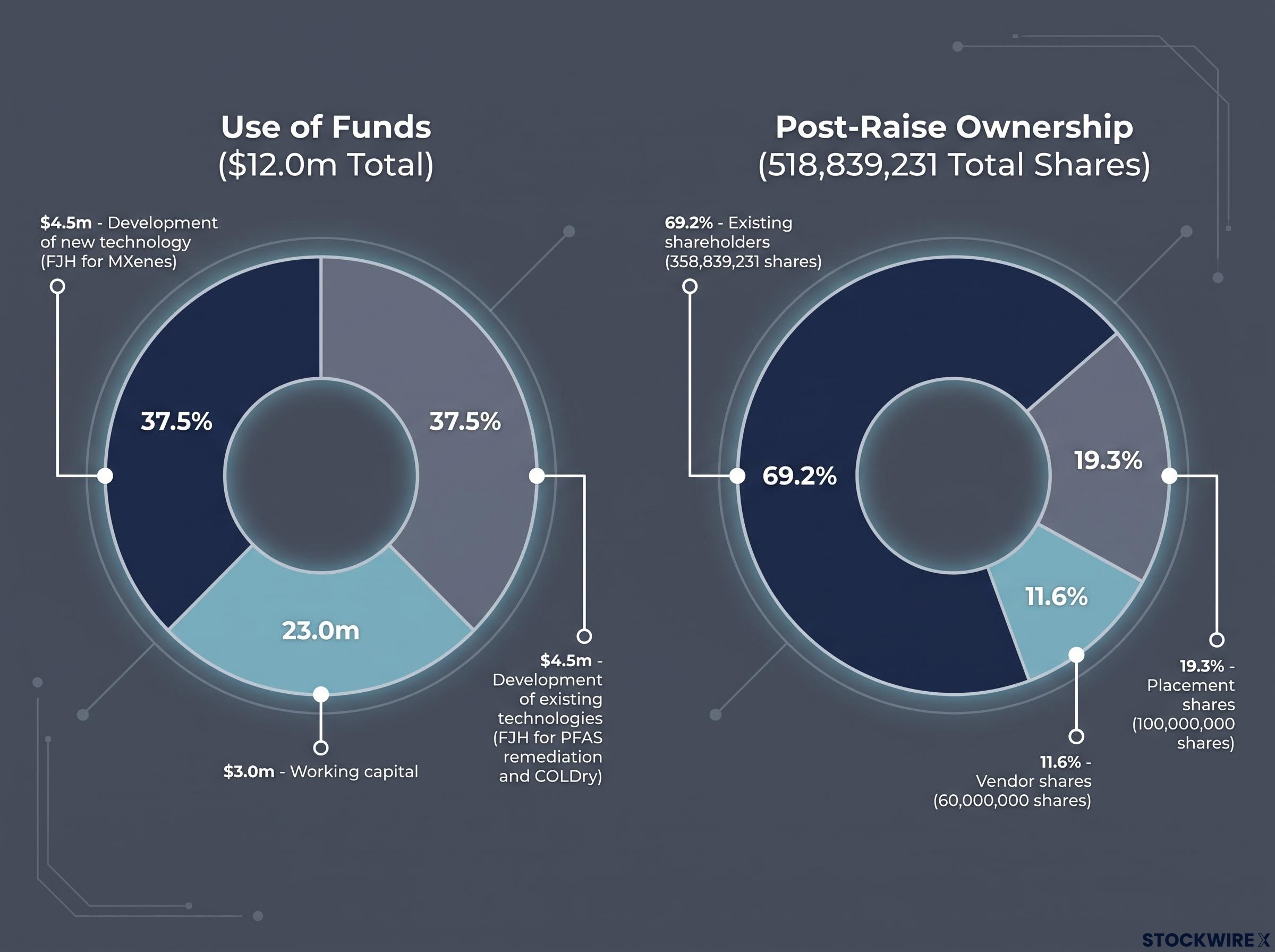
ECT has received firm commitments to raise A$12.0 million via a two-tranche placement priced at $0.12 per share. Tranche 1 will raise $10.6 million through 88.7 million shares under existing Listing Rule 7.1 and 7.1A placement capacity. Tranche 2 will raise the balance of $1.4 million through 11.3 million shares, subject to shareholder approval.
| Use of Funds | $m |
|---|---|
| Development of new technology (FJH for MXenes) | $4.5m |
| Development of existing technologies (FJH for PFAS remediation and COLDry) | $4.5m |
| Working capital | $3.0m |
| Total | $12.0m |
On a post-raise basis, existing shareholders would hold 69.2% (358,839,231 shares), vendor shares 11.6% (60,000,000), and placement shares 19.3% (100,000,000), for a total of 518,839,231 shares.
The presentation noted that both the acquisition and the Tranche 2 placement remain subject to shareholder approval. No forward earnings figures were disclosed, and the 12-month Metallium agreement remains the primary near-term development milestone outlined.
Don’t Miss the Next Advanced Materials Breakout
Big News Blast delivers FREE breaking ASX news directly to your inbox within minutes of release, complete with in-depth analysis already done for you. Join 20,000+ investors who stay ahead of market-moving announcements across tech, manufacturing and beyond. Click the “Free Alerts” button at Big News Blast to make sure the next major ASX story lands in your inbox first.