

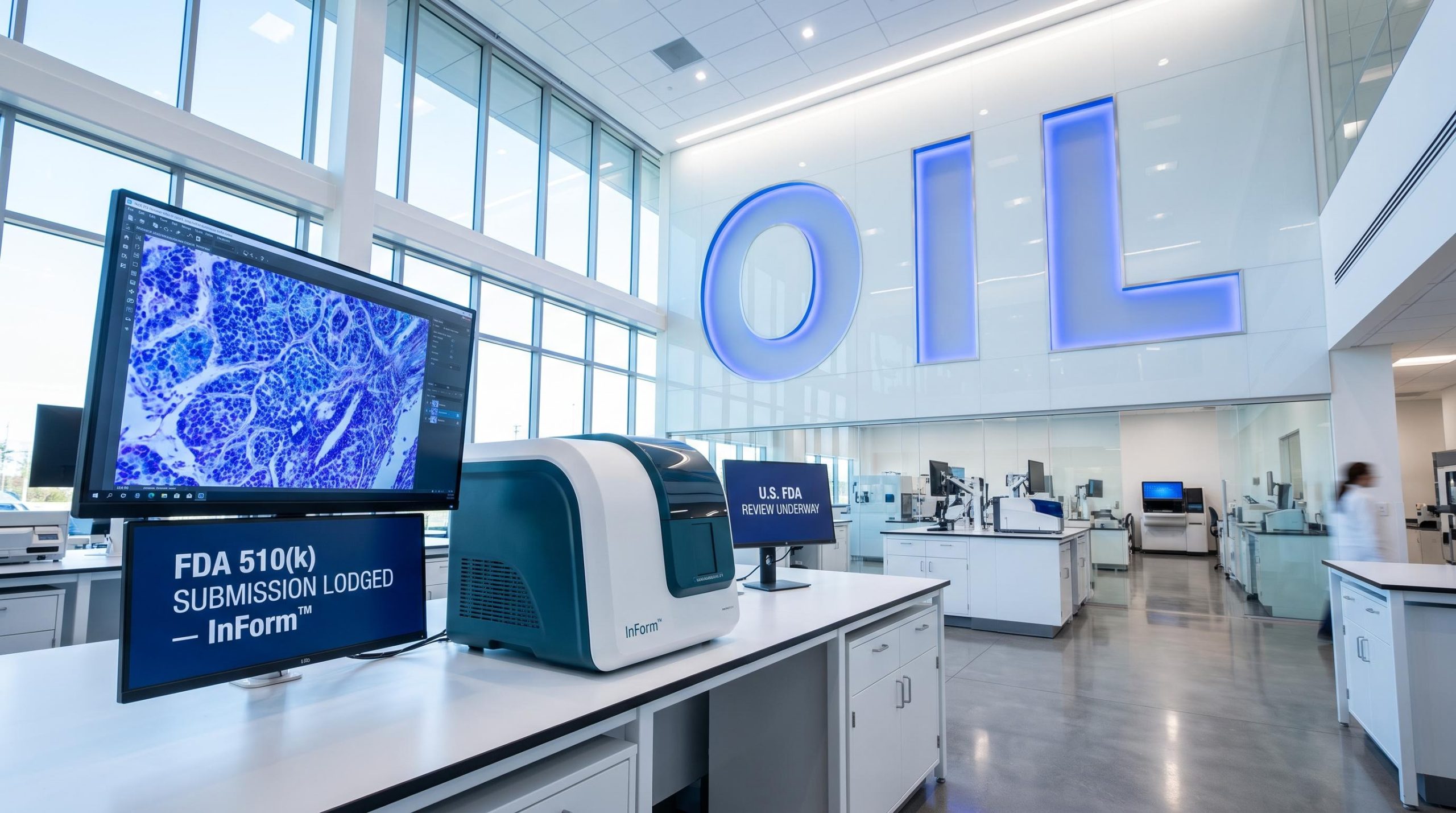
FDA submission lodged — InForm™ enters formal U.S. regulatory review
Optiscan Imaging Ltd (ASX: OIL) has lodged a 510(k) submission with the U.S. Food and Drug Administration (FDA) for its InForm™ digital pathology device, the company announced on 1 October 2026. The filing moves InForm™ beyond its internal development, testing and validation phase and into a formal FDA assessment process, marking the culmination of substantial technical, clinical and regulatory work since the device was unveiled in February 2025.
The InForm real-world case dataset assembled at Australian Clinical Labs across 84 cases and 13 tissue types was a direct input into the regulatory dossier now under FDA review, covering presentations from breast to skin and benchmarked against standard H&E-stained glass slide detail.
Successful clearance through this pathway is a necessary prerequisite for InForm™ to be commercially distributed and used within the U.S. market.
When big ASX news breaks, our subscribers know first
What is a 510(k) submission — and why does it matter?
A 510(k) is a premarket submission made to the FDA to demonstrate that a new medical device is substantially equivalent to a legally marketed predicate device that is already FDA-cleared. “Substantial equivalence” means the new device has the same intended use and the same or similarly safe and effective technological characteristics as the predicate.
For investors unfamiliar with the process, the pathway proceeds in structured stages:
- Acceptance assessment — The FDA conducts an initial review to confirm the submission is administratively complete and suitable for substantive evaluation.
- Substantive review — The agency assesses the device’s technical specifications, performance data, clinical evidence, and supporting documentation.
- Potential queries — The FDA may seek clarification or request additional information from the applicant before making a final determination.
- Determination — The FDA issues its decision; a positive determination grants 510(k) clearance, enabling commercial distribution for the device’s cleared indications.
As illustrated in Optiscan’s milestone progress chart (Figure 3 of the announcement), InForm™ now sits at the FDA submission stage, with regulatory clearance and commercial deployment the two remaining milestones ahead. This is a structured process, not a guarantee of clearance, but Optiscan has indicated it anticipates working directly with the FDA should additional data be requested during the review.
InForm™ — targeting a US$10.6 billion analogue market ripe for disruption
The U.S. anatomic pathology market was valued at approximately US$10.6 billion in 2025 and is forecast to reach US$15.35 billion by 2030, according to Grand View Research, as cited in the announcement. Pathology remains a largely analogue discipline, with conventional workflows still dependent on tissue processing and the preparation of glass slides reviewed under a physical microscope.
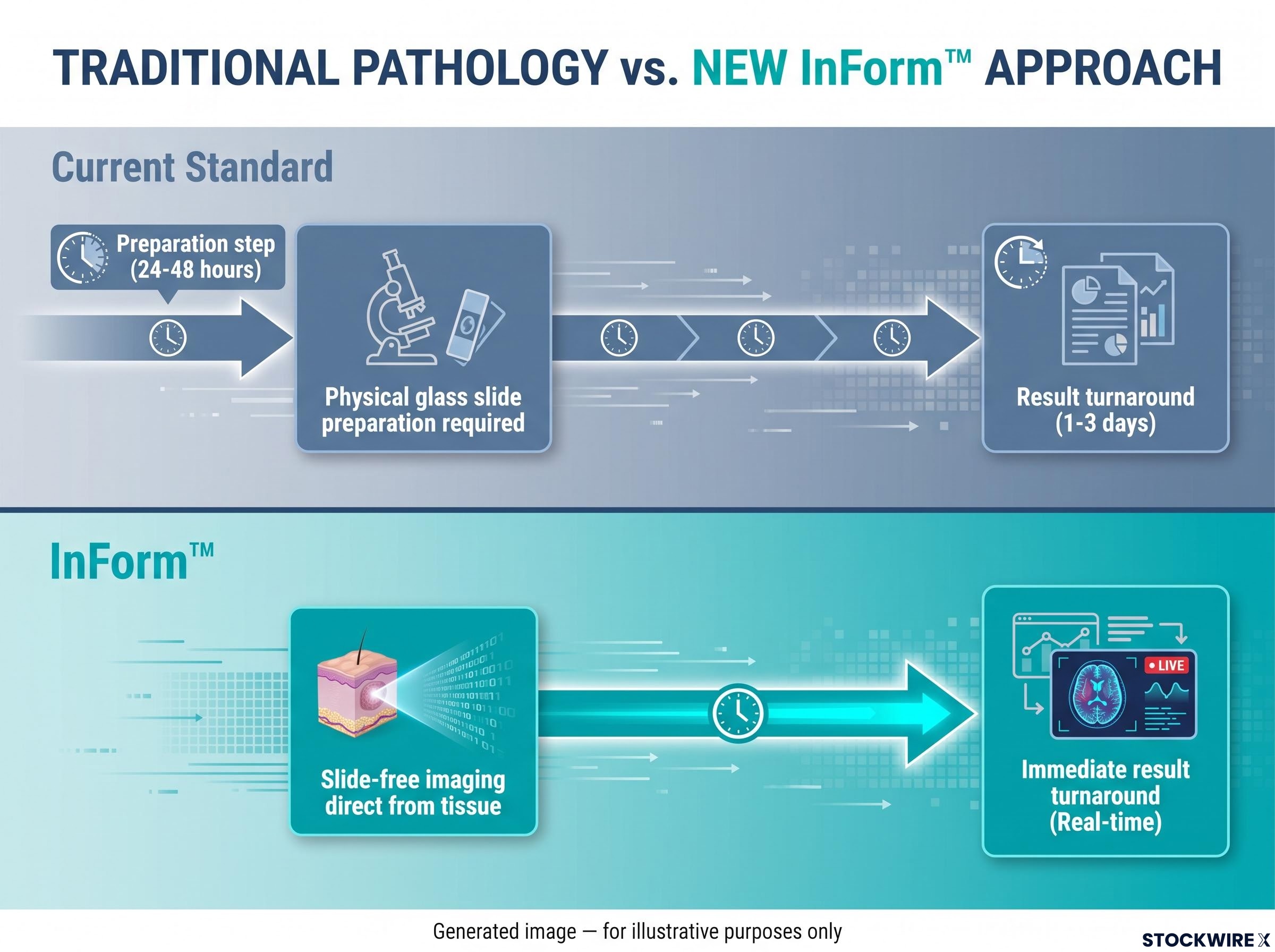
Digital pathology is beginning to reshape these workflows, but most existing solutions focus on digitising prepared glass slides after the fact. InForm™ takes a fundamentally different approach: the device enables real-time, slide-free digital microscopic imaging reviewed directly from freshly excised tissue at the point of contact, or from tissue fixed in preservatives commonly used in pathology laboratories.
As illustrated in Figure 2 of the announcement, this workflow compression is substantial. Under the current standard of care, a biopsy is prepared and sent to a laboratory (taking 24 to 48 hours), analysed, and then results returned (taking a further 1 to 3 days). With InForm™, imaging results are available immediately at the point of contact.
This positions Optiscan as an early mover in an emerging segment of digital pathology, with the potential to establish a new point of use within the workflow rather than compete solely within the existing slide-scanning market. The company acknowledges that this first-mover position is likely to be accompanied by a longer adoption curve, given clinical validation, workflow integration and user acceptance will be required before technological differentiation translates into meaningful commercial adoption. Optiscan notes it retains a significant competitive advantage given the super-high resolution, speed and cost effectiveness of its imaging platform.
| Dimension | Current Standard | InForm™ | Time Impact | Clinical Benefit |
|---|---|---|---|---|
| Tissue processing | Physical glass slide preparation required | Slide-free imaging direct from tissue | Eliminates 24–48 hour preparation step | No tissue destruction for imaging step |
| Imaging location | Centralised pathology laboratory | Point of contact / point of use | Immediate availability | Earlier access to microscopic information |
| Result turnaround | 1–3 days post-preparation | Real-time | Days reduced to immediate | Faster clinical decision-making potential |
| Tissue type | Fixed or processed tissue on slides | Fresh or fixed tissue at point of contact | No processing delay | Imaging from freshly excised tissue possible |
| Workflow position | Post-biopsy, post-lab processing | At point of biopsy or tissue contact | Upstream shift in workflow | Potential for new clinical use cases |
Beyond InForm™ — regulatory progress strengthens Optiscan’s broader platform
The work required to prepare the InForm™ 510(k) submission has materially strengthened Optiscan’s organisational capabilities across regulatory affairs, clinical development, quality systems, engineering, manufacturing and operational execution. These capabilities are now expected to benefit the broader product portfolio, with the potential to improve execution, reduce duplication and accelerate future regulatory submissions.
During the FDA review period, Optiscan intends to maintain active parallel workstreams:
- Continuing clinical studies to expand the evidence base for InForm™
- Building its clinical reference network
- Deepening engagement with pathology customers and institutions
- Engaging with potential commercial partners
- Preparing for market entry
Optiscan’s initial commercial focus is expected to centre on clinical reference sites, stakeholder engagement, and demonstrating workflow and economic value, before progressing to broader rollout.
Dr Camile Farah, CEO and Managing Director, Optiscan
“Lodgement of InForm™’s 510(k) submission with the FDA represents a key deliverable in our pathology device’s development strategy. InForm™ represents one of the most exciting opportunities within our portfolio. The device is not just digitising an existing pathology process. It has real potential to change where and when microscopic information becomes available for clinical use. Submitting our FDA submission brings us closer to introducing a fundamentally different workflow into the U.S., one of the world’s largest pathology markets. While InForm™’s regulatory approval process is progressed, Optiscan and its collaborators will continue to generate valuable clinical evidence that will be critical in demonstrating where InForm™’s value – and also that for our other devices – can be realised.”
Dr Camile Farah, CEO and Managing Director, Optiscan
“Achievement of this submission milestone would not have been possible without the inhouse skillsets Optiscan now possesses. The quality of our people, systems, regulatory capabilities, clinical experience and manufacturing readiness have been enhanced over time, and are now at the standard required to move our complex medical technology platform towards market. These capabilities, which have so effectively progressed InForm™’s development strategy, will now be drawn on as Optiscan advances future regulatory submissions, and builds its existing stable of commercial partnerships, both of which are central to the Company effectively executing its broader growth strategy with speed and confidence.”
What investors should watch for next
The 510(k) clearance, if granted, would enable commercial distribution of InForm™ across the U.S. for its cleared indications, representing a major transition from clinical and regulatory development toward commercialisation in one of the world’s largest healthcare markets.
The forward milestone sequence for investors to monitor is as follows: FDA acceptance assessment, substantive review, potential agency queries, and final determination. Optiscan has stated it anticipates working directly with the FDA on any additional data requests that may arise during the review.
Clinical studies will continue in parallel throughout this period, further expanding InForm™’s evidence base and supporting its broader development trajectory. A positive FDA determination would represent the next major value inflection point for the company.
The Mayo Clinic lumpectomy study, which opened recruitment for 35 US patients and evaluated both InVue and InForm within a single integrated surgical-pathology workflow, was among the US clinical programs designed to support the 510(k) evidence package submitted to the FDA.
Don’t Miss the Next Healthcare Breakthrough
Big News Blast delivers FREE breaking ASX healthcare news directly to your inbox within minutes of release, complete with in-depth analysis. Join 20,000+ investors already staying ahead of the market. Click the “Free Alerts” button at Big News Blast to start receiving alerts the moment market-moving news breaks.