

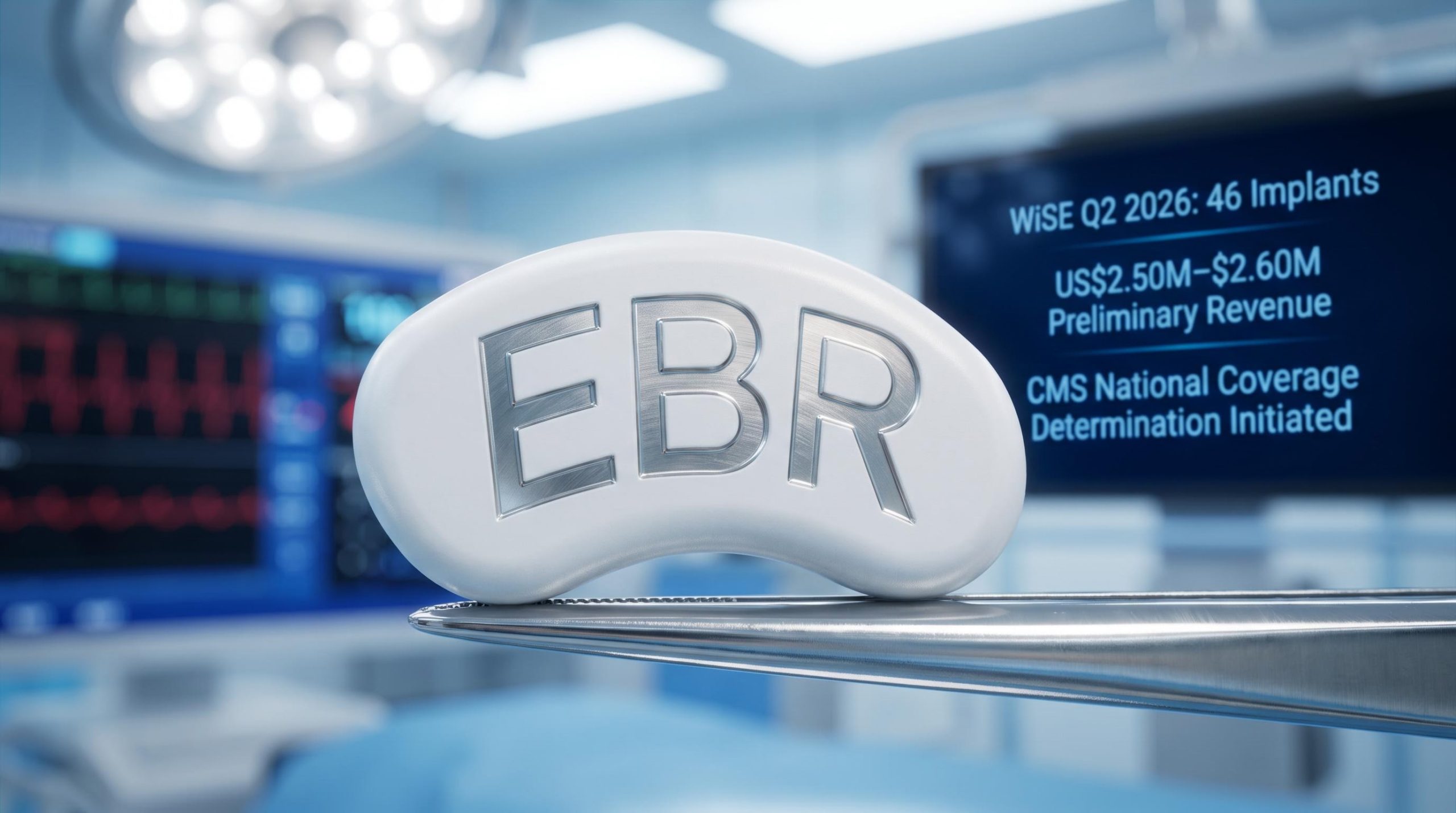
Q2 2026 commercial rollout delivers 46 new WiSE implants and revenue guidance
In its preliminary commercial activity update for the quarter ended 30 June 2026, EBR Systems reported 46 WiSE commercial implants completed during Q2 2026, lifting total implants across the pilot phase and Limited Market Release (LMR) to 117.
The company, which describes itself as the developer of the world’s only wireless cardiac pacing device for heart failure, expects to report revenue in the range of US$2.50M to US$2.60M for the quarter. These figures are preliminary, unaudited, and subject to quarter-end closing adjustments.
The update points to continued momentum in the early commercial adoption of a first-of-kind cardiac device, with growing physician training, purchasing contracts and institutional access underpinning the US rollout.
When big ASX news breaks, our subscribers know first
Q2 2026 commercial performance
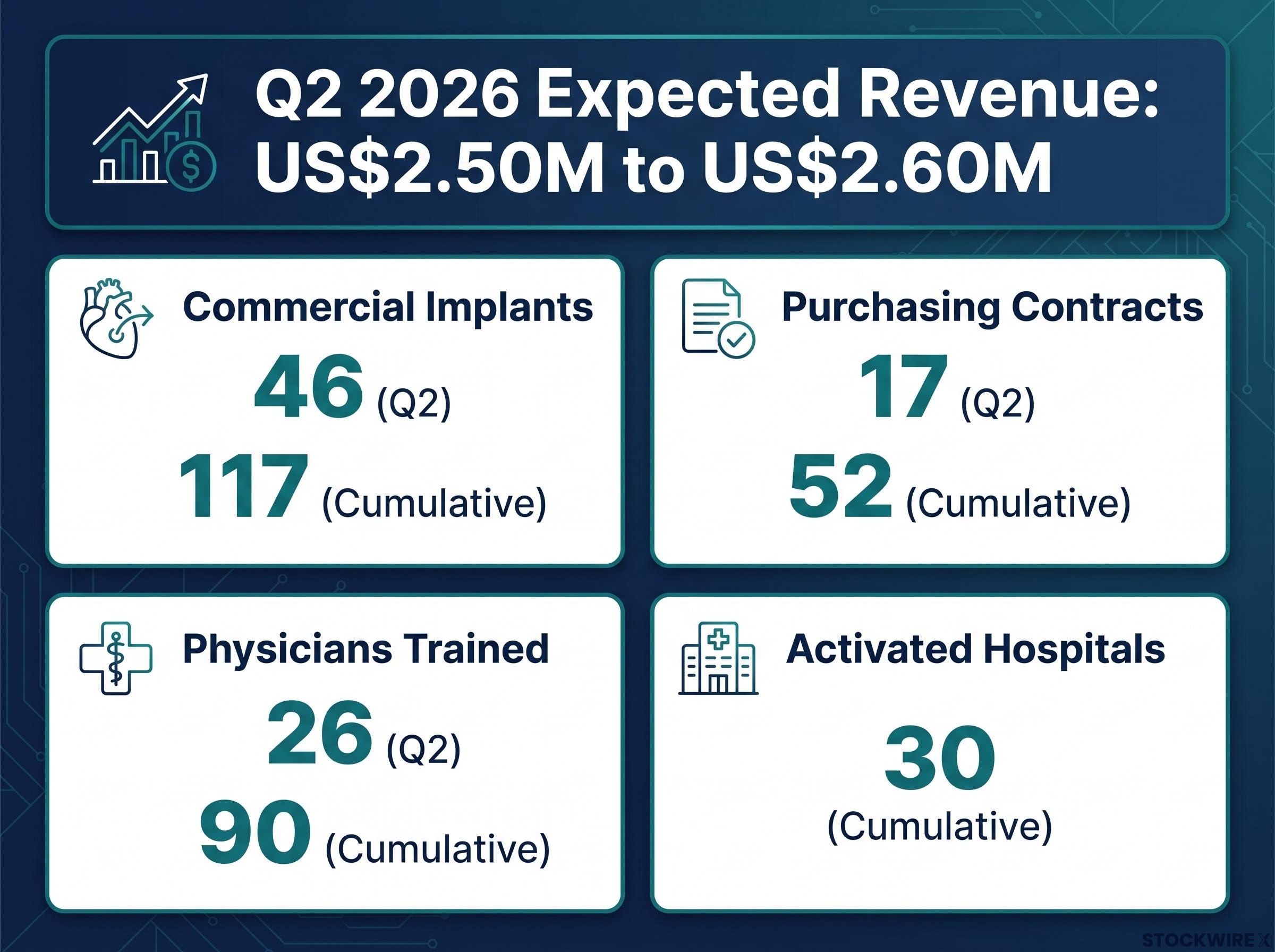
EBR recorded steady operational progress across the quarter, signing new purchasing contracts, training additional physicians and expanding its activated account base. The following metrics summarise activity for Q2 2026 alongside cumulative totals.
WiSE Q1 2026 implant growth saw EBR complete 41 commercial procedures and report preliminary revenue of US$2.25-2.36 million, establishing the sequential baseline against which the Q2 figures now show continued momentum.
| Metric | Q2 2026 | Cumulative |
|---|---|---|
| Commercial implants | 46 | 117 |
| New purchasing contracts | 17 | 52 |
| Physicians trained | 26 | 90 |
| Activated hospitals | — | 30 |
| Sites with 3+ implants | — | 17 |
Additional context from the quarter includes:
-
87 implants were completed during calendar year 2026 to 30 June.
-
More than half of activated accounts have now completed three or more WiSE implants.
-
A total of 90 physicians across 30 sites are now trained to implant the WiSE System.
EBR noted that this activity reflects continued physician demand and institutional recognition of the clinical and economic benefits of the technology. The company believes these are the most important early performance indicators for predicting durable commercial success.
Strategic shift to deeper utilisation
With more sites contracted, activated and staffed than initially anticipated at this stage of the LMR, EBR is deliberately de-emphasising the signing of new sites and the training of new physicians. Instead, the commercial team is being directed to focus on driving deeper utilisation within existing activated accounts.
The company framed this as a disciplined approach to scaling, supporting repeat procedural experience, internal field capability and more consistent case scheduling rather than a slowdown in demand.
John McCutcheon, President & Chief Executive Officer
“Given the greater-than-anticipated number of sites contracted, sites activated, and physicians trained at this stage of the LMR, we are directing our commercial team to de-emphasise signing additional sites and training new physicians and to focus more on driving deeper utilisation within existing accounts. This disciplined approach is designed to support sustainable commercial adoption as we continue to scale our field support, training and operational capabilities.”
What is WiSE and why it matters
WiSE stands for Wireless Stimulation Endocardially. According to EBR, it is the world’s only wireless, endocardial (inside the heart) pacing system in clinical use for stimulating the heart’s left ventricle.
The implant is described as roughly the size of a large grain of rice. Its design eliminates the need for pacing leads, which have historically been the major source of complications, effectiveness and reliability issues in cardiac rhythm disease management.
The initial product targets heart failure patients requiring Cardiac Resynchronisation Therapy (CRT), a treatment that helps the heart’s chambers beat in a more coordinated rhythm. WiSE is an investigational device in most markets and is currently only available for sale in the US.
For investors, the leadless design differentiates EBR within a large CRT market and underpins the clinical and economic case that hospitals are beginning to recognise.
Funding, reimbursement and purchasing access
The quarter delivered progress across three developments spanning the balance sheet, reimbursement and hospital access.
Capital raise
During Q2 2026, EBR partially completed a fully underwritten A$150 million capital raise, with the final A$35 million underwritten tranche expected to be completed by 24 August 2026.
The company stated the funding supports its pathway to cashflow breakeven and continued US commercial scale-up. It also strengthens the balance sheet and supports ongoing investment in sales and marketing expansion, manufacturing scale-up, cost of goods reduction and continued research and development.
Medicare coverage pathway
CMS formally initiated the National Coverage Determination process for WiSE during the quarter. EBR described this as a key milestone in its pathway toward broader Medicare coverage and expanded patient access.
The Medicare NCD review, formally initiated by CMS on 3 June 2026, carries a projected Final NCD date of 3 March 2027 and represents one of the most consequential near-term catalysts for expanding the addressable patient population beyond current reimbursement pathways.
Hospital network purchasing agreements
EBR secured purchasing agreements with three major US healthcare networks, establishing purchasing pathways to support broader hospital access as the US commercial rollout continues:
-
HCA Healthcare
-
Advocate Health
-
CHRISTUS Health
Further detail on these developments is expected in the company’s Q2 2026 Quarterly Activity Report and Form 10-Q.
Active investor and clinical engagement
EBR maintained investor, media and industry engagement throughout the quarter to support market understanding of its commercial scale-up strategy and the clinical role of the WiSE System.
In April, the company participated in Heart Rhythm 2026 in Chicago, the major global electrophysiology meeting, engaging with physicians and industry stakeholders around leadless left ventricular endocardial pacing.
Of note, Dr Niraj Varma of the Cleveland Clinic presented on real-world outcomes from the initial US commercial implants. The headline result was a halving of the overall complication rate seen in the SOLVE study, from 19.1% down to 10%.
Following the June capital raise, EBR undertook media interviews and investor-facing commentary focused on its strengthened funding position, the CMS National Coverage Determination process, the purchasing agreements with major US healthcare networks and the broader WiSE commercial rollout. For investors, the independent clinical data reinforces the safety and adoption thesis underpinning early commercial uptake.
Outlook and next steps
EBR continues to see positive demand for WiSE, with encouraging numbers of patients being identified and scheduled for H2 2026. The final A$35 million tranche of the capital raise is expected to be completed by 24 August 2026.
The company expects to provide further detail in its Q2 2026 Quarterly Activity Report and Form 10-Q. Senior management will also host an investor webinar on Friday 31 July 2026 at 10:00am AEST to discuss the results and the recent announcement regarding online speculation around a complication.
Taken together, the quarter reflects disciplined LMR execution, emerging revenue, a progressing reimbursement pathway and a strengthened balance sheet, positioning EBR for the next phase of its US commercial scale-up.
Don’t Miss the Next Healthcare Breakthrough on the ASX
Big News Blast delivers FREE breaking ASX healthcare news directly to your inbox within minutes of release, complete with in-depth analysis. Join 20,000+ subscribers already staying ahead of the market on ASX healthcare stocks. Click the “Free Alerts” button at Big News Blast to get the next market-moving announcement the moment it drops.