

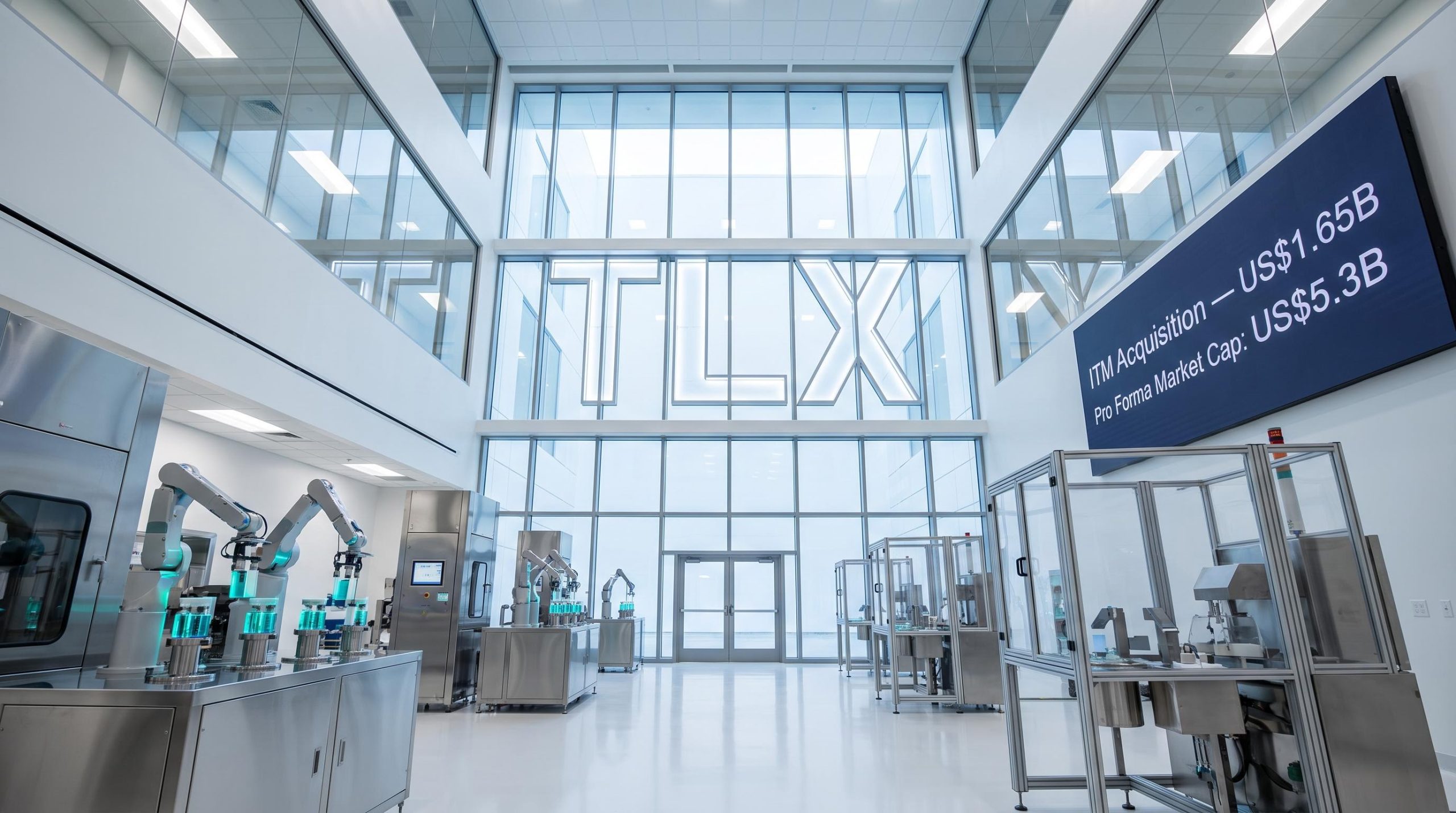
Telix acquires ITM to create a vertically integrated radiopharmaceutical powerhouse
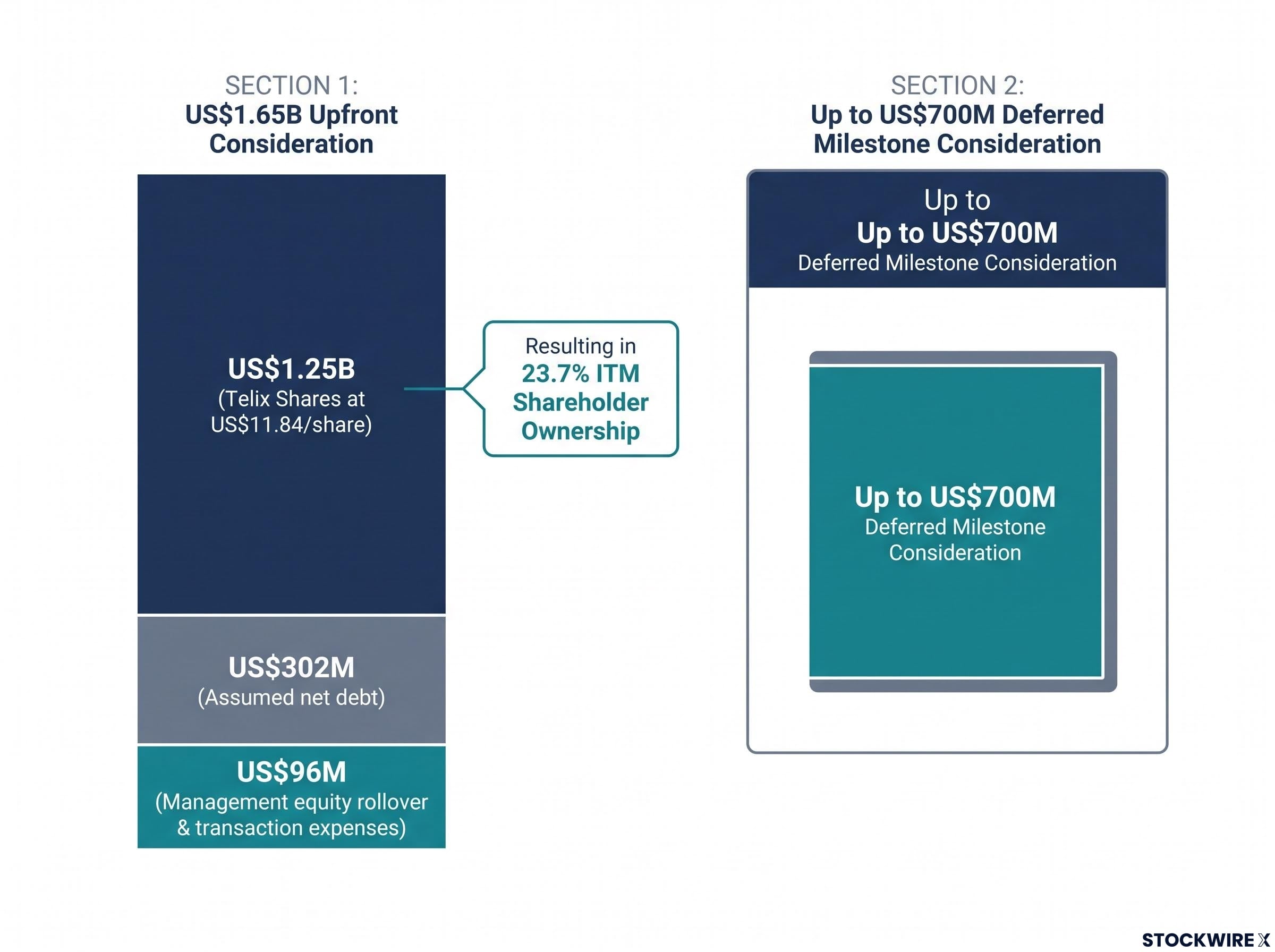
In its September 2026 investor presentation, Telix Pharmaceuticals outlined the strategic rationale for its proposed acquisition of ITM Isotope Technologies Munich SE, a transaction that would create a vertically integrated radiopharmaceutical company spanning manufacturing, therapeutics, and commercial precision medicine. The upfront consideration stands at US$1.65B on a cash-free/debt-free basis, with up to a further US$700M in deferred milestone consideration contingent on future regulatory and sales outcomes.
The presentation detailed a combined pro forma market capitalisation of US$5.3B, with the transaction expected to close by end of FY2026, subject to Telix Shareholder approval at an Extraordinary General Meeting (EGM) planned for November 2026.
The upfront consideration comprises approximately US$1.25B paid in Telix Shares at US$11.84 per share (released as Nasdaq ADRs after an escrow period), US$302M in assumed net debt, and US$96M in management equity rollover and transaction expenses payable by the sellers. Upon close, ITM Shareholders are expected to own 23.7% of Telix shares on issue, subject to escrow restrictions of up to 15 months.
When big ASX news breaks, our subscribers know first
What ITM brings to the table
The presentation positioned ITM as the world’s largest supplier of lutetium-177 (177Lu), with a commercially scaled, validated manufacturing and distribution platform spanning more than 65 countries and over 400 destinations weekly. ITM recorded US$273M in audited revenue for 2025, with unaudited H1 2026 revenue of US$156M, reflecting approximately 40% CAGR from 2021 to 2025 according to the presentation’s chart data.
ITM’s radioisotope platform is built around three pillars: 177Lu at commercial scale, 225Ac (actinium-225) being developed via the Actineer joint venture as a next-generation alpha-emitting isotope, and 161Tb (terbium-161) as a future growth opportunity. ITM is also the primary external supplier of 177Lu for Novartis’s Pluvicto, and the acquisition would secure supply for Telix’s own late-stage therapeutic pipeline, including TLX591-Tx, TLX597-Tx, and TLX250-Tx.
TLX591-Tx Phase 3 safety data released in March 2026 confirmed no treatment-related deaths and no new safety signals when combined with abiraterone, enzalutamide, or docetaxel across 36 patients, clearing the path for a 490-patient pivotal efficacy expansion and an FDA IND amendment submission.
ITM operational snapshot:
- US$273M revenue (2025 audited)
- 2x GMP manufacturing sites
- Approximately 850 employees
- >99% order fulfilment rate (2025)
- 24–48hr delivery within EU/US; 72hr across 65 countries
Understanding the radiopharmaceutical opportunity — why this market is accelerating
Radiopharmaceuticals are medicines that combine a targeting molecule with a radioactive isotope to deliver radiation precisely to cancer cells. The field is sometimes referred to as theranostics, a term combining therapy and diagnostics, reflecting the dual role these agents can play in both treating and imaging disease.
Lutetium-177 (177Lu) is a beta-emitting isotope that has been commercially validated through Novartis’s Pluvicto in prostate cancer and through somatostatin receptor (SSTR)-targeted therapies in neuroendocrine tumours (NETs). A key practical constraint in this field is the extremely short half-life of radioisotopes, which demands specialist logistics and just-in-time delivery to ensure product integrity at the point of treatment.
This supply chain complexity is precisely where ITM’s manufacturing and distribution infrastructure creates strategic value. The presentation highlighted that ITM’s manufacturing division is expected to generate FY2026 annualised EBITDA of US$106M (unaudited, based on H1 2026), illustrating how vertical integration can transform supply chain management from a cost and risk factor into a direct earnings contributor.
ITM-11 — the therapeutic catalyst with a US$1.7B addressable market
ITM-11 is a novel SSTR-targeted radiopharmaceutical incorporating edotreotide and no-carrier-added (n.c.a.) 177Lu, developed for the treatment of gastroenteropancreatic neuroendocrine tumours (GEP-NETs). The Phase 3 COMPETE trial demonstrated a statistically significant improvement in median progression-free survival (PFS) of 23.9 months for ITM-11 versus 14.1 months for everolimus, with a stratified hazard ratio of 0.673 (p=0.0223). These results were published in The Lancet in July 2026.
The safety profile was also notable. Grade 3/4 treatment-related adverse events occurred in 18% of ITM-11 patients compared with 40% for the everolimus arm. The presentation noted that the U.S. addressable market for drug-treated GI and pancreatic NETs is estimated at US$1.7B, covering approximately 25,400 drug-treated patients, while global annual sales for currently approved SSTR-targeted radioligand therapies are estimated at US$800M (management estimate).
On 7 August 2026, ITM received a Complete Response Letter (CRL) from the FDA. The presentation noted the CRL was limited to Chemistry, Manufacturing and Controls (CMC) and third-party commercial facility inspection items, with no clinical safety or efficacy issues identified and no additional clinical or nonclinical data requested. ITM intends to resubmit the NDA, with timing subject to remediation and FDA interaction. Resubmission, or a Telix/ITM agreed path-forward, is a closing condition for the transaction.
The CMC-related FDA resubmission process Telix navigated for Pixclara earlier in 2026 offers a useful reference point for the ITM-11 NDA resubmission now underway: both cases involved Complete Response Letters that raised manufacturing and controls issues without requesting additional clinical data, and the Pixclara outcome demonstrates that remediation and resubmission can proceed on a defined timeline.
Milestone payment structure
- Milestone #1: US$100M — FDA approval for G1-G2 GEP-NETs by end FY2027
- Milestone #2: US$100M — FDA approval for G2-G3 GEP-NETs by end FY2030
- Milestone #3: US$50M — FDA approval for lung NETs by end FY2031
- Net Global Sales Milestone: Up to US$450M — calculated as 3.0x ITM-11 net global sales in excess of US$150M in FY2030
Beyond the initial G1-G2 GEP-NETs indication, ITM-11 has two active Phase 3 expansion programs. The COMPOSE trial (enrollment completed, N=250) targets aggressive G2/G3 SSTR-positive GEP-NETs, with a second interim analysis expected in H1 2027. The LEVEL trial (investigator-initiated, approximately 90% enrolled) targets advanced SSTR-positive lung and thymic NETs, with an interim analysis expected in H2 2027.
| Program | Indication | Phase | Next Catalyst | Milestone Value |
|---|---|---|---|---|
| ITM-11 (COMPETE) | GEP-NETs (G1-G2) | Phase 3 (complete) | NDA resubmission (timing subject to remediation and FDA interaction) | US$100M upon FDA approval by end FY2027 |
| ITM-11 (COMPOSE) | GEP-NETs (G2-G3) | Phase 3 (enrolled) | Second interim analysis — H1 2027 | US$100M upon FDA approval by end FY2030 |
| ITM-11 (LEVEL) | Lung & thymic NETs | Phase 3 (IIT, ~90% enrolled) | Interim analysis — H2 2027 | US$50M upon FDA approval by end FY2031 |
| ITM-11 (KinLET) | SSTR+ tumours (paediatric) | Phase 1 | Trial progression | Not separately specified |
Financial profile of the combined group
The presentation outlined pro forma financials covering both the FY2025 full-year audited period and H1 2026 on an unaudited basis. Combined FY2025 revenue totalled US$1,077M (Telix US$804M plus ITM US$273M). For the first half of 2026, combined revenue reached US$633M (Telix US$477M plus ITM US$156M).
Combined pro forma cash at 30 June 2026 stood at US$325M (Telix US$252M plus ITM US$73M), with ITM figures translated at an EUR/USD spot rate of 1.14. The presentation also flagged US$50M in targeted synergies expected to be delivered in the first two years following close, excluding one-off integration costs, with ITM expected to be EBITDA positive from FY2027 onward.
| Metric | Telix (H1 2026) | ITM (H1 2026, unaudited) | Combined |
|---|---|---|---|
| Revenue (US$M) | 477 | 156 | 633 |
| Gross Profit (US$M) | 260 | 66 | 326 |
| Adjusted EBITDA (US$M) | 52 | (12) | 40 |
Source: ITM figures translated at EUR/USD spot rate of 1.14; unaudited. ITM H1 2026 Adjusted EBITDA excludes once-off costs of US$19M associated with a loan re-assignment.
The presentation did not include a direct quote from Dr. Christian Behrenbruch, Managing Director and Group CEO, in a directly attributable spoken form within the available source material.
What happens next — timeline and shareholder vote
The path to close centres on the EGM planned for November 2026, at which Telix Shareholders will be asked to approve the share issue comprising the upfront consideration, maximum share issues for each milestone payment, and the appointment of Dr. Andrew Cavey and Dr. Barbara Weber to the Telix Board of Directors for a three-year term effective from closing.
The escrow arrangements are structured in two tiers. All other ITM Shareholders are locked up until the earlier of Milestone #1 or 12 months post-close. Founders and key executives are locked up until the earlier of 3 months after Milestone #1 or 15 months post-close. If Telix Shareholders do not approve the upfront consideration share issue, a US$5M shareholder vote failure fee may be payable by Telix to ITM, and the transaction would not proceed.
The presentation framed the combined group around three complementary growth engines: best-in-class radioisotope manufacturing and supply chain, a late-stage therapeutic pipeline centred on ITM-11, and a scaled commercial precision medicine business.
Key upcoming milestones:
- EGM — November 2026 (shareholder vote)
- Transaction close — expected by end of FY2026
- ITM-11 NDA resubmission — timing subject to remediation and FDA interaction
- COMPOSE Phase 3 second interim analysis — H1 2027
- LEVEL Phase 3 interim analysis — H2 2027
Don’t Miss the Next ASX Healthcare Breakthrough
Big News Blast delivers FREE breaking ASX healthcare and biotech alerts directly to your inbox within minutes of release, complete with in-depth analysis. Join 20,000+ investors already staying ahead of the market. Click the “Free Alerts” button at Big News Blast to make sure you never miss the moment market-moving news drops.