


Medicare locks in stronger reimbursement for WiSE — effective 1 October 2026
The U.S. Centers for Medicare & Medicaid Services (CMS) has finalised increased Medicare inpatient reimbursement for EBR Systems‘ WiSE System under the FY2027 Inpatient Prospective Payment System (IPPS) Final Rule, effective 1 October 2026. The ruling strengthens two components of the existing inpatient reimbursement framework: an improved Medicare Severity Diagnosis Related Group (MS-DRG) classification and continued New Technology Add-on Payment (NTAP) support.
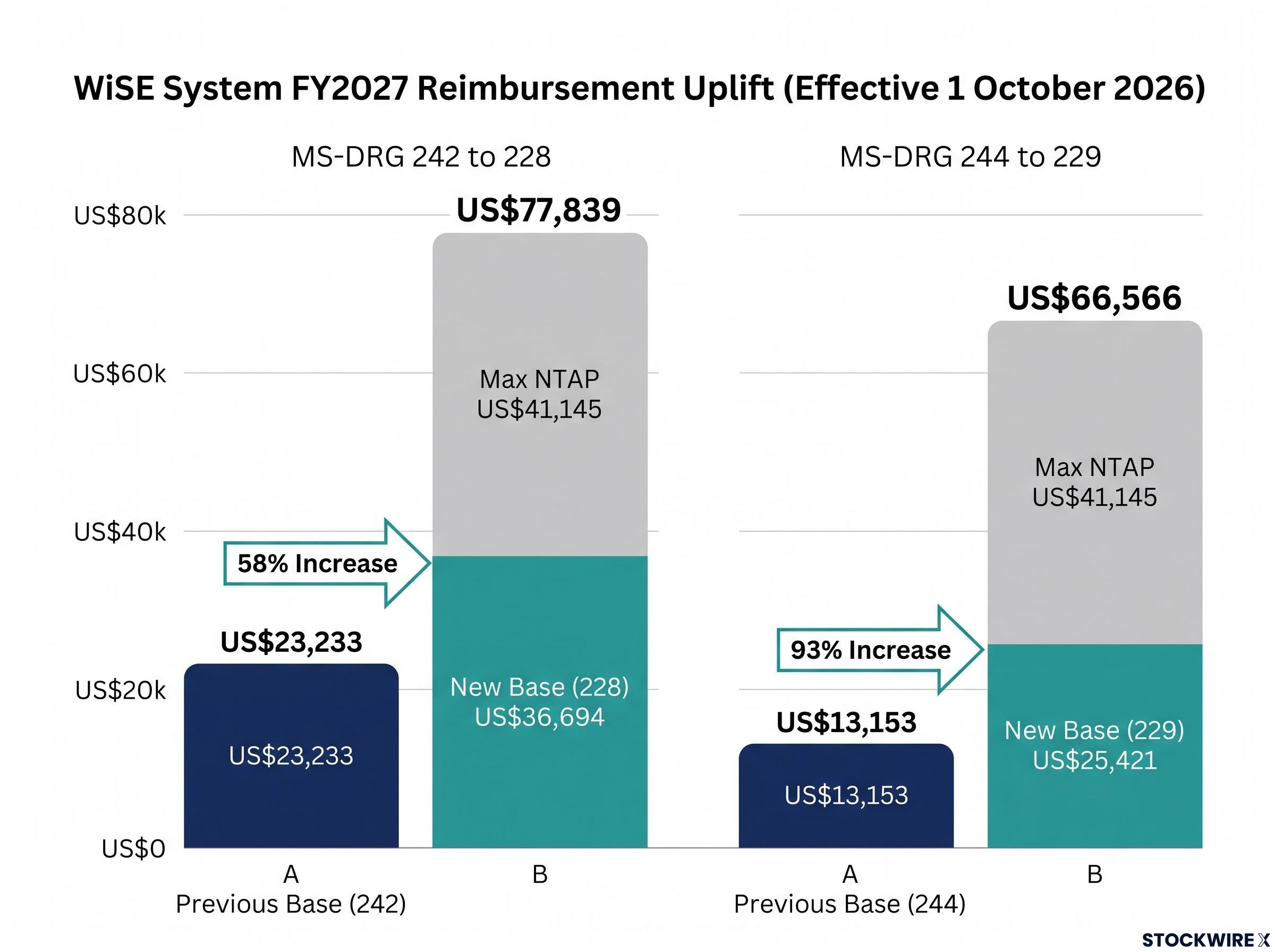
Under the final rule, eligible WiSE procedures are reassigned from MS-DRGs 242 and 244 to the higher-value MS-DRGs 228 and 229, respectively. The national base payment for procedures moving from MS-DRG 242 to MS-DRG 228 increases from approximately US$23,233 to US$36,694, a rise of approximately 58%. For procedures moving from MS-DRG 244 to MS-DRG 229, the base payment increases from approximately US$13,153 to US$25,421, an increase of approximately 93%.
Eligible procedures may also qualify for an NTAP of up to US$41,145. With the maximum NTAP applied, total Medicare payment may reach approximately US$77,839 under MS-DRG 228 and US$66,566 under MS-DRG 229.
Critically, CMS stated in its final rule that the WiSE electrode is “more closely aligned with leadless pacemaker procedures than conventional pacemaker procedures” — a classification acknowledgement that reflects the technology’s clinical differentiation.
John McCutcheon, President & Chief Executive Officer
“The final FY2027 Medicare payment rates represent a significant reimbursement and commercial milestone for WiSE. The increased inpatient reimbursement provides hospitals with a clearer and stronger payment pathway for eligible WiSE procedures, while better recognising the resources required to deliver this differentiated leadless technology. This outcome further strengthens the commercial foundation for WiSE as we scale our U.S. launch and work to expand access for heart failure patients who are not well served by conventional CRT.”
When big ASX news breaks, our subscribers know first
Understanding Medicare inpatient reimbursement for medical devices
For investors unfamiliar with U.S. healthcare economics, understanding why this ruling matters requires a brief look at how hospital payments work in the Medicare system.
-
What MS-DRGs are: Medicare Severity Diagnosis Related Groups (MS-DRGs) are categories used to classify inpatient hospital cases. CMS assigns a fixed payment rate to each MS-DRG, based on factors such as patient complexity, expected resource use, and the procedure performed. Hospitals receive that predetermined rate regardless of their actual costs.
-
What NTAP is: The New Technology Add-on Payment (NTAP) is a supplemental payment designed to bridge the reimbursement gap for novel medical technologies that may not yet be fully reflected in standard MS-DRG rates. It provides additional financial support while a new device builds sufficient claims history.
-
Why higher MS-DRG classification matters: When a procedure is assigned to a higher-value MS-DRG, the hospital receives a greater base payment for performing it. This directly reduces the financial risk hospitals face when adopting new technologies, particularly those with higher upfront costs or procedural complexity.
-
The link to commercialisation: For novel medical devices, reimbursement uncertainty is one of the most significant adoption barriers. When hospitals cannot be confident they will recover their costs, purchasing decisions stall. A stronger, clearer payment pathway removes a structural obstacle to uptake.
Reimbursement uplift at a glance
| MS-DRG Movement | Previous Base Payment | New Base Payment | Increase | Max Payment (incl. NTAP) |
|---|---|---|---|---|
| 242 → 228 | ~US$23,233 | ~US$36,694 | ~58% | ~US$77,839 |
| 244 → 229 | ~US$13,153 | ~US$25,421 | ~93% | ~US$66,566 |
Actual payments vary based on hospital- and case-specific factors and applicable CMS NTAP criteria.
Two pillars of the FY2027 framework
The FY2027 final rule reinforces two distinct reimbursement components for eligible WiSE procedures:
- Continued NTAP support: The maximum available NTAP of up to US$41,145 remains in place, providing supplemental payment support beyond the base MS-DRG rate.
- Improved MS-DRG classification: Procedures are reassigned to the higher-value MS-DRGs 228 and 229, categories aligned with leadless pacemaker procedures, consistent with CMS’s own stated view of how the WiSE electrode should be classified.
What this means for EBR’s U.S. commercialisation
WiSE is currently only available for sale in the U.S., making the domestic reimbursement environment the single most consequential commercial variable for EBR at this stage of its growth. The FY2027 ruling strengthens an existing pathway rather than creating a new one — NTAP support was already in place and the MS-DRG framework pre-existed — but the uplift is material in both scale and strategic significance.
The MS-DRG upgrade to categories aligned with leadless pacemakers reflects CMS’s own assessment that WiSE is more comparable to established leadless pacing technology than to conventional pacemaker procedures. That classification shift is expected to make it easier for hospital procurement and reimbursement teams to justify adopting WiSE for eligible patients.
The target patient population for WiSE is heart failure patients “not well served by conventional CRT” — a differentiated and underserved segment where standard therapies have demonstrated limitations. Reducing reimbursement-related barriers for hospitals treating this cohort is expected to support broader access and faster scaling of EBR’s U.S. commercial operations.
The FY2027 reimbursement uplift sits alongside a separate but related process: a national Medicare coverage determination review formally initiated by CMS on 3 June 2026, with a projected Final NCD date of 3 March 2027 that could establish uniform coverage for eligible WiSE procedures across all participating U.S. hospitals.
The improved MS-DRG assignment, combined with continued NTAP support, is expected to reduce reimbursement-related barriers for hospitals as EBR scales its U.S. commercialisation.
The WiSE commercial rollout across U.S. hospitals had already reached 117 cumulative implants and preliminary Q2 2026 revenue of US$2.50M-US$2.60M before the FY2027 reimbursement improvement takes effect, suggesting the stronger payment pathway arrives as procedural volumes are already building momentum.
About EBR Systems and the WiSE technology
Silicon Valley-based EBR Systems (ASX: EBR) is dedicated to the treatment of cardiac rhythm disease through wireless cardiac pacing. The company developed the WiSE technology to eliminate the need for cardiac pacing leads, historically the primary source of complications and reliability issues in cardiac rhythm disease management.
The WiSE implant is roughly the size of a large grain of rice and is designed to eliminate coronary sinus leads used to stimulate the left ventricle in heart failure patients requiring Cardiac Resynchronisation Therapy (CRT). WiSE is the world’s only wireless, endocardial pacing system in clinical use for stimulating the heart’s left ventricle and is currently only available for sale in the U.S.
Stay Ahead on ASX Healthcare News
Big News Blast delivers breaking ASX healthcare announcements straight to your inbox within minutes of release, with in-depth analysis already done. Join 20,000+ investors who never miss a market-moving update. Click the “Free Alerts” button at Big News Blast to start receiving FREE real-time coverage the moment news breaks.