
Control Bionics Details Platform Expansion Across Three Commercial Pillars

Control Bionics details expanding commercial footprint across assistive technology, sports and rehabilitation
In its June 2026 commercial update announcement, Control Bionics outlined progress across three strategic pillars showing simultaneous commercial momentum. The company is scaling a single neural-signal technology platform across multiple markets: Assistive Technology, NeuroTech Solutions, and Platform and Medical Technologies. The update highlighted the company’s transition from direct retail to wholesale distribution in the United States, supported by expanding insurance coverage and partner-led sales activation.
US states representing almost 70% of the US population now fund NeuroNode through the HCPCS code pathway. Claims activity currently breaks down to approximately 55% Medicare, 35% commercial insurance, and 10% Medicaid.
When big ASX news breaks, our subscribers know first
US distribution partnerships activate with funded sales underway
Management highlighted the activation of major distribution agreements that provide scale without proportional cost increases. The Tobii Dynavox partnership has completed onboarding activities, with first funded sales having commenced under the initial five-state agreement. The company outlined plans to engage with Tobii in June 2026 to commence planning for rollout into additional US states.
The PRC-Saltillo progress was detailed as another major distribution channel now delivering revenue. Following the signing of a US-wide distribution agreement in January 2026, funded sales have already commenced. The company is working with PRC-Saltillo on plans for broader activation across its sales organisation, with the full sales team of approximately 70 sales representatives expected to commence broader rollout activity in late US summer 2026.
The announcement detailed the New York Board of Education long-term supply agreement, which the company positioned as an established purchasing pathway for the NeuroNode that will be utilised by US distribution partners.
An iOS tablet Letter of Intent was outlined, contemplating 1,000 devices in the first 12 months. The company has received a US$100,000 advance payment, with shipping expected to commence in July 2026.
What is surface electromyography and why does it matter for investors?
Surface electromyography (sEMG) is the technology that captures electrical signals from muscles and converts them into actionable data. For Control Bionics, this is the core technology deployed across communication devices (NeuroNode), wearables (NeuroStrip), and research applications.
The platform model enables the same core technology to serve multiple revenue streams. Rather than developing separate technologies for each market, the company applies its sEMG platform across assistive communication, sports performance, rehabilitation, and research use cases. This structure allows research and development investment to generate returns across multiple channels simultaneously.
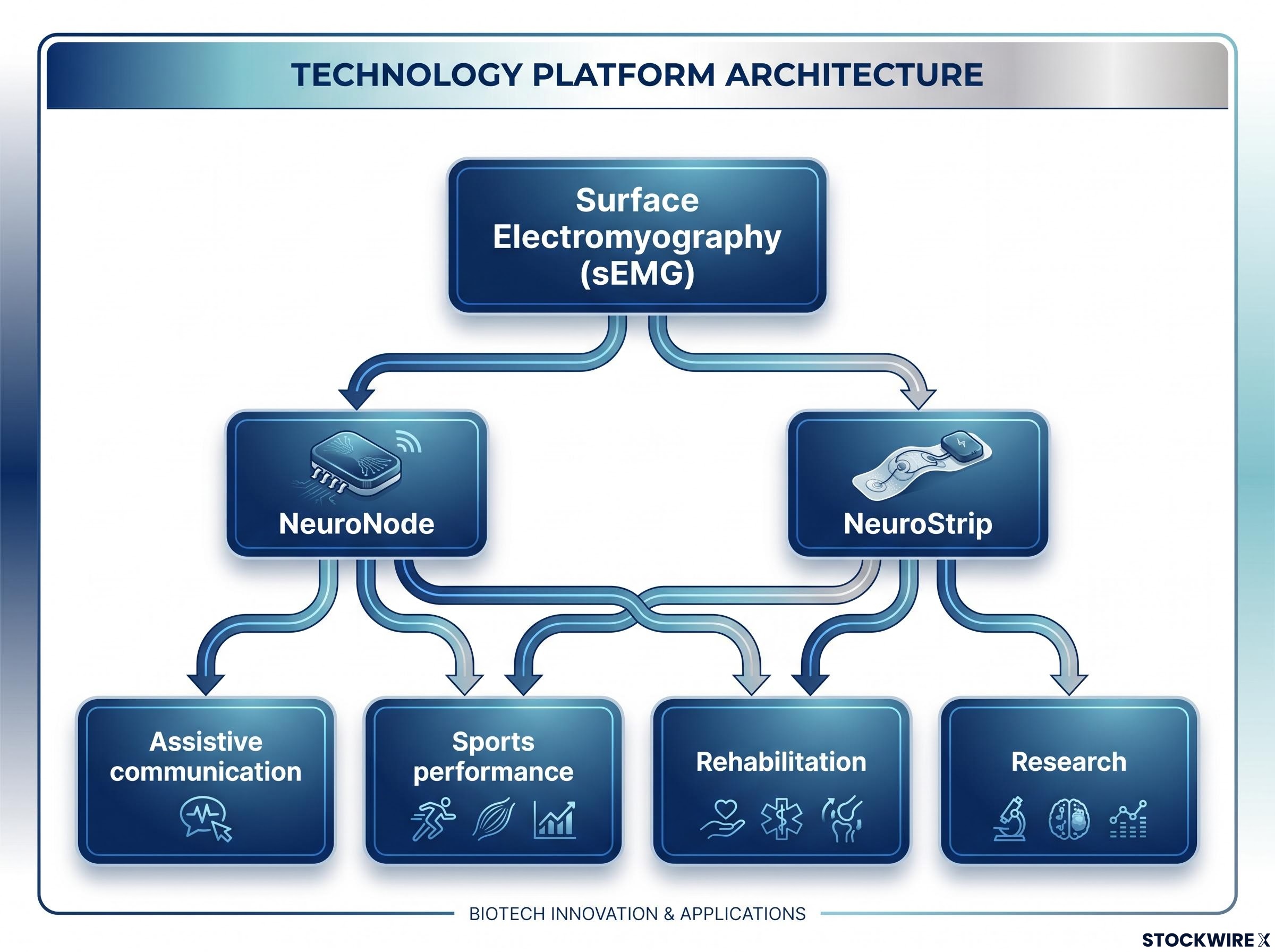
Platform companies can scale more efficiently than single-product companies because each advancement in the underlying technology benefits all product lines. For investors assessing Control Bionics beyond its assistive technology origins, understanding this platform architecture is essential to valuing the company’s market opportunity.
NeuroStrip gains traction across elite sport and rehabilitation channels
Australian sporting engagements
The update outlined current Australian trials demonstrating breadth of application across elite sport environments:
- Sydney-based AFL team: 3-month trial focused on return-to-play and player profiling applications
- Melbourne-based AFL team: 4-month trial assessing return-to-play applications
- Queensland-based rugby league team: 3-month trial for return-to-play decision making
- Australian national governing body for a major winter sport: 3-month trial focused on return-to-play applications
- Australian Institute of Sport: initial trial utilising NeuroStrip in athlete rehabilitation
The company outlined an engagement with Royal Rehab on an initial 3-month trial assessing the use of NeuroStrip in both clinical and at-home settings. Royal Rehab operates more than 50 locations across Australia, representing potential scale beyond elite sport into rehabilitation pathways.
International and US expansion
Management highlighted international interest extending beyond core US and Australian markets. A Control Bionics team is currently in Europe working with a major international football club actively pursuing the use of sEMG. An international rugby federation is expected to commence onboarding in mid-June 2026, with an international rugby league team also engaged on player readiness assessments.
US university engagements were detailed as validation opportunities in collegiate sport environments. Ohio University projects include 500+ athlete profiling as part of concussion protocols, approximately 100 general population baseline sEMG assessments, and basketball applications assessing muscle activity during strength training. Weber State is engaged on sEMG profiling of the entire women’s volleyball team.
The update outlined current NeuroBounce customers, the company’s sports performance programme combining sEMG feedback with targeted strength and conditioning protocols: Weber State, Hoops Hall, Club V South, and Peak Performance.
Rehabilitation channel development progresses in US and Japan
The company is rolling out NeuroStrip to the first clinic within Bay State Physical Therapy’s network of more than 160 clinics across the United States, representing a significant potential rehabilitation channel. Mayo Clinic has utilised NeuroStrip as part of a study into gait analysis and is currently assessing further research options in partnership with Control Bionics. Penn State Health is assessing NeuroStrip for use in research applications.
The Mountain Land Physical Therapy “Super Bridge” programme was presented as a case study demonstrating commercial and clinical outcomes. The prevention programme is designed for athletes above the age of 13 who want to improve performance and reduce injury risk using EMG biofeedback. It is a 12-session programme billed to insurance with a specific biofeedback code.
| Metric | Outcome |
|---|---|
| Revenue Per Client | $1,175 – $1,375 |
| Improved Jump Height | 3 – 9 inches |
| Increased Lateral Jump | Up to 15 inches |
The Japan Stroke Lab case study was outlined as a demonstration of clinical value in neurological rehabilitation. A patient recovering from a brain bleed had been left with significant walking difficulties. By introducing the NeuroTech, clinicians were able to visualise over-contraction of the patient’s right gastrocnemius in real time, enabling targeted treatment.
| Metric | Outcome |
|---|---|
| Gastrocnemius Peak Activity Reduced | 163.9 → 99.8 µV |
| Reduction in Muscle Overactivity | 39% |
| Post-Intervention Walking Round Trip | 0 Falls |
Platform strategy advances with Apple BCI integration and research partnerships
The company outlined the Apple BCI integration timeline, with the capability being built into the next generation of its software for commercial release in Q3 2026. Management highlighted this integration as expected to represent a significant enhancement to customer experience and create new potential use cases for Control Bionics’ technology outside of the traditional assistive technology market.
The update detailed research and academic partnerships that support continued validation of the company’s technology and contribute to long-term platform development:
- Mayo Clinic
- Barrow Neurological Institute
- Penn State Health
- University of Sydney
- Victoria University
- University of Melbourne
- ICCD Partners
These relationships are expected to generate new research and clinical use cases whilst contributing to the development of Control Bionics’ platform and data strategy.
German market opens new European reimbursement pathway
The NeuroNode was awarded HMV insurance coverage in Germany in February 2026, providing a new reimbursement pathway in one of Europe’s most important healthcare markets. Control Bionics outlined that it is currently in discussions with multiple potential German distribution partners to support the rollout of the NeuroNode in the German market.
Investors exploring the commercial mechanics behind this European expansion can find detail in our full explainer on the German HMV reimbursement listing, which covers how statutory health insurance fund coverage works, why the DACH region multiplies the value of a single regulatory win, and what the NeuroNode-only wholesale strategy means for operational scalability.
The next major ASX story will hit our subscribers first
Looking ahead
The company outlined significant progress across each of its three strategic pillars. In Assistive Technology, Control Bionics continues to benefit from the dedicated E2513 HCPCS code, increasing funding validation, US distribution partner activation, new iOS tablet opportunities, the New York Board of Education agreement, and the opening of the German market through HMV insurance coverage.
In NeuroTech Solutions, the company detailed a growing number of sports, rehabilitation, and research customer relationships across Australia, the United States, and international markets. These engagements are designed to validate NeuroStrip across athlete profiling, return-to-play, strength training, gait analysis, rehabilitation, and at-home clinical applications.
In Platform and Medical Technologies, Control Bionics outlined progress in Apple BCI integration, research partnerships, and broader platform opportunities that have the potential to extend the company’s technology into new markets and new commercial use cases. Management stated the company remains focused on converting this customer momentum into global scalable commercial outcomes whilst continuing to build its position as a leader in non-invasive neural-signal technology.
Want the Next MedTech Breakout in Your Inbox?
Join 20,000+ investors receiving FREE breaking ASX news within minutes of release, complete with in-depth analysis. Click the “Free Alerts” button at StockWire X to get real-time alerts on healthcare and biotech announcements the moment they hit the market.