

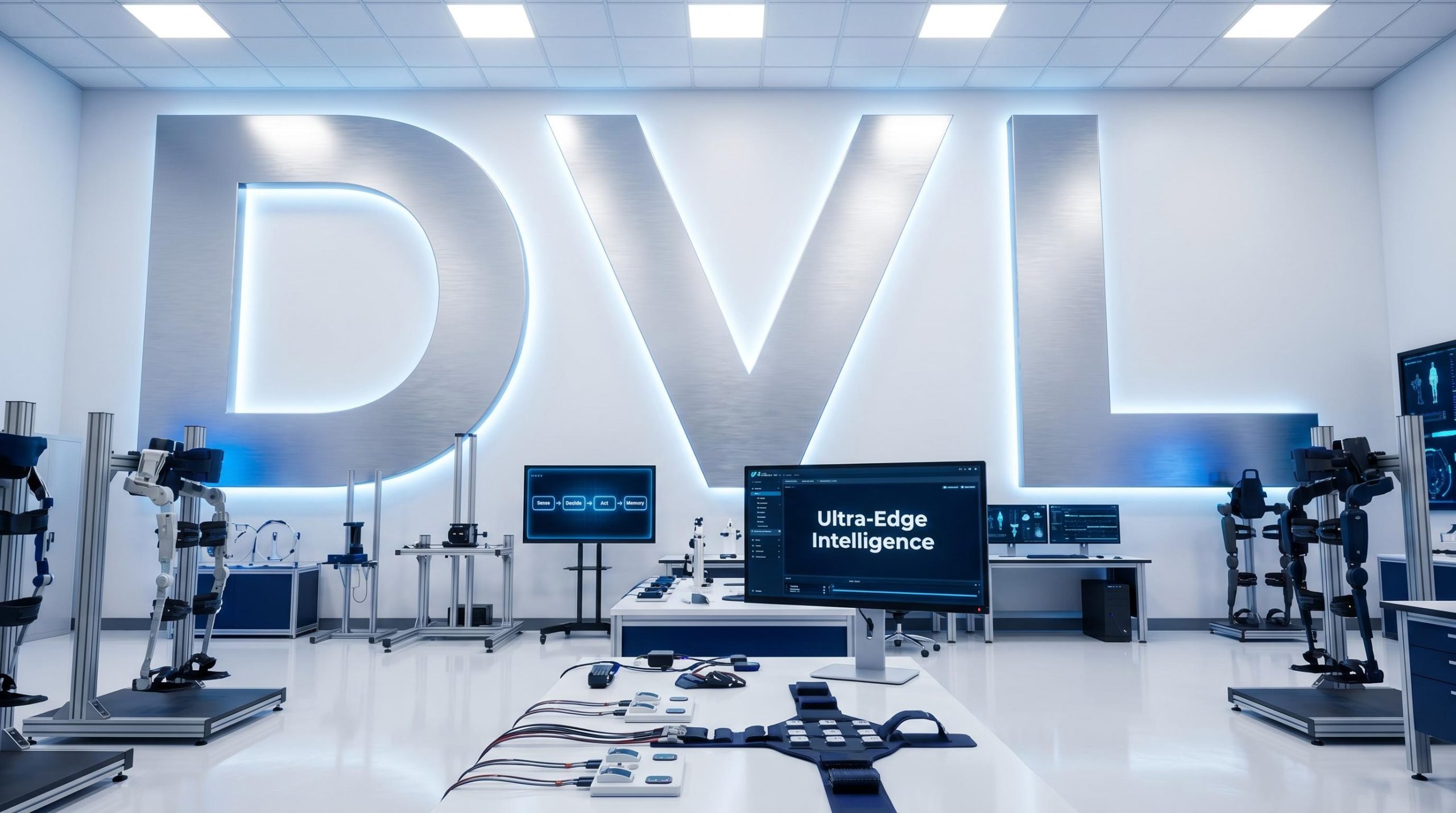
dorsaVi’s RRAM-neuromorphic platform targets 2x battery life improvement for exoskeleton systems
dorsaVi Limited (ASX: DVL) has completed a strategic technical analysis confirming its existing EMG and movement sensor platform fits within lower-limb exoskeleton and wearable robotics systems, marking a substantive commercial extension of the company’s Ultra-Edge Intelligence strategy. The analysis positions dorsaVi as the sensor-intelligence layer for next-generation exoskeleton systems, with projected performance improvements driven by RRAM-neuromorphic synergy forming the commercial centrepiece of the update.
Headline projected performance improvements include:
- Battery life improvement of more than 2× compared with continuous raw EMG streaming
- Wireless data volume reduction of 10–100×
- Sensor count reduction of 25–50%
- Sensor-node decision latency below 10–30 ms
- Real-time classification accuracy above 90%
Critically, dorsaVi is positioned as the sensor-intelligence layer rather than a builder of exoskeleton hardware, making it a potential partner to manufacturers rather than a competitor. This distinction opens multiple revenue pathways without requiring the company to develop the underlying robotic frame.
Mathew Regan, Group Chief Executive Officer
“This analysis makes clear that we don’t need to wait for next-generation hardware to participate meaningfully in the exoskeleton market. Our existing sensor platform can provide the intelligence layer that exoskeleton systems need today, for gait intent, fatigue monitoring, and validated performance measurement. What the RRAM–neuromorphic roadmap does is transform that position from valuable to decisive. Moving from streaming raw EMG data to delivering compact, real-time intent signals from the sensor itself is the performance shift that will make dorsaVi a core component of the next generation of exoskeletons, prosthetics, and rehabilitation robotics. We are building toward that deliberately, layer by layer.”
When big ASX news breaks, our subscribers know first
Understanding the exoskeleton intelligence gap — and why dorsaVi sits at its centre
A powered exoskeleton is a wearable robotic frame that works with the wearer’s body to augment movement, reduce physical strain, or restore lost mobility. The technology is advancing rapidly from research settings into commercial deployment, with demand concentrated across four primary verticals:
- Medical and rehabilitation — assisting patients recovering from stroke, spinal cord injury, or surgery. The World Health Organisation estimates over 12 million stroke patients annually worldwide, each a potential rehabilitation robotics user (World Stroke Organization, 2025).
- Industrial and occupational health — reducing workplace injury and worker fatigue in manufacturing, construction, logistics, and warehousing.
- Defence — supporting load-carrying augmentation for soldiers, backed by programmes funded by the United States Department of Defence and other defence ministries.
- Aged care and consumer mobility — supporting older adults to maintain mobility, reduce fall risk, and extend independent living, a vertical accelerated by global population ageing.
The global exoskeleton market is projected to reach US$1.79 billion by 2033, according to Grand View Research.
The technology gap constraining the market is not mechanical. Current exoskeleton systems react to movement after it has begun. Next-generation systems need to anticipate what the user intends to do before movement is fully executed. This is precisely where EMG sensing becomes the defining input: muscles generate electrical signals before physical movement occurs, and dorsaVi’s sensors capture this pre-movement intent data. The result is a system that can detect walking intent, leg swing, push-off, sit-to-stand transitions, stair climbing, and the onset of fatigue before the action is completed. Delivering this intent-detection and decision-intelligence layer is dorsaVi’s specific commercial role in the exoskeleton ecosystem.
From streaming to smart — what the RRAM-neuromorphic upgrade changes
What existing sensors can do today
dorsaVi’s FDA-cleared, TGA-certified sensor platform already supports five practical exoskeleton use cases without any hardware upgrade. In this near-term configuration, the sensors function as an external or semi-integrated sensing layer, measuring muscle activity and limb movement while software or an external controller interprets gait intent, gait phase, user effort, and fatigue. The table below defines the recommended sensor configuration and target performance benchmark for each application.
| Application / Function | Existing Sensor Count | Target Performance | Notes |
|---|---|---|---|
| Gait intent detection | 4–8 sensors | >85–90% classification accuracy | Real-time classification of movement intent |
| Gait phase recognition | 4–6 sensors | <30–50 ms timing error | Phase-accurate detection for control loop integration |
| Assist-as-needed tuning | 6–8 sensors | ±10% torque-assist variation | Adaptive control based on real-time muscle effort |
| Fatigue monitoring | 4–8 sensors | ≥10–20% EMG change sensitivity | Detects progressive muscle fatigue during use |
| Exoskeleton validation | 4 EMG + 1 motion sensor | ≥10–20% EMG reduction detectable | Documents assisted vs unassisted muscle unloading |
The three-stage deployment pathway
The technical analysis defines a staged configuration pathway that balances signal coverage, practical deployment complexity, and commercial readiness:
- Stage 1 — Full bilateral mapping (8 sensors): Beginning with eight sensors across the major lower-limb muscle groups, including tibialis anterior, gastrocnemius/soleus, quadriceps, and hamstrings. This configuration provides sufficient signal coverage to build robust gait-intent and fatigue models and identify the most useful muscle locations for each specific application.
- Stage 2 — Real-time supervisory control (4–6 sensors): Once the highest-value muscle locations are confirmed, the configuration reduces to four to six sensors for real-time supervisory control, supporting gait intent, phase recognition, and fatigue monitoring in a commercially deployable form factor.
- Stage 3 — Field validation (4 EMG + 1 motion sensor): For commercial demonstrations and clinical or industrial field validation, the configuration simplifies further to four EMG sensors plus one motion sensor, sufficient to demonstrate assisted-versus-unassisted muscle unloading and document exoskeleton performance in real-world conditions.
The RRAM-neuromorphic inflection point
The strategic limitation of dorsaVi’s current sensor platform is that devices primarily measure and transmit data. Continuous raw EMG streaming increases wireless bandwidth demand, processing overhead, latency, and battery consumption, making it less suited to the low-latency, closed-loop control that next-generation exoskeletons require.
This is where the RRAM-neuromorphic roadmap becomes the defining strategic shift. RRAM (resistive random-access memory) is fast, low-power non-volatile memory. Neuromorphic processing is brain-inspired local computing. Together, they enable in-sensor computing, where the EMG sensor itself performs local filtering, feature extraction, event detection, and confidence scoring without sending raw data to an external processor or the cloud. Rather than streaming continuous biosignal data, sensors would transmit compact, actionable decisions: swing intent probability, push-off readiness, fatigue index, and gait phase confidence.
The table below maps existing sensor configurations to projected future RRAM-neuromorphic smart sensor equivalents across four applications.
| Application | Existing Sensors | Future Smart Sensors | Basis for Reduction |
|---|---|---|---|
| Basic gait-phase detection | 4 sensors | 2–4 smart sensors | Local feature extraction and event detection reduces need for multiple raw channels |
| Swing / toe-clearance intent | 4 sensors | 2 smart sensors | Bilateral smart EMG nodes detect swing intent locally with embedded processing and confidence scoring |
| Sit-to-stand detection | 4–6 sensors | 2–4 smart sensors | Local onset detection and stored user-specific baselines reduce channel need |
| Full lower-limb intent detection | 8 sensors | 4–6 smart sensors | Local filtering, feature extraction, event detection, and confidence scoring reduce redundant channels |
The platform targets a sub-1mW power design enabling coin-cell battery-compatible operation, connecting directly to the Ultra-Edge Modular Design and Build programme announced on 6 May 2026. That programme focuses on translating dorsaVi’s RRAM and neuromorphic chip IP into a physical, manufacturable hardware platform with a three-layer architecture spanning sensing, compute, and memory.
Commercial pathway and what comes next
The completion of this strategic analysis is expected to guide the next phase of technical and commercial development across dorsaVi’s exoskeleton and robotics roadmap. The company’s four identified revenue pathways are:
- Sensor sales and OEM integration into exoskeleton products
- Licensing of sensor intelligence and future on-sensor algorithms
- Validation and supervisory-control services for clinical, industrial, and defence trials
- Recurring software and data services once smart sensors are deployed at scale
Validation work is progressing within existing FDA-cleared and TGA-certified hardware, consistent with the Ultra-Edge Modular Design and Build programme. In parallel, the company is continuing validation of the second group of neuromorphic IP assets, the sensing and signal interface technologies that translate real-world inputs from the body and environment into data the system can act on. That work is expected to further strengthen the combined RRAM-neuromorphic platform case across exoskeleton, prosthetic, and wearable applications.
The exoskeleton initiative aligns directly with dorsaVi’s Sense → Decide → Act → Memory architecture, representing a commercial extension of the existing platform rather than a strategic pivot. dorsaVi expects to update shareholders on commercial progress, partner engagements, and further validation milestones in the coming months.
Don’t Miss the Next Healthcare Tech Breakout
Big News Blast delivers FREE breaking ASX healthcare and tech news directly to your inbox within minutes of release, complete with in-depth analysis. Join 20,000+ investors already staying ahead of the market. Click the “Free Alerts” button at Big News Blast to receive the next market-moving announcement the moment it drops.