
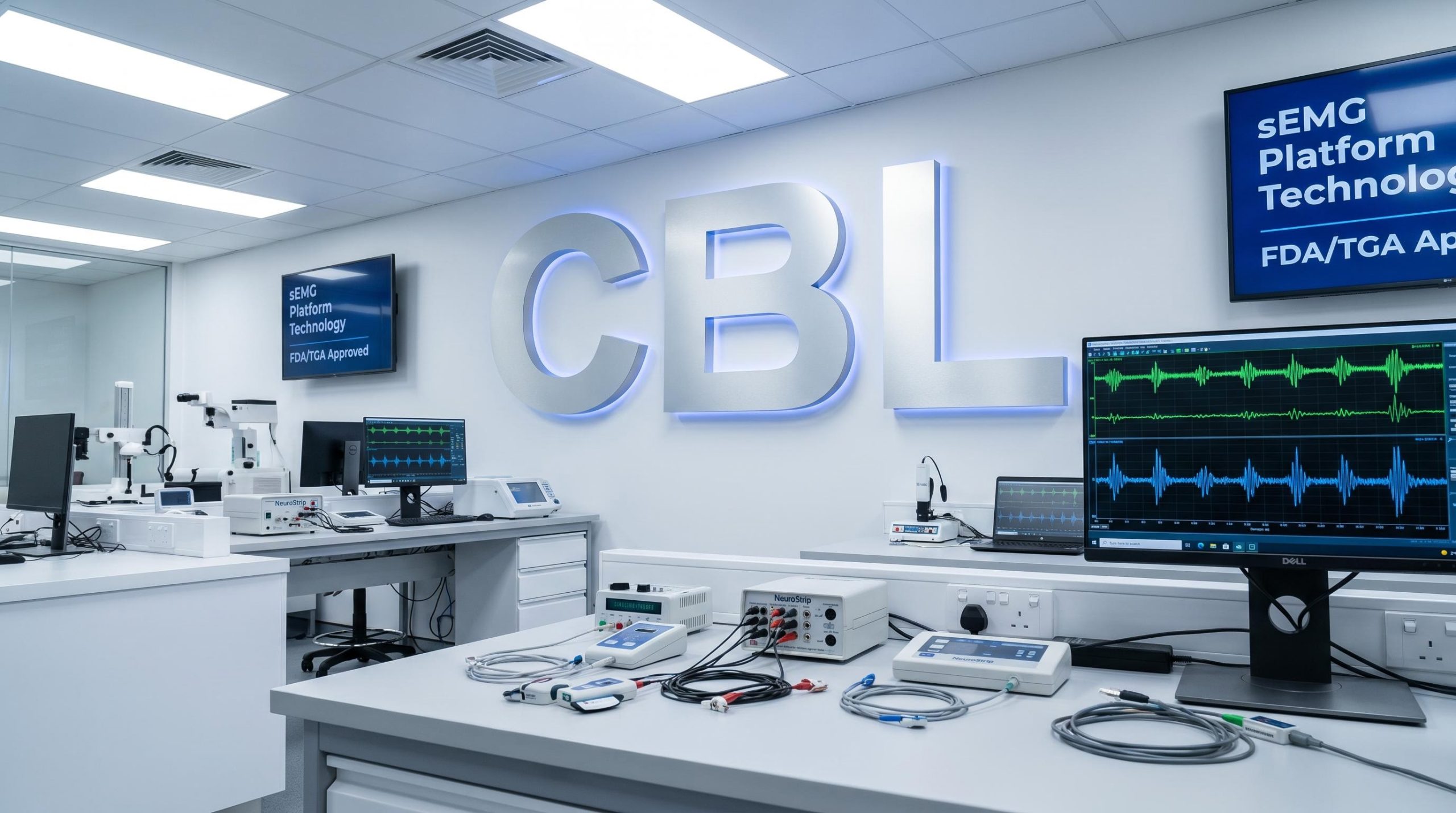
Control Bionics outlines path to scale across three commercial pillars
In its April 2026 investor presentation, Control Bionics detailed its strategic transition from standalone device company to scalable neurotechnology platform. The company converts muscle electrical signals into actionable data via surface electromyography (sEMG), with three commercial pillars now in place: Assistive Communication, Neurotechnology Solutions, and Platform and Medical Technology.
Management highlighted FY25 revenue of A$6.1M (+15% year-on-year), marking the strongest year in company history. As at 1 May 2026, the company’s market capitalisation stood at approximately A$23.5M.
The presentation outlined how CBL is monetising more than 25 years of R&D investment across multiple verticals from a single technology core, with wholesale partnerships in assistive communication and pilot programmes underway in sports performance and rehabilitation markets.
When big ASX news breaks, our subscribers know first
What is surface electromyography and why does it matter?
Surface electromyography (sEMG) is a non-invasive technology that reads electrical signals from muscles through skin sensors. CBL’s NeuroNode and NeuroStrip devices translate these signals into data for communication, rehabilitation, and performance applications.
The company has invested $40M+ over 25+ years of development, building 9 patent families and securing FDA, TGA, and CE registrations. This technical foundation has been refined in the most demanding clinical environment: severely movement-compromised patients. The technology is deployed, not theoretical.
The presentation outlined the strategic advantage: competitors cannot quickly replicate decades of clinical validation and regulatory approvals. CBL’s IP has been cited by nearly 70 organisations including Meta, Google, IBM, and Siemens.

Assistive Communication — wholesale partnerships unlocking scale
Management described the Assistive Communication market as worth $1B+ globally, growing more than 10% per annum, with CBL holding less than 1% share today. The division targets patients with ALS/MND, cerebral palsy, and progressive neurological conditions who have lost the ability to speak.
CBL holds the first new HCPCS reimbursement code awarded in 13 years, creating a dedicated US funding pathway that required decades of clinical validation. This regulatory barrier cannot be quickly replicated by competitors.
The presentation detailed wholesale partner agreements now in place:
| Partner | Market Position | Territory | Status |
|---|---|---|---|
| Tobii Dynavox | Global #1 | United States (5 states) | Six-month pilot, 170 US salespeople |
| PRC-Saltillo | Global #2 | United States | Formal distribution agreement executed |
| Smartbox | Regional player | UK and Ireland | Wholesale distribution |
| German distributor | To be confirmed | Germany | HMV approved, identification underway |
CBL estimates the US market for NeuroNode at a minimum of US$20M annually at scale (5,000 units at US$4,300). The wholesale model reduces cost of goods sold while scaling volume, with wholesale EBITDA margin exceeding 80% on NeuroNode.
The company reported that 376 ‘retail’ AAC systems were sold in FY25 with its own staff. The wholesale model transforms CBL’s addressable reach, providing access to 250+ distributor sales reps versus the current internal team.
Near-term AAC milestones
The presentation outlined four near-term objectives for the Assistive Communication division:
- Release of new NeuroNode Controller App
- Appointment of German distributor
- New distribution contracts signed in the US
- Expansion of existing distributor contracts
Neurotechnology Solutions — sports and rehabilitation markets
Management outlined combined addressable market opportunities of $2B+ in sports performance and $2.2B+ in rehabilitation, for a total market exceeding $4.2B.
The presentation described the problem CBL addresses: sports teams make return-to-play decisions without objective neuromuscular data, while physiotherapists manage complex rehabilitation without real-time visibility of muscle recruitment. Existing EMG technology requires wires, clinical setup, specialist interpretation, and is impractical outside laboratory environments.
The company’s NeuroStrip device is self-calibrating, adhesive, weighs 4 grams, and works in any gym, clinic, or field environment. The revenue model combines hardware acquisition with monthly subscription fees, generating a gross margin of 78%.
Customer traction detailed in the presentation includes:
- Mountain Land Physical Therapy (70 sites, USA) — signed, with insurance benefit
- Bay State Physical Therapy (160 sites, USA) — trial underway
- Australian Institute of Sport — trial underway
- Ohio University — athlete muscle activation profiling underway
- Multiple AFL clubs and Australian sporting entities in pilot phase
- Completed programmes with Utah Prep, SEDA College, Nets on Fire, Hoop Hall, and Princeton University
JJ Mandaquit, University of Washington
“+16.5cm vertical in 3 weeks. ESPN ranked #47.”
The presentation noted that existing clients prove the model, with dedicated sales hires planned to scale the business. CBL stated it will appoint business development and growth leads for Neurotechnology Solutions in both Australia and the US.
Platform and medical technology — the third commercial pillar
The presentation described how the third pillar monetises the platform itself through technology partnerships, clinical research, and data commercialisation. This represents a capital-light opportunity with potential for high-margin revenue from licensing, APIs, and research partnerships.
CBL highlighted its integration with Apple’s Brain-Computer Interface (BCI) technology, stating it is “the only company in the world with a commercially available product using Apple’s BCI technology” with FDA and TGA approval and established funding pathways already in place.
Research partnerships outlined in the presentation include Ohio University, Northeastern University, Boston College, University of Sydney, Mayo Clinic, and Barrow Neurological Institute. The company noted its Stroke Lab Japan partnership has a 100-patient clinical study underway with a leading Japanese neurologist.
Management stated that CBL’s patents have been cited by nearly 70 organisations including Meta, Google, IBM, and Siemens, demonstrating the platform’s technical relevance beyond the company’s own commercial applications.
Near-term platform milestones
The presentation listed three platform-focused objectives:
- Apple BCI release to distribution partners
- Clinical partnerships announced publicly
- Control Bionics Hackathon to identify new applications
Investment thesis and financial position
The presentation outlined a four-pillar investment thesis:
1. Validated platform with genuine IP moat: 25 years of R&D, 9 patent families plus provisionals, FDA, TGA, and CE registrations. The technology has been proven in clinical deployment, not merely conceptual.
2. Multiple revenue pathways from one platform: Three independently scalable pillars (Assistive Communication, Neurotechnology Solutions, Platform and Medical Technology) all operate from a single underlying neurotechnology platform.
3. Clear near-term catalysts: Wholesale volume growing, customer announcements expected, Apple BCI release to distribution partners, and continued technology advancements.
4. Data as a differentiator: The company stated that its high-fidelity physiological data creates a unique strategic position. Building data lakes to train AI models establishes what management described as “an enviable market position” with intertwined patented hardware, software, and efficacious data creating a powerful moat.
The presentation detailed the financial position as at 31 March 2026: cash of A$1.2M following A$5.4M capital raised in FY25. Management noted that the AAC division became profitable on a monthly basis in H1 FY26.
| Division | Revenue Model | EBITDA Profile | Cost Base (by 30/6/26) |
|---|---|---|---|
| Assistive Communication | Per device sales (NeuroNode US$4,300, Tablets wholesale ~US$3,000) | Monthly profitability H1 FY26. Wholesale margin 80%+ (NeuroNode), 30% (tablets) | A$3.5M |
| Neurotechnology Solutions | Hardware acquisition + monthly subscription | Investing for growth. Gross margin 78% | A$2.1M |
| Platform & Medical Technology | Hardware acquisition + monthly subscription (research/partnerships) | Capital light, data moat. Gross margin 79% | A$1.1M |
The investment thesis presents CBL as a platform play with multiple revenue opportunities. If one pillar underperforms, others provide optionality for growth across a combined addressable market exceeding $7B (management estimates).
Want the Next MedTech Breakthrough in Your Inbox?
Join 20,000+ investors receiving FREE breaking ASX news within minutes of release, complete with in-depth analysis. Click the “Free Alerts” button at StockWire X to get real-time alerts the moment market-moving announcements drop across Healthcare, Tech, Finance, and emerging sectors.