
When euro holdings swing from roughly 50% overheld to slightly underheld, the natural assumption is that investors are rushing back into the dollar. BNY‘s iFlow custody data says they are not. The euro net short positioning now building has a different cause from the one seen in Q2, and that cause changes what the reading means.
The distinction matters on 14 October 2026 because an identical headline can carry opposite meanings. A net short driven by a scramble for dollar liquidity points to stress across every currency. A net short driven by hedging adjustments points to something narrower and more technical.
If you follow currency flows, mistaking one for the other can lead you to bet on a dollar surge that the data does not support.
After this, you will be able to separate hedging-led positioning from panic-led positioning, and you will know the specific condition BNY wants to see before it calls a bottom in the euro.
Why does this net short differ from the Q2 dollar scramble?
The headline number is dramatic. According to Geoff Yu of BNY, euro holdings among iFlow custody clients have moved from about 50% overheld against their rolling one-year average to slightly underheld, a full reversal in a few months.
Then the specifics start to chip away at the drama. “Overheld” is measured against a one-year average; it is not a count of investors who are long. Yu also stresses that the absolute short is not excessive, and EUR/USD holdings are not weak compared with recent history.
BNY’s read on the driver Yu attributes the shift to greater hedging by cross-border clients, describing it as specific to the euro rather than a broad grab for dollars.
That is the key contrast with Q2, when a net short euro stance reflected generalised dollar demand.
| Period | Driver | Where it shows up | Breadth | Read-through for the euro |
|---|---|---|---|---|
| Q2 2026 | Scramble for dollars and dollar liquidity | Selling of other currencies against the dollar | Broad, across many currencies | Euro weakness as part of general dollar stress |
| October 2026 | Increased hedging by cross-border clients | Mainly euro crosses, not EUR/USD | Euro-specific | Targeted rotation away from euro-area exposure |
The setup made this correction likely. In September, BNY found cross-border hedges nearly 60% below their one-year average, with the euro almost 2% above its one-year BIS real effective exchange rate (REER) average. The REER is a trade-weighted value of a currency adjusted for inflation. EUR/USD now sits near 1.12, with the European Central Bank (ECB) deposit rate at 2.50% after the 10 September hike.
BNY also notes that holdings and valuations remain far from 2024 levels. For you, that means the market has room to push further but has not reached the capitulation point that usually marks a turn. Treat this as an early-stage signal, not an exhausted one.
The euro valuation drivers that matter most, including the ECB’s symmetric 2% mandate, BTP-Bund spreads and Federal Reserve rate differentials, explain why a positioning swing in custody data rarely tells the whole story on its own.
When big ASX news breaks, our subscribers know first
How hedging through crosses shows up in custody data
Here is the puzzle: aggregate euro holdings are falling, yet EUR/USD holdings look unremarkable. The answer sits in how global investors protect their foreign assets.
A custody holding is an asset a bank keeps safe and administers on a client’s behalf. BNY’s iFlow tracks these across roughly $62 trillion in assets under custody and administration, with daily T+1 indicators (data published one business day later) across FX, equities and fixed income.
Suppose a cross-border investor holds Swiss, Nordic or British assets. Hedging means using currency contracts to offset the exchange-rate risk on those assets, and the investor has four decisions to make:
- Asset currency: what currency the underlying investment is priced in.
- Liability currency: what currency the investor ultimately owes or reports in.
- Funding currency: what currency finances the position.
- Relative hedging cost: which exposure is cheaper to hedge, given interest-rate gaps.
For a euro-based investor, these choices often run through EUR/CHF, EUR/SEK, EUR/NOK or EUR/GBP. None of them needs to touch the dollar.
Why EUR/USD can look normal while the euro is net short
Because the activity sits in crosses, the dollar leg stays comparatively quiet. BNY’s newer hedge-ratio methodology links custody holdings to client-level FX positions, which is how it can see the hedging rather than infer it.
What this looks like is hedge-ratio normalisation after a period when euro exposure was underhedged, not a wholesale exit from euro assets. Research also suggests that hedge-ratio changes may amplify currency moves in either direction, though that claim has not been independently confirmed.
The lesson for you: never read aggregate euro data as a pure EUR/USD call. Knowing which instrument carries the flow tells you what the flow is actually saying.
Where is the money going, and what does it do to European currencies?
If the hedging runs through crosses, the money has to land somewhere. According to iFlow, capital is leaving the eurozone and heading mainly to Switzerland and the Nordic countries, whose public finances investors regard as very sound, and the U.K. is picking up some of it too.
The cross levels reflect it. EUR/CHF sat near 0.9325 and EUR/GBP near 0.8447 on 14 October. Earlier data from ECB reference rates showed EUR/NOK down about 0.4% and EUR/SEK down about 0.36% between 1 and 2 October, meaning stronger krone and krona.
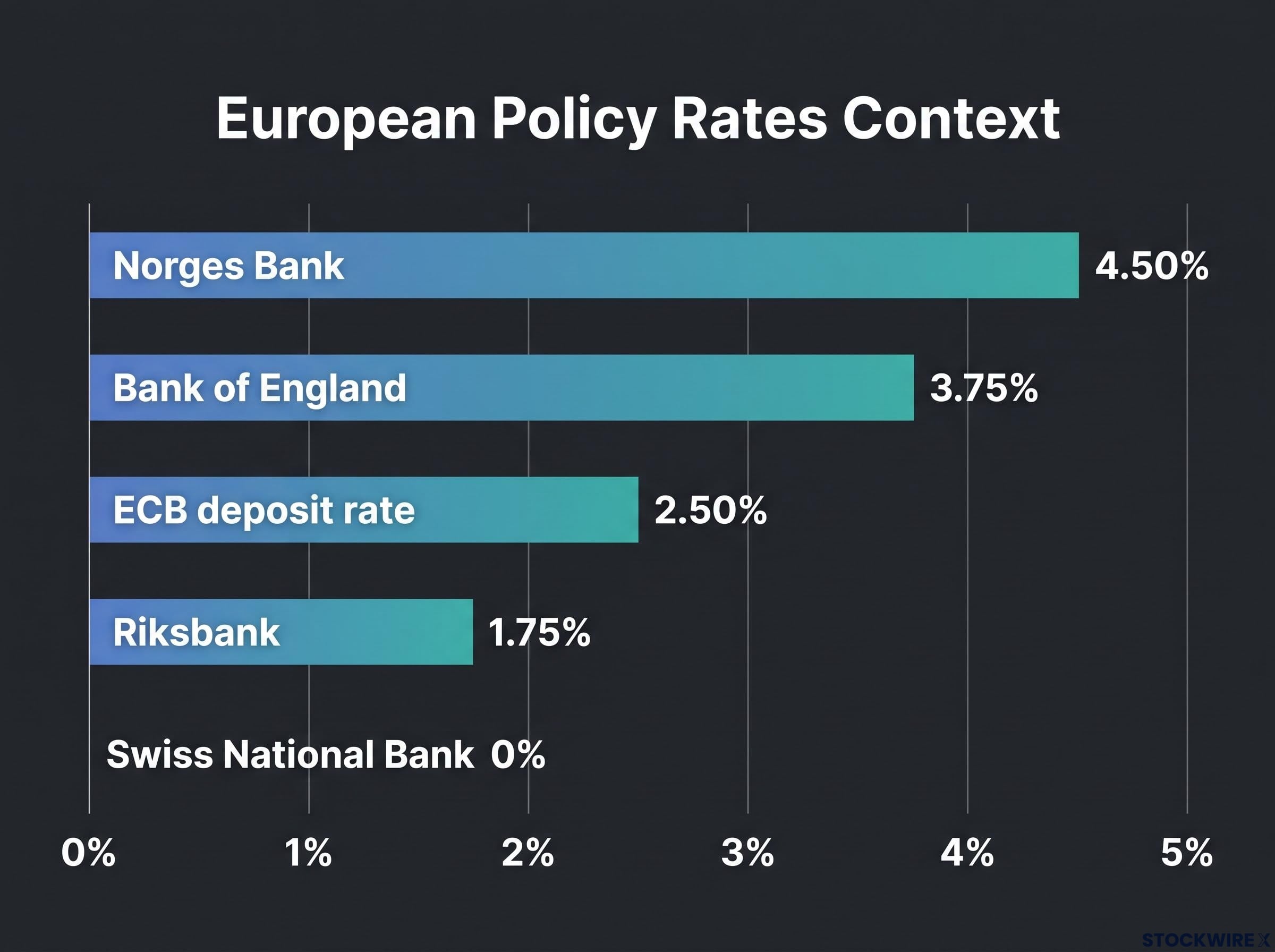
Why these destinations? The explanations collide, and policy rates explain part of it:
- Norges Bank: 4.50%, after a hike on 24 September
- Bank of England: 3.75%, held by a 6-3 vote with three members preferring a hike
- ECB deposit rate: 2.50%
- Riksbank: 1.75%
- Swiss National Bank: 0%
| Interpretation | Logic | Implication for the euro |
|---|---|---|
| Fiscal strength | Switzerland and the Nordics carry credible public finances; the U.K. also benefits | Reallocation toward stronger balance sheets, not simple risk flight |
| Safe-haven demand | The franc draws defensive buying even at a 0% policy rate | A firmer CHF can weigh on the euro even if the ECB stays restrictive |
| Rate differentials | NOK and GBP yield more than the euro | Fewer expected ECB hikes erode the euro’s forward carry |
| Cross-border hedging | BNY sees more hedging; EUR/USD holdings not unusually weak | Likely normalisation, not abandonment of euro assets |
| Effective exchange rate effect | A weaker euro lifts trade-weighted currencies elsewhere in Europe | Neighbouring economies may need marginally less tightening |
The last row is the payoff most readers miss. A weaker euro does not make neighbouring economies more restrictive; it gives them stronger trade-weighted currencies, which cushions imported inflation and may reduce the tightening their central banks need.
If you track Nordic, Swiss or sterling assets, a euro slide is not just a euro story. It can shape the next move from Oslo, Stockholm, Zurich and London.
Investors exploring where the franc cross heads next can read our deep-dive into the EUR/CHF forecast, which maps the 0.91-0.95 corridor institutions expect.
Why a euro bottom remains elusive, and how far to trust the data
The bearish case rests on rates. BNY will not name a euro low while markets still expect further hikes, since those expectations are what lifted the currency earlier.
BNY’s stance No durable euro bottom until tightening is priced out of the interest-rate curve.
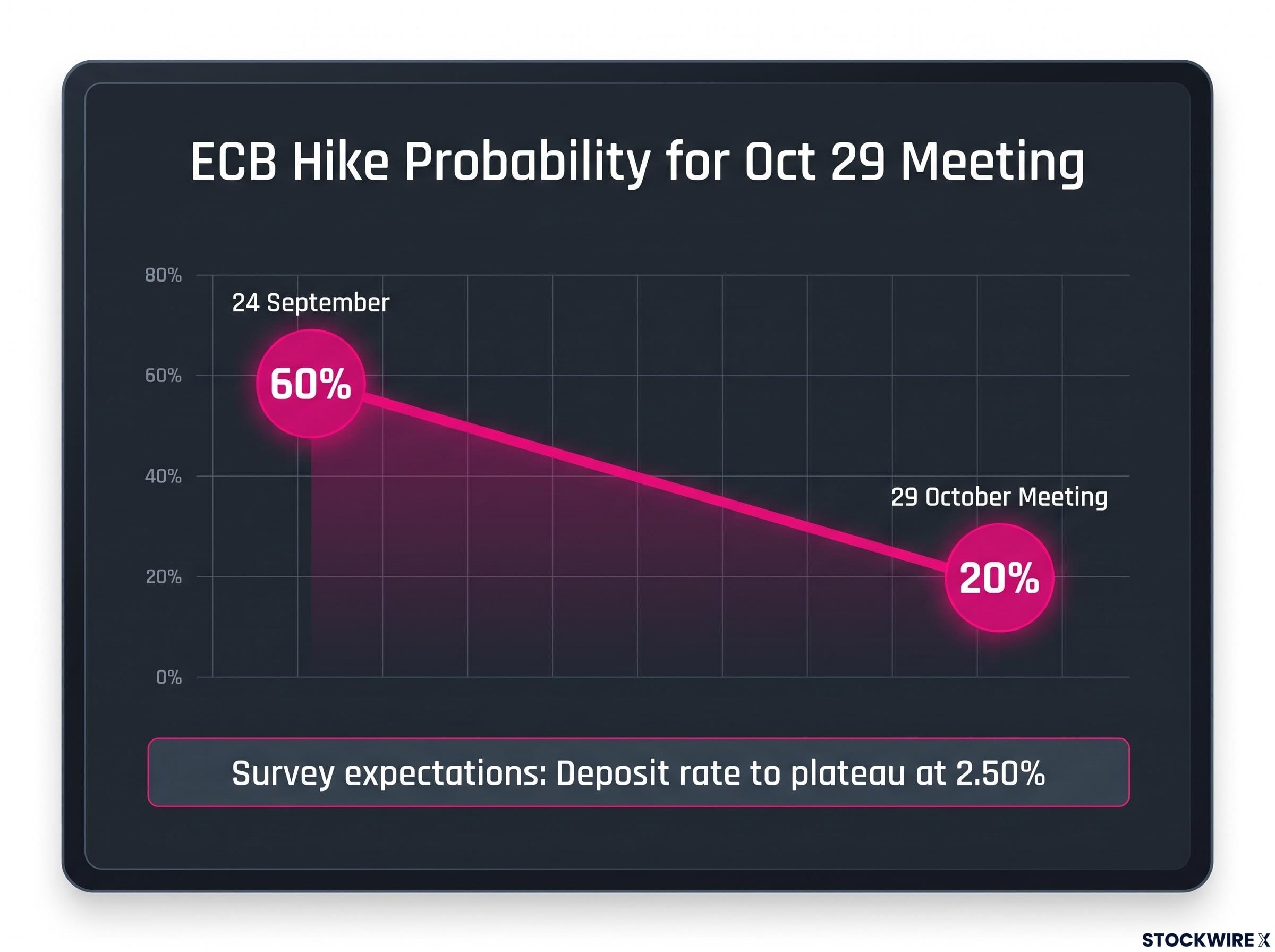
The pricing is already slipping. Admiral Markets put the probability of an ECB hike at the 29 October meeting near 20%, down from about 60% on 24 September. The ECB’s account of its September meeting showed surveys expecting the deposit rate to plateau at 2.50%.
The economist consensus behind the December hike call is notable: 64 of 73 economists expect a move to 2.75%, even though 70 expect the ECB to hold on 29 October.
ABN AMRO ties euro weakness to shifting rate differentials. The counterargument deserves weight: BNP Paribas Wealth Management still expects a December hike, while European fiscal expansion and strategic-autonomy investment could rebuild support. Because shorts are not excessive, squeeze risk is lower, but not gone.
A turn would need a catalyst, such as:
- Renewed pricing of ECB tightening
- A reversal of cross-border hedges
- Softer U.S. data
- A swing in risk sentiment
Then turn the same scepticism on the dataset itself:
- Sample: iFlow may reflect BNY clients rather than the whole market (an unconfirmed but reasonable caution).
- Holdings are not bets: custody positions can reflect allocations, hedges or collateral.
- Relative readings: “overheld” compares with a one-year average.
- Timing: T+1 data shows change, not whether it caused the price move.
- Different lenses: CFTC futures data can diverge from iFlow without either being wrong.
The takeaway for you: one positioning dataset can confirm a trend, but it cannot time the end of one.
What the net short tells you, and what it does not
The euro is net short, but not aggressively so. The driver is hedge normalisation and rotation into the franc, krone, krona and sterling, not a rerun of the Q2 dollar panic.
Before acting on any positioning headline, run three checks. Which instrument carries the flow, crosses or EUR/USD? What is the cause, hedging or liquidity stress? And what catalyst would change it, with rate pricing at the top of that list?
The next test arrives at the ECB’s 29 October meeting. Whether tightening is priced further out, or back in, will decide whether BNY’s caution on a euro bottom holds. Any forward-looking views cited here are speculative and subject to change with market developments.
This article is for informational purposes only and should not be considered financial advice. Investors should conduct their own research and consult with financial professionals before making investment decisions. Past performance does not guarantee future results.
—