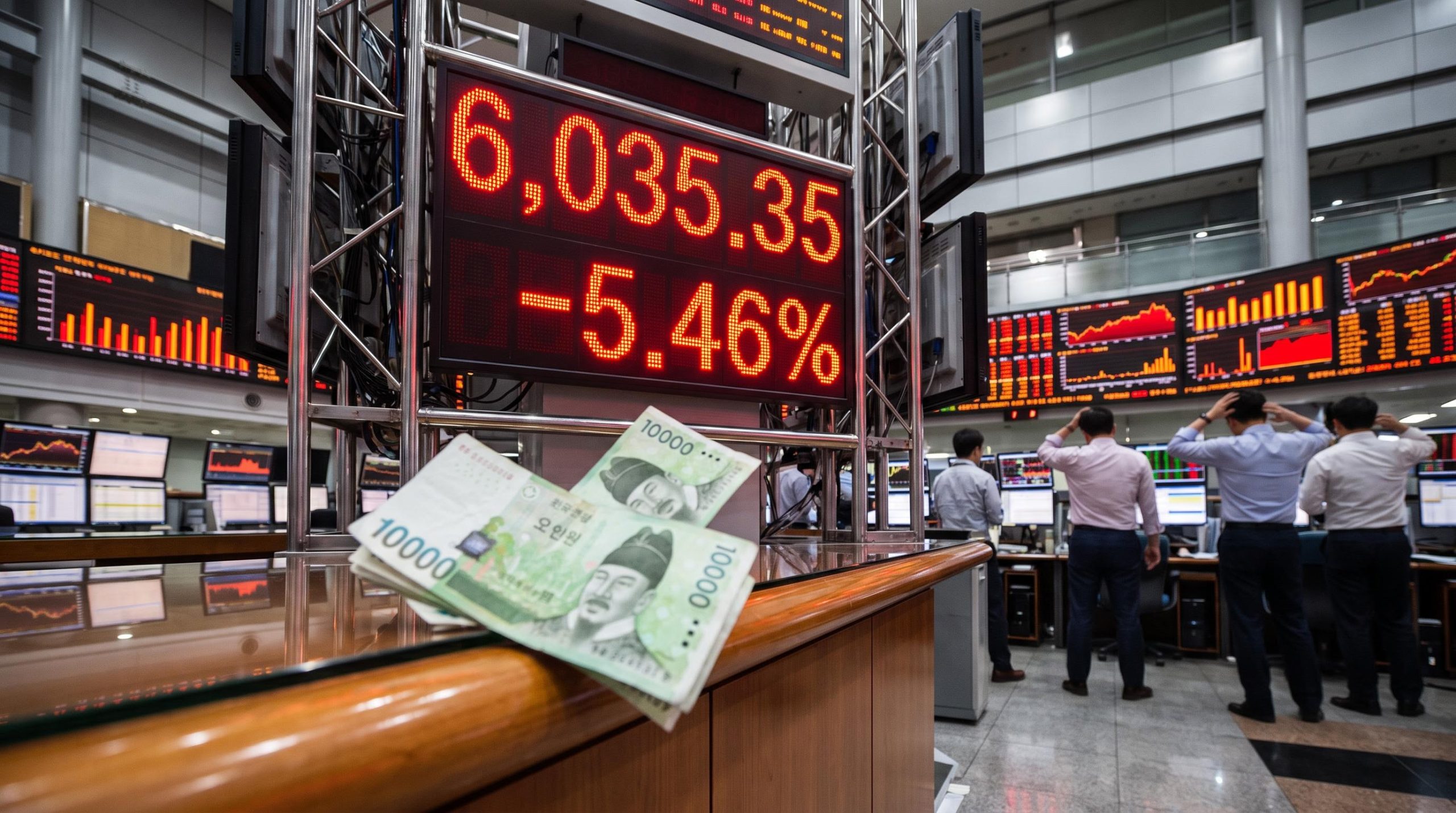
Demand for protection against a weaker Korean won rose after the KOSPI fell 5.46% to 6,035.35 on Tuesday 13 October, according to MUFG economist Michael Wan. The KOSPI selloff, led by the country’s two largest chipmakers, spread from the equity market into the currency market within a single session.
Foreign investors sold roughly ₩4.52 trillion (about US$3.4 billion) of Korean shares, according to Korea Exchange-based reports. That selling explains why the equity rout and the won are now moving as one story.
The picture is not one-directional. The won steadied on Wednesday, with USD/KRW easing to ₩1,338.3, even as stocks stayed weak.
Here is why equity selling turns into currency risk, what the rise in hedging demand does and does not signal, and which indicators will show whether the pressure is easing.
Why did foreign selling push investors to hedge against a weaker won?
Wan’s observation was simple: the steep drop in Korean stocks lifted demand for hedges against won weakness.
MUFG’s read on the won Michael Wan linked the equity rout to rising demand for protection against a weaker won, alongside foreign equity outflows of about US$3.3 billion, according to comments relayed by the FXStreet Insights Team.
His comments reached the market through an AI-assisted, editor-reviewed FXStreet article, so they are a secondary relay of his view. The outflow figure also varies by outlet: the Korea Herald reported ₩2.2 trillion and Aju Press reported ₩5.1532 trillion. The KRX-based ₩4.52 trillion is the most consistently reported figure, and it sits close to MUFG’s estimate, but it should not be treated as definitive.
How risk reversals work
A risk reversal is the price gap between options that pay off if the won weakens and options that pay off if it strengthens. When that gap moves toward won-weakness options, investors are paying more for downside protection. The FXStreet report gives the direction of this skew but no numerical reading.
The link from share sale to currency hedge is close to automatic:
- A foreign investor sells Korean shares.
- The investor receives won.
- The proceeds are converted into dollars.
- That conversion creates spot or forward selling of the won.
- Investors with remaining Korean exposure buy USD/KRW calls or similar protection.
- Risk reversals shift toward greater won downside protection.
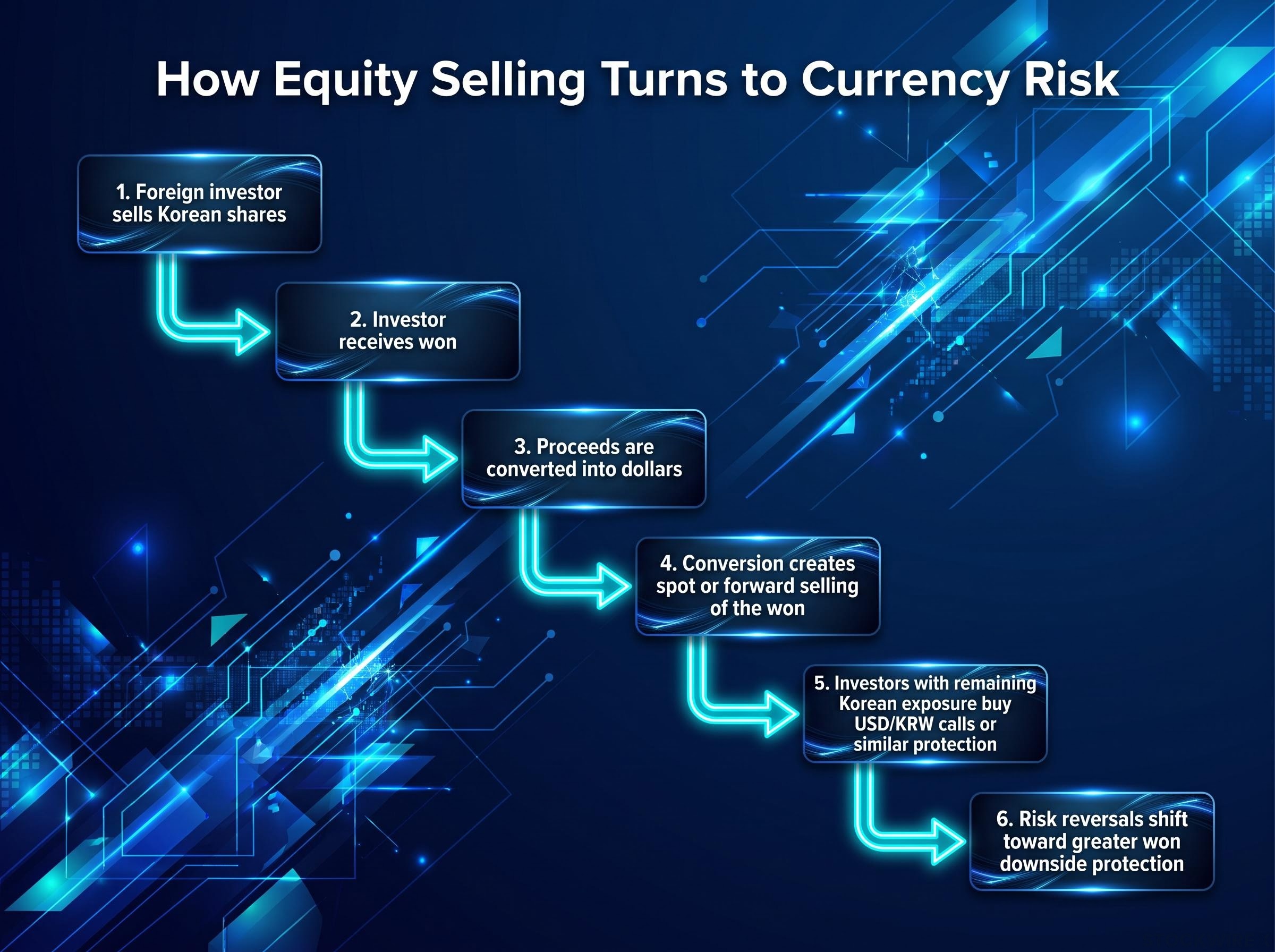
The process is mechanical, not a matter of panic. For you, the signal is that investors still holding Korean assets are paying up to cap currency losses. If you hold Korean exposure unhedged, a falling won can add to equity losses.
Investors exploring Korean exposure can read our dedicated guide to investing in South Korean stocks, which explains how KRW movements act as a second return driver.
When big ASX news breaks, our subscribers know first
What triggered the KOSPI selloff in the first place?
The currency strain began with three pressures landing on a market crowded into two stocks:
- Semiconductor liquidation: Samsung Electronics and SK Hynix led the decline after an AI- and memory-led rally left the index heavily concentrated in both names.
- Chinese competition: reports of progress at CXMT revived fears about lower-cost memory rivals.
- AI-capex doubts: weakness in US chip stocks raised questions about how long AI infrastructure spending can last.
| Instrument | Move | Level | Date |
|---|---|---|---|
| KOSPI | -5.46% (-348.89 points) | 6,035.35 | 13 October 2026 |
| Samsung Electronics | About -7.39% | About ₩232,000 | 13 October 2026 |
| SK Hynix | About -10.09% | About ₩1.443 million | 13 October 2026 |
| KOSPI | -0.44% | Not reported | 14 October 2026 |
The stock-level moves come from Seoul Economic Daily and have not been independently confirmed.
CXMT is reported to have made progress on a 4F² DRAM cell architecture, a denser memory-cell design. It plans DDR5-related server memory before the end of 2026. Pepperstone’s Chris Weston framed the development as evidence of China’s ambitions in AI hardware, with an important limit:
The CXMT 4F2 DRAM design was shown at a conference rather than shipped, and CXMT shares fell alongside the incumbents, which points to sector-wide uncertainty rather than a clean shift of value from Seoul to Shanghai.
The mass-production caveat Weston noted that CXMT had not yet shown mass production at scale, and that the development did not immediately displace South Korea’s lead in high-bandwidth memory (HBM), the specialised memory used in AI accelerators.
Broadcom CEO Hock Tan’s warning that capital may become AI’s biggest constraint added weight to the spending doubts. Jung In Yun of Fibonacci Asset Management Global said Samsung’s strong earnings were overshadowed by both concerns.
For you, the key point is that the market priced future risk to Korean memory pricing power, not realised damage. That makes the duration of the pressure depend on evidence, not just headlines.
Is the won under real pressure, or is the hedging demand overstated?
Rising hedging demand looks alarming on paper. A day later, the won told a more mixed story.
USD/KRW closed at ₩1,345.1 on 13 October, then eased to ₩1,338.3 on 14 October, a ₩6.8 gain for the won despite continued equity weakness (figures not independently confirmed). Exporter dollar selling and broader dollar conditions offset part of the equity-driven pressure.
Custodian bank settlement mechanics, a chip-driven trade surplus and coordinated intervention have previously pulled USD/KRW in the opposite direction to a falling KOSPI, which helps explain why the won held up in this session.
Past episodes show what a deeper feedback loop looks like:
- 2008: foreign deleveraging hit stocks and the won together.
- 2020: pandemic outflows weakened the won until policy support arrived.
- 2022: US rate rises and dollar strength pressured both markets at once.
This shock is concentrated in equity valuations and technology expectations, not in Korea’s external financing. Major semiconductor exports still support the currency, which separates it from a balance-of-payments crisis.
What officials and the NPS have (and have not) done
No emergency Bank of Korea intervention or Ministry of Finance package has been reported. The Ministry has said it would act to stabilise markets when necessary.
The National Pension Service (NPS) was reported to be largely absent as a dip buyer and to have altered its allocation and hedging activity, though it has not disclosed the scale of its currency hedging. These reports remain unverified.
The read for you: rising hedging demand is a warning about risk appetite, not proof of a currency crisis. Weigh it against the export flows still supporting the won.
What should investors watch to see if the pressure is easing?
Daishin Securities’ Lee Kyung-min said Wednesday’s rebound attempt drew bargain buying but was held back by weak AI momentum, higher oil prices and caution before US inflation data. No attributed KOSPI forecasts from major global banks were found, so the answer will come from data, not predictions.
Ordered by how quickly each signal shows up:
- Foreign net flows in Samsung, SK Hynix and the KOSPI.
- USD/KRW within the ₩1,330-₩1,350 range.
- KRW risk reversals.
- US chip stocks and AI-capex commentary.
- NPS rebalancing and official action from the Bank of Korea or Ministry of Finance.
- CXMT shipping at scale, plus HBM orders, prices and lead times.
| Indicator | Worsening reading | Improving reading |
|---|---|---|
| Foreign net flows | Selling continues in chip leaders | Selling slows or turns to buying |
| USD/KRW | Breaks above ₩1,350 | Holds near ₩1,330 |
| Risk reversals | Downside protection keeps getting pricier | Skew flattens |
| CXMT and HBM | Proven volume shipments | HBM orders and prices hold |
Each line tells you whether currency risk on Korean holdings is building or fading before you adjust exposure.
What the selloff changes for won risk, and what it does not
The selloff showed how quickly a crowded equity trade can become a currency-hedging story. One session does not establish a won downtrend. The won’s firmer close on 14 October shows that export flows and dollar conditions still offset equity outflows.
The question now is which force wins. Two signals will settle it: whether foreign selling in Korea’s chip leaders fades, and whether risk reversals stop moving toward won downside protection. If both improve, the hedging spike looks like a one-off reaction. If both worsen, the currency risk deserves more weight.
This article is for informational purposes only and should not be considered financial advice. Investors should conduct their own research and consult with financial professionals before making investment decisions. Past performance does not guarantee future results, and forward-looking statements are speculative and subject to change based on market developments.