South Korea’s Won just hit an 11-month low against the Dollar, powered by 56% year-over-year export growth in the first 20 days of August and a central bank that raised rates for the first time in three and a half years. That progress is now parked at a crossroads: two policy events this week will determine whether 1,380 gives way or USD/KRW snaps back toward 1,400.
The structural backdrop has shifted cautiously in the Won’s favour. Export momentum, a recurring trade surplus, and a Bank of Korea (BoK) explicitly committed to currency stability are all pulling in the same direction. But technical indicators are flashing consolidation risk, and the global Dollar context set by the Federal Reserve’s Jackson Hole symposium will either amplify or overwhelm those domestic tailwinds. Two central banks, two decisions, and a currency pair already stretched after a sharp move lower.
Here is the framework for reading both events, the specific technical levels that matter, and the scenarios that will define USD/KRW’s next leg. Whether Jackson Hole and the BoK confirm or complicate the Won’s momentum, you will know which signals to watch and what each outcome means for the pair’s direction.
What is driving the Won’s 11-month run and where the pair stands now
USD/KRW touched an intraday low of 1,380 on Friday, its weakest level in 11 months, as exporter and corporate dollar selling sustained downward pressure on the pair. The broader push into the high-1,380s has been driven by two forces working in tandem: record semiconductor-led export growth generating heavy USD selling from Korean corporates, and a softer global Dollar environment that has amplified the move.
Shipments surged 56% against the same period a year earlier across the opening 20 days of August, with record semiconductor volumes underpinning the advance and a substantial trade surplus accumulating as a result, channelling significant exporter dollar selling into KRW.
Korea Customs Service export data for the first 20 days of August confirmed the 56% year-on-year surge, with semiconductor shipments nearly tripling to a fresh record and the trade surplus reaching approximately $14 billion for the period.
What makes this move notable is what is not driving it. OCBC strategists Sim Moh Siong and Christopher Wong note that inflows tied to foreign equity positions in South Korea have not provided consistent directional support, with that channel running in both directions rather than adding uniform upward pressure on the Won. The domestic fundamentals, exports, trade surplus, and BoK’s bias toward currency stability, are doing the heavy lifting. Hot-money inflows are not the engine here.
That distinction matters. Export-driven flows are more durable than portfolio inflows, which can reverse on sentiment shifts. But the same OCBC analysis flags residual headwinds: persistently elevated crude oil prices and elevated US long-duration bond yields continue to weigh on the Won’s upside potential. And the technicals are starting to flash caution. The bullish momentum that drove the recent move has lost conviction, and the RSI on USD/KRW has drawn close enough to oversold readings to raise the prospect of a near-term pause ahead of two binary macro events.
Commerzbank’s characterisation of repatriation-driven flows as structurally distinct from speculative positioning matters here: corporate dollar selling tied to cash cycles is harder to reverse on a single headline than hot-money inflows, which is why the Won’s support has held even during periods of equity market volatility.
The 56% export surge explains why the Won has come this far, but fading momentum signals tell you the market may need a fresh fundamental catalyst to push through 1,380 rather than simply coasting on existing flow.
Technical levels to anchor the week ahead
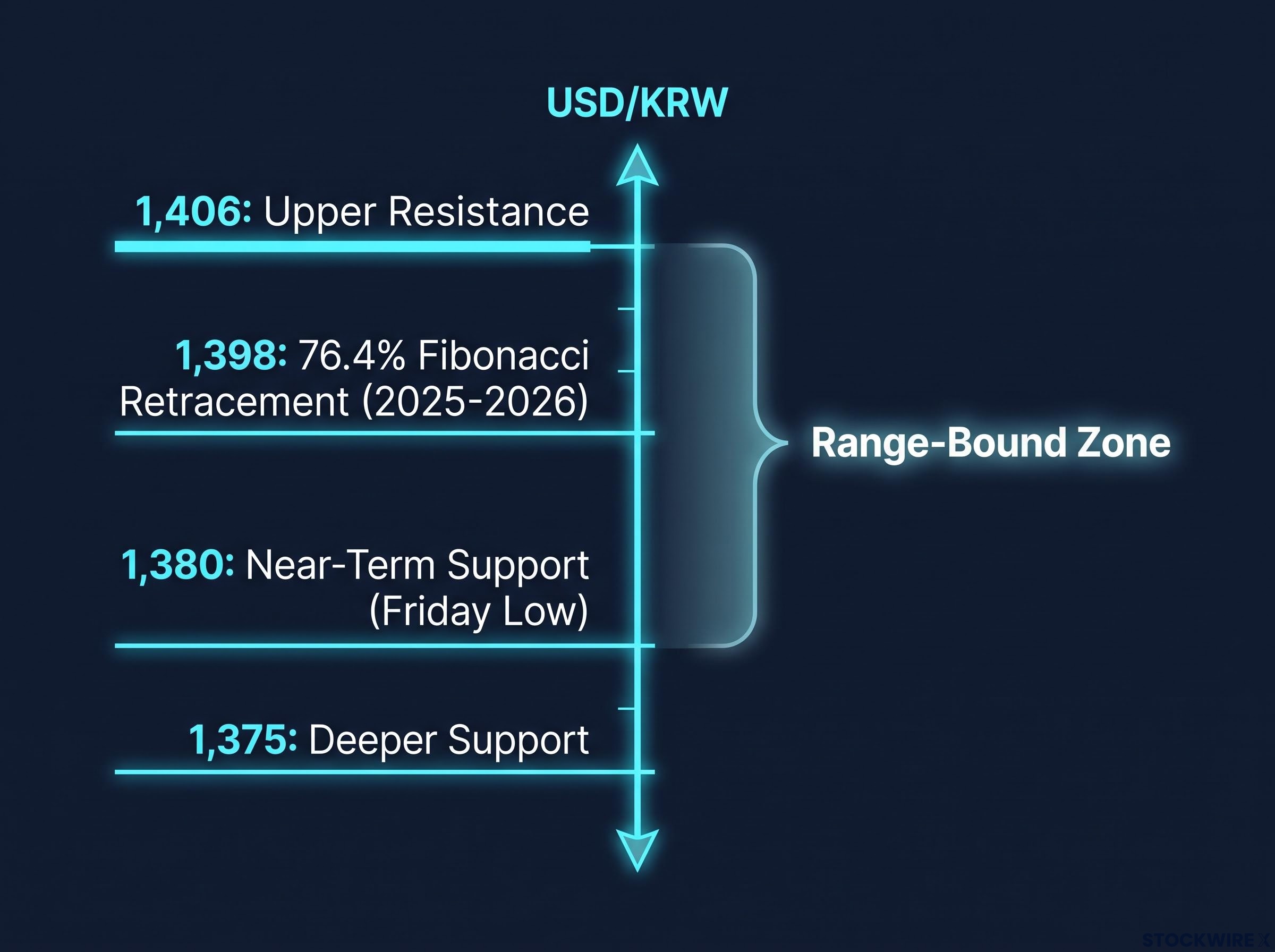
The pair is currently operating within a 1,380-1,400 range-bound zone. The levels that bookend the next move are specific and well-defined.
| Level | Price | Significance |
|---|---|---|
| Near-term support | 1,380 | Friday’s intraday low; immediate technical anchor |
| Deeper support | 1,375 | Next meaningful level below; a sustained break here signals domestic fundamentals overpowering residual Dollar strength |
| Fibonacci resistance | 1,398 | 76.4% Fibonacci retracement of the 2025 low to 2026 high range |
| Upper resistance | 1,406 | Upper boundary; a clear hold above argues for a more sustained correction higher |
A Fibonacci retracement level is a price point derived from measuring a previous high-to-low range and identifying where within that range a reversal or pause becomes statistically more likely. The 1,398 level sits at the 76.4% retracement of USD/KRW’s move from its 2025 low to its 2026 high, making it the first meaningful resistance zone the pair would need to clear on any bounce.
Fibonacci retracement levels derive their statistical significance from measuring prior high-to-low ranges across any currency pair, with the 76.4% retracement, less commonly cited than the 61.8% or 50% levels, consistently appearing as a zone where institutional positioning re-evaluates trend continuation versus reversal.
A sustained break below 1,375 would signal that domestic fundamentals have genuinely overpowered the residual Dollar strength from high US yields and crude oil. A clear hold above 1,406 argues for a more sustained correction higher, one that would reframe the Won’s recent gains as a correction within a broader range rather than a new trend.
When big ASX news breaks, our subscribers know first
Jackson Hole sets the Dollar context that everything else runs through
The Won’s structural tailwinds are real, but they operate within a Dollar envelope. Jackson Hole is where that envelope gets resized.
The Fed Chair’s speech this week is primarily a USD story for the Won. Whatever domestic support South Korea’s export growth and BoK policy provide, it runs through the global Dollar filter that Jackson Hole will calibrate. Two scenarios define the range of outcomes:
Warsh’s communication regime introduces a complication the current framework must account for: unlike Powell-era Jackson Hole addresses that reliably telegraphed rate intentions, the 2026 speech is deliberately engineered to avoid a September signal, meaning investors who arrive expecting guidance carry the sharpest repricing risk from a hawkish surprise.
- Dovish outcome (faster or deeper easing than currently priced): Softer US yields and a weaker Dollar would amplify the Won’s existing export-driven support. Exporter dollar selling is already active, so a weaker Dollar from Jackson Hole is the cleanest route to an extension of the Won rally. A clean break below 1,380 and a move toward the mid-1,370s become credible, with room for further downside if follow-through is strong.
- Hawkish outcome (higher-for-longer pushback against aggressive rate-cut pricing): Elevated or rising US long-end yields support the Dollar, likely triggering profit-taking and a USD/KRW bounce toward the 1,398-1,406 resistance zone. Given how quickly the Won has strengthened, even a modest re-steepening in US yields could trigger a short-term squeeze higher.
Markets already lean KRW-positive. That positioning asymmetry means a hawkish surprise could pack more short-term punch than a dovish confirmation.
OCBC’s Sim Moh Siong and Christopher Wong have flagged elevated US long-end yields as an existing headwind for the Won. A hawkish surprise would compound that pressure rather than introduce it fresh.
If Powell delivers a hawkish surprise, the Won’s structural story does not break, but it loses its near-term edge. You are watching for whether Jackson Hole validates or delays the next leg lower in USD/KRW, not whether it changes the multi-month direction. And because Jackson Hole lands first this week, its outcome will frame how markets interpret the BoK decision that follows within days. Getting the sequencing right matters.
What the Bank of Korea decision actually means for USD/KRW
The BoK raised its policy rate to 2.75% in July, the first hike in three and a half years, and framed the move around persistent inflation pressures and Won weakness rather than growth optimism. That framing is itself the signal. The BoK has explicitly made currency stability a binding constraint on its policy decisions, repeatedly referencing past episodes where USD/KRW spiked into the 1,500s as context for its sensitivity to volatile FX moves.
The BoK’s July rate decision raised the base rate by 25 basis points to 2.75%, with the Monetary Policy Committee citing inflationary pressure and financial stability as the governing considerations, a framing that embedded currency stability as a binding policy constraint.
Strong August export data and the Won’s recent strengthening have led some analysts to see room for at least a hawkish hold or even another hike. The rate gap between South Korea and the US has narrowed since July but remains negative, meaning the BoK’s room to cut is constrained by the carry trade arithmetic: cut too far and the rate differential widens again, making the Won less attractive to hold.
Reading the guidance, not just the decision
The BoK’s Monetary Policy Committee (MPC) decision lands on Thursday. But the rate number alone will not tell you the full story. The post-decision statement and press conference language carry as much market weight as whether the rate moves.
The signal to watch for in a hawkish hold scenario is any language around “willingness to hike again” if inflation or Won weakness re-emerges. That phrase, or close variants, confirms the BoK is keeping the door open and tells you the floor under the Won remains firm. Contrast that with any language emphasising growth risks or tolerance for currency appreciation, which would read as an early signal of a future dovish pivot, functionally KRW-negative even if the headline rate does not move.
| Scenario | Probability | Rate decision | USD/KRW implication |
|---|---|---|---|
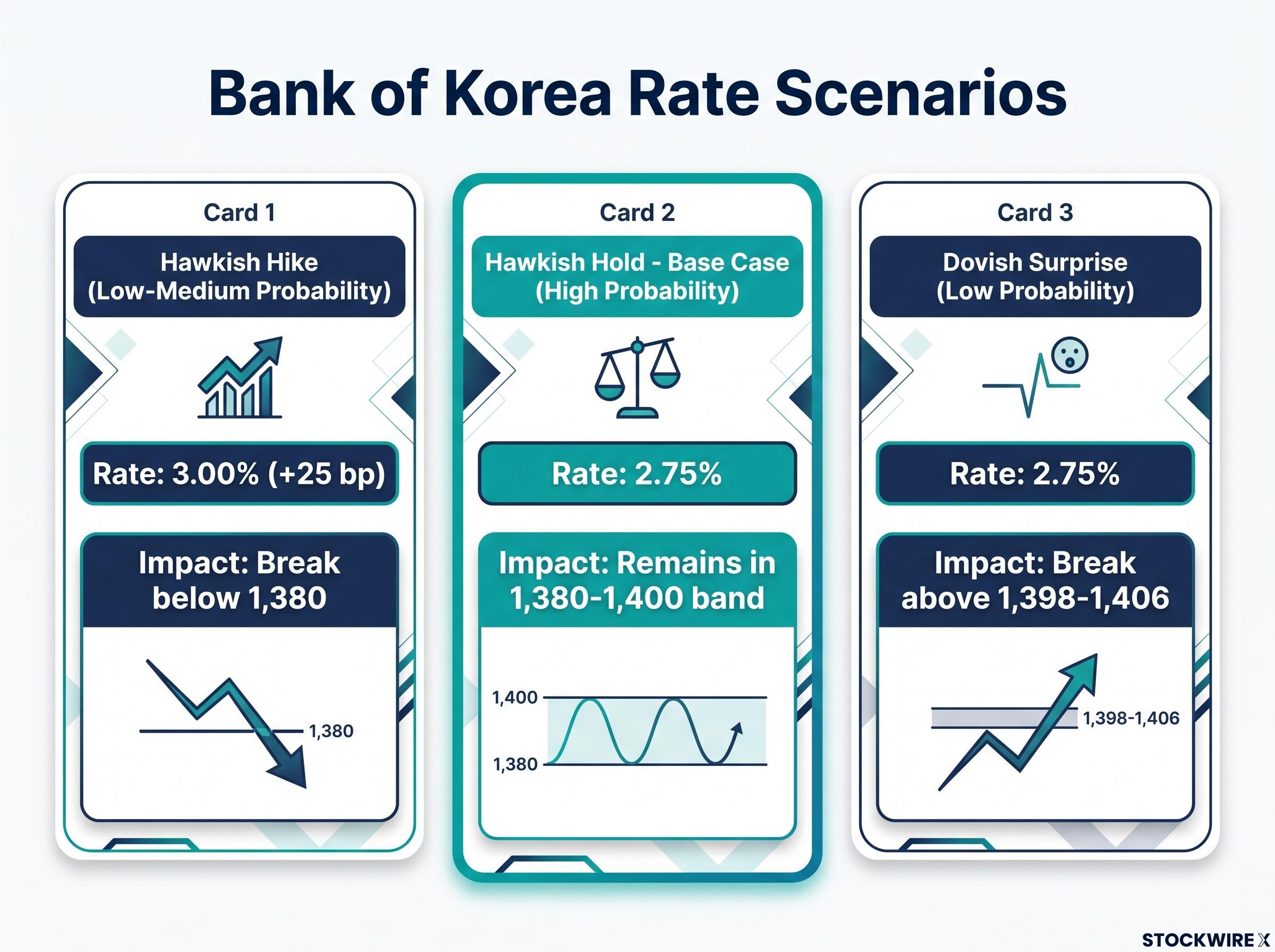
| Hawkish hike | Low to medium | 3.00% (+25 bp) | Decisive break below 1,380 becomes credible; markets look toward deeper support |
| Hawkish hold (base case) | High | 2.75% (unchanged) | USD/KRW remains broadly within the 1,380-1,400 band |
| Dovish surprise | Low | 2.75% (unchanged, but dovish guidance) | Break above 1,398-1,406 resistance zone more likely; attention shifts to higher ranges |
Because markets are already positioned for at least a firm hold, a genuinely dovish surprise would probably pack more punch in USD/KRW terms than a modestly hawkish outcome. A hold with dovish signalling on future cuts is functionally a KRW-negative event even if the headline number does not move. You should weight the guidance language as heavily as the rate decision itself.
Structural tailwinds versus event-week noise: the medium-term case for the Won
Whatever happens this week, the medium-term directional lean has shifted. The structural drivers supporting Won appreciation are durable, and they are not contingent on any single event outcome:
The Won’s outperformance among Asian peers reflects a structural advantage that goes beyond near-term export data: Seoul’s more than 1,000 trillion won in planned AI and chip investment through 2035 anchors sustained foreign portfolio inflows in a way that generic Asia FX baskets, exposed to the Thai baht and Philippine peso, cannot replicate.
- Robust and sustained export growth, particularly in semiconductors, generating organic dollar-selling flow
- A large and recurring trade surplus that creates persistent demand for Won
- BoK’s explicit prioritisation of currency stability, limiting the scope for aggressive easing
- A narrowing Korea-US rate differential, reducing one of the persistent headwinds the Won faced during its period of multi-year weakness
Independent macro model projections from TradingEconomics point to USD/KRW at approximately 1,381 by end-quarter and approximately 1,341 over 12 months. These projections have not been independently verified and should be read as directionally consistent with the structural thesis rather than as a precise price target.
Macro model projections point toward the mid-1,300s over 12 months, consistent with the structural direction of travel. These are unverified and should be treated as a directional consistency check, not a price target.
The medium-term case is not without conditions. Three developments would materially weaken it:
- A sustained crude oil price spike that erodes South Korea’s terms of trade and widens the current account deficit
- Aggressive Fed re-pricing that pushes US yields materially higher and reverses the Dollar’s softening trend
- A BoK pivot to rate cuts that re-widens the Korea-US rate differential and undercuts the carry appeal of holding Won
A bounce toward 1,400 after this week’s events would be a tactical correction within a structural trend, not a signal to abandon the Won-positive thesis, unless the BoK’s language or the Fed’s tone fundamentally shifts the rate-differential calculus. Separating this week’s binary event risk from the medium-term trend is the most important analytical task for anyone watching the pair with a horizon beyond Friday.
Watching 1,380 and 1,398 while the central banks speak
The sequencing this week is straightforward: Jackson Hole sets the Dollar envelope, then the BoK decision on Thursday either confirms or complicates the domestic picture within that envelope.
Three variables will determine which scenario unfolds:
- The Fed Chair’s tone on easing pace at Jackson Hole. Dovish language amplifies the Won’s existing tailwinds; hawkish pushback compresses them.
- The BoK’s rate decision. A hike to 3.00% would be the strongest signal; a hold is expected, meaning the market reaction depends on the third variable.
- The BoK’s guidance language on future policy. “Willingness to hike again” confirms the hawkish stance; emphasis on growth risks or tolerance for appreciation signals a dovish pivot.
The two numbers that frame the outcome are specific. A sustained break and hold below 1,375 signals the medium-term KRW-bullish thesis is playing out and the structural drivers have overwhelmed event-week noise. A clear break and hold above 1,406 signals a short-term reversal, one that would refocus attention on higher ranges and argue for a reassessment of the near-term directional bias.
The structural backdrop now leans Won-positive. It now takes an active surprise, a hawkish Fed or a dovish BoK, to push USD/KRW sustainably higher.
The burden of proof has shifted. For most of the Won’s period of multi-year weakness, the default was Dollar strength and the Won needed a catalyst to rally. That equation has flipped. Exports, the trade surplus, and the BoK’s stance now provide the baseline support. You do not need to predict which scenario wins this week. You need to know which numbers to watch and which signals confirm or invalidate the prevailing thesis. This week delivers both within days.
This article is for informational purposes only and should not be considered financial advice. Investors should conduct their own research and consult with financial professionals before making investment decisions. These statements are speculative and subject to change based on market developments and central bank policy decisions.