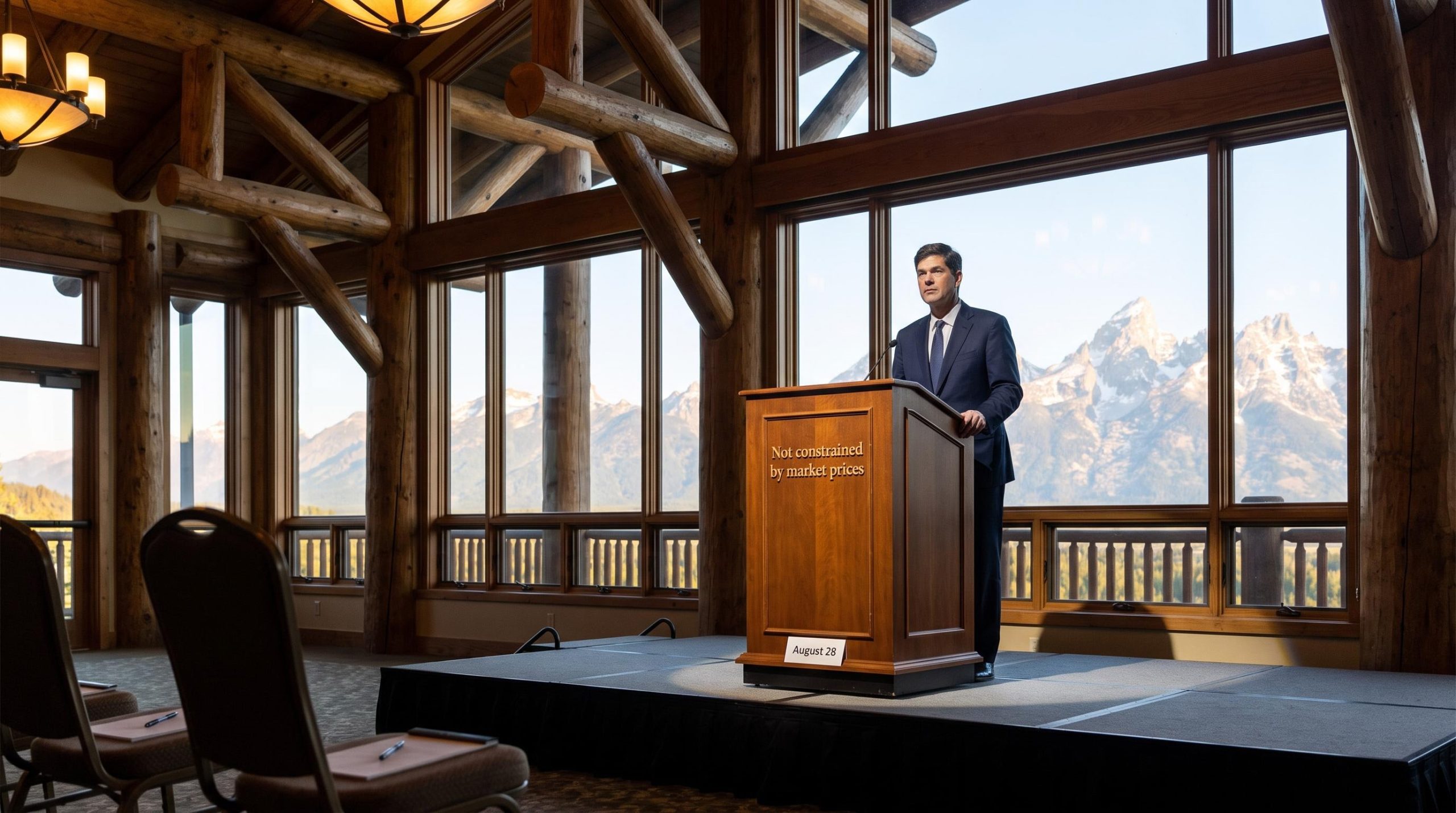
Markets want Kevin Warsh to walk to the podium at Jackson Lake Lodge on August 28 and hand them a September rate decision. TD Securities strategists say that is almost certainly not going to happen. The most-watched Federal Reserve speech of the year may be deliberately designed to give investors nothing to trade on in the conventional sense.
The timing makes the silence harder to accept. This is Warsh’s first Jackson Hole keynote as chair, it falls three weeks before the September 16 FOMC meeting, and a decade of heavy forward guidance from his predecessors has conditioned markets to treat major Fed addresses as rate-path previews. That conditioning is precisely what makes this speech unusual.
Here is what this piece gives you: a clear map of what Warsh is likely to say, why the absence of a rate signal is itself a signal, and how to read the address for what it actually communicates rather than what it fails to deliver. Think of it as preparation, not prediction.
The speech Warsh has already told you not to expect
Since taking office on May 22, 2026, Warsh has been the clearest communicator of what will not happen on August 28. He has systematically dismantled the guidance apparatus his predecessors built:
- Removed his own projections from the Fed’s dot plot, the chart showing where each policymaker expects rates to land
- Shortened the forward-looking materials the Fed publishes alongside decisions
- Floated reducing the number of scheduled policy-setting meetings
These are not random bureaucratic tweaks. They are architectural choices. Warsh has said the Jackson Hole address is still a “blank page” and that he wants to steer the conversation away from what he calls getting “caught up in the myopic,” the quarter-point debates that dominated his predecessors’ tenures.
Warsh’s June FOMC statement, which ran roughly 130 words and stripped all forward guidance and rate bias language, sent the two-year Treasury yield surging 18 basis points intraday, providing the clearest early evidence that the new communication regime would move markets even without a rate change.
“Not constrained by market prices.”
That phrase, delivered in one of Warsh’s earlier public appearances, is the sharpest warning shot aimed at investors expecting a choreographed September preview. A chair who pre-announces the absence of a rate signal is telling you that his communication regime has changed structurally, not just for one speech. Every future Fed address under Warsh needs to be interpreted through that lens.
When big ASX news breaks, our subscribers know first
What Warsh is expected to actually say
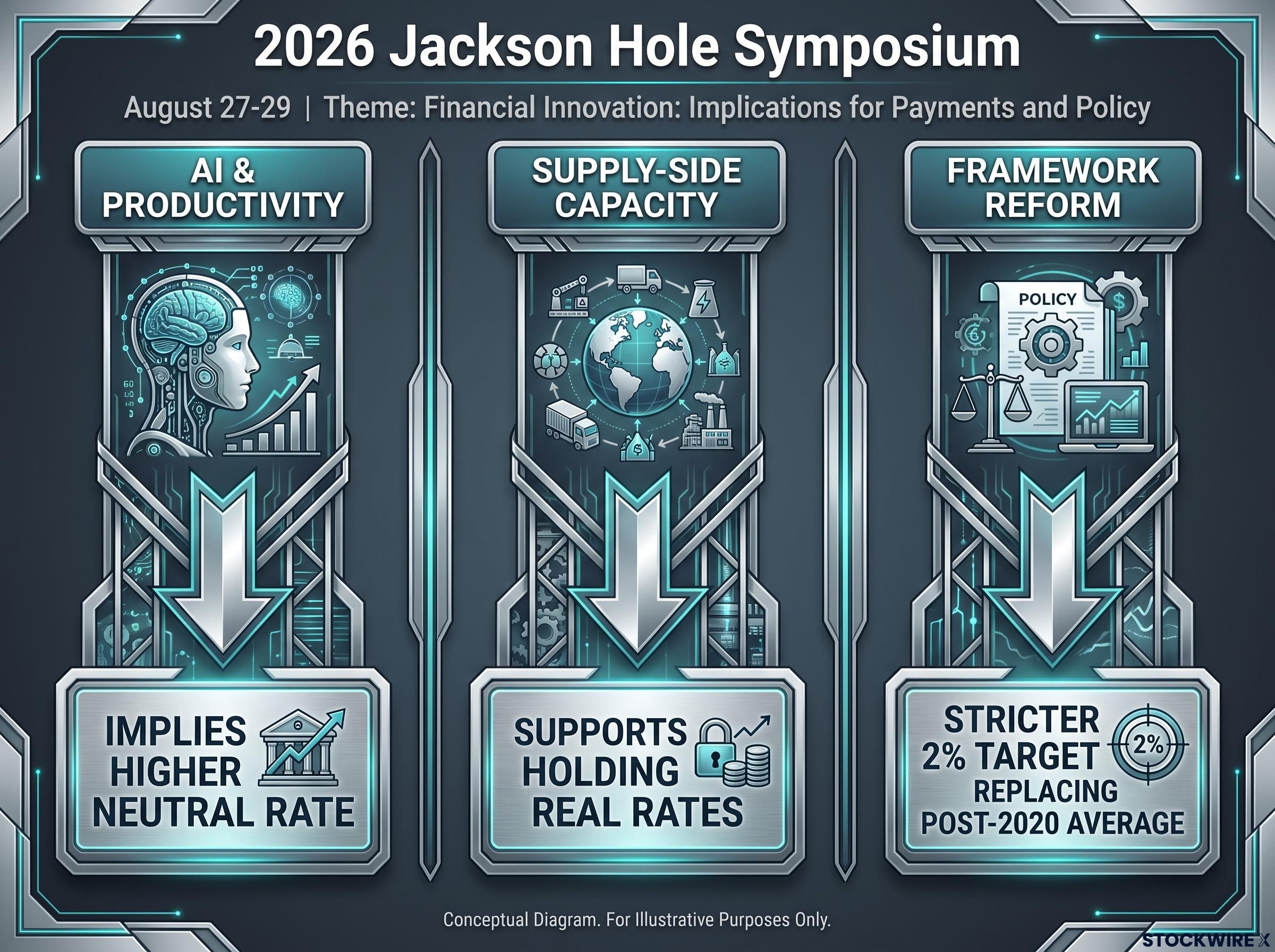
The 2026 Jackson Hole symposium runs from August 27-29 under the theme “Financial Innovation: Implications for Payments and Policy.” The theme itself signals where Warsh’s head is. Rather than inflation prints and labour reports, he is expected to build his address around three structural pillars, each one reinforcing a single worldview: the economy can tolerate tighter policy for longer than markets currently assume.
| Theme | What Warsh is expected to emphasise | Implied policy signal |
|---|---|---|
| AI and productivity | AI-driven gains raise the economy’s sustainable growth rate | Higher neutral rate; “tight” policy is less restrictive than it looks |
| Supply-side capacity | Deregulation, capital investment, labour adjustment, deglobalisation | Reduced inflationary pressure supports holding real rates |
| Framework reform | Review of post-2020 flexible average inflation targeting | Stricter 2% target; leaner communication structure |
The neutral rate concept ties these themes together. The neutral rate is the interest rate at which the economy neither accelerates nor slows. If AI genuinely lifts the economy’s long-run growth potential, the neutral rate rises with it. That means the Fed’s current rate, which sounds restrictive, may be closer to neutral than markets think.
Framework reform as the sleeper signal
The framework review carries the highest stakes of any structural theme Warsh could address. Since 2020, the Fed has operated under flexible average inflation targeting, a regime that allowed inflation to run above 2% for extended periods to make up for past undershoots. A return toward a stricter 2% target would reduce the Fed’s tolerance for above-target inflation runs. What that tells you, particularly if you hold long-duration assets, is that the Fed’s reaction function would become structurally more hawkish over the medium term, regardless of what happens at the September meeting.
A speech organised around productivity, supply-side durability, and framework tightening is not a neutral academic exercise. It is an implicit argument that the Fed does not need to rush toward cuts. Listen for it that way.
How markets are likely to trade an opaque speech
The productive question is not “what will Warsh say?” but “which instruments will tell you how institutional money interpreted what he said?” Here is the contingency map.
The 2-year Treasury yield is the first-mover instrument. It is the maturity most sensitive to perceived changes in the near-term policy path. Fed funds futures, the contracts traders use to price the probability of rate moves at specific meetings, are the second. Together, they translate speech tone into rate expectations in real time.
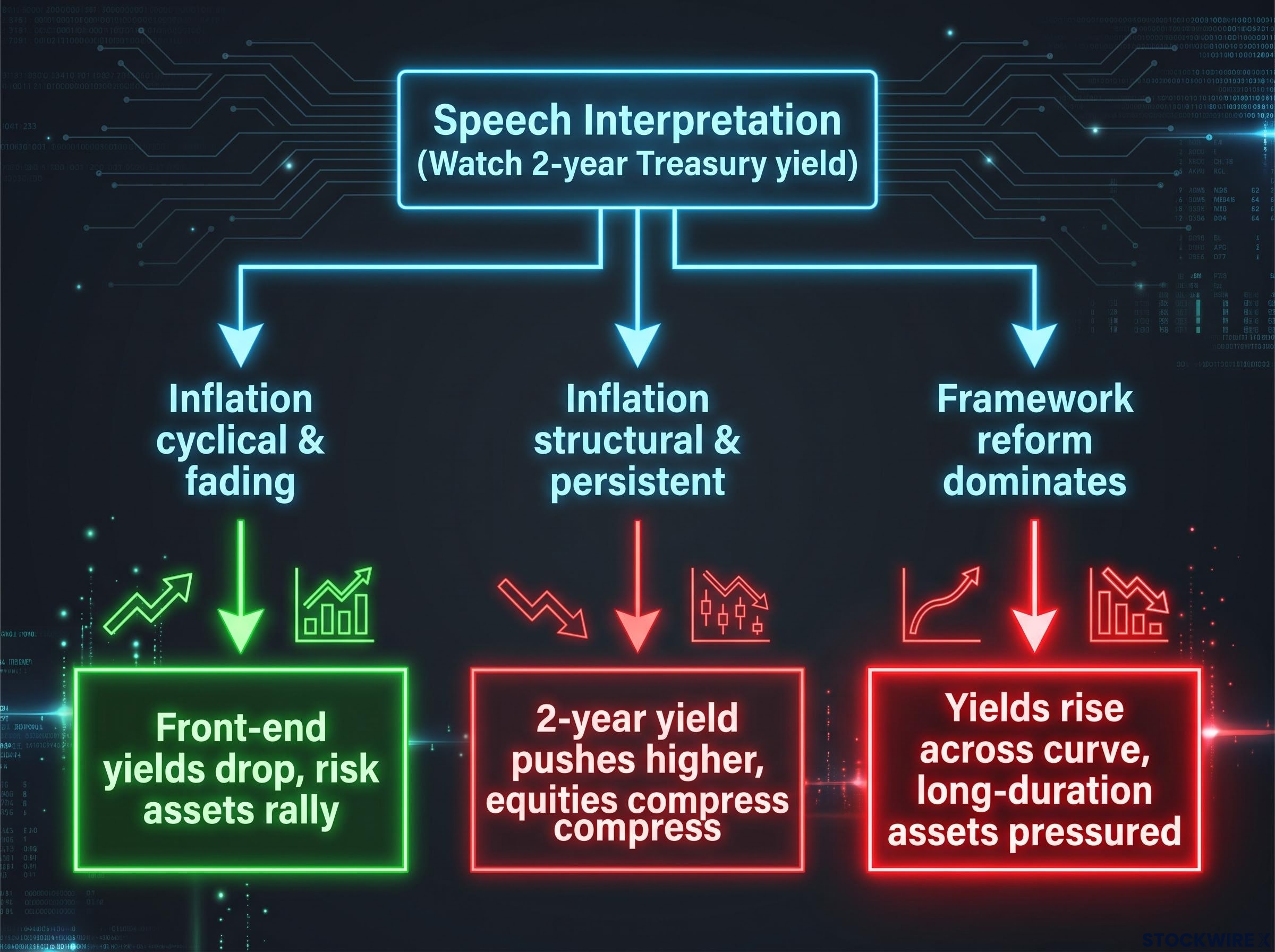
Three interpretive branches will compete in the hours after the address:
- Inflation framed as cyclical and fading: Front-end yields drop as traders price earlier easing; risk assets rally
- Inflation framed as structural and persistent: 2-year yield pushes higher; rate-sensitive equities compress
- Framework reform language dominates: Yields rise across the curve as markets price a structurally more hawkish Fed; long-duration assets face the sharpest pressure
Warsh’s “not constrained by market prices” framing creates an asymmetric yield risk. If markets are positioned for dovish signals that never arrive, the repricing on the hawkish side is larger than the relief rally on the dovish side.
The asymmetric equity risk premium entering Jackson Hole, estimated between 4.4% and 5.1%, means equities are more exposed to hawkish surprises than they are positioned to benefit from dovish relief, a dynamic that maps directly onto Warsh’s ‘not constrained by market prices’ framing.
A speech built around structural philosophy with no calendar anchor increases dispersion in market interpretations. That dispersion elevates short-term volatility as traders try to infer stance from theme. Front-end yield movements in the hours after the address will tell you more about how sophisticated participants read Warsh’s framing than any analyst commentary published the following morning. Watch the 2-year before reading the takes.
What the framing shift means if you are a long-term investor
If you are positioning around this speech, the following framework matters more than any single line Warsh delivers:
- Do not anchor on a rate sentence. Warsh has engineered a communication style designed to avoid exactly that. The most important signals will be conceptual, not operational.
- Structural optimism signals tighter-for-longer tolerance. A speech heavy on AI productivity and supply-side capacity is not a bullish short-term signal. It is a multi-quarter argument that the economy can handle real rates at current levels without breaking.
- Respect the hawkish surprise asymmetry. Warsh’s “not constrained by market prices” signal means the downside risk to dovish consensus trades is higher than the upside. If you hold long-duration Treasuries or rate-sensitive equities, a hawkish surprise is the more likely unexpected outcome.
- Focus on direction, not timing. The question worth answering is not “what does September look like?” but “what is the Fed’s risk tolerance for the next 12-18 months?” The themes Warsh is expected to emphasise provide a meaningful answer.
The practical challenge of rebuilding rate-expectations toolkit under the Warsh regime is substantial: every data release now carries direct pricing weight that the Fed’s prior guidance buffer used to absorb, making each CPI and payrolls print a de facto policy signal in its own right.
TD Securities strategists identify the central risk as one of mismatch: investors arriving at the address primed to extract rate guidance that the speech was never constructed to provide. Investors who recalibrate for that possibility now, before August 28, avoid the interpretive scramble that follows.
What remains genuinely open after August 28
The September 16 FOMC decision will remain genuinely unresolved after the Jackson Hole address, regardless of how Warsh’s remarks land. Structural themes do not substitute for meeting-specific data. The three-week window between August 28 and September 16 is where closer-in economic releases will resolve what the speech deliberately leaves open.
The real uncertainty is not whether Warsh will hike or cut in September. It is whether the communication regime shift he is engineering will compress or expand the Fed’s near-term flexibility as new data arrives across that gap.
If you leave August 28 with a clear framework for how this Fed thinks, rather than a September prediction, you are better positioned than those who reduce the entire speech to a binary cut-or-hold read. The framework review is ongoing; Jackson Hole is a signal of direction, not a completed policy document.
TD Securities frames the address as “a regime-signalling speech with constrained forward guidance.” That is the lens worth adopting before the first sentence leaves Warsh’s mouth.
Reading the Fed through a new lens, not a familiar one
Warsh has already told markets what kind of chair he intends to be. Jackson Hole is the first opportunity to see that regime operating at scale. The data to watch is not in the speech itself but in the 2-year yield reaction and in the communications that follow between August 28 and September 16.
FOMC meeting frequency is itself under structural review: Warsh has raised the possibility of cutting from eight to six annual sessions, a change that would concentrate positioning and hedging into fewer, higher-stakes windows and amplify the market impact of every data release between meetings.
The real payoff of understanding this address correctly is not one trade on a Friday morning. It is a recalibrated approach to interpreting Fed communication for the duration of the Warsh era. Investors who retool their interpretive framework now, before the speech, hold a structural advantage over those who arrive at Jackson Lake Lodge still expecting a Powell-era rate choreography.
This article is for informational purposes only and should not be considered financial advice. Investors should conduct their own research and consult with financial professionals before making investment decisions. These statements are speculative and subject to change based on market developments and Federal Reserve actions.