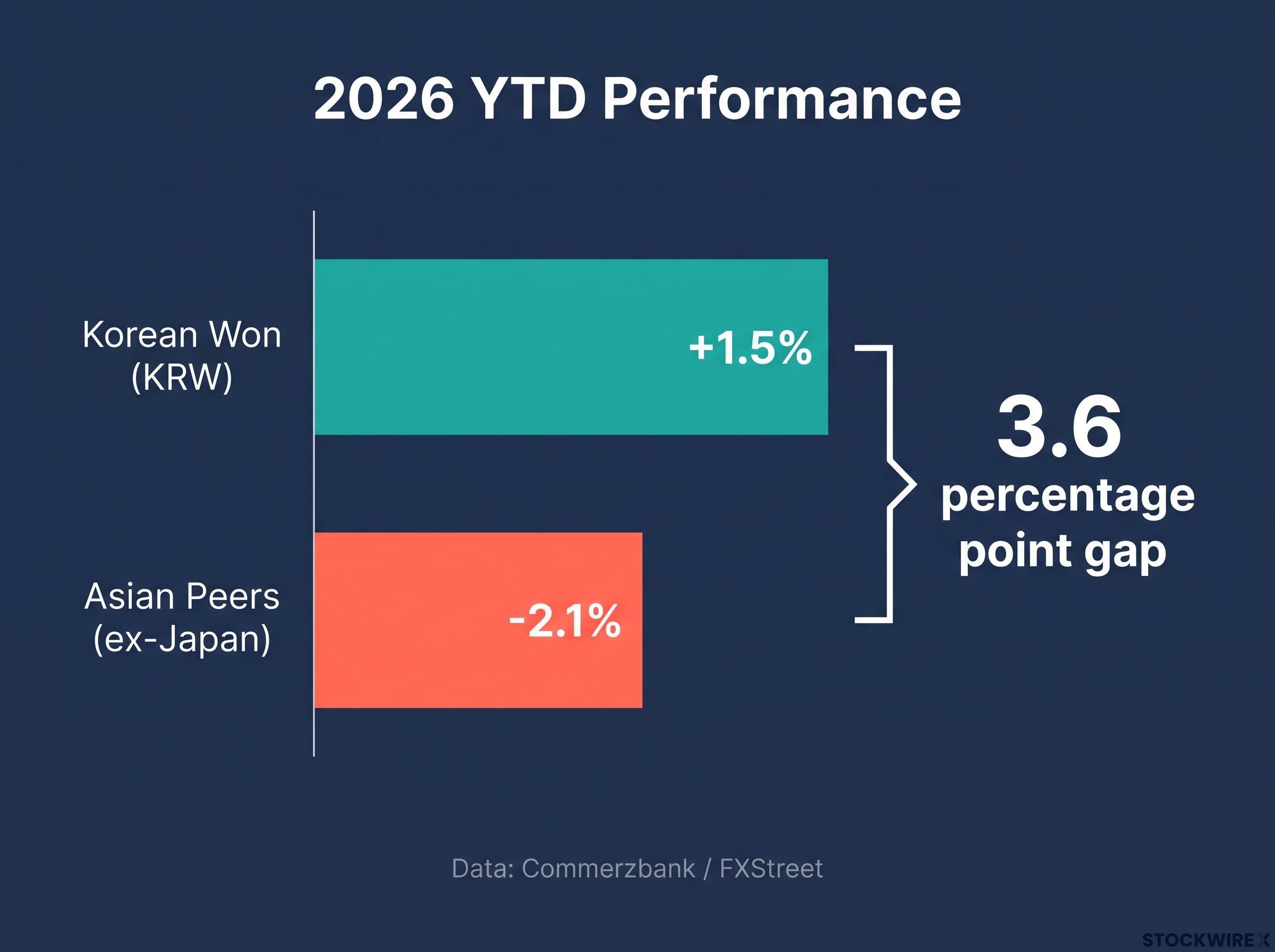
Most Asian currencies are down 2.1% against the US dollar on a year-to-date basis in 2026. The Korean won has moved in the opposite direction, appreciating 1.5%. That 3.6 percentage point gap between the won and its regional peers is not noise.
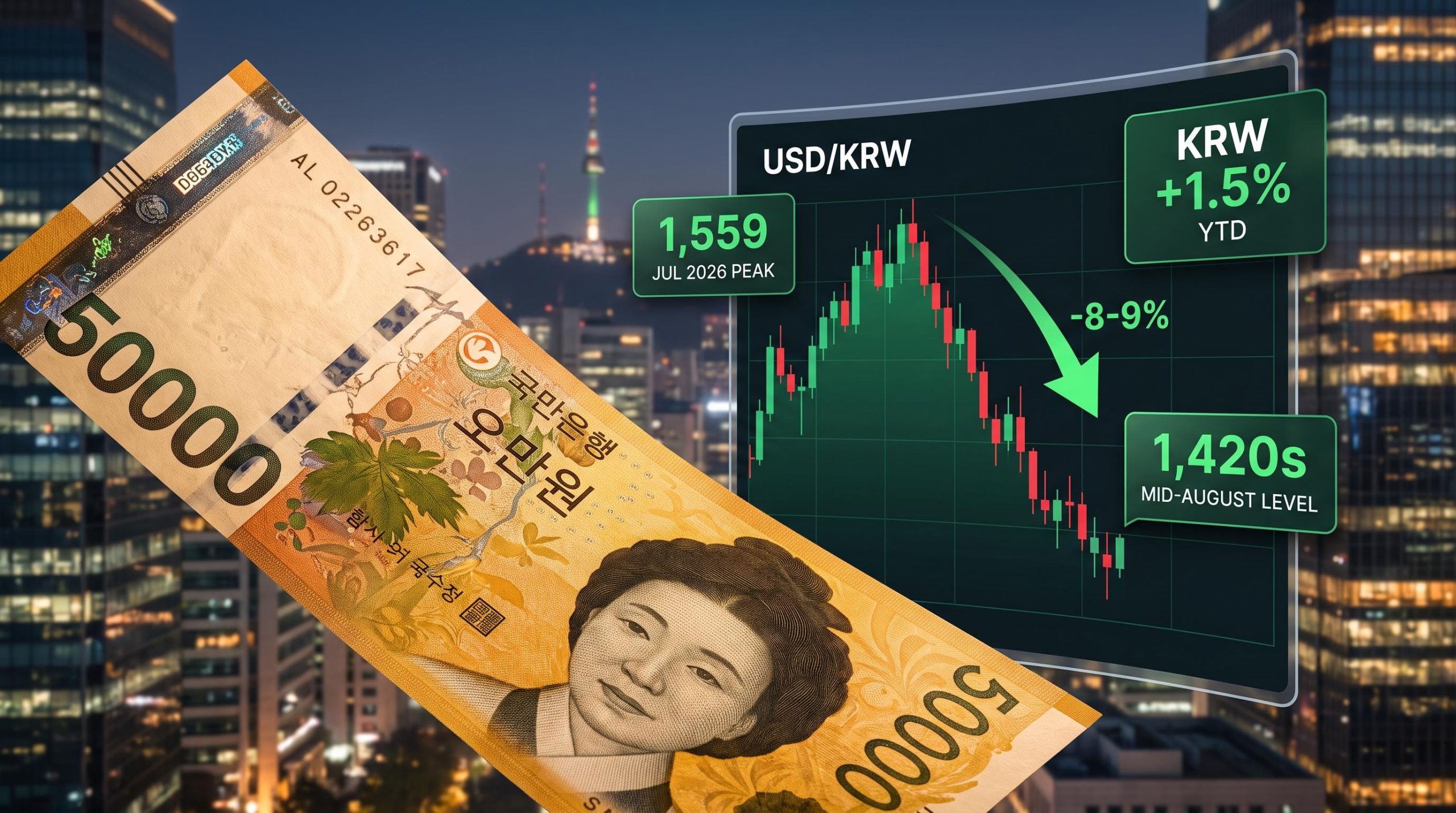
It reflects something structural about how South Korea’s export-driven economy converts foreign earnings into domestic currency demand. Between its July 2026 high and mid-August, USD/KRW dropped from around 1,559 to the low-1,420s, a shift of roughly 8-9% that is too large and too persistent to attribute to sentiment fluctuations alone.
Here is the mechanics behind how an export surplus becomes currency strength, and what conditions would need to shift for this trend to reverse. The explanation sits in flow dynamics, not market faith.
How far the won has moved, and what the numbers actually show
USD/KRW peaked at approximately 1,559 in July 2026, sitting close to the top of its 52-week range of roughly 1,372-1,562. By mid-August, the pair had fallen to the low-1,420s. For readers less familiar with currency pair conventions: a falling USD/KRW number means the won is getting stronger, because fewer won are needed to buy one US dollar.
The magnitude of that retreat matters. An 8-9% appreciation in a matter of weeks is not a routine fluctuation. It is a sustained directional shift, and the explanation for it lies in structural flow dynamics rather than speculative positioning.
| USD/KRW at July peak | USD/KRW at mid-August | Won appreciation from peak |
|---|---|---|
| ~1,559 | Low-1,420s | ~8-9% |
The won’s outperformance extends beyond the July-to-August move. Commerzbank, as reported by FXStreet, characterises the won as the second-best performing Asian currency year-to-date.
Asian central bank policy divergence has widened the macro context in which Korea’s currency story sits: Bank Indonesia’s shock 50-basis-point hike in May 2026 was driven by rupiah defence rather than domestic conditions, and Goldman Sachs projected the Bank of Korea among the candidates to join a regional tightening sequence in H2 2026, a scenario that would introduce an additional policy variable into the won’s flow-based appreciation story.
Source note: Commerzbank, as reported by FXStreet, attributes a 1.5% year-to-date KRW gain versus a regional average (excluding Japan) of -2.1%. These specific figures are sourced from that analysis and were not independently corroborated in broader cross-currency datasets. The relative-strength narrative is well supported by wider market commentary.
When big ASX news breaks, our subscribers know first
Why exporters are the won’s most powerful structural buyers
South Korea’s largest companies, spanning semiconductors, consumer electronics, and automobiles, sell globally and collect revenues predominantly in US dollars. When those firms bring earnings home to fund domestic operations, they must sell dollars and buy won.
This is not a trade that happens once. It happens on a cycle tied to real corporate cash needs: capital expenditure, wages, tax payments. According to Commerzbank, as reported by FXStreet, corporate repatriation of export earnings was a primary driver behind the pair’s roughly 8.9% decline from its July high, with those ongoing dollar-to-won conversions acting as a reliable and recurring source of KRW demand.
The repatriation chain works in three steps:
- A Korean exporter sells semiconductors or vehicles abroad and receives US dollar revenue.
- The company converts those dollars into Korean won onshore to meet domestic obligations.
- That conversion creates sustained KRW buying pressure, pushing USD/KRW lower.
What makes this different from speculative FX positioning is persistence. A hedge fund can reverse a currency bet on a single headline. A semiconductor manufacturer repatriating quarterly revenues to pay engineers in Seoul cannot. The flow is tied to Korea’s status as a current-account surplus, export-surplus economy, and it runs on its own calendar regardless of market mood.
South Korean semiconductor export performance reached an all-time high of $173.4 billion in 2025, according to the Ministry of Trade, Industry and Energy, confirming that the dollar-revenue volumes flowing through the repatriation cycle are substantial enough to generate the sustained KRW buying pressure the won’s appreciation reflects.
For anyone assessing the durability of won strength, this distinction matters. Repatriation-driven appreciation is qualitatively different from speculative-driven appreciation. It is harder to dislodge, more predictable in its timing, and anchored to trade data rather than positioning data.
What foreign portfolio inflows add to the repatriation story
Repatriation is not the only source of won demand. Foreign investors buying Korean equities or government bonds must first acquire KRW to complete those transactions, creating a parallel demand channel that reinforces the repatriation effect.
Commerzbank’s analysis explicitly pairs these two forces together.
The scale of that portfolio demand became concrete on 31 July 2026, when foreign portfolio inflows into Korean equities reached their largest single-day total in Kospi history at approximately 7.2 trillion won, a figure that illustrates how quickly the inflow channel can shift in magnitude when institutional sentiment turns.
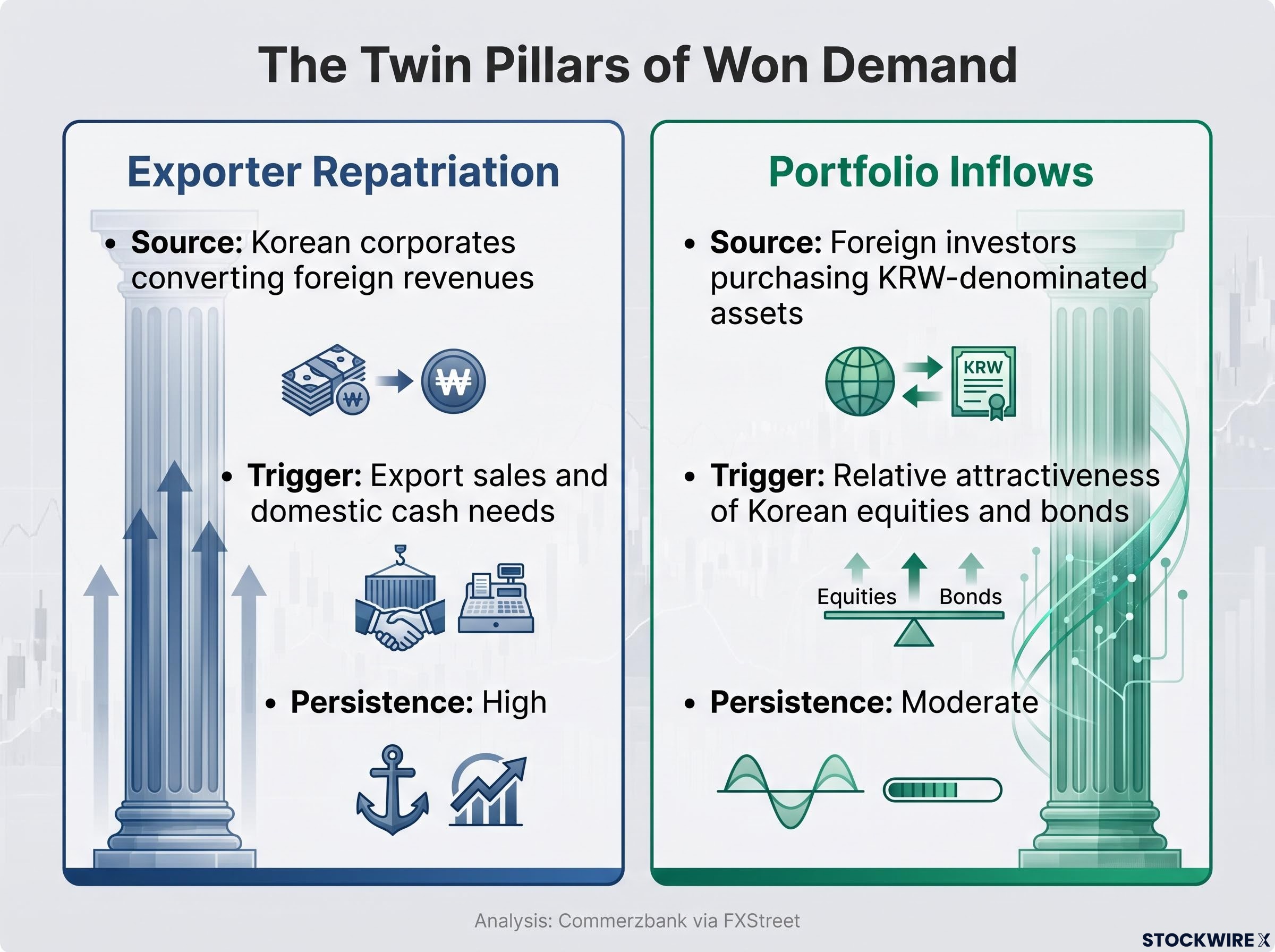
“Twin pillars”: Commerzbank, as reported by FXStreet, characterises exporter repatriation and foreign portfolio inflows as the twin pillars supporting the won’s recent strength, each operating through a distinct mechanism but producing the same directional pressure on USD/KRW.
As Korean benchmark volatility has moderated, risk-adjusted returns have become more attractive. The semiconductor-heavy composition of Korean equity indices gives foreign investors targeted exposure to a sector experiencing strong global demand, and any continued easing of equity market volatility could draw in additional portfolio inflows and lend near-term support to the won.
The two demand channels are structurally distinct:
Exporter repatriation:
- Source: Korean corporates converting foreign revenues
- Trigger: Export sales and domestic cash needs
- Persistence: High; tied to trade cycle and corporate obligations
Portfolio inflows:
- Source: Foreign investors purchasing KRW-denominated assets
- Trigger: Relative attractiveness of Korean equities and bonds
- Persistence: Moderate; sensitive to global risk appetite and volatility regime
The implication is that the won’s near-term trajectory is partly hostage to global risk appetite. A return of broad equity volatility could drain portfolio inflows and remove a pillar of support even if exporter fundamentals remain intact. If you hold KRW-denominated assets or track Korea exposure, equity market conditions are a leading indicator for currency flows, not just for equity returns in isolation.
The mechanics behind how an export surplus becomes currency strength
The KRW case illustrates a mechanism that applies to any export-surplus economy operating under a floating exchange rate. Understanding it gives you a transferable framework, not just a Korea-specific observation.
In a floating FX regime, exchange rates reflect supply and demand for currencies. When a country consistently exports more than it imports, its corporates accumulate foreign currency. When those earnings are repatriated, they must be converted back into the domestic currency. That process works in three steps:
- The trade surplus generates a net accumulation of foreign currency at the corporate level.
- Repatriation of those earnings creates persistent buying demand for the domestic currency.
- That demand, sustained over time, pushes the domestic currency’s value higher relative to the foreign currency.
The fall in USD/KRW from approximately 1,559 to the low-1,420s is this mechanism operating in real time, driven by steady flow-based demand rooted in Korea’s current-account surplus structure.
Why flow-based appreciation differs from speculative currency moves
Flow-based demand and speculative demand produce the same directional outcome on a chart, but they behave very differently under stress.
Flow-based demand is tied to corporate cash management: predictable cycles, driven by trade data, and difficult to reverse on a headline. Speculative demand is tied to positioning and sentiment, and it can reverse within a single session. Commerzbank attributed the won’s move to consistent real-money flows rather than a macro re-rating of Korea, which tells you the currency’s support structure does not depend on central bank intervention or a bullish narrative holding together. That is a meaningfully different risk profile for FX exposure in any export-surplus economy.
The won’s sensitivity to broad dollar moves is a specific instance of a more general principle: US dollar supply and demand dynamics in the global FX system shape emerging market currency trajectories regardless of those countries’ own trade or current-account positions, because the dollar appears on one side of 89.2% of all FX trades globally.
What could extend the rally, and what could end it
Two columns frame the forward view for the won. On one side, three factors would sustain current strength. On the other, three risks could erode it.
| Supportive factors | Risk factors |
|---|---|
| Continued Korean equity market stabilisation, sustaining portfolio inflows | A renewed broad-based US dollar rally lifting USD/KRW despite solid Korean fundamentals |
| Persistent strength in semiconductor and electronics export cycles, maintaining repatriation volume | A global trade slowdown materially cutting Korean export revenues and repatriation flows |
| Any moderation in overall US dollar strength, letting Korea’s domestic story show through | A spike in equity volatility prompting foreign investors to reduce Korean asset exposure |
Because repatriation and portfolio inflows are distinct drivers, a risk affecting one does not automatically destroy the other. That gives the won some resilience against single-factor shocks.
Dollar sensitivity in practice: On a session when the pair ticked 0.3% higher to 1,421, Commerzbank’s analysis pointed to broad US dollar firmness as the cause, with no change in Korea’s underlying fundamentals driving the move. That distinction matters: the won can weaken on global dollar dynamics even when its own flow story remains intact.
Commerzbank’s analysis points to easing equity market volatility as a factor that could lend the won additional near-term upside, should that calming trend continue. But global macro variables, the dollar trajectory and the equity volatility regime, may matter as much as Korea’s own trade performance in determining whether the won holds these levels. You need to watch the US Federal Reserve outlook and Korean export data simultaneously, not one in isolation.
This article is for informational purposes only and should not be considered financial advice. Investors should conduct their own research and consult with financial professionals before making investment decisions. These statements are speculative and subject to change based on market developments and economic conditions.
A won rally built on flows, not faith
The won’s outperformance against Asian peers is grounded in two identifiable, structural forces: exporter repatriation and foreign portfolio inflows. Both are tied to real economic activity rather than speculative positioning, and both operate through mechanisms that do not require central bank intervention or a bullish market narrative to function.
Export-surplus economies carry a built-in currency support structure when repatriation cycles are active. The KRW case in mid-2026 is a clean live example of that principle at work.
Three variables will determine whether the won holds its gains into the remainder of 2026: equity market stability, export cycle momentum, and the US dollar trend. Until those shift materially, the flow-based case for won strength remains intact.
For investors wanting to model how the US dollar trajectory might evolve into year-end, our full explainer on ING’s dollar outlook covers the bank’s 6-12 month EUR/USD target of 1.20-1.22, the Jackson Hole catalyst framework, and the five signals ING uses to track whether a sustained dollar dip is materialising.