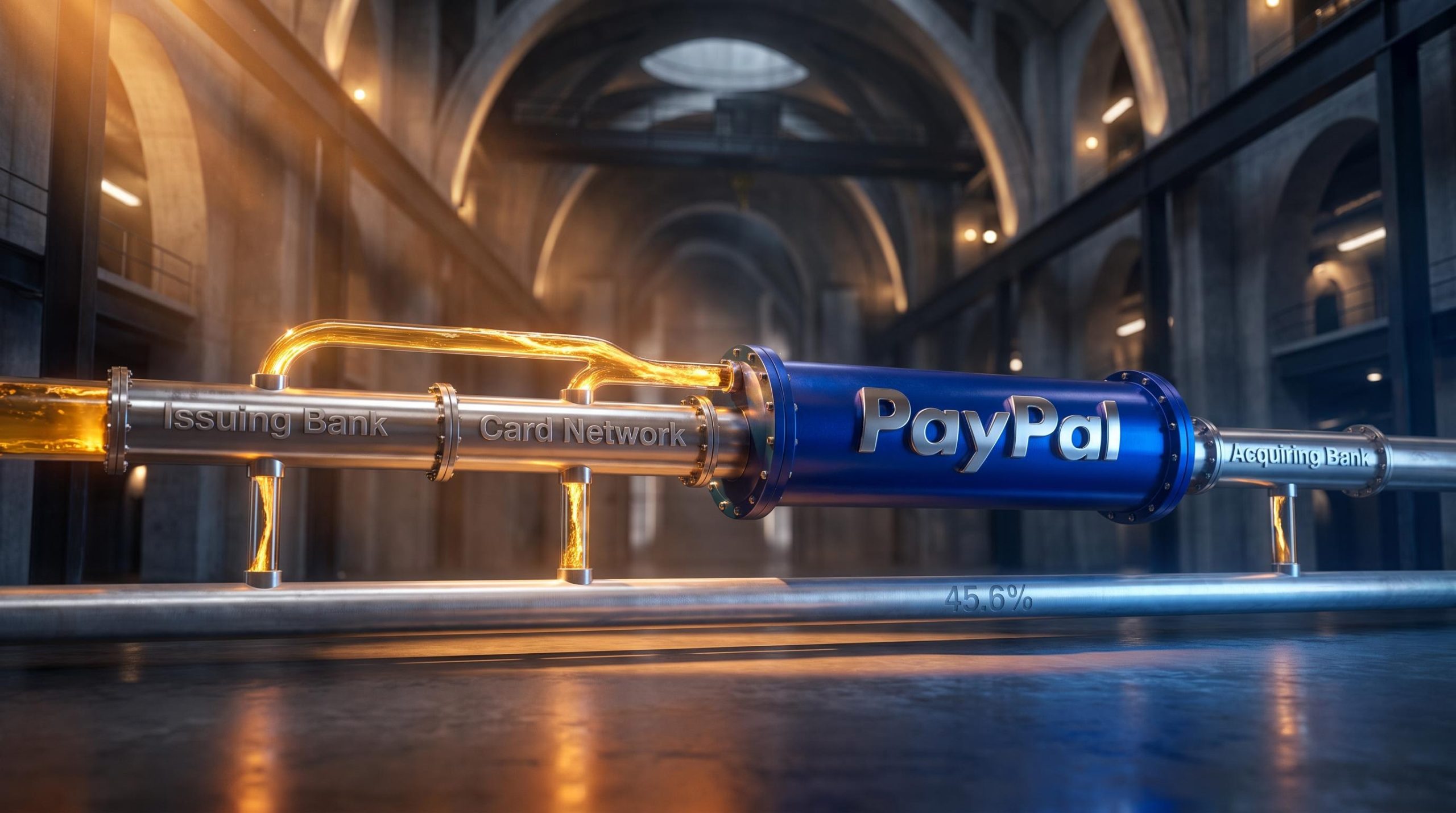
Every time you click “Pay with PayPal,” a quiet chain of intermediaries goes to work, and each one skims a fraction of a percent from the merchant before the money lands. PayPal’s entire business rests on staying one of those indispensable links.
That dependency is now being tested. A new generation of payment rails moves money between bank accounts directly, cutting most of those links, PayPal included, out of the picture entirely.
Here is why this matters right now. PayPal is reporting revenue growth while simultaneously disclosing transaction margin compression, which is the financial fingerprint of a business whose core mechanism is under structural pressure. If you follow fintech or the payments industry as an investor, you need to understand the plumbing before you can judge the prognosis.
This piece gives you a working framework for how PayPal actually earns money, why that mechanism is threatened, and what the company is building to survive the threat. Treat it as foundational knowledge that will change how you read every PayPal headline from here on.
The payment chain most consumers never see
When you tap a card or click a checkout button, it feels instant and singular. Behind that single moment sits a four-party system that has quietly run global commerce for decades.
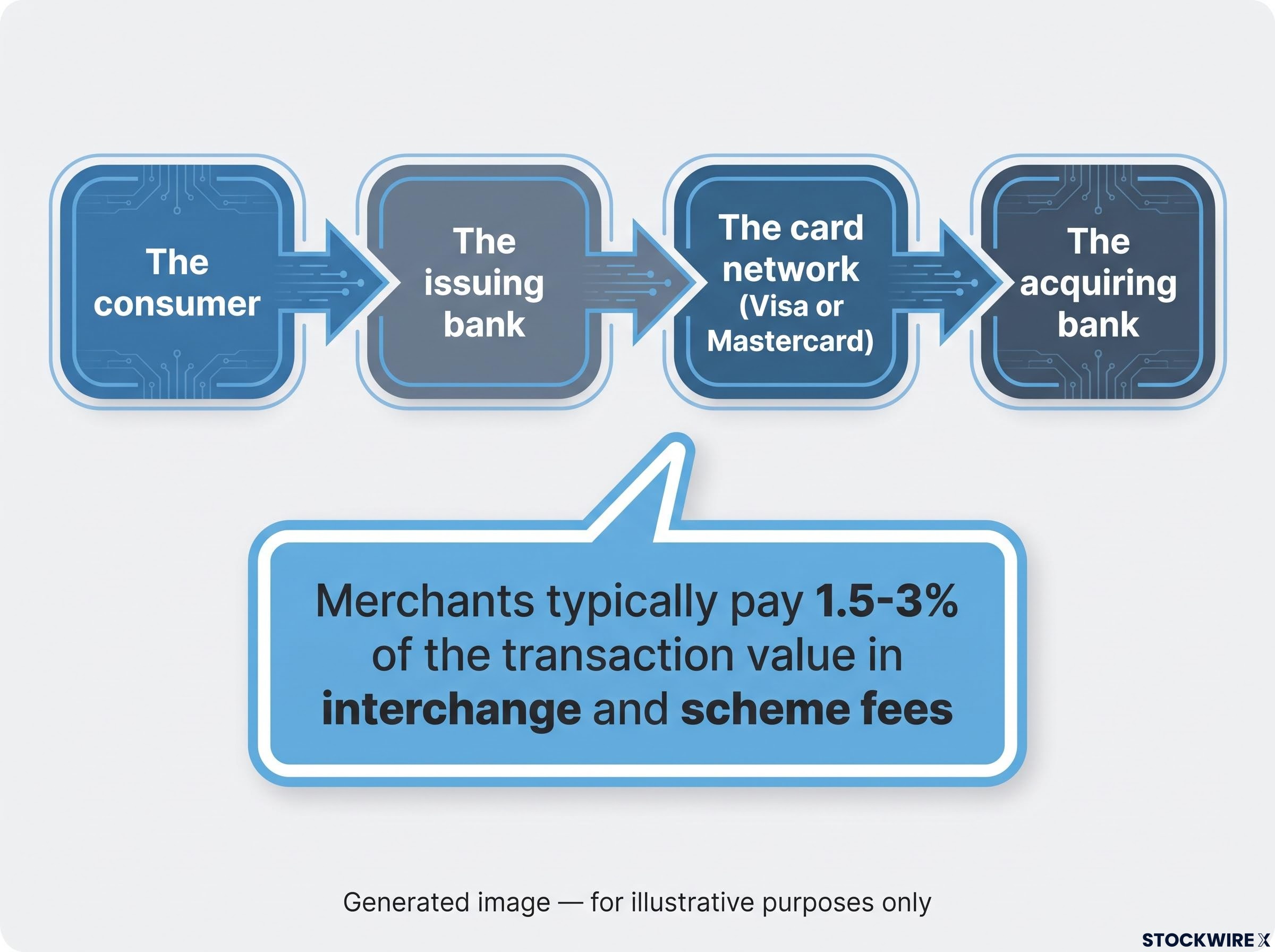
Here is the sequence that plays out in the fraction of a second after you pay:
- The consumer initiates the payment, either by tapping a card or confirming a digital checkout.
- The issuing bank (your bank, the one that gave you the card) authorises the transaction and confirms you have the funds or credit.
- The card network (Visa or Mastercard) routes the authorisation and settlement messages between the banks.
- The acquiring bank (the merchant’s bank) receives the funds and settles them into the merchant’s account.
Every one of those participants takes a cut. Merchants typically pay 1.5-3% of the transaction value in interchange and scheme fees, and the issuing bank captures the largest slice because it carries the credit risk if you never pay your bill.
That fee stack is the water the entire industry swims in. It is also the pool PayPal has spent two decades inserting itself into.
Where PayPal sits in the chain and how it earns
PayPal’s founding pitch was simple: take the four-party tangle above and make it feel like one button. It earns fee income depending on how much of the chain it controls on any given transaction.
At its most profitable, PayPal acts as both issuer and acquirer at once. When a PayPal user pays another PayPal user, the money can move inside PayPal’s own system, and it keeps a far larger share of the fee.
The picture changes when you fund a PayPal payment with an underlying Visa or Mastercard. In that case PayPal still has to pay interchange to your issuing bank, which shrinks its net take on the transaction.
This is where the numbers get pointed. In Q2 2026, PayPal reported total net revenues of $8.7 billion, of which transaction revenues made up $7.832 billion, roughly 90% of the base. Its business is overwhelmingly about earning fees on payments.
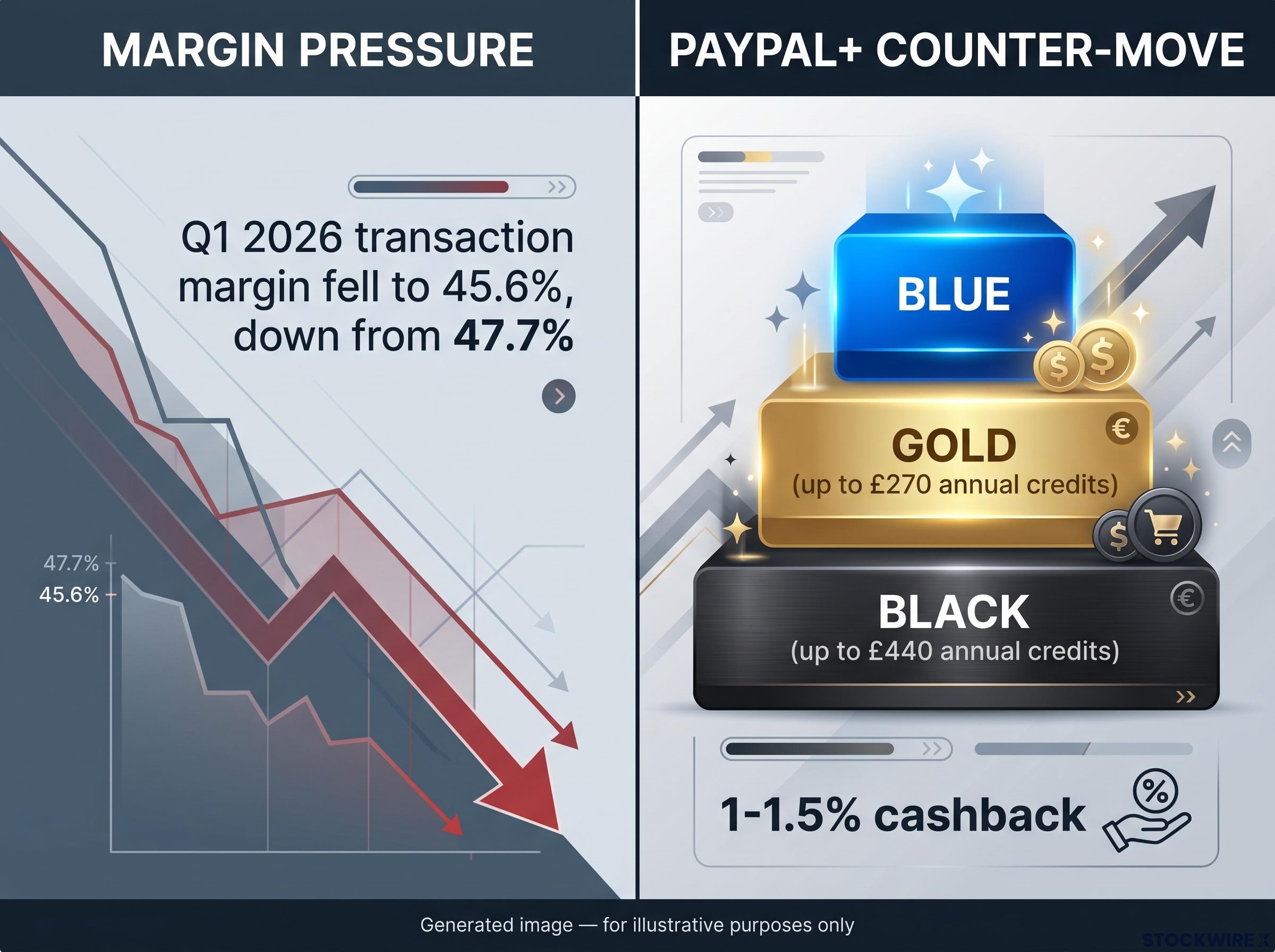
Now look at the margin. In Q1 2026, PayPal’s transaction margin fell to 45.6%, down from 47.7% a year earlier. That decline tells you something important: even as it processes more volume, PayPal is keeping a smaller share of each dollar that passes through. It is the clearest financial signal that the competitive environment is tightening around its core mechanism.
When big ASX news breaks, our subscribers know first
Why the payment ecosystem works the way it does
Knowing what the chain looks like is one thing. Understanding why it has survived in this exact form, despite everyone in it taking a cut, is what lets you judge which parts are genuinely defensible.
The short answer is that each layer earns its fee by doing a real job:
- The consumer brings the demand and the funds.
- The issuer assumes the credit risk and fronts the money (the “float”) until you settle your bill.
- The card network provides near-universal acceptance and guarantees settlement between banks that may never have interacted.
- The acquirer manages the merchant relationship and shoulders fraud liability.
- The intermediary (PayPal) reduces friction and provides the consumer trust that makes people click “buy.”
The system has proven durable because every participant is paid for a function that genuinely needs doing. Merchants accepted the cost for years because the alternative, building their own payment infrastructure from scratch, was far more expensive than the fees.
The card network economics that sustain Mastercard’s near-60% operating margins rest on the same interchange stack PayPal depends on, which is why structural pressure on one incumbent signals directional risk for both, even as their exposure to A2A displacement differs materially.
Two features do a lot of the heavy lifting here: chargeback protection and dispute resolution. If a purchase goes wrong, you can claw the money back, and merchants get a structured process for handling disputes. That safety net is a large part of why both sides accept card fees as a legitimate cost of doing business, and it becomes the key weakness in the alternatives we will get to shortly.
Here is the catch for anyone assuming this arrangement is permanent. It is not inevitable. It is incumbency, and incumbency can be dislodged when a government builds a better rail and pushes people onto it.
India proves the point. Its Unified Payments Interface (UPI), a state-backed instant payment system, accounted for roughly 75% of all digital payment transactions by volume in FY 2023-24, handling around 131 billion transactions. It has heavily substituted debit card and ATM usage, forcing card providers to pivot toward services layered on top of payments.
The RBI Annual Report on UPI documents how the system reshaped India’s payment landscape by substituting debit card and ATM usage at a scale that forced traditional card providers to rethink their merchant service strategies entirely.
Brazil tells the same story even faster.
Within two and a half years of launch, Brazil’s central-bank-run Pix system was used by over 140 million individuals, roughly 80% of the adult population, handling more than 3 billion transactions a month.
Those examples tell you that consumer payment behaviour can shift rapidly and permanently when an alternative rail hits critical mass. That precedent matters directly for how you assess PayPal’s long-term addressable market.
| Platform | Geography | Adoption scale | Card behaviour displaced |
|---|---|---|---|
| Zelle | United States | $1.2 trillion sent in 2025 | Peer-to-peer and small-business card transfers |
| UPI | India | ~75% of digital transactions, FY 2023-24 | Debit card POS and ATM withdrawals |
| Pix | Brazil | ~140 million users within 2.5 years | Debit and credit card payments |
The bank-to-bank threat: what it is and why it matters now
The threat to PayPal is not a distant hypothetical. It is a mechanism already running at scale, and the gap between PayPal’s current model and the world these rails are building is widening in real time.
How account-to-account payments work
Account-to-account (A2A) payments move money directly between two bank accounts using instant payment rails: Zelle in the US, SEPA Instant in Europe, and FedNow. There is no card network in the middle, which means no interchange fee funding the traditional ecosystem.
That absence is the whole point. In Europe, pay-by-bank transactions, supported by the EU Instant Payments Regulation, cost 30-70% less than card payments. Analysts have started calling this wave “the silent card killer.”
The scale is already serious. Over 2025, Zelle moved $1.2 trillion, a 20% increase over 2024, across 4.2 billion transactions, reaching 100 million monthly active accounts by December 2025.
That $1.2 trillion figure is not a fringe statistic. It is evidence that bank-to-bank rails have already crossed the scale threshold where they represent a genuine revenue-at-risk number for any intermediary whose income depends on card-linked transaction fees. PayPal’s own margin slide from 47.7% to 45.6% is where that pressure is starting to register in the financials.
Stablecoin payment rails introduce a third competitive vector beyond A2A and OS-level wallets: the GENIUS Act, enacted in July 2025, formally sanctions regulated stablecoin infrastructure in the US, creating a reserve-backed settlement alternative that operates outside the card interchange stack entirely.
The macro forecast underlines it. Capgemini’s World Payments Report 2025/2026 estimates that A2A instant payments could offset between 15% and 25% of future global card transaction volume growth.
Why complete displacement is not imminent
None of this means the card system collapses tomorrow. The barriers slowing A2A adoption are real, and they cluster around the exact features that make cards feel safe.
- Dispute resolution gaps: A2A rails largely lack the mature chargeback and dispute infrastructure that cards provide, so a payment gone wrong is harder to reverse.
- Merchant integration friction: A survey cited by Paystrax found that roughly 90% of merchants still decline A2A options in favour of familiar card processing, partly because new rails often demand new terminals or software.
- Consumer habit: People trust the card in their wallet and the protections that come with it.
- Fraud vulnerability: Open-banking ecosystems introduce new fraud vectors, with credential abuse and account takeover documented as points of exposure.
The most substantive of these is the dispute and chargeback gap. It is the single largest reason merchants and consumers hesitate to abandon cards.
Here is the read you should take, though. These are engineering and regulatory problems, not permanent structural limits. The question for anyone watching PayPal is not whether they get solved, but how fast, and that pace is the real variable.
PayPal’s counter-move: building a commerce layer on top of payments
PayPal’s leadership can see the same rails you can. Its response is not to win a race on transaction throughput it may eventually lose, but to climb above the payment layer entirely.
The strategy, which management frames as “Commerce-as-a-Service,” is to turn PayPal into a commerce discovery layer. The idea is to monetise the cross-merchant transaction data PayPal already holds, through advertising and a loyalty programme, so that merchants and consumers keep it in their workflow even if the underlying payment shifts.
The advertising bet
PayPal’s advertising platform uses its cross-merchant data and artificial intelligence to serve targeted ads and improve product discovery for shoppers. It is expanding internationally, including a UK rollout, and moving into “off-site ads,” which are ads informed by PayPal’s data but displayed outside PayPal’s own apps and sites.
The company is also pushing its Fastlane checkout button across third-party websites, widening the surface where its data can work. The logic is straightforward: the more merchants and shoppers PayPal touches, the more valuable its advertising inventory becomes.
The PayPal+ loyalty play
Alongside advertising, PayPal relaunched PayPal+ in the UK in November 2025. It is a free, tiered rewards programme (Blue, Gold, and Black) where everyday usage earns points that translate into roughly 1-1.5% cashback.
The tier thresholds sit at 25,000 and 50,000 points. Gold members can earn up to £270 in annual spending credits, and Black members up to £440. Early engagement looks encouraging: in December 2025, branded checkout volume rose mid-single digits year-over-year for enrolled UK users, growing faster than for non-enrolled users.
Both initiatives cost money now for a payoff later, and the analyst community is split on whether the payoff arrives.
| Thesis | Supporting evidence | Key risk |
|---|---|---|
| Bullish: data and user base enable a defensible commerce layer | Northwise Project (Nov 2025) models 100-250 basis points of operating margin expansion by 2030 if the ad pivot succeeds | Ad revenue is not yet broken out in filings; the thesis rests on unproven scale |
| Bearish: core payment margins are structurally compressing | Seeking Alpha flags a 3-point near-term hit to transaction margin from the investments | Fitch Ratings (Mar 2025) projects only mid-single-digit transaction margin growth |
That 3-point near-term drag is the crux of the investor question. PayPal is spending real margin dollars today on an advertising revenue stream that has not yet appeared as a separate line in its public filings. You are being asked to take the strategic logic on faith before the financial proof exists.
Fitch Ratings (March 2025) projects only mid-single-digit transaction margin growth, reflecting doubt over whether advertising can scale fast enough to counter the external headwinds pressing on PayPal’s core.
The regulatory wildcard in the data strategy
The data strategy carries a threat the financials do not capture. A December 2025 report by Netzwerk Datenschutzexpertise accuses PayPal of GDPR and payment-supervision violations in Germany.
The core allegation is an “unlawful change of purpose”: using sensitive payment data for advertising through its “Offsite Ads” feature, relying on vague default-activated consents and retention periods of up to ten years. If regulators act, PayPal could face fines or be forced to alter the ad model before it reaches scale.
There is a parallel exposure worth noting. PayPal’s own 2025 Form 10-K warns that new regulatory limits on interchange fees could damage its competitive position and card-programme revenue. The regulatory environment, in other words, is a live variable on both sides of the strategy.
What the PayPal story is really about for the next decade
Strip away the quarterly noise and one structural question sits underneath everything: can PayPal convert its data and user-base advantages into a defensible commerce layer before its transaction-fee revenues are eroded by rails that do not need it?
Three forces are pulling against each other. The card ecosystem remains durable, protected by dispute resolution and consumer habit. Bank-to-bank rails are proven at scale in India, Brazil, and increasingly the US. And PayPal is trying to reposition above the rails rather than fight on them.
Its fate does not hinge on whether A2A payments grow; that growth looks close to certain. It hinges on whether PayPal can build enough value in the commerce discovery layer that people keep it in their workflow even after the payment mechanism underneath shifts.
Merchant defection patterns provide some of the sharpest evidence of the directional shift: in one documented case, PayPal’s share of a merchant’s online payment receipts contracted from roughly 25% to below 10% as Apple Pay captured approximately 40% of the same merchant’s total volume.
The pressure is compounding from above, too. Apple Pay reportedly exceeded 650 million users by 2025, and OS-level wallets are competing directly for the checkout real estate PayPal’s branded button occupies.
PayPal acquisition dynamics add another layer to the margin compression story: Stripe and Advent International tabled an unsolicited all-cash offer of $60.50 per share, implying a valuation of just over $53 billion, less than one-fifth of PayPal’s $322 billion peak, and PayPal’s board rejected the bid as inadequate.
Here is the signal to hold onto. In Q2 2026, PayPal’s revenue still grew 5% to $8.7 billion even as its margins compressed. That combination, growing revenue with shrinking margins, is the financial signature of a business in transition: the old model is not broken yet, but it is being slowly replaced, and the window for the new model to prove itself is measured in years, not decades.
Three variables will decide it:
- Whether advertising scales and survives the regulatory scrutiny now building in Germany.
- Whether PayPal+ engagement genuinely lifts checkout frequency rather than just rewarding existing behaviour.
- How fast A2A rails close the dispute-resolution gap that currently protects the card system.
Watch those three, and the next PayPal headline will read very differently.
This article is for informational purposes only and should not be considered financial advice. Investors should conduct their own research and consult with financial professionals before making investment decisions. Past performance does not guarantee future results, and financial projections are subject to market conditions and various risk factors. Forward-looking statements are speculative and subject to change based on market developments and company performance.