
A basket of European stocks is projecting long-term earnings growth of roughly 7 percentage points above the broader European market. Yet it trades on price-to-earnings multiples broadly in line with that same market, after underperforming it by around 10%. Superior earnings that the market has flatly refused to pay up for.
That basket is Citi’s European Autonomy Basket, introduced on 9 March 2026, linking approximately 20 stocks to industrial protection and strategic resilience themes. The underperformance began at the onset of the Middle East conflict and has persisted despite the structural spending commitments that underpin the theme. What deepens the puzzle is corroboration: AXA Investment Managers, Candriam, Allianz Global Investors, and Amundi have each, independently, framed European strategic autonomy as a multi-year structural theme.
So the theme has institutional buy-in and the earnings profile to match, but the multiple has not moved. What follows here is a framework for deciding whether that gap is a genuine mispricing worth acting on, or a discount that reflects risks the consensus is already pricing correctly.
The basket’s composition: which stocks Citi has placed inside the trade
Citi splits the basket into two thematic sub-buckets, and the distinction matters more than it first appears. Trade protection beneficiaries are companies positioned to gain from tariffs, subsidies, and preferential procurement that shield European production. Strategic resilience beneficiaries are the companies building the capacity Europe wants to control itself: defence, energy, and strategic technology.
On the trade protection side, Citi named ArcelorMittal, Volkswagen, Renault, Lanxess, and BASF as the most direct beneficiaries. In steel, the record shows most clearly that meaningful protection can translate into improved earnings and higher valuations, whereas the policy-driven gains available to autos and chemicals remain largely unrealised.
The strategic resilience group is broader, spanning defence, utilities, and technology: Leonardo, Rheinmetall, Thales, Vestas, Schneider Electric, EDP, Orsted, TotalEnergies, ASML, BE Semiconductor, and ASM International.
| Stock | Sector | Sub-Category | 2026 YTD Performance |
|---|---|---|---|
| ASML | Semiconductor equipment | Strategic resilience | +59.30% (to 28 Aug 2026) |
| Rheinmetall | Defence | Strategic resilience | -26.03% (to 30 Aug 2026) |
| Volkswagen (pref) | Automotive | Trade protection | -14.9% (to 15 Jun 2026) |
| ArcelorMittal | Steel | Trade protection | Not disclosed |
| Leonardo, Thales, others | Defence / tech / utilities | Strategic resilience | Mixed |
The spread inside a single basket is the story here.
Intra-basket divergence ASML returned +59.30% year-to-date through 28 August 2026. Rheinmetall lost 26.03% through 30 August 2026. Same basket, opposite directions.
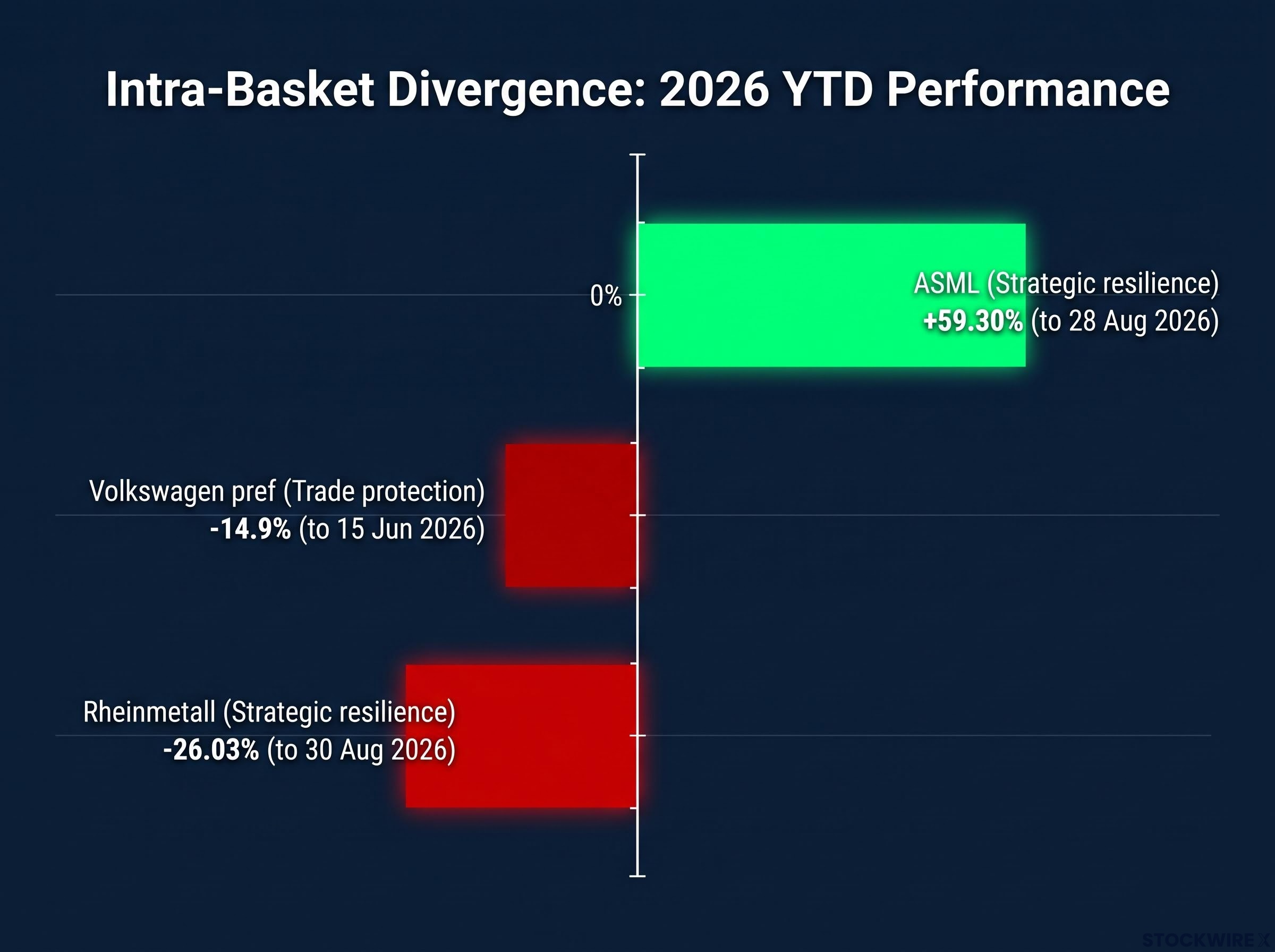
That gap tells you this is not a monolithic trade. The basket’s aggregate underperformance masks radically different dynamics at the stock level. Before you decide whether to hold the whole thing or pick your spots, you need to understand which sub-theme is doing the dragging, because they are not moving together.
When big ASX news breaks, our subscribers know first
Why a 7-point earnings growth advantage has not moved the multiple
The discount is not one problem. It is four, stacked on top of each other, and each one compounds the last.
- European earnings scepticism, where the market refuses to reward beats
- A defence sub-sector that genuinely overshot and is now consolidating
- An institutional ownership ceiling from ESG frameworks that have only just changed
- An automotive and industrial drag suppressing the aggregate multiple
Start with the scepticism, because it colours everything else. Franklin Templeton observed that the STOXX 600 returned just 4.2% year-to-date through 13 February 2026, and that stocks beating both revenue and earnings actually underperformed the index by 11.9% over that period (a figure flagged as unverified in the underlying research). When a market punishes the companies that deliver, a strong earnings profile is not enough to earn a re-rating on its own.
Layered onto that is the automotive drag. WisdomTree noted three years of essentially flat MSCI Europe earnings, with a 1.5% earnings decline in 2025 driven heavily by autos wrestling with EV transition costs and competition. That weakness sits inside the basket through Volkswagen and Renault, pulling the aggregate multiple down even where the non-auto components are growing faster.
The defence sub-sector’s specific valuation arc
Defence is where the overshoot lived. According to Bank of America, the European defence group’s valuation premium to the STOXX 600 reached 120-130% at peak optimism.
The defence premium, then and now Bank of America calculates the sector’s premium to the STOXX 600 peaked at 120-130% and had compressed to roughly 70% by late 2025.
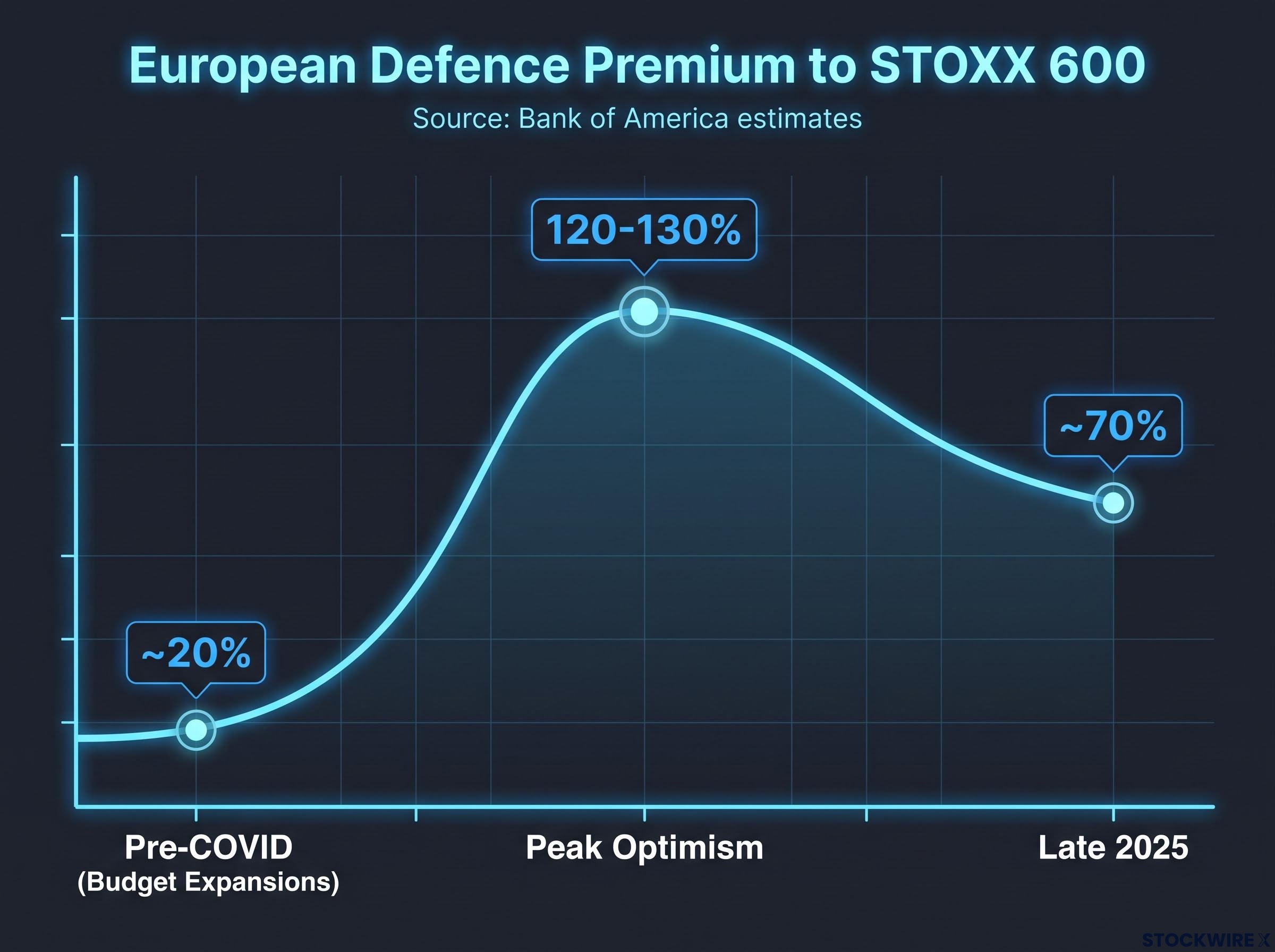
For historical scale, before COVID-19 the sector typically traded at around a 20% premium during budget expansions and a 20% discount during contractions, per Bank of America. So a 120-130% premium was a genuine overshoot, and the retreat to 70% is a consolidation within a longer uptrend rather than a fundamental reversal. Some major defence names are down as much as 50% from their 2025 peaks as investors shift focus to execution risk and backlog conversion. Morningstar cited Rheinmetall trading at roughly a 53% discount to its €2,380 fair-value estimate (unverified). For patient capital, Bank of America’s forward framing is the bullish anchor: approximately 11.6x EV/EBIT on 2028 estimates with zero net leverage.
Rheinmetall’s specific execution risk crystallised when the company guided 2026 free cash flow conversion above 40%, against market expectations of 70-90%, repricing the stock on the day despite revenue guidance implying 40-45% growth; that gap between revenue growth and cash generation is precisely the kind of execution risk that separates a committed order book from a realised earnings forecast.
Why institutional ownership hasn’t caught up to the regulatory change
The fourth factor is the slowest to move. In late 2025, Delegated Regulation (EU) 2025/1775 clarified that only prohibited-weapons companies must be excluded from certain sustainable-finance benchmarks.
Delegated Regulation (EU) 2025/1775, published in the Official Journal of the European Union, replaced the prior ‘controversial weapons’ exclusion standard with a narrower ‘prohibited weapons’ criterion, materially reducing the universe of defence companies that sustainable-finance benchmarks must exclude.
The problem is that market perception lags regulation. Many institutional mandates still apply informal caps on defence exposure that no longer have any regulatory basis. That is a structural overhang, not a fundamental verdict on the earnings thesis, and it points to a re-rating catalyst: when mandate reviews catch up to the rules, a buyer that has been absent could re-enter.
The institutional underweight in European equities extends beyond the autonomy basket specifically: the June 2026 BofA Global Fund Manager Survey showed European equities at their most underweight positioning since December 2024, a pool of latent demand that has not yet moved into the market and that amplifies the re-rating potential if mandate reviews accelerate.
For a UK investor weighing European equity exposure, the read is this. The basket’s fundamentals are intact. What is not yet in place are the conditions under which those fundamentals get recognised. That is a timing question, not a value trap.
The structural case: what five years of policy commitments actually means for earnings
The forward earnings case does not rest on confidence. It rests substantially on capital that governments have already committed.
Start with the headline pledges from the June 2025 NATO Summit.
NATO’s 5% GDP defence commitment, formalised at the June 2025 Hague Summit, sets the binding investment floor from which analysts derive long-range order-book projections for European defence contractors, making the spending trajectory less contingent on annual budget cycles than prior NATO pledge frameworks.
The NATO spending pledge Allies committed to invest 3.5% of GDP annually on core defence requirements, plus an additional 1.5% of GDP on defence- and security-related spending, by 2035.
Behind that sits the proposed 2028-2034 EU Multiannual Financial Framework of roughly €2 trillion, which includes a €409 billion European Competitiveness Fund targeting clean energy, digital transition, biotech, and defence. This is why the earnings projection carries a different risk profile than a typical thematic forecast: a large share of the demand is legislated, not hoped for.
Candriam maps the breadth of that demand across five pillars:
- Energy, driven by security-of-supply investment in generation and grids
- Aerospace and defence, driven by the NATO and EU spending commitments
- Technology, driven by digital sovereignty and semiconductor capacity
- Strategic industries and materials, driven by reshoring and supply-chain control
- Healthcare, driven by resilience in critical medical supply
Allianz Global Investors frames strategic autonomy as a “new engine of European growth,” pointing to secure communications, sensing and radar systems, electronic components, geospatial intelligence, cybersecurity, and autonomous systems. Morningstar views the structural demand drivers for European defence earnings as extending well beyond 2026, with sentiment expected to shift more meaningfully positive into 2027 (unverified).
For a UK investor asking whether this is a thematic story or a fundamental earnings story, the answer is increasingly both. The commitments are granular enough and long-dated enough to flow through into auditable order books and revenue at the stock level, which is what turns a theme into a forecast you can hold.
What could close the gap, and what could prevent it
The valuation gap closes in one of two ways, and it is worth being explicit about them.
- Earnings catch up to the multiple, as successful execution and order-book conversion validate the growth
- The multiple compresses further, as fiscal constraints and policy risks bite
Which one happens depends on how four risks play out.
| Risk factor | Source | Quantified impact | Most exposed |
|---|---|---|---|
| Fiscal drag on defence budgets | Fitch Ratings | Median 0.6% of GDP core defence rise, 2025-2029, pressuring deficits | Sector-wide defence names |
| Germany’s post-2026 funding gap | Scope Ratings | ~13.8% of central government revenues once the €100bn special fund is exhausted by end-2026 | Rheinmetall, Germany-exposed defence |
| Modest macro growth boost | IMF / ECB | ~0.1pp per year euro-area growth in 2026-27 | Broad autonomy theme |
| Trade-policy retaliation | ECIPE | Subsidies act as a protectionist tax, ~two-thirds of added trade costs (unverified) | ArcelorMittal, VW, Renault, Lanxess, BASF |
Germany is the concentrated near-term risk. Scope Ratings points out that once the €100 billion special defence fund is exhausted by end-2026, the country faces a budgetary gap of around 13.8% of central government revenues. If Europe’s largest defence spender hits a structural funding shortfall in 2027, the order-book growth underpinning the earnings case for Rheinmetall and other Germany-exposed names shifts from committed to contingent. That is the difference between a forecast you can bank and one you have to hope for.
The trade-policy risk cuts the other way, at the protection sub-bucket. ECIPE frames new subsidies and preferential procurement as effectively a protectionist tax that raises trade costs and invites economic retaliation, which could cap the upside for ArcelorMittal, Volkswagen, Renault, Lanxess, and BASF specifically.
Set against those risks is the clearest catalyst: the institutional mandate re-rating. As mandate reviews catch up to Delegated Regulation (EU) 2025/1775, a structural buyer absent from defence allocations could re-enter, and that is a flow the current discount does not yet reflect.
Germany’s structural reform package, which Bank of America cited when lifting its Stoxx 600 target to 630 in July 2026, carries direct implications for the autonomy basket: income tax relief effective January 2027 and labour-market flexibility measures could improve the domestic demand backdrop for German-exposed industrials, while BofA’s own caution that hard economic verification does not arrive until 2027 mirrors the patience framing in this analysis.
Past performance does not guarantee future results. Financial projections are subject to market conditions and various risk factors, and forward-looking statements are speculative and subject to change based on market developments.
What the valuation gap tells you, and when it might matter
The core finding is straightforward. The basket’s 7 percentage point earnings growth advantage is not priced because several compressing forces are acting at once: ESG-driven ownership caps, a defence sector that genuinely overshot, an automotive drag, and blanket scepticism toward European earnings. None of those is a verdict that the earnings thesis is wrong. They are the reasons a correct thesis can sit unrewarded.
That reframes the roughly 10% underperformance since the Middle East conflict onset. It is explicable, and the conditions under which it reverses are identifiable. They are simply not yet in place.
The broader European equity underperformance context matters here: the STOXX Europe 600 sat roughly 9% behind the S&P 500 over the same reference period, with Barclays identifying specific sector rotation catalysts, including potential de-escalation in the Middle East, as the mechanisms most likely to unlock consumer, banking, and luxury names first before autonomy-adjacent names follow.
Here is what to track as leading indicators of a re-rating:
- The pace of institutional mandate reviews following EU 2025/1775, the clearest structural buyer signal
- Germany’s 2027 federal budget defence allocation, measured against the 2026 special-fund baseline
- Order-book conversion rates at the major defence names, the test of execution over theme
- Any escalation in the autos and steel tariff environment, which could trigger retaliation
The forward framing from Bank of America (approximately 11.6x EV/EBIT on 2028 estimates) and Morningstar’s expectation of a sentiment inflection into 2027 both point the same way. For a UK investor, this is a patience trade, not an absent thesis. The catalysts are real but they run on policy and budget cycles measured in quarters to years, not weeks.
This article is for informational purposes only and should not be considered financial advice. Investors should conduct their own research and consult with financial professionals before making investment decisions.