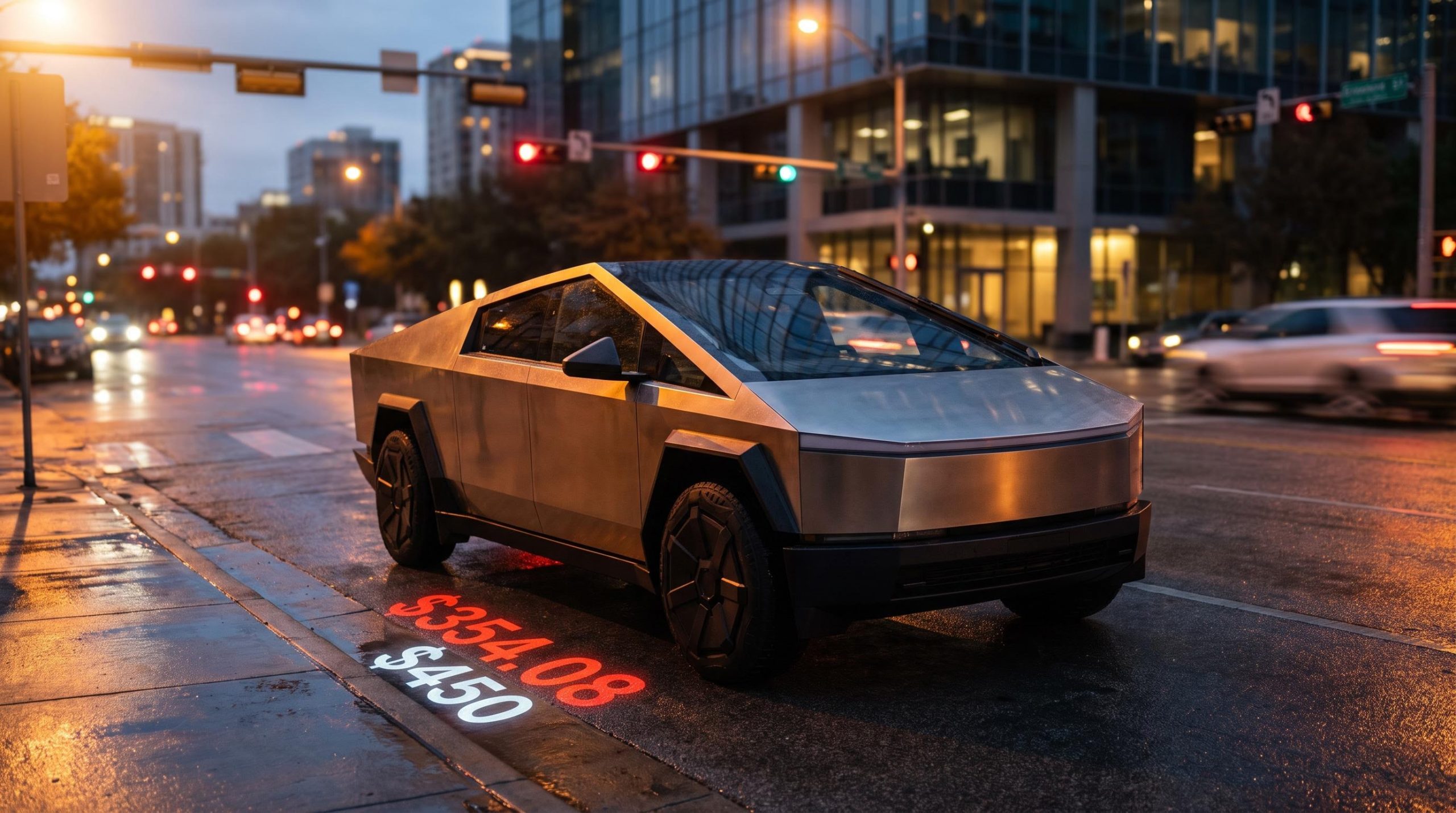
On 3 September 2026, Tesla shares climbed 5.4% ahead of the company’s Cybercab launch event in Austin, closing at $376.37. By the end of the next trading session, every dollar of that gain had vanished, with shares down roughly 6% to $354.08. The stock moved close to 11 percentage points in 48 hours on news that, by most accounts, added almost nothing new.
The Austin event produced no fresh data on production timelines, manufacturing costs, or per-ride pricing. What it did produce was a regulatory audit from the National Highway Traffic Safety Administration (NHTSA), a wave of analyst criticism, and a question that matters more than the event itself: if Tesla’s valuation is mostly a bet on a business that barely exists yet, how do you weigh a disappointing product launch against a $450 fair value estimate?
This piece works through the specific mechanics of why the market reacted the way it did, what Morningstar’s valuation framework actually assumes, and what the distance between those two things tells an investor trying to decide whether the sell-off created an opportunity or confirmed a concern. The answer lives in the gap, and understanding that gap is the whole exercise.
What the Austin launch actually delivered, and what it did not
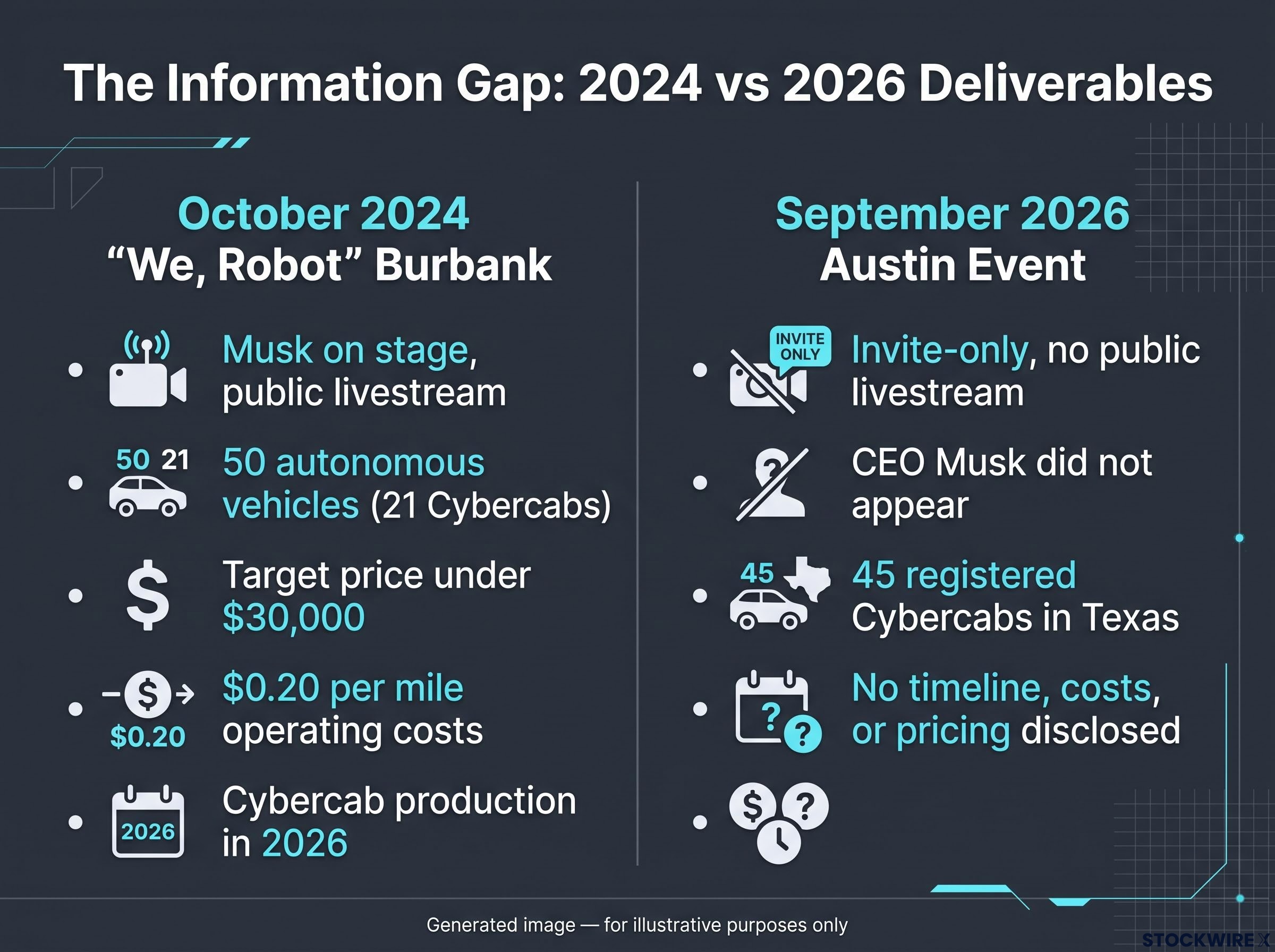
The 3 September 2026 event in Austin was a departure from Tesla’s usual product theatre. Attendance was invite-only, limited to a small group of company staff and social media personalities. There was no public livestream, and CEO Elon Musk did not appear.
Attendees were offered rides in the Cybercab, a two-seater vehicle with no steering wheel and no pedals, operating across the full Austin geofence rather than on fixed routes. The rides worked. The disclosure did not.
Here is what the event actually contained versus what it left open.
What was disclosed:
- Rides in limited areas of Austin using a fleet of just 45 registered Cybercabs in Texas
- A sign-up portal for fleet operators to register future purchasing interest
- Management’s indication that the Cybercab would let Tesla undercut existing ride-hailing rivals on price
- Confirmation of an asset-light model where Tesla sells vehicles to fleet operators while retaining operational involvement
What was not disclosed:
- Any timeline for Cybercab production
- Target costs to manufacture the vehicle
- Per-ride pricing figures
- Fleet size or rollout targets
- Any application for a formal NHTSA exemption
That second list is the story. Immediately after the event, NHTSA opened an audit of roughly 1,000 Cybercabs, examining whether Tesla’s self-certification approach meets federal safety standards written around human drivers.
Morningstar, 7 September 2026: “the market is reacting to the event not featuring management guidance, such as the timeline for Cybercab production or target costs to produce the vehicle.”
The market’s reaction was not irrational panic. It was a precise response to a defined information gap. Understanding that distinction matters before you can judge whether the sell-off was a signal or noise.
What 2024 promised versus what 2026 delivered
The contrast with Tesla’s own history sharpens the disappointment. At the October 2024 “We, Robot” event in Burbank, Musk committed to specific numbers: Cybercab production starting in 2026, a target price under $30,000, and operating costs of roughly $0.20 per mile over time.
That event was a full production. Musk was on stage, the livestream was public, and around 50 autonomous vehicles were present, including 21 Cybercabs.
The 2026 event delivered none of the equivalent guidance and none of the equivalent format. RBC Capital Markets analysts described it as offering “limited new incremental disclosure relative to prior announcements.” The structural driver of the sell-off was not the invite-only format. It was the absence of any update against the concrete commitments Tesla itself had made two years earlier.
When big ASX news breaks, our subscribers know first
Why Morningstar held its $450 fair value through the sell-off
While near-term price targets scattered, Morningstar did not move. Its $450 fair value estimate, reaffirmed on 7 September 2026, had been unchanged since early July when the firm raised it from $425 on stronger delivery expectations.
Tesla’s Q2 2026 deliveries of 480,126 vehicles, a 25% year-over-year gain that ended two consecutive years of declining sales, were the data point that prompted Morningstar’s July fair value raise from $425 to $450, making the delivery recovery the foundation on which the pre-event valuation was built.
The reason it held is that Morningstar’s figure is a different instrument entirely. It is a long-term, probability-weighted intrinsic value estimate, not a 12-month price target. That distinction is load-bearing, because a single launch event carries almost no weight against a multi-year discounted cash flow model.
The inputs that anchor $450 are almost entirely forward-looking. Robotaxis account for over 30% of Morningstar’s Tesla valuation despite contributing well under 0.5% of 2025 revenue, priced in the model at roughly 25% below current human-operated ride-hailing alternatives.
Morningstar’s Tesla valuation has nearly doubled from $195 to $450 across roughly 18 months, with the entire increase driven by scaled probability weightings on robotaxi and Optimus monetisation rather than improvements in the existing auto business, which means each upward revision makes the estimate simultaneously more ambitious and more sensitive to autonomous execution delays.
The Cybercab event did not touch those inputs. Morningstar’s model assumes a full rollout across 2027-2028, and an event with no new negative data on that timeline does not shift a probability-weighted estimate. The firm attributed part of the drop to a “sell the news” dynamic following the 5.4% pre-event rally.
Morningstar, 7 September 2026: “We maintain our $450 per share fair value estimate for narrow-moat Tesla.”
Here is how Morningstar’s stance held across the summer and into the launch.
| Date | Event | Fair Value | Star Rating |
|---|---|---|---|
| 2 July 2026 | Fair value raised on stronger Q2 deliveries | $450 | Undervalued |
| 18 August 2026 | Reports Cybercab will join robotaxi fleet | $450 | 4 stars |
| 7 September 2026 | Shares fall on Cybercab launch disappointment | $450 | 3 stars |
The detail worth reading closely is the shift from 4 stars to 3 stars. That change came from the share price moving, not the fair value. At 3 stars, Morningstar sees Tesla as slightly undervalued, not deeply discounted.
That nuance tells you how the firm sizes the opportunity. Its Very High Uncertainty rating means shares need to trade at a steeper discount before Morningstar treats Tesla as a high-conviction buy. If you are weighing whether to act on the post-event dip, that is the signal that matters: upside exists, but the margin of safety is not yet wide.
The assumptions that make $450 credible, and the risks that make it fragile
The $450 figure is not a forecast of what will happen. It is a weighted average of scenarios, and it includes ones where it is materially wrong. To judge whether the current share price is cheap, you need to see both sides of that weighting.
The bull-case inputs are specific. A successful robotaxi launch on the 2027-2028 timeline, high-margin software and services revenue from Full Self-Driving (FSD) adoption, and an asset-light fleet model where Tesla sells vehicles to operators while collecting recurring revenue. Each of those, if it lands, lifts long-term free cash flow well above what the current auto business generates.
The bear-case inputs are equally specific, and they sit inside the same model. Morningstar flags capital expenditure exceeding $25 billion over three years with uncertain returns, plus EV margin compression from price cuts and intensifying Chinese competition. On top of that sits regulatory fragmentation: the United States has no unified federal autonomous-vehicle framework, so approvals must be won state by state.
The regulatory dimension is where the comparison with rivals becomes instructive, less as a technology contest and more as a risk benchmark.
The robotaxi market structure that makes Tesla’s asset-light fleet model plausible is the same one Waymo’s city-level data complicates: in San Francisco, Los Angeles, and Phoenix, Uber’s trip growth accelerated quarter-over-quarter even as Waymo expanded, suggesting that AV deployment and platform aggregation may be complementary rather than winner-takes-all dynamics.
| Company | Regulatory Strategy | Current Status | Key Risk |
|---|---|---|---|
| Tesla | Self-certification, no exemption filed | NHTSA audit of ~1,000 vehicles underway | Non-compliance finding could delay rollout |
| Waymo | Permitted multi-city deployment | Over 220 million autonomous miles logged | Slower, capital-heavy scaling |
| Cruise | Permitted, later revoked | Terminated after safety incident | Programme collapse, ~$10bn write-downs |
| Zoox | Formal NHTSA exemption | Operating with production caps | Growth capped by exemption terms |
Waymo’s figure of over 220 million autonomous miles through March 2026 should be treated as reported rather than independently confirmed. Cruise, by contrast, illustrates the tail risk: a single safety crisis ended the programme regardless of prior progress, at a cost of roughly $10 billion in write-downs.
The full set of risks Morningstar attaches to Tesla is worth listing plainly:
- Cyclicality of global auto demand
- Intensifying EV competition from incumbents and Chinese entrants
- Ongoing price cuts eroding margins
- Heavy capex on autonomy and robotics with uncertain payoff
- Governance concerns tied to Musk’s pledged shareholdings
- Autonomous-vehicle rules still in flux across states
The distance between Wells Fargo’s $130 target and Morningstar’s $450 is not analyst noise. It reflects fundamentally different assumptions about how probable robotaxi execution really is. Deciding which set of assumptions is closer to correct is the actual investment question.
What the regulatory audit changes
The NHTSA audit of roughly 1,000 Cybercabs deserves separate attention because of the path Tesla chose. Rather than applying for a formal exemption, Tesla self-certified under existing federal standards written for human-driven cars.
That is a different risk profile from Zoox, which secured an exemption with production caps and time limits attached. Tesla’s approach preserves flexibility but leaves it exposed to an adverse finding.
If NHTSA concludes the vehicles do not comply, Tesla could face deployment restrictions or additional requirements. Either outcome would push back the 2027-2028 rollout that Morningstar’s model depends on, which is precisely why this audit, and not the launch event itself, is the variable that could move the fair value.
Reading the analyst divergence as a signal about uncertainty, not consensus
The spread of price targets on Tesla looks like disorder. Wells Fargo’s Colin Langan sits at $130, Barclays at $370, and Morningstar’s fair value at $450. That range is not a failure of analysis.
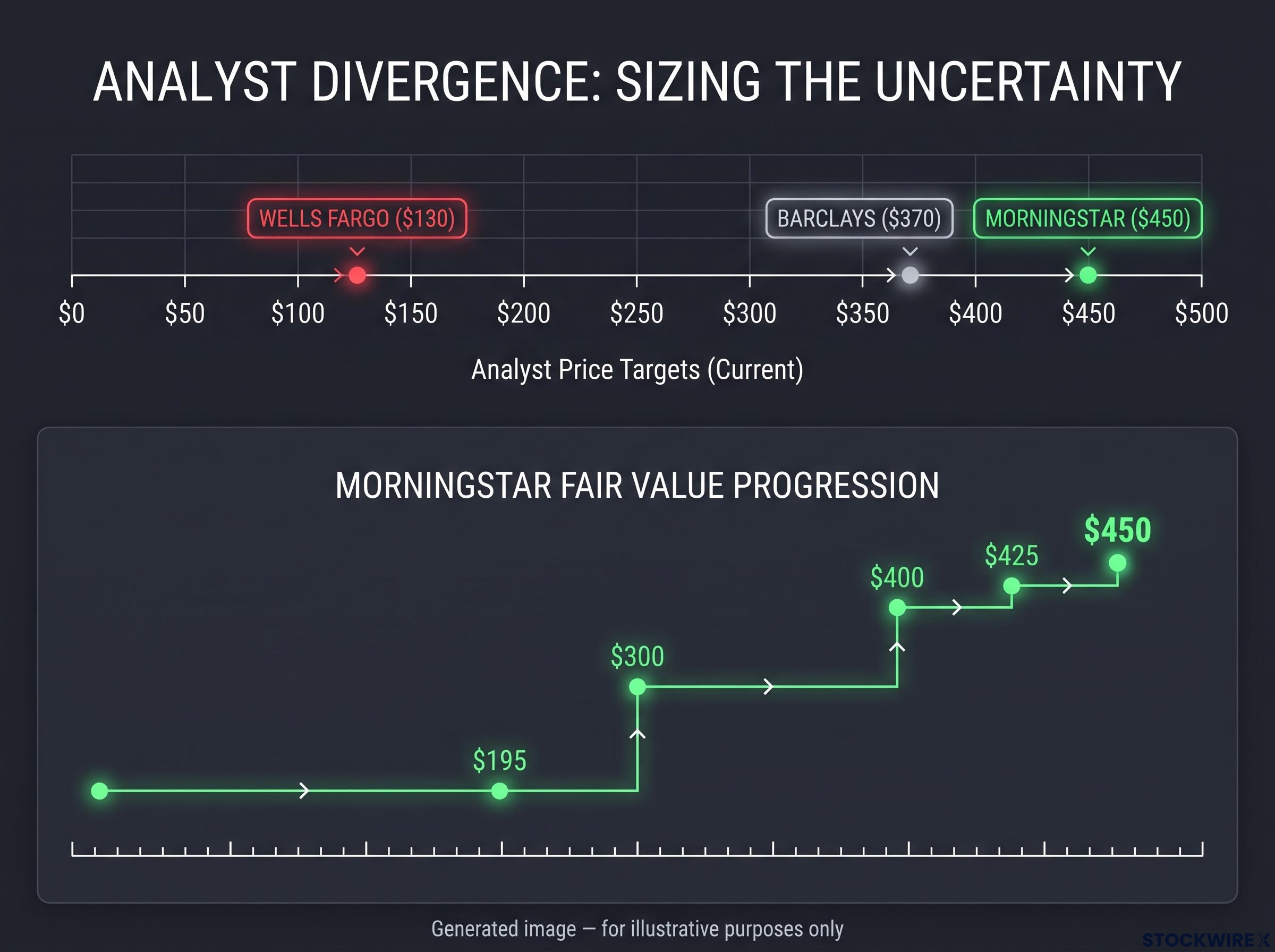
It is an accurate reflection of genuine uncertainty. Each figure applies a different probability weighting to the same unresolved future: whether Tesla scales autonomous driving successfully, and when. Where you land depends entirely on how likely you think that outcome is.
Wide analyst price target spreads on high-uncertainty growth stocks are not a sign of analytical failure; they reflect the mathematical reality that terminal value assumptions drive up to 80% of a discounted cash flow model’s output, meaning two analysts sharing identical near-term revenue forecasts can still arrive at targets that differ by a factor of three or more.
The Very High Uncertainty rating is the honest label for this situation. It means Tesla should be held in scenario ranges, not point estimates, and it explains why RBC Capital Markets could criticise the thin disclosure while still recommending the stock. Two valid assessments can coexist when the underlying outcome is this wide.
One detail deserves emphasis. Morningstar’s fair value has climbed over time, from $195 to $300, then $400, then $425, and finally $450, as the firm raised its probability weighting on robotaxi and Optimus monetisation.
Morningstar rates the post-event shares “slightly undervalued” at 3 stars, not “deeply discounted” at 4 or 5.
That progression cuts both ways. The higher the estimate climbs, the more of it rests on autonomous execution, which makes the current $450 more sensitive to setbacks than the earlier, lower figures ever were.
If Morningstar’s robotaxi assumptions prove directionally correct, $450 likely understates where shares could trade. If those assumptions are wrong or delayed by several years, both $450 and the current price may overstate intrinsic value. That asymmetry is the honest frame for holding the position, and three variables will determine which way it resolves.
- NHTSA audit outcome: a compliance finding either clears or constrains the rollout timeline
- Austin fleet scaling data: real-world evidence of whether the service grows or stalls
- New production timeline disclosures: the guidance the launch event pointedly withheld
This article is for informational purposes only and should not be considered financial advice. Investors should conduct their own research and consult with financial professionals before making investment decisions. Past performance does not guarantee future results, and financial projections are subject to market conditions and various risk factors.
What the gap between event volatility and long-term valuation tells you
The core finding is straightforward. The Cybercab launch delivered no new negative evidence against Morningstar’s central valuation assumptions. The sell-off reflected the absence of information, not the arrival of bad information, and those are very different things for a long-term investor.
That is why the honest question after this event is not “was the Cybercab launch a success?” It is “does the evidence available now change my probability weighting on autonomous execution?” Morningstar’s 7 September 2026 answer is clearly no.
With shares in the mid-$360s, roughly 20% below the $450 fair value, Tesla sits at 3 stars. That means slight undervaluation, not a high-conviction entry point. For the stock to reach 4-star territory, the Very High Uncertainty designation requires it to trade at a steeper discount still, so that threshold is the number worth watching.
The variables that will validate or revise the $450 figure are now specific and observable, and they resolve on different clocks.
- NHTSA audit resolution: the nearest-term catalyst, capable of confirming or constraining the deployment path
- Austin fleet scaling trajectory: the medium-term read on whether real-world demand and operations hold up
- New production or cost guidance: the longer-term test, and the direct measure of the over $25 billion capex Morningstar flags as the central execution risk
The framework here extends beyond Tesla. For any high-uncertainty, wide-moat name where a single product moment creates a short-term divergence from long-term valuation, the discipline is the same: separate event-driven noise from fundamental signal, and act on the second, not the first.