
When a government announces a capital gains tax increase, the instinct for equity investors is immediate and familiar: sell first, ask questions later. The assumption sits deep in the market’s reflexes, that a heavier tax on gains must drag share prices down with it.
Australia has just run a live test of that assumption. Since Treasurer Jim Chalmers handed down the 2026-27 Budget in May, the country’s capital gains tax framework has been overhauled, yet Australian equities recovered from their initial post-announcement dip, kept pulling in billions of dollars of exchange-traded fund (ETF) inflows through the first two quarters of the year, and sat ahead of the MSCI World Index on a year-to-date basis as of 8 September 2026. The fear and the data are pointing in opposite directions.
Here is what the Australian numbers actually tell you about how equity markets respond to a capital gains tax overhaul, why the structural reasons run deeper than the political headlines, and what the case means if you are watching similar debates take shape in the UK or the US. You should finish with a working framework, not just a reason to relax.
What Australia’s 2026 capital gains tax overhaul actually changed
The reform is real, and it is now law. Announced on 12 May 2026 as part of the federal Budget, it scraps the longstanding 50% capital gains tax discount that applied to assets held for more than twelve months. In its place comes CPI-linked cost base indexation, meaning your asset’s original purchase price is adjusted upward for inflation before the gain is calculated, plus a minimum 30% effective tax rate on the real, inflation-adjusted gain.
That last distinction matters more than the headlines let on. The new regime taxes real gains, not nominal ones. Stripping out inflation before applying the rate narrows the practical scope of the change considerably compared with how it was first reported.
The rules apply to individuals, trusts, and partnerships. Companies sit outside them, governed by their own tax treatment. Both enabling laws, the Treasury Laws Amendment (Tax Reform No.1) Act 2026 and the Income Tax Rates Amendment (Tax Reform No.1) Act 2026, received royal assent on 26 June 2026.
| Event | Date | Key implication |
|---|---|---|
| Budget announcement | 12 May 2026 | 50% discount slated for abolition; markets react |
| Royal assent (Acts No. 49 and 50 of 2026) | 26 June 2026 | Reform becomes law |
| New CGT rules take effect | 1 July 2027 | Applies only to gains accruing from this date |
The four core elements of the reform are worth isolating:
- Abolition of the 50% discount on assets held more than twelve months
- CPI-linked cost base indexation, so only real gains are taxed
- A minimum 30% effective tax rate on those real gains
- Full grandfathering of gains accrued before 1 July 2027
What stays the same: the grandfathering provision explained
The single most misread feature of the reform is its start date. The new rules bite only on gains accruing after 1 July 2027. Every dollar of embedded gain in your existing portfolio keeps the 50% discount treatment when you eventually sell, a point confirmed in Australian Taxation Office (ATO) guidance.
The ATO guidance on the 2026 CGT reforms confirms that the grandfathering provision is comprehensive: every dollar of gain accrued before 1 July 2027 retains the 50% discount treatment on eventual sale, meaning the reform’s practical reach on existing portfolios is narrower than the headline change implies.
Picture a share portfolio you have held since 2022. All the growth up to 1 July 2027 is locked in under the old rules and discounted by 50% when realised. Only the growth after that date falls under indexation and the 30% minimum.
The dual-calculation grandfathering rules require investors who acquired assets before 1 July 2027 to split their gain into a pre-commencement portion, taxed under the old 50% discount, and a post-commencement portion taxed under indexation and the 30% minimum floor, a mechanical complexity that the old flat-discount system made entirely unnecessary.
For long-term holders, that means the reform reaches only the marginal future gain on existing positions, not the substantial gain already built up. The policy shock to established portfolios is far smaller than the phrase “capital gains tax hike” suggested, and that is the foundation for everything that follows.
When big ASX news breaks, our subscribers know first
What the market data shows about investor behaviour since May 2026
Australian equities did dip when Chalmers presented the proposals in May, while international markets pushed higher over the same stretch. Then they recovered, tracked global equities upward, and, according to Fisher Investments analysis published on 8 September 2026, moved ahead of the MSCI World Index on a year-to-date basis. Precise percentage figures for the ASX 200 against the MSCI World are not available in the current research, but the direction is clear and consistent.
The more revealing signal is where the money went. If sophisticated investors genuinely feared the reform, you would expect them to trim equity exposure. They did the opposite.
The ETF market acceleration visible in the Q1 and Q2 2026 data is not an isolated quarterly event; by mid-2026, the Australian ETF industry had crossed A$372 billion in total assets, with H1 FY26 inflows alone matching the entire calendar year 2024 figure, confirming the structural shift predates and runs through the CGT reform debate.
ETF flow data through the first half of 2026 reads as a real-time referendum on the fear narrative, and the verdict is emphatic.
| Period | Asset class | Inflows (AUD) | Notes |
|---|---|---|---|
| Q1 2026 | Australian equities | $4.15 billion | Global equities took $6.90 billion |
| Q1 2026 | Australian bonds | $2.73 billion | Equities the dominant allocation |
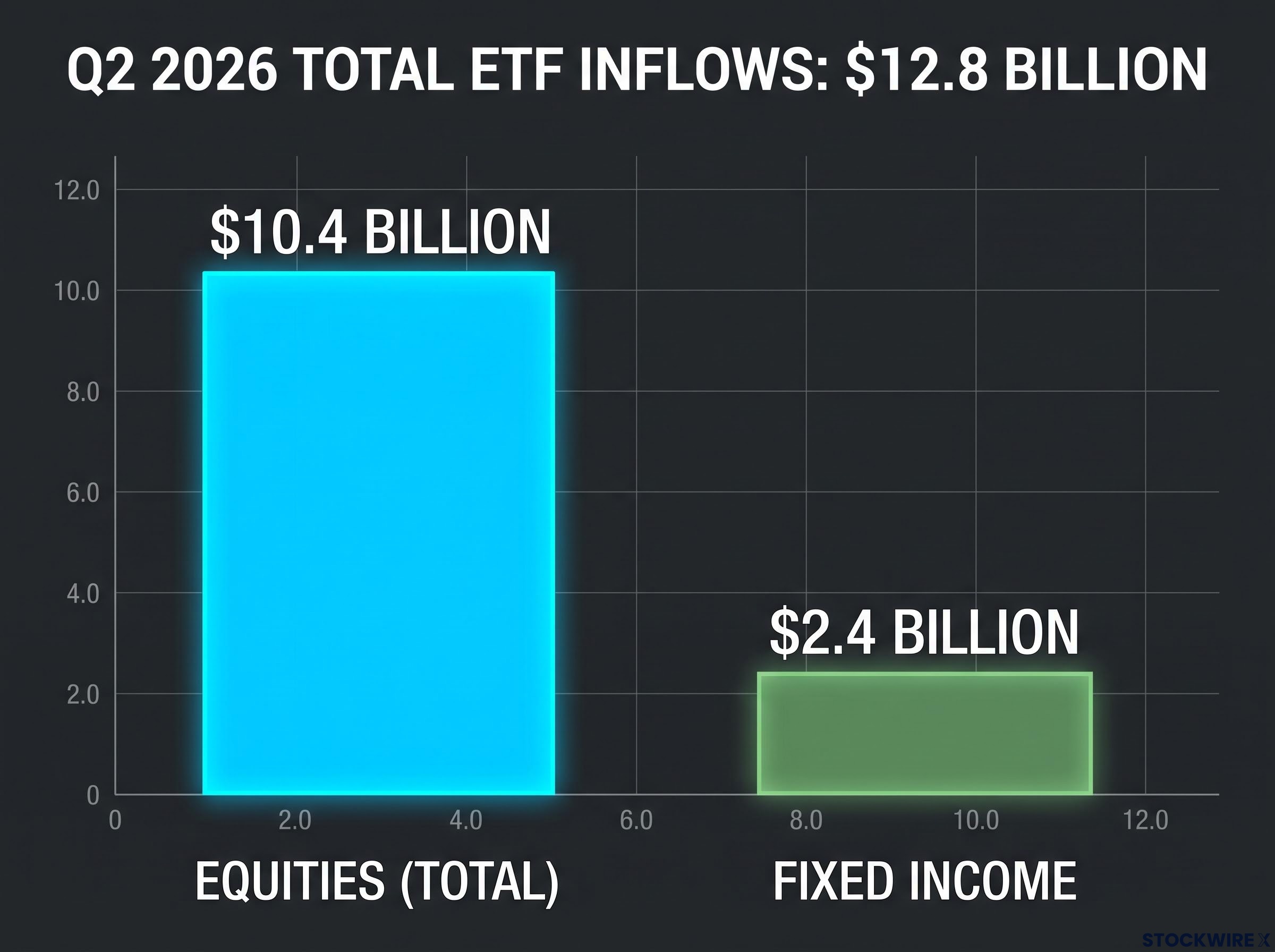
| Q2 2026 | Equities (total) | $10.4 billion | Of $12.8 billion total ETF inflows |
| Q2 2026 | Fixed income | $2.4 billion | Equities “the clear preference” |
The detail inside those quarters reinforces the pattern. In March 2026 alone, $1.76 billion flowed into domestic equity ETFs, with $880.5 million into the Vanguard Australian Shares Index ETF (VAS) and $319.0 million into the iShares Core S&P/ASX 200 ETF (IOZ), according to Bell Potter’s March 2026 ETF report. Morningstar’s Q2 review recorded Australia large-blend funds leading at $3.0 billion, North America at $1.9 billion, and Australia equity income at $0.7 billion.
Australian investors poured $10.4 billion into equity ETFs over the June 2026 quarter, described by Morningstar as “the clear preference” for investors, in the middle of a live capital gains tax reform debate.
That figure is the point. The investors best placed to judge whether the reform warranted fear chose to add equity exposure, not shed it.
Why equity markets are structurally insulated from domestic tax policy
The market did not just shrug. It was always likely to, and understanding why turns this from a comforting anecdote into a reusable mental model. Three structural factors do the work.
The first is who actually owns Australian shares. The second is what Australia’s market is made of. The third is what really moves equity valuations over time.
The role of international capital in Australian equity pricing
A material share of Australian equities is held by offshore institutions and funds. For those investors, Australian capital gains tax rules are irrelevant; they are taxed under their home country’s regime, whatever Canberra decides.
That is the most underappreciated reason domestic tax changes rarely generate sustained international selling. A UK pension fund or a US asset manager holding ASX-listed shares has no fresh incentive to sell simply because Australia altered its own CGT treatment.
If you hold a diversified Australian equity index fund, a substantial portion of that fund’s shareholder base sits entirely outside the reach of the reform. The domestic tax change has a structurally limited grip on the fund’s price.
The second factor is composition. Australia’s market leans heavily toward natural resources and financials, and Fisher Investments assessed sector composition, particularly that resources weighting, as a more influential driver of equity returns than the domestic tax changes. Commodity cycles and global demand set the tone for those sectors, not the ATO.
The third factor is the primacy of earnings and macro conditions. Well-telegraphed CGT changes applied only to future accruals mainly shift the timing of when investors realise gains, a short-run distortion, rather than the long-run valuation of the underlying businesses.
Stock returns are tied far more closely to macroeconomic conditions and corporate earnings than to local tax rules.
The general public-finance literature backs this up. Large or sudden CGT increases can trigger “lock-in”, where investors delay selling to avoid the tax, or a rush to sell before implementation, but these effects tend to be sector-specific, hitting property developers, small caps, and high-growth firms harder than the broad index.
The three insulation factors, in summary:
- Foreign investor immunity: offshore owners are taxed at home, so domestic CGT changes create no exit incentive
- Sector composition: resources and financials, driven by global cycles, dominate returns
- Earnings and macro primacy: valuations track profits, rates, and global risk appetite, not local tax rates
Australia’s reform, by targeting real gains and applying only to future accruals, deliberately avoids the mechanisms that might otherwise spark sustained selling.

What the Australian case means for investors watching UK and US debates
The same debate is playing out elsewhere. Fisher Investments noted that the UK is weighing potential capital gains tax increases while the US is considering inflation indexing of the cost basis, both active through 2026. The framework built from the Australian case travels directly to both.
Apply it and the conclusion holds. A CGT change that is well-telegraphed, applied only to future accruals, and focused on real rather than nominal gains is unlikely to be a meaningful driver of equity returns in either direction. Fisher Investments reached exactly that view for the UK and US debates.
The Australian result strengthens that prior rather than proving it universal. The reform’s specific design carried an advance notice period before the July 2027 start, full grandfathering of embedded gains, and a real-gains focus. Those features are what neutralised the shock.
The broader economic consequences of the reform extend beyond equity valuations: Australian labour productivity fell 0.6% in the March 2026 quarter capping six years of near-zero growth, and the new CGT rules risk compounding an existing distortion that already tilts corporate incentives toward distributing profits rather than reinvesting them in productive capital.
Change the design and you change the outcome. A larger or more sudden CGT increase with no grandfathering, landing in a market with heavy retail participation, could genuinely trigger lock-in or accelerated selling and move prices in the short run.
So the practical instruction for a UK or US equity investor is to read the design, not the headline rate. The variables that determine whether your existing portfolio is actually at risk are these:
- Australia: confirmed law, future accruals only, real gains focus, grandfathering in place
- UK: debate active, design still to be determined
- US: debate active, potential inflation indexing, design still to be determined
Until the UK and US design details are settled, the headline rate tells you very little about the likely market impact.
This article is for informational purposes only and should not be considered financial advice. Investors should conduct their own research and consult with financial professionals before making investment decisions. Past performance does not guarantee future results, and these observations may not hold under different reform designs or market conditions.
Making sense of CGT reform as an equity investor in 2026
The Australian experiment is compelling precisely because it is live and data-backed. A $10.4 billion equity ETF inflow in a single quarter, arriving in the thick of a capital gains tax overhaul, is about as clean a rebuttal to reflexive fear as markets produce. But the durable value is not the reassurance; it is the framework.
Three principles carry into any future CGT debate you encounter:
- Market structure beats tax headlines. Foreign ownership and sector composition shape returns far more than domestic tax policy.
- Design determines impact. Whether a reform applies to future or existing gains, targets real or nominal returns, and gives advance notice matters more than the rate itself.
- Macro and earnings dominate. Over any meaningful horizon, corporate profits and economic conditions drive equity returns regardless of the CGT regime.
As these debates intensify globally through late 2026, the Australian case gives you a data point against panic, not a licence to ignore policy design. Before you adjust your positioning in response to any capital gains tax announcement, assess the reform’s design before you assess the headline rate.
For investors wanting to translate the framework into specific portfolio actions before the 1 July 2027 transition, our comprehensive walkthrough of CGT planning strategies covers low-turnover ETF structuring, superannuation contribution timing, and the terminal wealth gap that the new regime creates over a 30-year horizon.