Soft Payrolls, Sticky Wages: the Fed’s Dilemma in 2026
15 hrs ago


Tesla disclosed 480,126 vehicle deliveries for Q2 2026 on 2 July, a figure that simultaneously set a new second-quarter record and ended two consecutive years of declining sales. The day after the announcement, shares of Tesla’s Chinese parts suppliers surged by as much as 10% in a single session.
The result landed against a backdrop of persistent scepticism about Tesla’s demand trajectory, sustained pressure from Chinese EV rivals, and unresolved investor debate over whether the company’s push toward lower-priced trims was strategic expansion or defensive retreat. A 25% year-over-year jump and a 34% sequential gain answered part of that question directly.
Here is what actually drove the record quarter, what the supplier rally signals about market expectations for the rest of 2026, and where the unresolved risks sit before the 22 July earnings call. The number to watch, and the reason it matters, comes at the end.
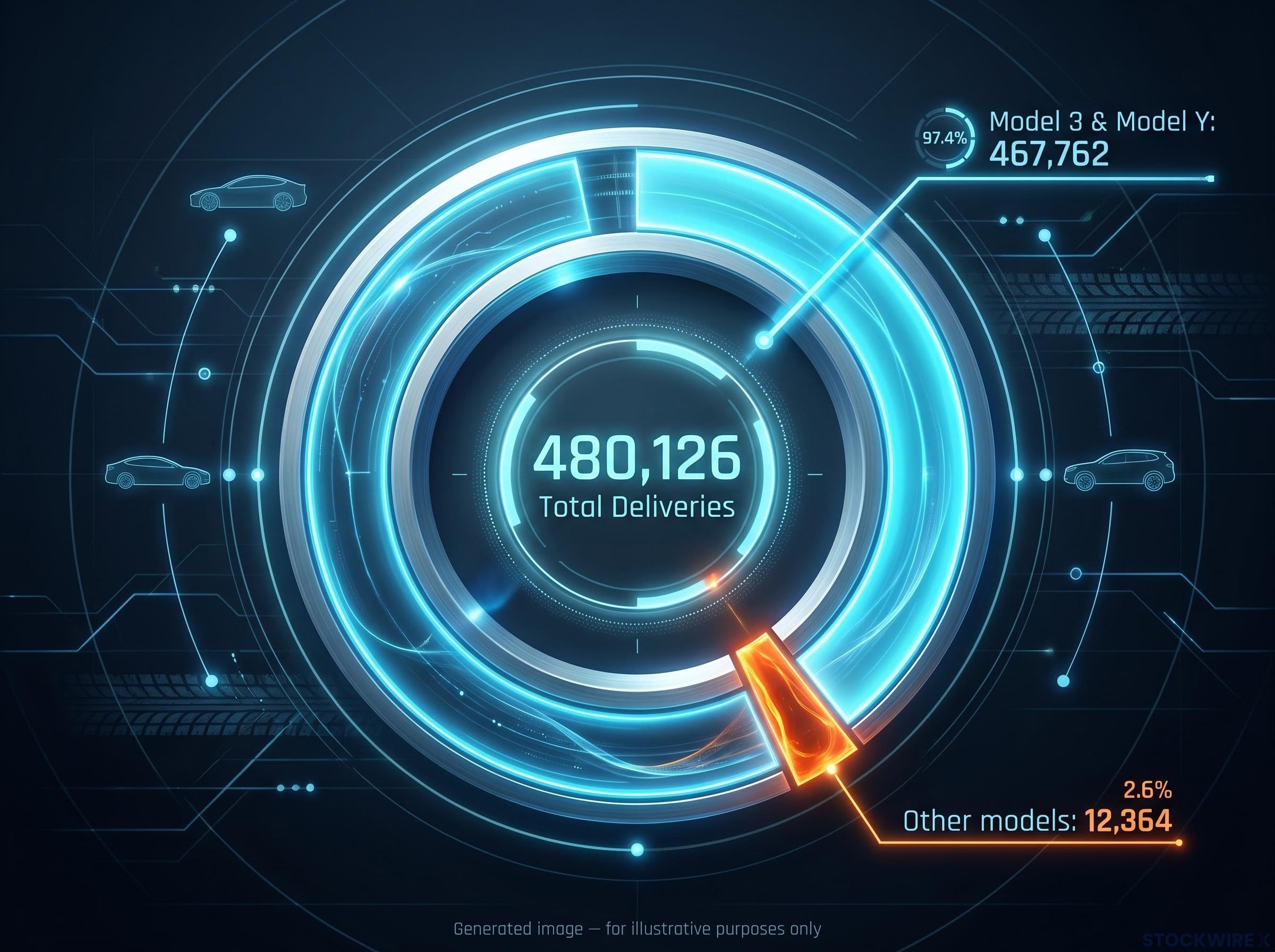
Tesla delivered 480,126 vehicles and produced 451,758 units in Q2 2026, according to the company’s 2 July press release. Model 3 and Model Y accounted for 467,762 of those deliveries; other models contributed 12,364 units.
Tesla’s Q2 2026 production and deliveries press release confirmed 480,126 vehicles delivered and 451,758 units produced, with Model 3 and Model Y accounting for the substantial majority of the total.
The figures mark the strongest second quarter in Tesla’s history and the fourth-best quarter overall. More importantly, they arrived after a period that had shaken confidence in the company’s growth trajectory.
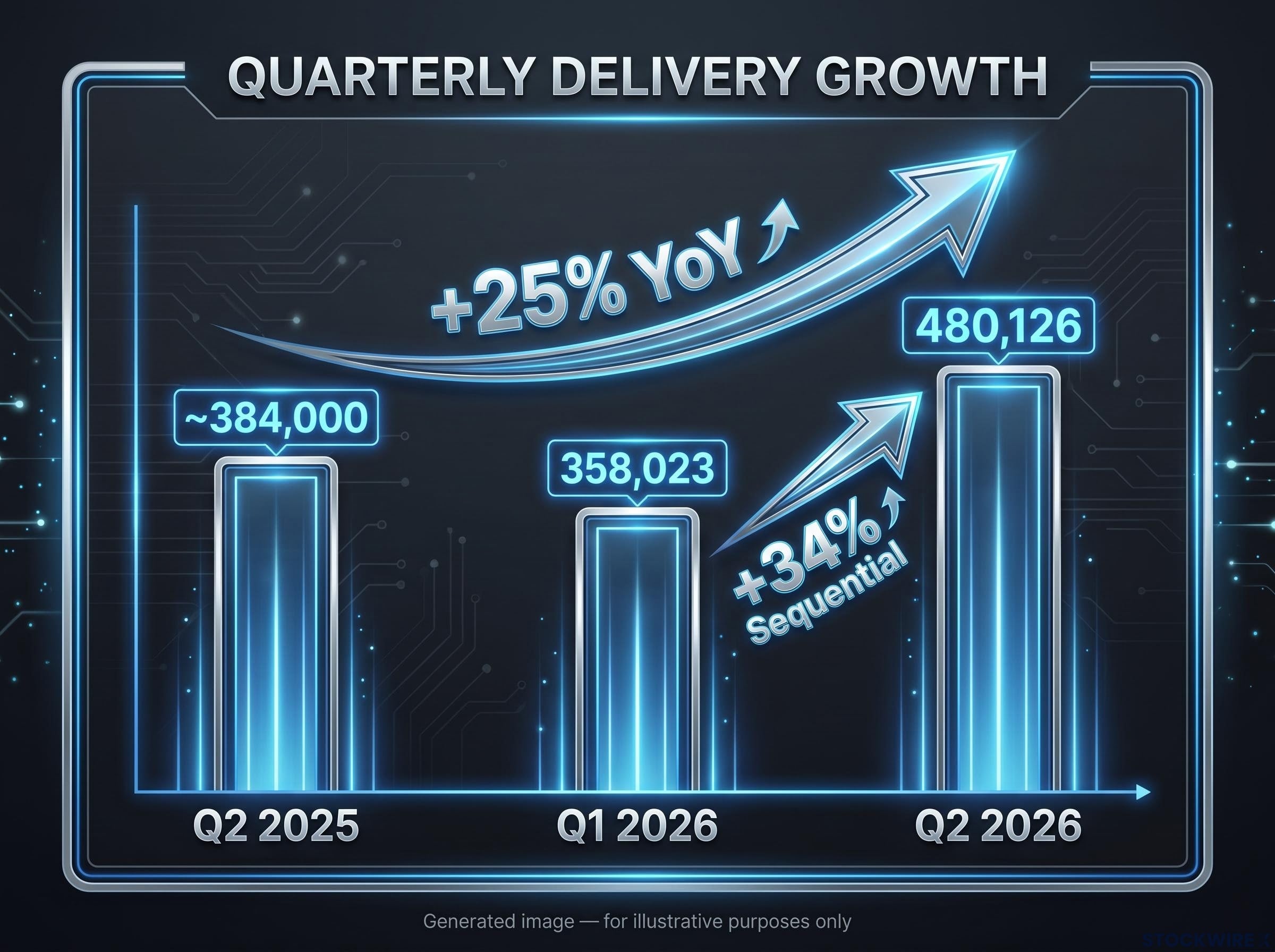
Two years of declining sales had allowed the “structural demand erosion” thesis to take hold. A 25% year-over-year increase (from approximately 384,000 in Q2 2025) and a 34% sequential jump (from 358,023 in Q1 2026) did not merely stabilise the trend. That sequential acceleration, 34% in a single quarter, tells you this was not a slow drift upward but a decisive volume snap, shifting the framing from stabilisation to genuine inflection.
| Quarter | Deliveries | Production | YoY Change | Sequential Change |
|---|---|---|---|---|
| Q2 2025 | ~384,000 | N/A | N/A | N/A |
| Q1 2026 | 358,023 | N/A | N/A | N/A |
| Q2 2026 | 480,126 | 451,758 | ~25% | ~34% |
The delivery number is striking. What matters more is whether investors can trust the drivers behind it. Three distinct levers explain the Q2 recovery, and their variety is what makes the result structurally interesting rather than a one-off.
The geographic spread of this recovery is directly relevant to how you assess risk going forward. Tesla is not dependent on a single market holding up, which reduces the scenario risk if one region turns hostile through regulation, trade friction, or intensified local competition.
China occupies a unique dual position in Tesla’s business. The Shanghai Gigafactory is the company’s most cost-efficient production facility, serving both as a hub for global vehicle exports and as the local manufacturing base for vehicles sold within China itself. That dual function, cost base and sales base, makes it simultaneously Tesla’s greatest operational advantage and its most contested market.
The refreshed Model Y produced at Shanghai illustrates the strategic necessity of this arrangement. Chinese EV competitors, led by BYD, operate on product cycles measured in months rather than years. Without locally tailored refreshes, Tesla risks falling behind on features, interior quality, and value perception in the world’s largest EV market.
Chinese EV competitive pressure on Tesla’s Shanghai operation is materially different from the threat that faces Western automakers in their home markets, because BYD and its domestic rivals operate behind the same trade walls that block Chinese vehicles from US and European consumers, meaning the intensity of the China-market battle has no regulatory buffer.
For investors, China is simultaneously Tesla’s biggest manufacturing advantage and its most contested sales market, meaning the Shanghai operation’s performance is never just a production story but always also a competitive signal.
Despite the product refresh, China growth in Q2 was modest rather than dominant. That tells you something about the intensity of local competition. Domestic rivals compete on aggressive pricing, rapid product cycles, and increasingly sophisticated software features. Tesla’s durable China edge relies more on brand, Full Self-Driving (FSD) capability (the company’s advanced driver-assistance software), and the Supercharger network than on hardware alone.
Any further share loss to local competitors would pressure the Shanghai operation’s utilisation rates and begin to undermine the cost advantage that makes the entire export model work. The production story and the competitive story are inseparable.
The morning after Tesla’s announcement, three key Chinese suppliers posted sharp single-day gains in mainland trading on 3 July 2026.
| Supplier | Component Supplied | 3 July Move |
|---|---|---|
| Ningbo Tuopu | Chassis components | +10.01% |
| Zhejiang Sanhua | Thermal management and heat-control systems | +9.06% |
| Ningbo Xusheng | Lightweight aluminium structural parts | +6.63% |
A 5-10% single-day move in deeply embedded supply chain stocks is not a backward-looking pat on the back for Q2. It is a forward-looking revision. The size of these moves tells you that professional market participants are not merely acknowledging one good quarter; they are revising their multi-quarter outlook for Tesla’s Shanghai production ramp. That is the more meaningful signal.
The Tesla ecosystem trade: Owning key Chinese suppliers offers a way to gain operational leverage to Tesla’s production cycle, potentially at lower valuations but with amplified upside and downside relative to Tesla itself. When Tesla’s volumes rise, these suppliers’ earnings can grow faster. When volumes stall, they can underperform sharply.
The supplier rally functions as a real-time market sentiment gauge on Tesla’s production trajectory, and it is especially useful now, before Tesla’s own earnings provide margin and guidance data on 22 July.
The record print is constructive. It is also incomplete.
The single most important number arriving on 22 July is gross margin. If it holds or improves alongside record volume, the turnaround thesis gets a structural foundation. If it deteriorates sharply, the record quarter becomes a milestone that cost more than it was worth.
Tesla’s Q1 2026 earnings established the baseline context for reading Q2: Tesla beat consensus on revenue, adjusted EPS, and gross margin, yet the forward P/E remained above 180x, meaning the automotive segment’s performance alone was never sufficient to justify the share price without execution across robotics and autonomy.
This article is for informational purposes only and should not be considered financial advice. Investors should conduct their own research and consult with financial professionals before making investment decisions.
Forward-looking statements regarding Tesla’s margins, competitive positioning, and future delivery trajectory are speculative and subject to change based on market developments and company performance.
22 July is the date that either validates or complicates the Q2 delivery beat. Volume without margin data is an incomplete verdict. Three metrics will settle the question:
For both Tesla equity holders and Chinese supplier investors, these are the numbers that determine whether the sentiment-driven relief rally gets a fundamental foundation or gets corrected. The supplier stocks are particularly exposed: if margins hold, the 3 July rally may extend; if margins disappoint, operational leverage cuts both ways.
Scenario-based valuation is particularly relevant here because Tesla’s share price already embeds a future business mix, including autonomy and robotics revenues, that does not yet appear in reported financials, meaning the Q2 delivery beat and the 22 July margin print each shift the probability weighting across those scenarios rather than resolving the valuation question outright.
Tesla’s 480,126 deliveries ended two years of decline and set a record. The supplier rally already has that priced in. What happens next depends on three numbers, and you now know exactly which ones to watch.
Tesla delivered 480,126 vehicles in Q2 2026, setting a new second-quarter record and marking a 25% increase year-over-year from approximately 384,000 deliveries in Q2 2025.
Three factors drove the volume surge: the introduction of lower-priced Model 3 and Model Y trims, the rollout of a refreshed China-manufactured Model Y from the Shanghai Gigafactory, and strong performance in European markets.
Ningbo Tuopu, Zhejiang Sanhua, and Ningbo Xusheng rose between 6.63% and 10.01% on 3 July 2026 because a single-day move of that size in supply chain stocks signals a forward-looking revision to multi-quarter production expectations, not merely a reaction to one good quarter.
Gross margin is the critical unknown: lower-priced trims almost certainly compressed profitability, and the 22 July earnings call will reveal whether Tesla bought its volume recovery with economics it can sustain or economics that erode long-term value.
The three numbers that will confirm whether the record quarter was a genuine inflection are gross margin percentage, operating leverage trajectory, and regional revenue mix between China and Europe.