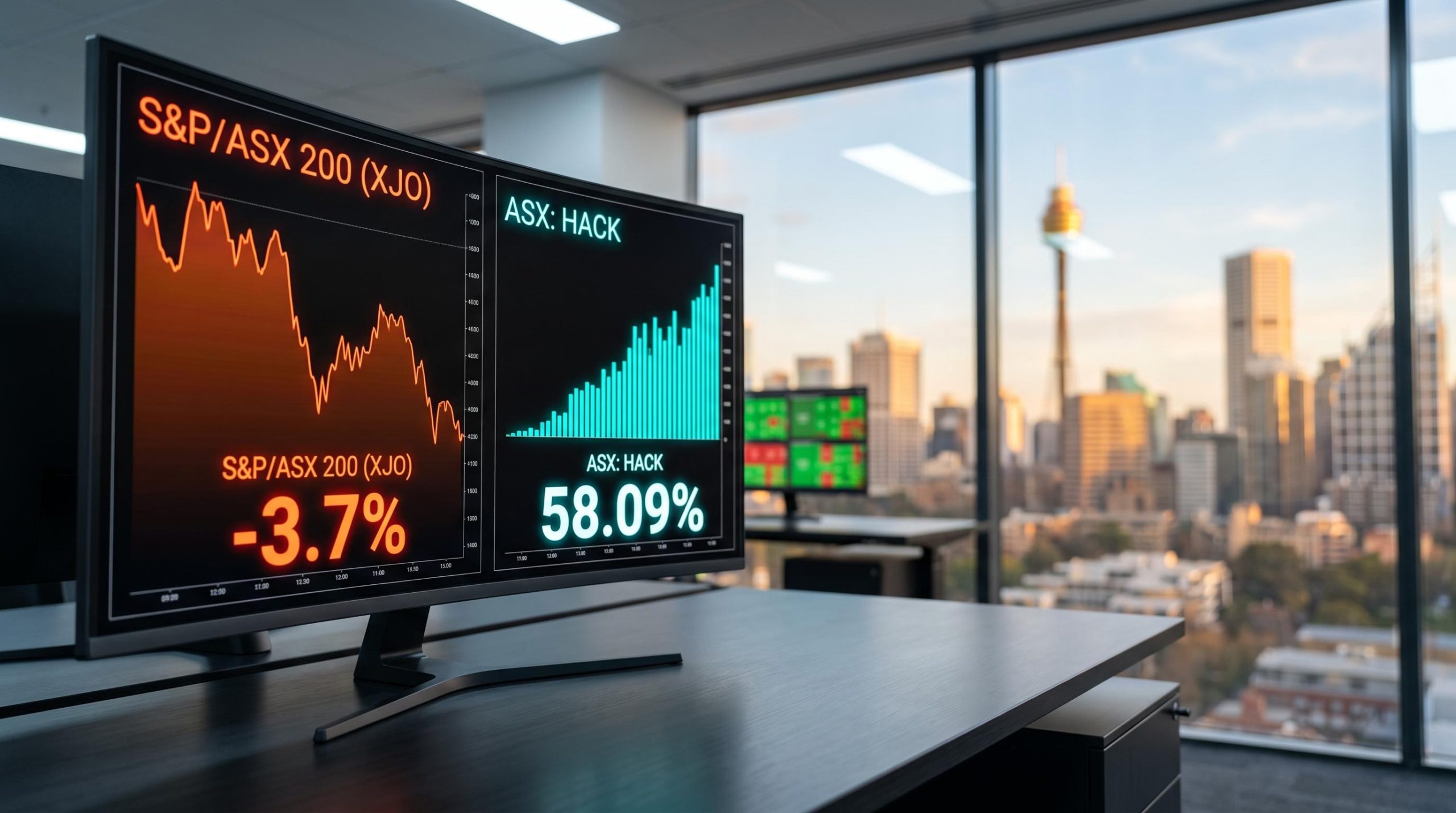
The S&P/ASX 200 is down roughly 3.7% over the past month. In that same window, one ASX-listed cybersecurity ETF returned 58% over six months.
Sit with that gap for a moment.
That kind of spread is not short-term noise, and it is not a coincidence. It is the footprint of a structural rotation, capital moving toward sectors where artificial intelligence is genuinely reshaping earnings rather than simply brushing against them.
The central question is which sectors AI is actively helping and which it is merely touching. The answer sorts three of the best-performing corners of the ASX thematic ETF market into a clear hierarchy.
Here is what the data reveals about the structural case for cybersecurity, healthcare and biotech, and gaming, what is driving each one’s valuations, and where the risk of reading the narrative too cleanly begins.
Why the ASX 200 pullback has not touched every sector equally
As of 8 September 2026, the S&P/ASX 200 (ASX: XJO) sat at 8,920.80, down 1.00% on the day. The index had pulled back roughly 3.7% over the prior month, though it held onto a modest 2.37% year-to-date gain.
A broad, passive slice of the Australian market has essentially gone sideways-to-down. Yet a handful of thematic funds have moved in the opposite direction, and forcefully.
That divergence is the story. When the benchmark weakens while specific thematic ETFs surge, it signals that money is rotating toward sectors where earnings visibility has structurally improved, not just sectors having a good week.
Over six months, the BetaShares Global Cybersecurity ETF (ASX: HACK) returned 58.09% (as at 31 July 2026), while the Global X Cybersecurity ETF (ASX: BUGG) posted 72.75% (as at 31 August 2026).
The three sectors under examination each carry a distinct relationship to the AI theme:
- Cybersecurity: AI is expanding the attack surface, forcing enterprise and government security budgets higher.
- Healthcare and biotech: AI is compressing the cost and timeline of drug development while a GLP-1 obesity wave opens vast commercial markets.
- Gaming: AI is lowering development costs and personalising player experiences, supporting a rebound from a weak year.
The size of the spread between the index and these funds matters for one practical reason. It tells you that sector selection is generating returns that passive ASX exposure simply cannot replicate right now.
That is the appeal, and also the trap. Outperformance of this magnitude invites investors to chase the number without scrutinising the drivers. The rest of this analysis does the scrutinising, sector by sector, before turning to whether the gains are durable.
When big ASX news breaks, our subscribers know first
Cybersecurity’s re-rating: how AI flipped from threat to tailwind
Not long ago, the market worried that AI would gut the cybersecurity sector. The fear was straightforward: if machines could automate vulnerability detection, specialist security vendors might become commoditised, their pricing power eroded.
That thesis inverted through 2026.
Rather than replacing security tools, AI has supercharged the threat side of the equation. Attackers now deploy AI to build more sophisticated, scalable, and harder-to-counter intrusions, while the ongoing shift to cloud and digital infrastructure keeps widening the surface they can target.
The offence-defence asymmetry shaping enterprise security budgets is more acute than headline spending figures suggest: Palo Alto Networks’ internal AI scan compressed five to seven years of conventional vulnerability discovery into six weeks, a demonstration that attacker capability is scaling faster than most vendor product cycles can absorb.
More threats mean bigger budgets. According to Gartner, global information-security end-user spending is projected to reach US$213 billion in 2025, up from US$193 billion in 2024, then climb to US$240 billion in 2026, a 12.5% year-on-year increase. Longer term, Gartner projects the market reaching US$309-311 billion by 2029, a 10-11% compound annual growth rate.
| Year | Global Spend (US$ billion) | Year-on-Year Growth |
|---|---|---|
| 2024 | $193B | — |
| 2025 | $213B | ~10% |
| 2026 | $240B | 12.5% |
| 2029 (projected) | $309-311B | 10-11% CAGR |
The rally had a specific trigger. HACK surged approximately 31% from early April 2026, an advance explicitly linked to the launch of a frontier AI model (“Claude Mythos Preview”) that exposed major vulnerabilities and put platform-security vendors firmly back in favour. Over the 90-day window from mid-April to mid-July 2026, HACK returned roughly 47.8% with about 2.05% daily volatility.
The catalyst is what made the structural case visible to markets. The budgets were already growing; the model launch simply forced the market to price it.
What Australian government budgets signal for the sector
The demand story is not purely a US enterprise phenomenon. It is written into Australian public spending.
Federal cybersecurity funding layered A$586.9 million from the 2025-26 Federal Budget on top of the existing A$2.3 billion REDSPICE initiative, pushing cumulative federal allocations through 2030 to roughly A$2.88 billion. Victoria added a state-level A$100 million four-year commitment, evidence of spend cascading from federal to state governments.
This is the detail that separates a durable re-rating from a momentum trade. Government mandates are not discretionary budget lines that vanish when sentiment cools; they represent guaranteed forward revenue for the platform-security vendors that dominate HACK and BUGG.
For you, that changes the revenue-visibility calculus. When a chunk of a sector’s demand is locked into multi-year government commitments, the case for durability rests on contracts rather than narrative alone.
Healthcare and biotech: two different rallies inside the one sector label
“Healthcare ETF” sounds like a single category. The returns say otherwise.
The BetaShares Global Healthcare ETF, Currency Hedged (ASX: DRUG), a broad fund, returned roughly 2.14-2.60% over six months. The Global X S&P Biotech ETF (ASX: CURE), focused on biotech, returned between 13.25% and 27.73% over the same period, depending on the data cut-off.
That is a chasm inside one sector label. The outperformance is not spread evenly across healthcare; it is concentrated in the biotech sub-segment sitting at the intersection of AI-accelerated pipelines and the obesity-drug commercial wave.
Three structural tailwinds explain the concentration:
- The GLP-1 obesity pipeline: More than 120 next-generation GLP-1 drugs are in development across roughly 60 companies, anchored by the April 2026 FDA approval of orforglipron (Foundayo), the first oral, non-peptide GLP-1 receptor agonist.
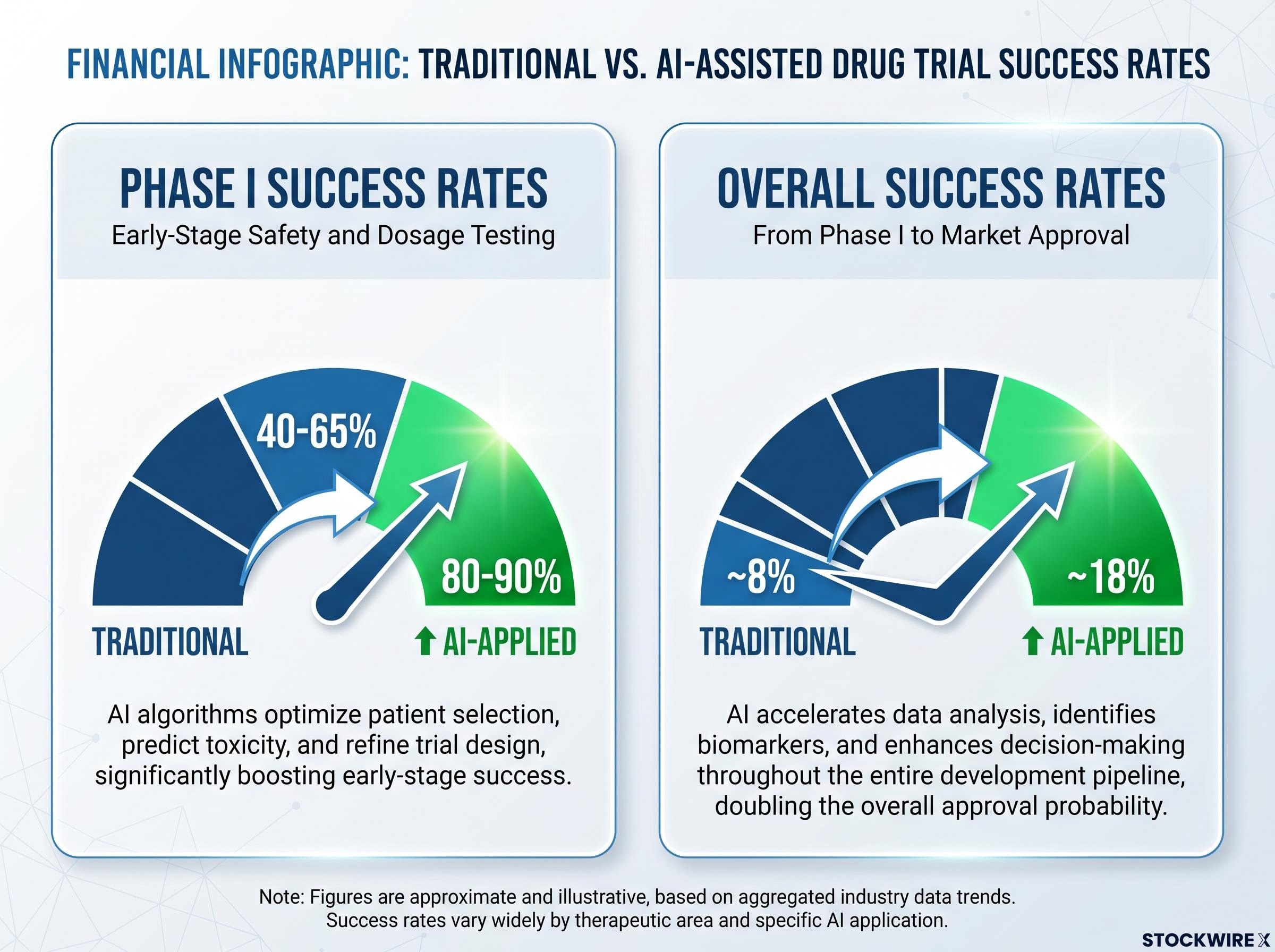
- AI in drug discovery: AI applications are cited for lifting Phase I trial success rates from roughly 40-65% to 80-90%.
- An M&A supercycle: H1 2026 saw US$106 billion deployed across 201 biopharma deals.
Analysts project the GLP-1 market could expand from US$62 billion to US$157 billion by 2035.
The oral GLP-1 competition shaping that projected US$157 billion market is more nuanced than approval headlines suggest: Novo Nordisk holds approximately 90% of current oral GLP-1 prescriptions yet its stock sits roughly 60% below its mid-2024 peak, a valuation tension that illustrates how pipeline leadership and commercial pricing risk can diverge sharply.
Policy is reinforcing the commercial case. The Medicare GLP-1 “Bridge” pilot launched on 1 July 2026, capping copays at US$50 per month, a signal that access, not just approval, is broadening.
The DRUG-versus-CURE gap tells you precisely where the market believes the innovation premium sits. Not in established healthcare broadly, but in the biotech names positioned at the front of the pipeline. For an Australian investor choosing between the two, treating a 2% fund and a 27% fund as interchangeable would miss the entire point.
AI as the infrastructure of next-generation drug development
Here AI is not a theme bolted onto biotech. It is changing the underlying economics of how drugs get made.
Beyond the Phase I improvements, AI is cited for potentially more than doubling overall trial success rates, from roughly 8% to about 18%. When success rates double, the expected value of an entire pipeline re-rates.
The institutional signals confirm this is not speculative positioning. Lilly and NVIDIA announced a US$1 billion, five-year AI Co-Innovation Lab at JPM26, and AstraZeneca acquired Modella AI. Major pharma is putting balance-sheet capital behind the shift, which is a firmer validation than any fund flow.
Gaming ETFs: a smaller story with a different shape
Gaming has rebounded too. The rebound is real, but it is a different animal from cybersecurity or biotech, and the difference matters.
The BetaShares Video Games and Esports ETF (ASX: GAME) rose approximately 6% from late July through early September 2026. Set against its year-to-date return of roughly -19.63% as at early August 2026, that 6% is recovery, not breakout.
Over six months, GAME’s return ranges from -11.90% to +3.36% depending on the cut-off. In other words, the fund is clawing back ground, not compounding on strength.
The structural tailwinds behind the renewed interest are genuine:
- Ongoing migration toward digital game distribution.
- Growth in subscription and in-game monetisation revenue.
- AI adoption in game development, lowering production costs and enabling more personalised player experiences.
- An expanding global audience for gaming content and esports.
The structural case is sound. What it lacks is the guaranteed-demand engine that government budgets give cybersecurity, or the double-catalyst force that AI pipelines and GLP-1s give biotech.
For you, that year-to-date context strips the 6% rebound of any false equivalence with the other two sectors. GAME reads as a speculative recovery story rather than a structural momentum play, and sizing it accordingly is the disciplined response.
What every thematic rally eventually meets: the structural risk layer
The structural case for each sector is real. That does not make the funds safe.
Thematic ETFs share a recurring pattern: they launch and gather assets at narrative peaks, then mean-revert. A 2019-2023 study of thematic baskets found roughly -4% annual alpha and a maximum drawdown of -60%, versus -34% for the S&P 500, leaving investors about 27% behind the broad index. Separate academic research found narrowly focused thematic ETFs underperformed broad benchmarks by around 30% over their first five years.
Three structural risks apply across all three sectors covered here.
Concentration comes first. Thematic ETFs frequently have top-10 holdings making up 40-60% of total assets, against roughly 20-25% in a broad index. That amplifies drawdowns when sentiment turns.
| Risk Dimension | Thematic ETF Profile | Broad Index Equivalent |
|---|---|---|
| Top-10 holdings (% of assets) | 40-60% | ~20-25% |
| Historical max drawdown (2019-2023 basket) | -60% | -34% (S&P 500) |
| Fund survival rate (within 15 years) | ~45% survive | Broad-market persistence far higher |
Then valuation timing. Buying after a 58% or 72% run means buying securities that have already re-rated, precisely the entry point history punishes.
The behaviour gap in thematic funds turns reported performance into a misleading benchmark: the ARK Innovation ETF posted a time-weighted return of approximately 233% while the typical investor experienced roughly negative 35%, a divergence driven by inflows concentrated near peak valuations that the fund’s headline number never reflects.
Survival risk closes the loop. Roughly 55% of thematic funds disappear within 15 years, and only about 9% both survive and outperform global equities. The 2020-2021 boom saw thematic assets surge more than 3.5x to US$200 billion, then tumble around 45% over the next two years, with record closures in 2022.
The recurring expert conclusion: thematic ETFs are best sized as satellite holdings, not core exposures.
That framing is the takeaway to carry. The historical data tells you that even when the structural narrative is correct, entry timing and position sizing determine the outcome. Being right about the theme does not protect you from a 60% drawdown if concentration and valuation risk hit at once.
Biotech-specific risk: when the narrative outruns the pipeline
Biotech carries its own layer on top of the shared risks.
The GLP-1 story faces pricing pressure. Payer and government pushback, particularly through Medicare and Medicaid negotiations, could compress margins even as unit volumes climb. High demand does not guarantee high profitability if the price gets negotiated down.
And AI-improved trial odds still leave substantial failure risk. Biotech valuations can overshoot fundamentals quickly, echoing the genomic and COVID-era boom-bust cycles. This is a calibration point, not a bear case: the structural tailwinds are real, but they do not erase trial-level or pricing-level risk.
Structural conviction versus narrative timing: where that leaves Australian investors
Pull the three analyses together and a clear hierarchy of structural conviction emerges.
- Cybersecurity: highest conviction. Government mandates and AI-driven threat expansion give it the clearest revenue visibility, anchored by a 10-11% spending CAGR through 2029.
- Healthcare and biotech: strong but concentrated. The structural case is powerful in specific sub-segments, with the GLP-1 market projected to reach US$157 billion by 2035, but risk is elevated and the innovation premium sits narrowly.
- Gaming: recovery, not breakout. Real tailwinds, but a return profile that reflects a rebound off a weak year rather than structural momentum.
The risk profile, by contrast, is consistent across all three vehicles. Concentration, valuation timing, and survival risk apply regardless of how strong the underlying theme is.
That consistency points to a single practical response: satellite allocation rather than core portfolio weight. The finding that only about 9% of thematic funds both survive and outperform global equities is not a reason to avoid them entirely. It is the precise reason position sizing and ongoing thesis review matter more than the entry decision alone.
ETF concentration risk is often underestimated by investors holding multiple thematic funds: because cybersecurity, biotech, and gaming ETFs draw from overlapping pools of large-cap tech and growth names, a portfolio spanning all three may hold as few as 30 unique stocks rather than the broad diversification the fund count implies.
The forward variable to watch is whether AI keeps expanding the threat surface and improving drug-discovery economics, which extends the bullish case, or whether current valuations have already priced the structural shift in full.
This article is for informational purposes only and should not be considered financial advice. Investors should conduct their own research and consult with financial professionals before making investment decisions.
Past performance does not guarantee future results, and financial projections are subject to market conditions and various risk factors.