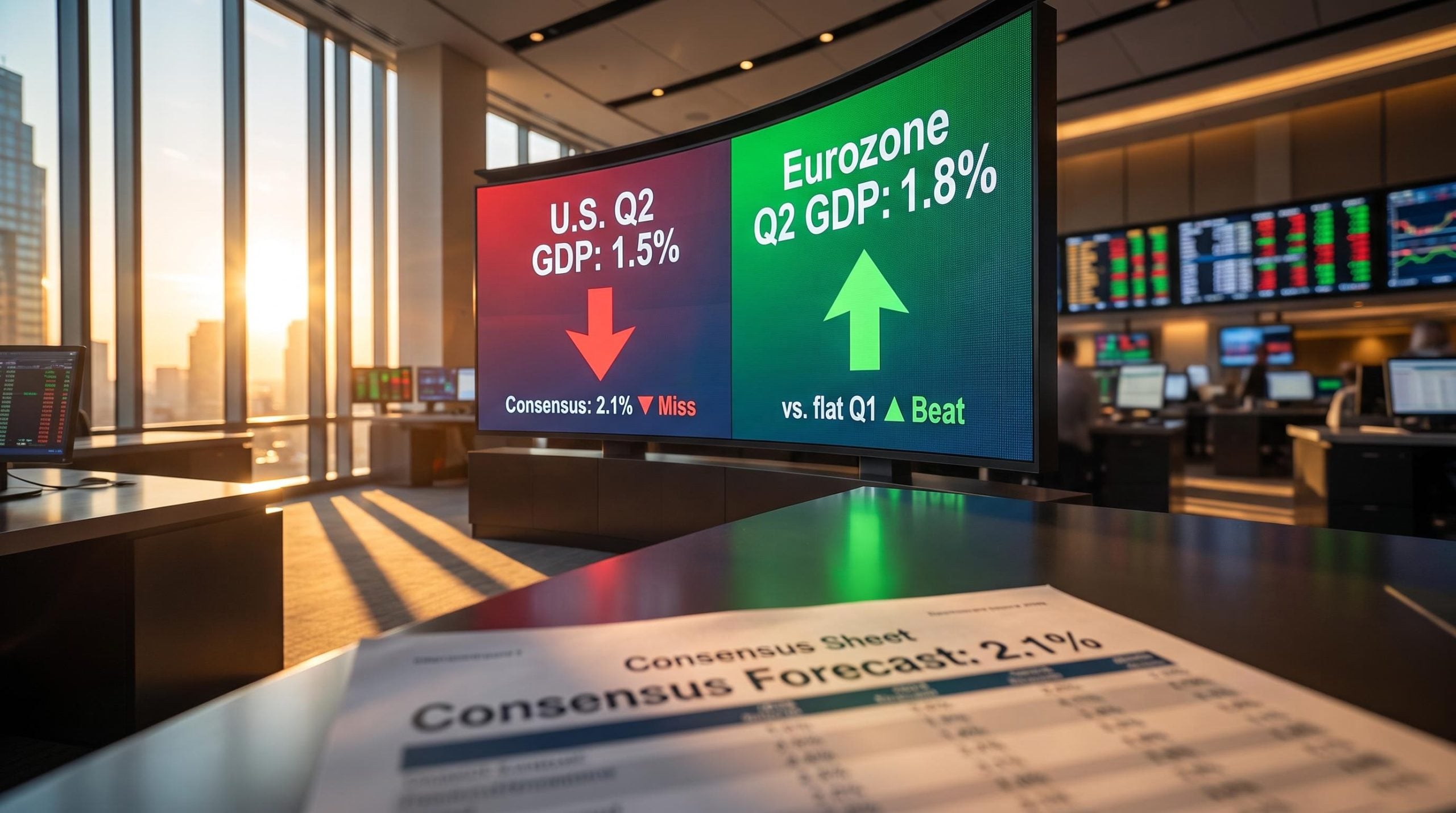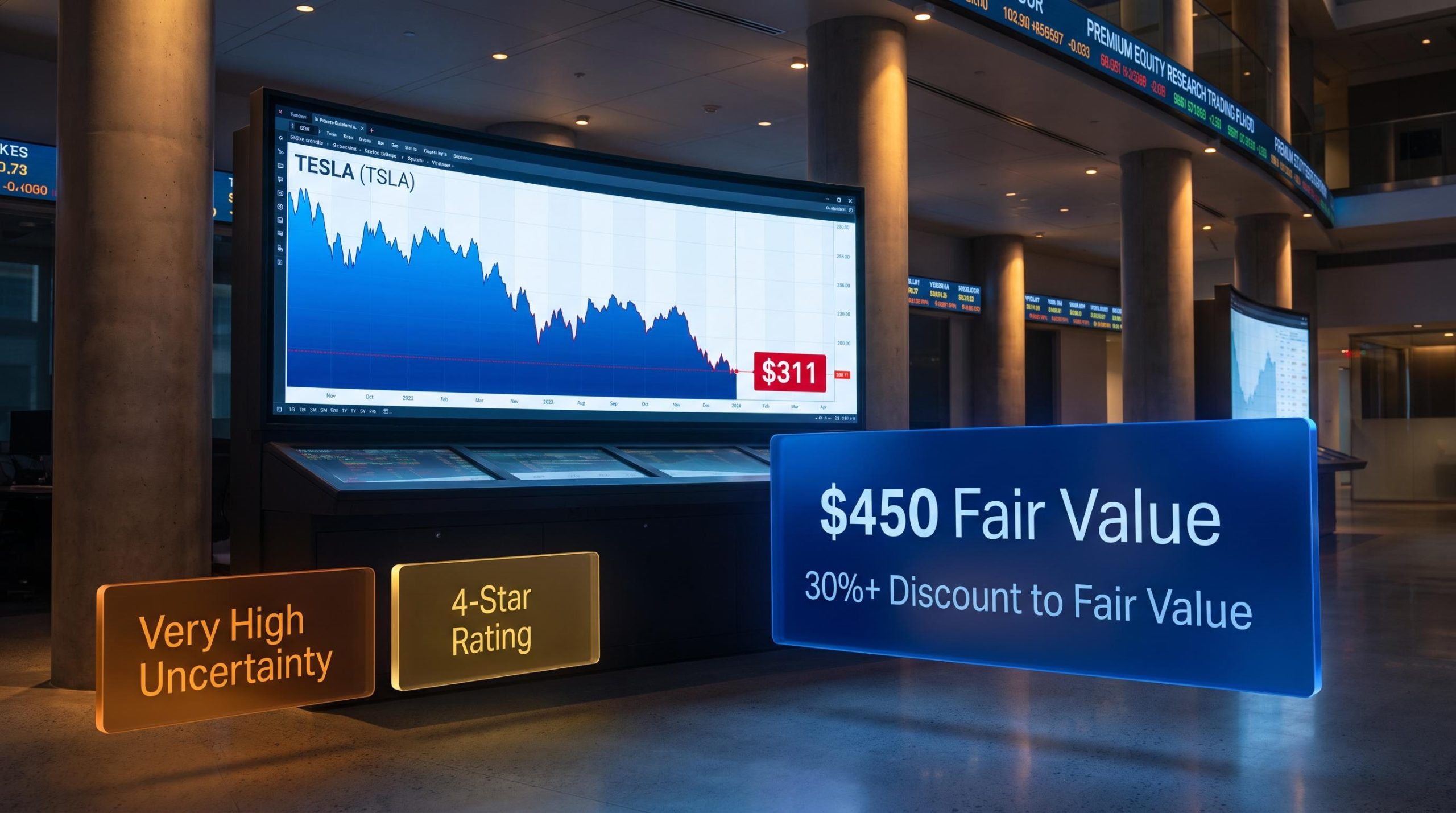
Tesla lost nearly 18% in a single week, and Morningstar’s response was to raise its conviction, not lower it. That divergence between market sentiment and analyst positioning is where this analysis begins.
Morningstar maintains a $450 fair value estimate on TSLA while the stock trades around $311, a gap of more than 30%. The firm simultaneously assigns Tesla its highest uncertainty rating. Understanding what those two signals mean together, and how a hypothetical SpaceX merger complicates the picture further, is not straightforward. The mechanics matter enormously before drawing any conclusions about whether the discount is real.
Here is a framework for reading Morningstar’s Tesla thesis on its own terms, stress-testing the assumptions behind the $450 figure, and understanding what the merger scenario analysis actually tells you about Tesla’s fundamental position versus its market price. By the end, you should be able to answer three questions for yourself: whether to treat the Morningstar discount as actionable, how to weight the uncertainty rating, and what the SpaceX scenario math adds (or does not add) to a standalone investment case.
How Morningstar’s rating system actually signals a buy
Tesla’s move from 3 stars to 4 stars did not happen because Morningstar became more optimistic about the business. It happened because the stock price fell.
Tesla lost 17.81% in a single week, driving the share price to approximately $311 while Morningstar’s fair value estimate held steady at $450.
That is the entire mechanism. Morningstar’s star rating system is price-relative-to-fair-value, meaning a company can cycle through multiple ratings in a short period without any change in underlying business performance. The scale works as follows:
- 4-5 stars: Undervalued. The stock price sits meaningfully below Morningstar’s fair value estimate.
- 3 stars: Fairly valued. The price is close to fair value.
- 1-2 stars: Overvalued. The price exceeds what Morningstar’s model says the company is worth.
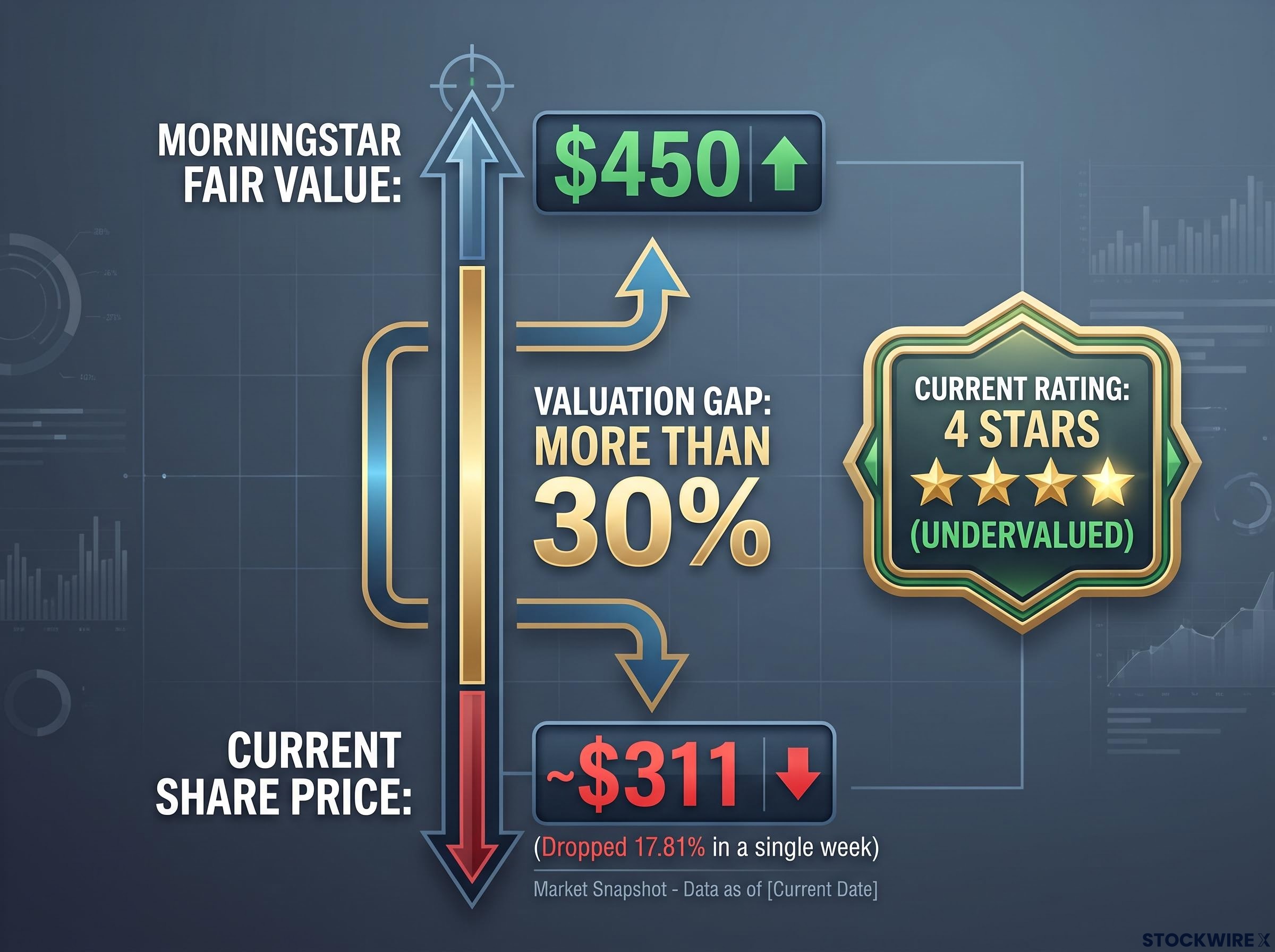
The rating and fair value are issued by Seth Goldstein, CFA, Senior Equity Analyst at Morningstar. What the rating change tells you is something specific about the gap between price and Morningstar’s model. It tells you nothing about whether the model itself is correct. Hold that distinction clearly before evaluating the $450 figure.
When big ASX news breaks, our subscribers know first
What the $450 fair value estimate is actually built on
Morningstar’s $450 fair value is the present value of probability-weighted future free cash flows (the sum of all cash a business is expected to generate, discounted back to today’s dollars based on how likely each scenario is to occur). It is not a 12-month price target, and the distinction matters.
Intrinsic value estimation through discounted cash flow analysis is structurally sensitive to terminal value assumptions, which typically drive 60-80% of a model’s total implied worth, a structural fragility that makes Morningstar’s revision from $195 to $450 less surprising when the underlying technology assumptions shift.
The revision history makes the model’s sensitivity visible:
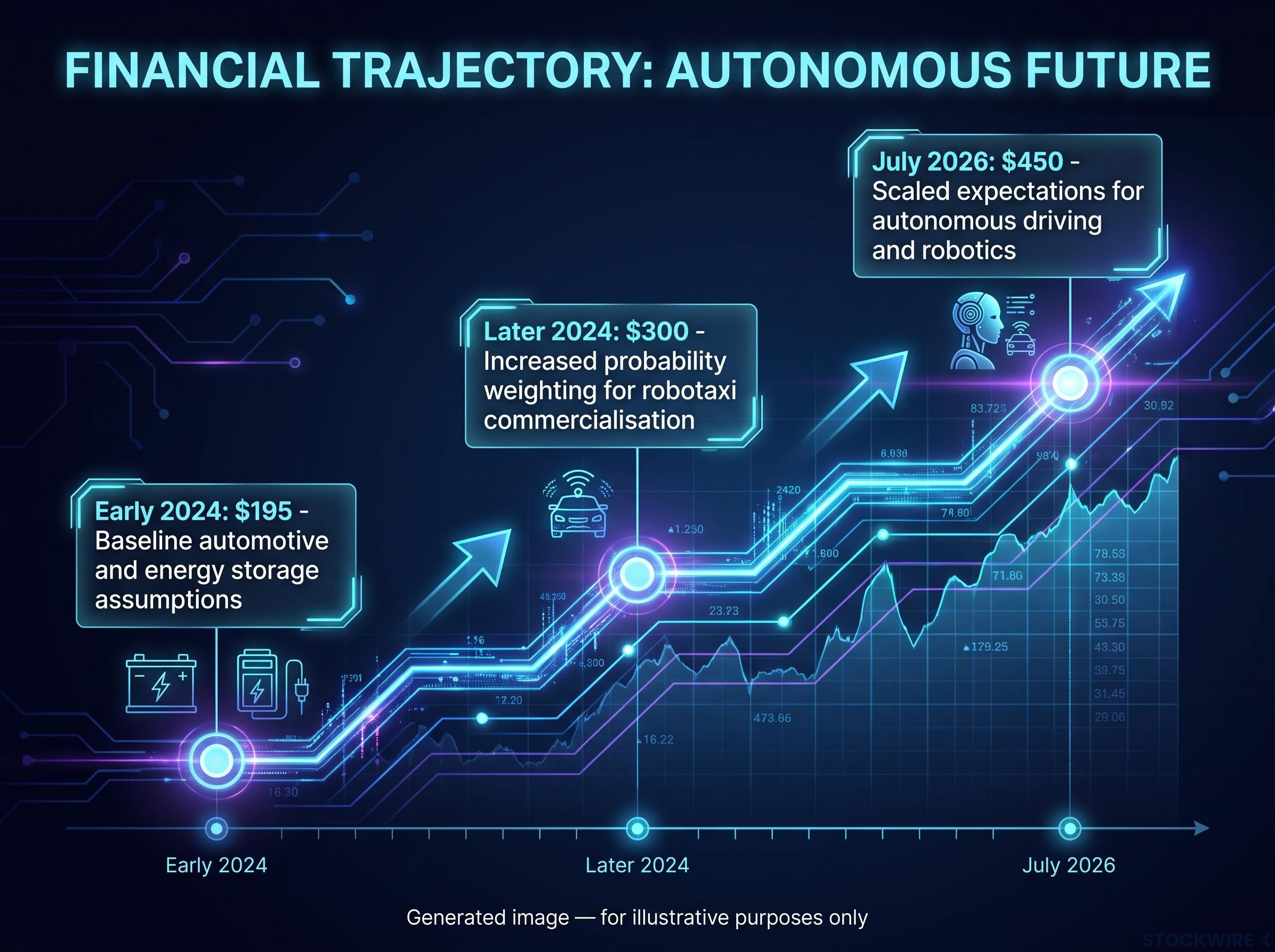
| Approximate Date | Fair Value Estimate | Primary Driver of Revision |
|---|---|---|
| Early 2024 | $195 | Baseline automotive and energy storage assumptions |
| Later 2024 | $300 | Increased probability weighting for robotaxi commercialisation |
| Current (July 2026) | $450 | Scaled expectations for autonomous driving and robotics |
A move from $195 to $450 in roughly 18 months tells you the estimate is highly sensitive to assumptions about technologies that have not yet generated meaningful revenue. This is a model built on optionality, not on earnings that already exist.
The three long-term bets inside Morningstar’s model
Autonomous driving and robotaxis carry the highest weight. The argument is straightforward: if Tesla successfully deploys a robotaxi network, its earnings mix transforms from low-margin vehicle manufacturing to high-margin software and services. This is the single largest contributor to the gap between $195 and $450.
Optimus, Tesla’s humanoid robotics programme, is embedded as a long-dated option. Morningstar’s model does not treat this as a near-term revenue assumption. It is included as a probability-weighted upside scenario that could scale over a multi-year horizon.
Energy storage supports Tesla’s narrow moat and growth profile but functions as a secondary contributor rather than a primary valuation lever. It reinforces the business case without driving the headline fair value figure.
Knowing what is inside the $450 estimate lets you decide whether you share Morningstar’s probability assessments for each business line. That is the only intellectually honest way to evaluate whether the discount is real or a model artefact.
JPMorgan’s Tesla price target of $475, issued in June 2026 after a 228% single-note increase from $145, rests on the same three unproven pillars Morningstar weights: robotaxi services, Optimus robotics, and FSD licensing, yet the firm rated Tesla Neutral rather than Overweight, signalling that risk-reward at current prices is balanced rather than compelling.
How to interpret Morningstar’s uncertainty rating for Tesla
Morningstar assigns Tesla a Very High Uncertainty rating alongside a narrow economic moat designation. The uncertainty rating means Tesla’s future cash flows span a very wide range of plausible outcomes. Three factors drive that range:
- Technology execution risk: Full self-driving, robotaxis, and Optimus all remain in early or pre-commercial stages. None has been proven at the scale Morningstar’s model requires.
- Regulatory exposure: Autonomous vehicle deployment depends on regulatory approvals that vary by jurisdiction and remain incomplete.
- Capital expenditure intensity: Planned capex exceeding $25 billion over the next three years increases the stakes. If returns on that investment disappoint, free cash flow compression follows.
Tesla’s $25 billion capex commitment over the three-year cycle was confirmed on the Q2 2026 earnings call, where management explicitly linked the spending to robotaxi expansion and artificial intelligence infrastructure, underscoring how directly the capital programme is tied to the technology bets inside Morningstar’s model.
Here is the part that most investors skip: under Morningstar’s framework, a Very High Uncertainty stock requires a deeper discount before reaching 4-star territory than a lower-uncertainty company would. The 30%+ gap between price and fair value has already cleared that higher bar.
Morningstar’s equity research methodology codifies how uncertainty ratings interact with the star system, specifying that Very High Uncertainty stocks require a wider price-to-fair-value discount before qualifying as undervalued, which is precisely the dynamic at work in Tesla’s current 4-star designation.
Historical context: Tesla has previously traded 40-60% above Morningstar’s fair value estimate (placing it in 2-star overvalued territory), demonstrating that the stock can swing to extremes in both directions around the model.
A 30% discount to fair value on a Very High Uncertainty stock is not the same proposition as a 30% discount on a stable-cash-flow business. If you accept this trade-off, you are being compensated for the possibility that the robotaxi and robotics scenarios never materialise at scale. Skipping the uncertainty rating and focusing only on the star count means accepting risks you have not fully priced.
The SpaceX merger scenario and what “merger math” actually reveals
Morningstar’s merger analysis is not a prediction. No Tesla-SpaceX combination has been formally announced as of 31 July 2026, and Morningstar’s $450 fair value is a standalone Tesla estimate. The merger math serves a different purpose: it reveals how much stronger Tesla’s fundamental position is than its market capitalisation currently implies.
Morningstar estimates that Tesla shareholders should hold 50% to 68% of any combined Tesla-SpaceX entity, based on fundamentals-based valuation rather than market capitalisation comparison.
That range is attributed to Seth Goldstein, CFA, Senior Equity Analyst at Morningstar. The logic behind it is specific:
| Company | Market Cap Status | Revenue and Earnings Profile | Morningstar Ownership Implication |
|---|---|---|---|
| Tesla | Public; valued by market capitalisation at roughly a 20% haircut relative to SpaceX | Leads on revenue, operating earnings, and free cash flow generation | 50-68% of combined entity |
| SpaceX | Private; carries a valuation premium despite its earnings stage | Capital-intensive growth phase; current earnings trail Tesla’s | Residual stake (32-50%) |
The tension is clear. On a market capitalisation basis, SpaceX carries a premium over Tesla, yet Tesla outpaces it on revenue, operating earnings, and free cash flow by Morningstar’s reckoning. Morningstar treats that gap as a market pricing anomaly rather than a fair reflection of relative value. Any deal structured around market caps alone would dilute Tesla shareholders below what Morningstar considers their fair economic share.
The relevance to a standalone investor is not about the merger itself. It is about what the analysis implies for Tesla’s intrinsic position relative to its current price.
For investors wanting to understand the structural mechanics behind the merger scenario, our dedicated guide to the SpaceX IPO’s merger implications covers the CFIUS obstacles, consolidation precedents from SolarCity and xAI, and the equity-issuance language that makes a stock-for-stock deal structurally feasible for the first time.
Why Morningstar’s Tesla thesis is a multi-year proposition, not a trade
Morningstar’s autonomous driving and robotics thesis is explicitly not a 12-month story. The upside case depends on business lines that are still in early commercial or pre-commercial stages, and the $25 billion-plus capex commitment over the next three years signals how far Tesla is from harvesting that upside.
The revision history from $195 to $450 over roughly 18 months demonstrates that the model will continue to change. New evidence on autonomous driving regulation, Optimus production, and energy storage adoption will push the estimate in either direction.
Morningstar itself has framed the recent selloff as a “good opportunity for long-term investors,” not a short-term trading signal. If you are evaluating Tesla on a 12-month horizon, Morningstar’s analysis is the wrong tool. The fair value estimate is a 5-plus-year instrument.
Conditions that would move the model higher or lower
What would support upward revision:
- Regulatory clearance for robotaxi deployment at scale in major markets
- Early Optimus commercial contracts demonstrating demand validation
- Continued energy storage margin expansion above current levels
- Capital expenditure generating visible returns on invested capital
What would pressure the estimate downward:
- Full self-driving regulatory setbacks or deployment delays
- Intensified EV competition compressing vehicle margins further
- Capital expenditure overruns reducing free cash flow below model assumptions
- Failure of Optimus to reach commercial viability within Morningstar’s projected timeline
Mismatching the analyst’s time horizon with your own is one of the most common ways to use high-quality research incorrectly.
For investors evaluating whether their own horizon matches a five-plus-year thesis, our full explainer on individual investor time horizon advantages covers the structural freedom from redemption pressure and benchmark constraints that makes holding through multi-year theses genuinely achievable for self-directed investors in ways it is not for most institutional managers.
What the discount-to-fair-value question demands from any investor
The question “is Tesla undervalued?” has a technically correct answer inside Morningstar’s framework: yes, materially, with the stock trading at a 30%+ discount to the $450 fair value at approximately $311 per share.
The more useful answer for any individual investor is conditional. Accepting that discount as genuine upside requires independently assigning a meaningful probability to autonomous driving and robotics contributing materially to Tesla earnings within a multi-year horizon.
Morningstar has been wrong on Tesla before. The revision history, from $195 to $300 to $450, is evidence of the model’s sensitivity rather than its precision. The $450 figure is a directional signal, not a guaranteed destination.
- The thesis aligns with investors who are: patient, risk-tolerant, operating on a multi-year horizon, and holding genuine conviction that autonomous driving and robotics will convert to earnings at scale.
- The uncertainty rating is disqualifying for investors who: require a shorter horizon, have low tolerance for volatility, or are sceptical that unproven technology revenue will materialise.
Tesla’s narrow economic moat is the floor-level competitive advantage Morningstar attributes to the business independent of the technology optionality. It provides some downside support, but the gap between “narrow moat” and $450 is almost entirely filled by long-dated technology bets.
Investors who can separate what the Morningstar model says from whether they personally believe its assumptions are better positioned to make an honest decision than those who treat a 4-star rating as a buy signal without examining the underlying thesis.
This article is for informational purposes only and should not be considered financial advice. Investors should conduct their own research and consult with financial professionals before making investment decisions.
Past performance does not guarantee future results. Financial projections are subject to market conditions and various risk factors. Morningstar’s fair value estimates are subject to revision as new information becomes available.
Acting on a 30% discount when the model itself may still be moving
The Morningstar thesis will be tested by specific, observable events over the next several years. Tracking those events, rather than the share price alone, is the honest signal of whether the $450 estimate is converging with or diverging from reality.
- Capital expenditure returns (nearest term): the $25 billion-plus three-year capex cycle is the first observable test. Are returns on this investment materialising in free cash flow?
- Robotaxi regulatory approvals (medium term): scaled deployment in major jurisdictions would validate the highest-weight assumption in the model.
- Optimus commercial contracts (longer term): early commercial demand would confirm the robotics option has real value, not just optionality.
- Energy storage margin trajectory (ongoing): sustained margin improvement supports the moat thesis and the secondary valuation layer.
Morningstar’s standalone fair value: $450 per share. This is the operative baseline, unaffected by unannounced merger speculation. The 50-68% ownership range in a hypothetical SpaceX combination is relevant context if a deal is ever formally proposed, but it does not alter the standalone case.
For a reader holding or considering TSLA, the most useful action is not to act on the current star rating but to build a personal checklist of the technology and regulatory milestones that would confirm or invalidate the thesis, and revisit that checklist as evidence arrives. The 30% discount is a starting condition, not a guarantee. The thesis is confirmed or denied by what happens to autonomous driving, robotics, and capital allocation over the next three to five years.