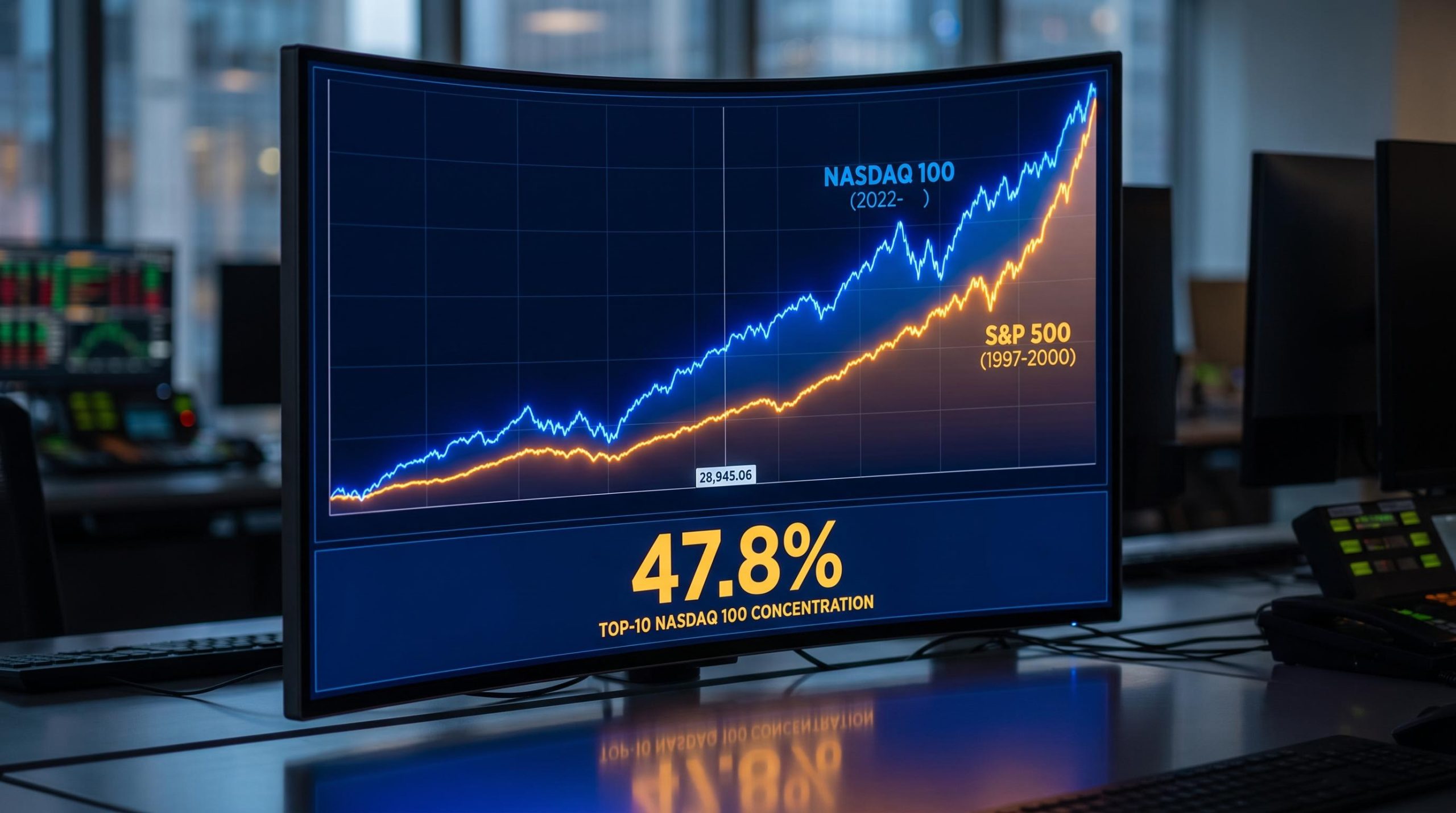
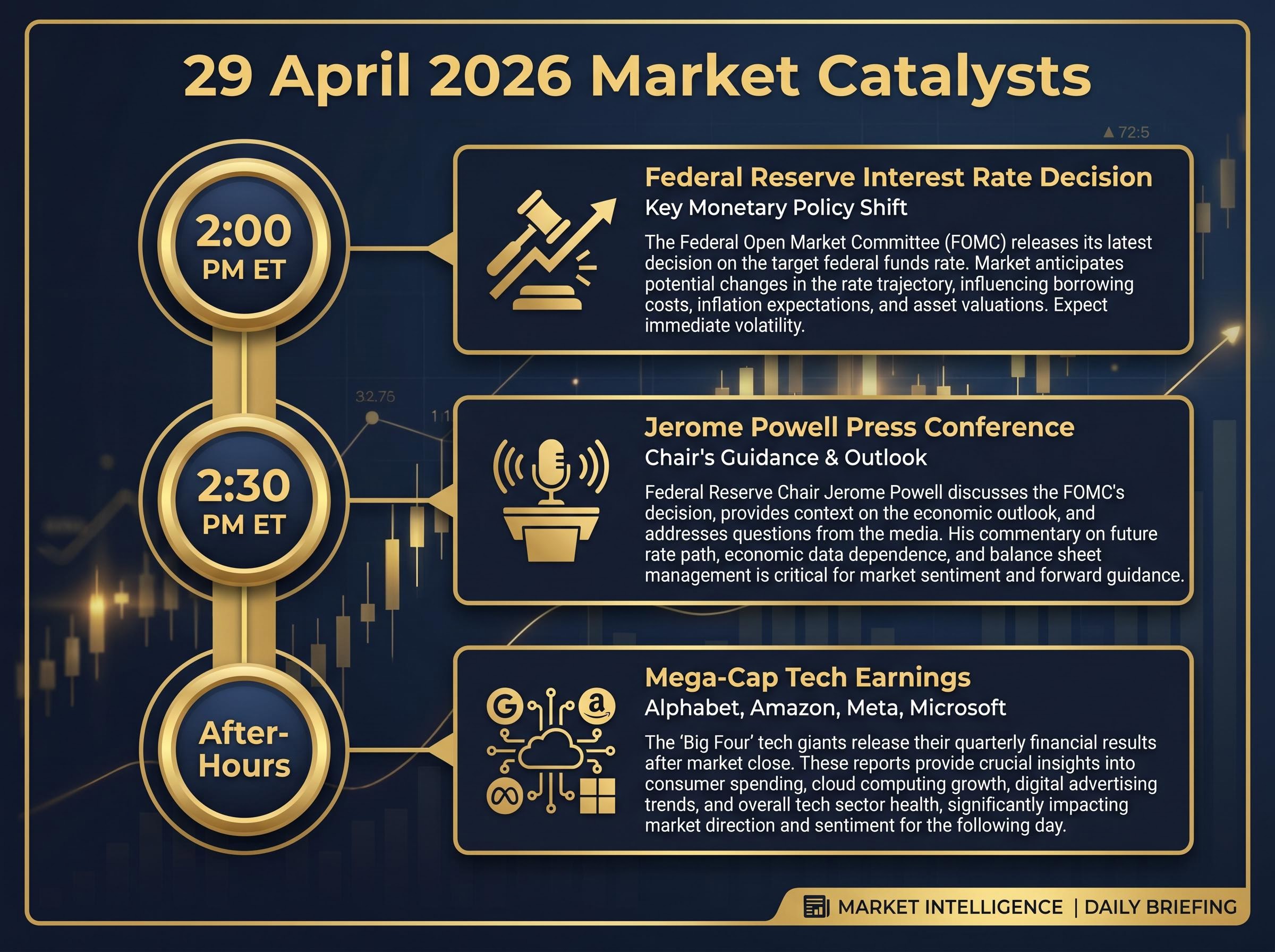
The S&P 500 and Nasdaq traded lower in early pre-market action on 29 April 2026, as investors braced for a collision of macroeconomic policy and mega-cap corporate disclosures. For those tracking stock market news, today represents a rare convergence of market-defining catalysts. A 2:00 PM ET Federal Reserve interest rate decision shares the spotlight with after-hours earnings from the world’s largest technology companies.
This session provides a complete roadmap for assessing today’s specific market triggers. The trajectory of equities will depend entirely on Jerome Powell’s inflation commentary this afternoon and the artificial intelligence infrastructure spending metrics that dictate tomorrow’s opening bell.
Geopolitics Force a Hawkish Pause for the Federal Reserve
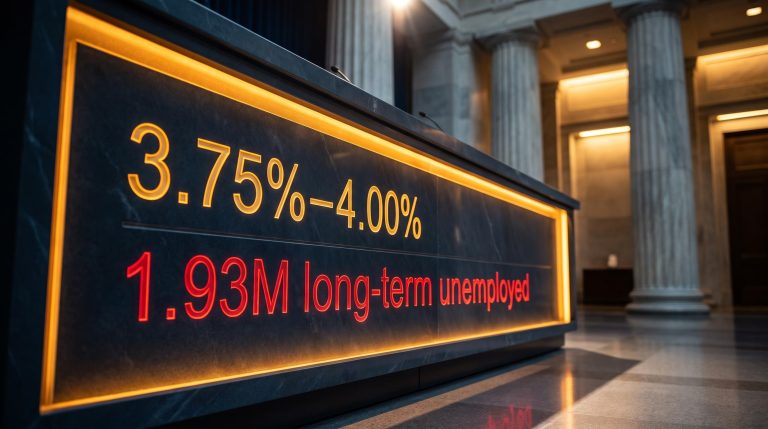
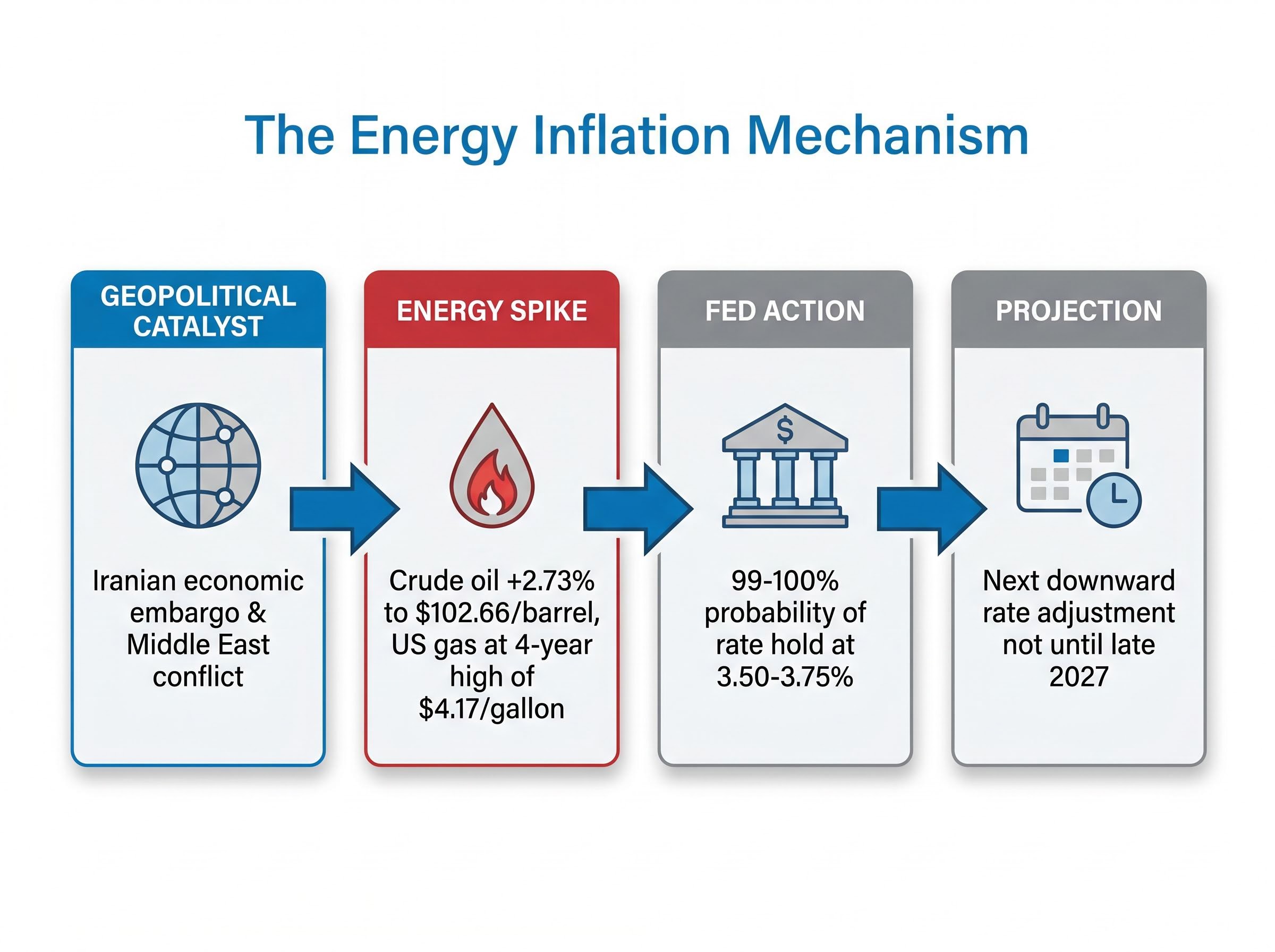
Central bank officials are nearly certain to hold interest rates steady in the face of new inflationary threats. The Trump administration’s Iranian economic embargo and the broader Middle East conflict act as the primary catalysts keeping borrowing costs elevated. According to CME FedWatch Tool data, there is a 99 to 100 percent probability of a rate hold at 3.50-3.75 percent.
The CME Group derivatives exchange data actively reflects this macroeconomic tension, tracking overnight lending futures to quantify exact market expectations ahead of scheduled Federal Open Market Committee announcements.
This geopolitical pressure translates directly to consumer costs, with crude oil prices rising 2.73 percent to $102.66 per barrel. Consequently, the average US gasoline price has hit a four-year high of $4.17 per gallon. These metrics help investors understand exactly why rate cuts remain off the table for the immediate future.
Jerome Powell is expected to deliver a hawkish tone during his scheduled 2:30 PM ET press conference. Market participants are watching for three specific developments during the briefing:
Powell’s assessment of two-sided inflation risks and the potential necessity for future rate hikes. Commentary regarding his scheduled 15 May 2026 departure from the central bank. * Remarks addressing the confirmation process for his presumed successor, Kevin Warsh.
When big ASX news breaks, our subscribers know first
How Global Conflicts Dictate Domestic Monetary Policy
The immediate news cycle often obscures the direct cause and effect between Middle Eastern border conflicts and central bank paralysis. When geopolitical shocks disrupt international supply chains, the cost of raw materials and transport inevitably surges. These rising energy costs then filter down to the consumer level, systematically decreasing discretionary household income.
The Energy Inflation Mechanism
The Federal Reserve cannot responsibly stimulate the economy with rate cuts when exogenous geopolitical shocks are driving up the cost of living. Lowering borrowing costs during a supply-driven inflation spike risks accelerating price increases without actually solving the underlying supply chain constraints.
This environment creates an extended “wait and see” mandate for policymakers as they monitor the ongoing Iran war. Reportedly, financial market indicators are now projecting that the next downward rate adjustment will not occur until late 2027. This macroeconomic framework explains why international borders directly impact local equity portfolios and valuations.
For investors trying to navigate this extended pause in monetary easing, our detailed coverage of geopolitics and Fed interest rates examines the specific supply chain metrics that officials monitor before considering future downward adjustments.
Mega-Cap Tech Prepares to Reveal Artificial Intelligence Spending Realities
As macroeconomic fears dominate the afternoon, microeconomic realities will seize control after the closing bell. Four mega-cap technology companies report earnings tonight, bringing a gravitational pull that cannot be ignored. Reportedly, Alphabet, Amazon, Meta, and Microsoft collectively represent 18.3 percent of the entire index.
The central tension for these disclosures lies in the lack of visibility into artificial intelligence infrastructure capital expenditures. While revenue expectations remain clear, market anxieties persist regarding the massive costs of AI investments, particularly following recent internal performance misses by prominent AI startups. These metrics will determine whether the multi-trillion-dollar AI rally has the fundamental backing to continue through the summer.
The sheer scale of AI infrastructure investment has fundamentally changed valuation models for major technology companies, requiring an unprecedented allocation of operating cash flow toward physical data centres and computing hardware.
| Company | Expected EPS | Projected Revenue | YoY Revenue Growth |
|---|---|---|---|
| Alphabet | $2.62 | $92.22 billion | 20.6% |
| Amazon | $1.62 | $177.85 billion | 14.3% |
| Meta | $6.62 | $55.0 billion | N/A (Guidance Midpoint) |
| Microsoft | $4.06 | $81.43 billion | 16.2% |
Consumer Spending Fractures as Digital Payments Outpace Tourism
Beyond the technology sector and the Federal Reserve, a fractured consumer economy is emerging where digital transactions thrive while discretionary travel stalls. Payment processors are reporting strong earnings, contrasting sharply with the declining outlooks of online accommodation platforms. Inflation and international conflicts are simultaneously suppressing travel demand while driving up everyday transaction volumes.
The resulting geopolitical stock market impact creates a clear bifurcation, as energy-intensive industries suffer severe margin compression while defensive consumer staples absorb the excess capital flow.
Visa shares jumped 5 percent following a Q2 earnings beat, delivering an EPS of $3.31 and $11.23 billion in revenue, representing a 17 percent increase. Reportedly, the company recorded a 9 percent increase in transaction volumes, alongside American Express logging an 11 percent expansion. Conversely, first-quarter accommodation reservations declined due to overseas hostilities.
Sector Divergence Commentary The consumer economy has bifurcated; core electronic payments are expanding through inflation, while discretionary travel sentiment deteriorates under geopolitical pressure.
This divergence suggests discount merchandise retailers like Costco and TJX could capture shifting consumer spending habits. These sector rotation opportunities offer defensive positioning amid ongoing instability.
Alternative Energy Emerges as the Quiet Artificial Intelligence Beneficiary
Secondary sectors are successfully capitalising on the primary technology narrative, providing actionable investment themes outside the crowded mega-cap trade. Bloom Energy provides a concrete proxy for the physical infrastructure demands of the digital economy. The company’s post-market performance highlights how the artificial intelligence boom requires massive real-world power generation.
The Infrastructure Investment Case
Reportedly, first-quarter sales for Bloom Energy climbed 130 percent to $751.1 million, shattering Wall Street estimates of $540 million. Management subsequently raised 2026 revenue projections. Reportedly, the company’s collaboration with Oracle stands as tangible proof of the energy requirements supporting data centre expansion.
The official first quarter financial results specifically outline plans to deploy up to 2.8 gigawatts of fuel cell capacity, highlighting the sheer scale of off-grid power generation required by modern computing facilities.
This localised success connects directly back to the broader theme of technological capital expenditure. An earnings-focused investment model tracking these infrastructure beneficiaries has outperformed the benchmark.
Assessing the Aftermath of Wall Street’s Heaviest Trading Session
Market momentum over the next several weeks will be defined entirely by the data revealed between 2:00 PM ET and the close of after-hours trading today. Investors face the dual threat of the Federal Reserve’s inflation fight and the technology sector’s massive capital spending requirements. The resilience of the 3.50-3.75 percent interest rate threshold will heavily influence tomorrow’s opening bell.
If the central bank signals that rates will remain elevated through 2027, the fundamental strength of mega-cap earnings becomes even more critical to sustain index valuations.
This article is for informational purposes only and should not be considered financial advice. Investors should conduct their own research and consult with financial professionals before making investment decisions. Past performance does not guarantee future results, and financial projections are subject to market conditions and various risk factors.