Australia’s headline inflation is finally falling, but the measure the Reserve Bank of Australia actually uses to set the cash rate has not moved in two months, and the next decision is three days away.
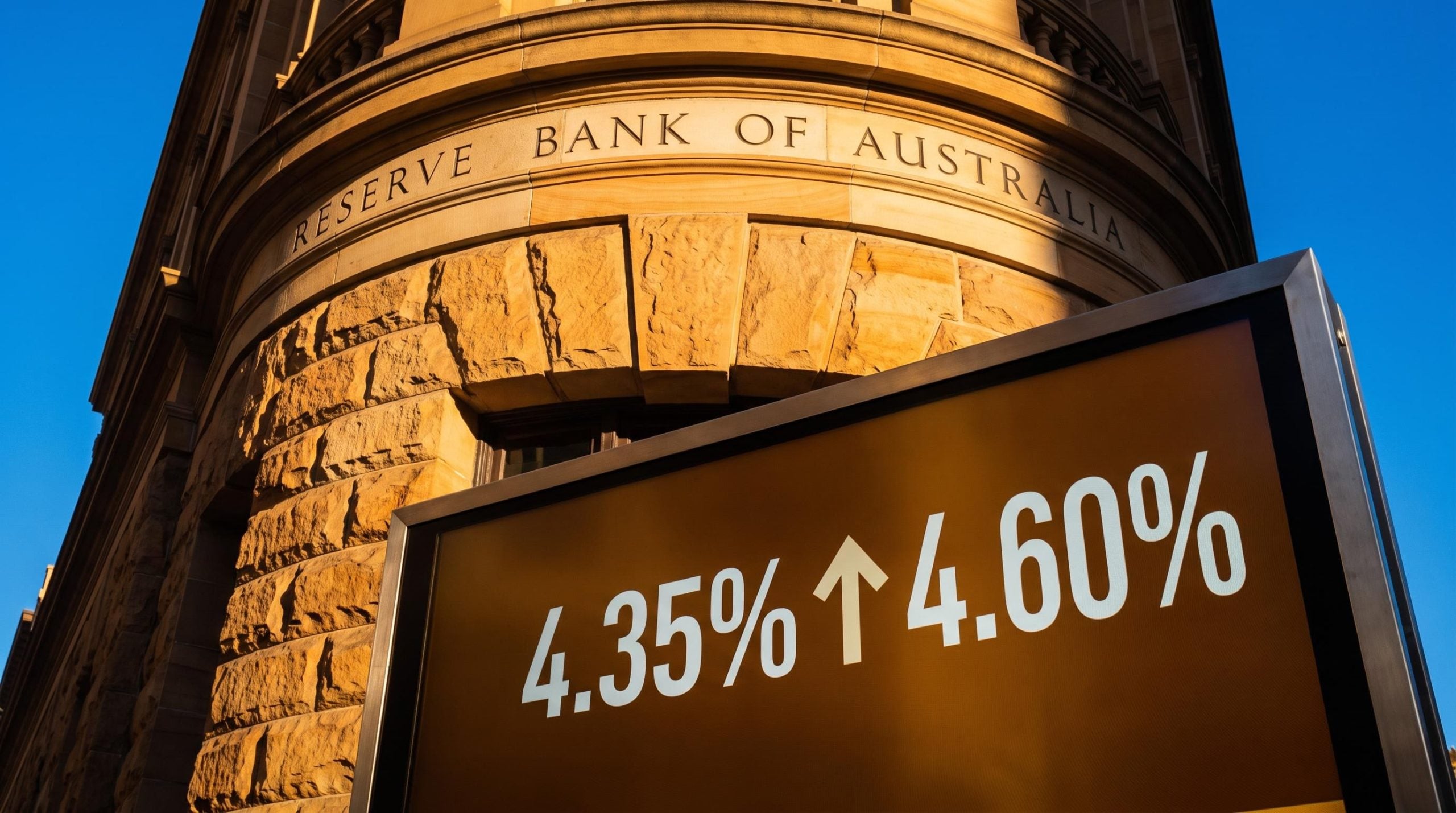
That gap sits at the centre of what could be the most consequential RBA rate hike decision of the year. The cash rate has held at 4.35% through two consecutive meetings, in June and August 2026, with the next call due on 29 September 2026. Nearly all economists surveyed by InvestingLive on 24 September 2026 expect a 25bp lift to 4.60%, though that figure comes from a single survey source that has not been independently confirmed.
This meeting feels different from the previous two for one reason: the data arriving since August has not settled the core inflation question. Here is what the numbers actually show about where inflation is and is not responding, why that distinction matters for the Board’s call, and what either outcome would mean for Australian dollar assets heading into Q4.
What the inflation numbers actually show, and where they diverge
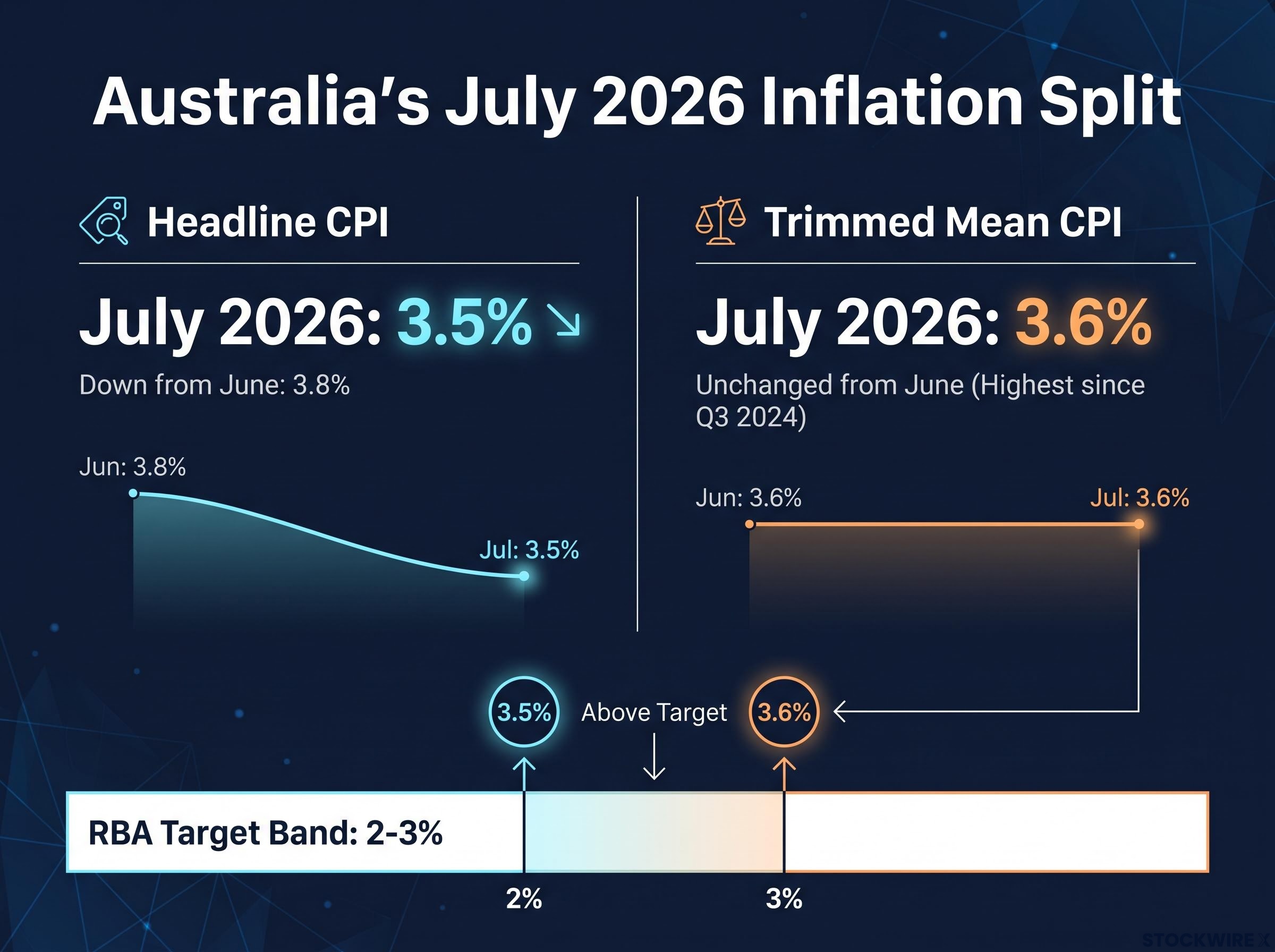
Start with the reading that made headlines. In the year to July 2026, the Australian Bureau of Statistics reported headline consumer price inflation (CPI) at 3.5%, down from 3.8% in June.
On the surface, that looks like progress. Prices are still rising faster than the Reserve Bank wants, but the pace is easing.
Then look one layer deeper, and the story changes. The monthly CPI figure rose 1.0% in July, the fastest monthly pace in four months and above the 0.8% the market had penned in. Disinflation at the annual level, acceleration at the monthly level: the two do not sit comfortably together.
The reading that matters most for policy tells the harder story. Trimmed mean CPI, the RBA’s preferred core measure, held at 3.6% year-on-year in July, unchanged from June and the highest since Q3 2024. It also landed slightly above the 3.5% consensus.
The ABS July 2026 CPI release confirmed headline annual inflation at 3.5%, trimmed mean unchanged at 3.6%, and a monthly rise of 1.0%, the combination of annual deceleration alongside monthly acceleration that sits at the centre of the Board’s current dilemma.
Trimmed mean is the number the Board watches because it strips out the most volatile price movements at either end, the goods that spike or collapse for reasons monetary policy cannot touch. What is left reflects domestically driven price pressure more cleanly than the headline figure, which is exactly why the Bank leans on it.
Both readings remain above the RBA’s 2-3% target band. But the split between them is the point. The headline improvement is real and it is also misleading as a guide to what the Board will do, because the measure it actually targets has not budged.
The June 2026 trimmed mean reading came in at 3.6%, slightly below the RBA’s own May forecast of 3.8%, providing modest comfort to markets while still sitting well above the 2-3% target band and well short of the sustained improvement the Board has said it needs before reassessing policy.
Where is the disinflation happening? Largely in goods, where supply chains have normalised and price growth has cooled. Where is it not happening? In services and wage-sensitive categories, where a tight labour market keeps feeding pressure into the very components trimmed mean captures.
For anyone reading RBA communications, the takeaway is direct: track trimmed mean, not headline CPI. The persistence of core inflation at 3.6% is the single variable keeping a September hike credible rather than surprising, even after two holds.
The August projection and what it would signal
There is one more piece of data still to land before the meeting. ING economists Deepali Bhargava and Lynn Song, writing via FXStreet, project that August CPI will accelerate to 4.1% year-on-year, driven by higher diesel and food costs alongside stubborn underlying pressure.
That is a forecast, not a released figure, and it sits well above the July headline of 3.5%, so treat it with appropriate caution. But if August lands anywhere near that projection, it would harden the case for a hike considerably and leave the Board little room to hold a third time without appearing to ignore its own core measure.
When big ASX news breaks, our subscribers know first
How the RBA reads growth and the labour market alongside inflation
A rate hike into a weakening economy is a different decision from a rate hike into a resilient one. The Reserve Bank is currently facing the latter, and that changes the risk calculus.
Australia’s Q2 2026 GDP beat forecasts, according to ING economists cited by FXStreet, though the specific figure was not confirmed in the available research. The read for the Board is straightforward: prior hikes have not slowed the economy to a degree that would make additional tightening reckless.
That growth resilience connects directly back to the inflation problem. A tight labour market keeps wage-sensitive price categories elevated, and those categories feed the services inflation that keeps trimmed mean stuck at 3.6%. Strong employment and sticky core inflation are two sides of the same coin.
The Board’s own language captures how it sees current settings.
“Somewhat restrictive” was how the RBA described monetary policy in its August 2026 statement. The phrase is doing more work than it appears. It signals the Board believes current settings are already pressing down on demand, that policy is working rather than sitting at neutral.
Read alongside the data, three conditions underpin the case for another move:
- Trimmed mean CPI stuck at 3.6%, unchanged and above consensus
- A Q2 2026 GDP figure that beat expectations
- A labour market tight enough to keep services inflation elevated
The two holds in June and August, both unanimous, are better understood as deliberate observation periods than as hesitation. The Board explicitly chose to wait and assess the lagged effects of prior hikes, and in June it cited an oil supply disruption as a complicating external factor that domestic policy could not fully address.
The August statement framing set the baseline the Board is now accountable to: a tightening bias preserved through language on residual hike risk, which the September decision either validates by acting or undermines by holding a third consecutive time against sticky core inflation.
The overtightening risk is genuine, and the Bank has been open about it. Push too hard before earlier hikes fully filter through, and the damage lands on growth and jobs.
But here is what the GDP beat changes. A strong economy running alongside sticky core inflation is precisely the combination that gives the Board both the empirical and the political cover to move. A third consecutive hold becomes harder to justify if trimmed mean will not improve on its own.
Why central bank moves in Washington and Tokyo matter for the RBA’s decision
The Reserve Bank is not making this decision in a vacuum. In the week before the September meeting, both the US Federal Reserve and the Bank of Japan (BoJ) raised their benchmark rates by 25bp, each citing inflation risks and each signalling that future moves would depend on the data.
That matters because of how currencies respond to rate differentials. When peer central banks tighten and the RBA holds, the interest rate gap narrows or reverses in favour of other currencies, and capital tends to follow the higher yield.
Rate differential mechanics explain why the RBA’s hold option carries an asymmetric cost in late 2026: the AUD’s structural support depends on maintaining a yield premium over peer central banks, and that premium narrows each time the Fed or BoJ moves without a matching response from the Board.
The consequence shows up in the exchange rate. If the RBA holds while the Fed and BoJ move, the Australian dollar faces downward pressure as yield differentials shift against it.
And a weaker Australian dollar is not just a market-price story. It raises the cost of imports priced in US dollars, and those higher import costs feed straight back into domestic CPI, adding to an already-elevated trimmed mean. This is the imported inflation feedback loop, and it is the reason a hold could actively worsen the problem the Bank is trying to solve.
The pressure is already visible in the market.
AUD/USD was approaching the 0.7000 level at the time of the source reporting, its weakest since early August. A sustained break below that threshold would signal the market losing confidence in the RBA’s willingness to defend yield competitiveness.
Here is how the three central banks compare heading into the decision.
| Institution | Most recent move | Stated stance |
|---|---|---|
| US Federal Reserve | +25bp (week prior) | Data-dependent, citing inflation risks |
| Bank of Japan | +25bp (week prior) | Data-dependent, citing inflation risks |
| Reserve Bank of Australia | Hold at 4.35% (Aug 2026) | “Somewhat restrictive”, assessing lagged effects |
This gives the Board a secondary argument for hiking that has nothing to do with domestic demand. Matching peer central banks on yield helps limit AUD depreciation, which in turn limits the imported inflation channel.
For anyone holding Australian assets or carrying currency exposure, the read is this: the global central bank environment in late September 2026 makes the RBA’s hold option more expensive than it was earlier in the year. Standing still now carries a cost that standing still in June did not.
What happens to Australian inflation, growth, and the AUD if the RBA hikes to 4.60%
The near-consensus expectation is a hike, but the more useful analysis is what each path would and would not resolve. Consider the two scenarios in turn.
- The RBA hikes to 4.60% with a pause signal. This would most likely be framed as fine-tuning to contain sticky core inflation rather than the launch of a fresh tightening cycle, given that policy is already described as “somewhat restrictive”. The market read: a possible terminal rate. The key risk: if investors treat it as one-and-done, the currency support from the move fades quickly, capping any sustained AUD upside.
- The RBA holds at 4.35% against peer tightening. A third consecutive hold, set against Fed and BoJ hikes and a trimmed mean that has not improved, risks being read as complacency. The market read: reduced confidence in the RBA’s inflation resolve. The key risk: accelerated AUD selling and a deeper slide toward and through 0.7000, amplifying imported inflation.
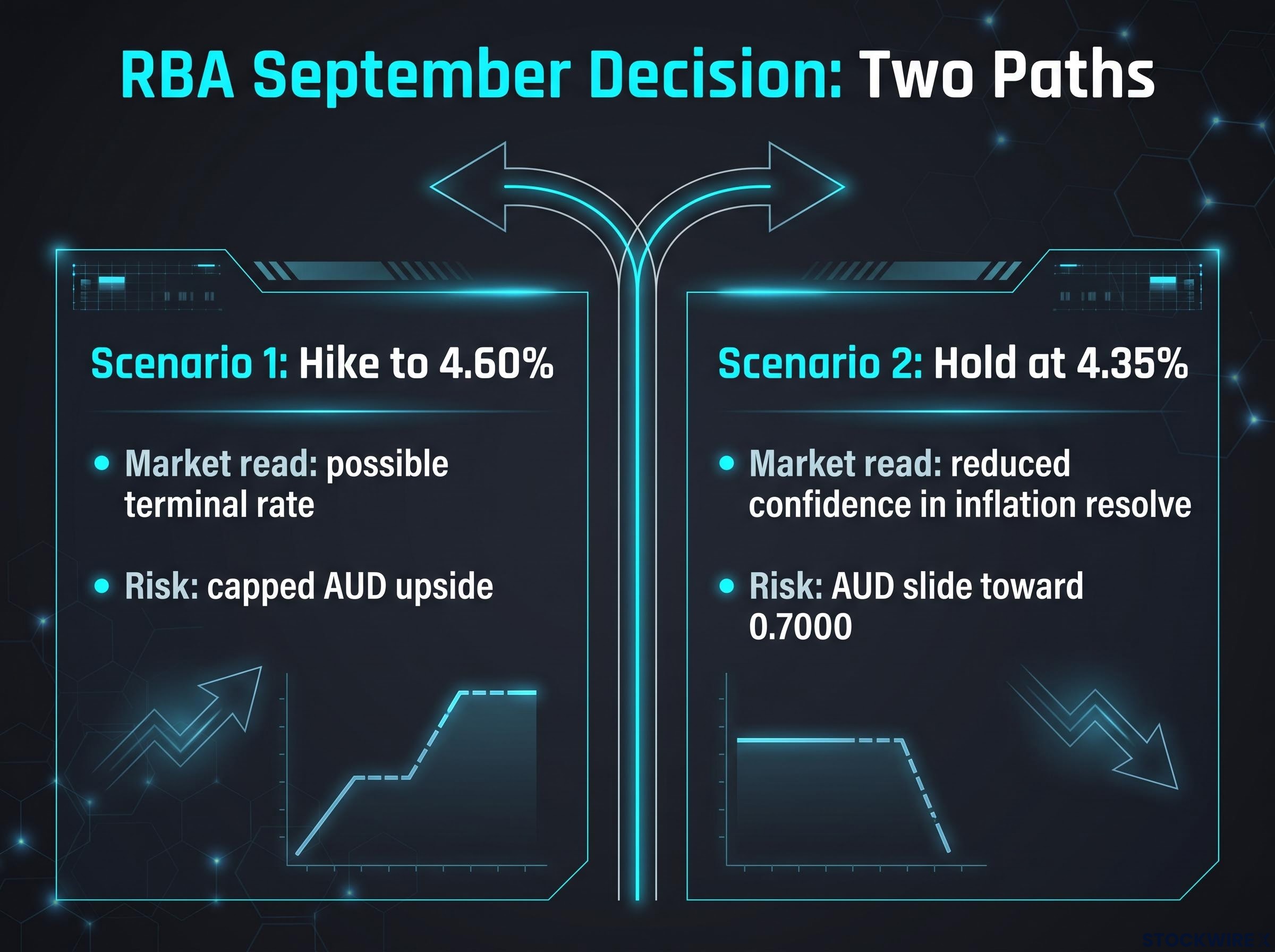
Be clear about the limits of the hike, though. Lifting to 4.60% would signal the Board’s continued vigilance, but it would not by itself close the gap between trimmed mean at 3.6% and the top of the 2-3% target band. That is still 60bp of daylight above the ceiling that a single 25bp move does not erase.
The expectation itself rests on the InvestingLive survey of 24 September 2026, in which nearly all economists forecast the 25bp hike. That is a single survey source, unverified independently, so weight it accordingly rather than treating it as settled.
The language of the statement matters as much as the number
Central bank decisions come in two parts: the rate move and the words that accompany it. The rate is the headline, but the forward guidance is what tells markets whether the cycle is finished.
Watch the framing closely. Language echoing the June and August statements, an emphasis on assessing lagged effects and holding to observe, would signal a pause and cap the AUD’s response. Language stressing that inflation risks remain weighted to the upside, which ING expects the Board to convey, would keep the door open to further moves and give the currency more durable support.
That is why the accompanying statement is where the real signal lives. The rate number is largely priced in. The Board’s framing of the path ahead is what will set the tone for Australian asset prices through Q4 2026.
What the September decision signals about the inflation cycle’s endpoint
The central tension is simple to state and hard to resolve: headline inflation is responding, core inflation is not. The September meeting is the first genuine test of whether the Board reads that divergence as a reason to act or a reason to keep waiting.
The outcome sets the frame for everything that follows. If the Board hikes and signals a pause, markets will treat 4.60% as the terminal rate. If it holds, the next inflation reading becomes the pivot point, and the pressure simply rolls forward.
Three variables will determine the post-September trajectory:
- The August CPI outcome, due before the meeting, and how close it lands to ING’s 4.1% projection
- The language of the September statement on future moves, pause-signalling versus vigilance-signalling
- The direction of AUD/USD in the two weeks after the decision, with proximity to 0.7000 serving as a live gauge of market confidence in RBA credibility
For anyone monitoring Australian rates, fixed income, or currency positions, the statement is the policy inflection point regardless of the rate outcome. It sets the Board’s working assumption about the terminal rate for the rest of the year.
The structural reality narrows the legitimate reasons to hold. Inflation is above target, core is stuck at 3.6%, peer central banks are tightening, and the economy is not in recession. That combination does not leave much room to stand still without a cost.
For readers wanting the broader structural picture beyond the September decision, our full explainer on the Australian economic outlook covers the RBA’s own trimmed mean projections through late 2027 and the AI-driven external demand buffer that is currently absorbing growth damage from the energy shock.
The importance of the September decision, in the end, lies less in the 25bp increment than in what it reveals about the Board’s confidence that 4.60% is enough. Uncertainty about that single question is what will drive Australian asset volatility through the close of 2026.
This article is for informational purposes only and should not be considered financial advice. Investors should conduct their own research and consult with financial professionals before making investment decisions. Past performance does not guarantee future results, and financial projections are subject to market conditions and various risk factors. Forward-looking statements are speculative and subject to change based on economic developments and central bank decisions.