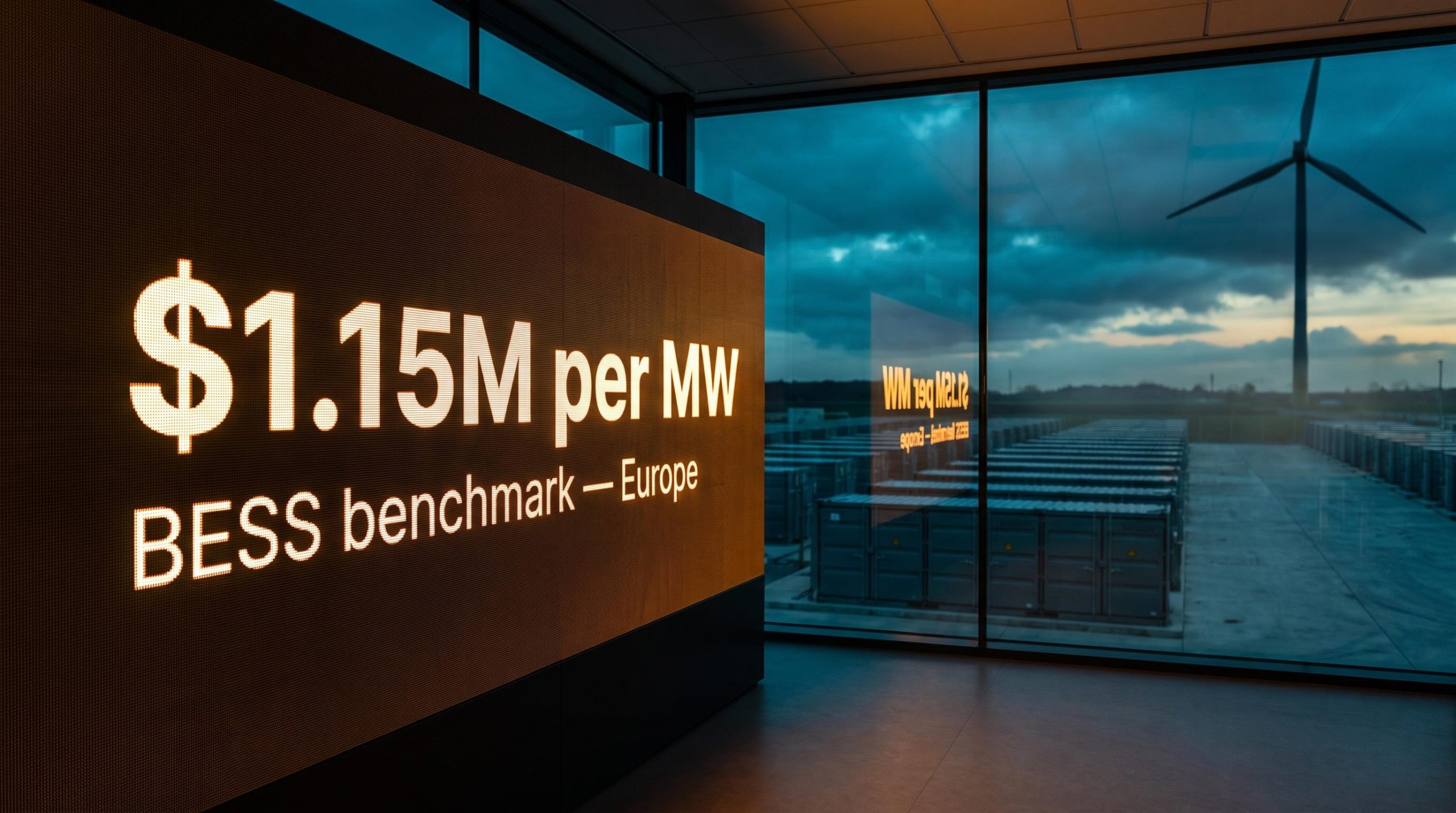
The largest operational battery storage portfolio ever sold in Europe just closed at roughly $1.15 million per megawatt. At almost the same time, a Bitcoin mining company bought a Texas wind farm for the specific purpose of taking it off the grid.
These two transactions have almost nothing in common. Different countries, different technologies, different buyers. Except for the one thing that connects all of it: whoever controls reliable, grid-connected power now holds something the market is willing to pay a structurally different price for.
Across 2024 to 2026, a quiet repricing has been running through energy infrastructure. It is not driven by the cost of generating electricity. It is driven by the value of being certain you will have it when you need it.
Power certainty, meaning guaranteed, dispatchable, congestion-free access to electricity at a specific point on the grid, is emerging as a distinct investable characteristic, separate from simple generation capacity. The deal pipeline across battery storage, wind, and solar reflects that shift.
This piece works through the specific transactions and benchmarks that define the repricing, what they reveal about how different buyer types are valuing power assets, and where the structural risks sit for anyone tracking this theme. The data is concrete. The implications are actionable.
The HEIT transaction set a new benchmark, and the number matters
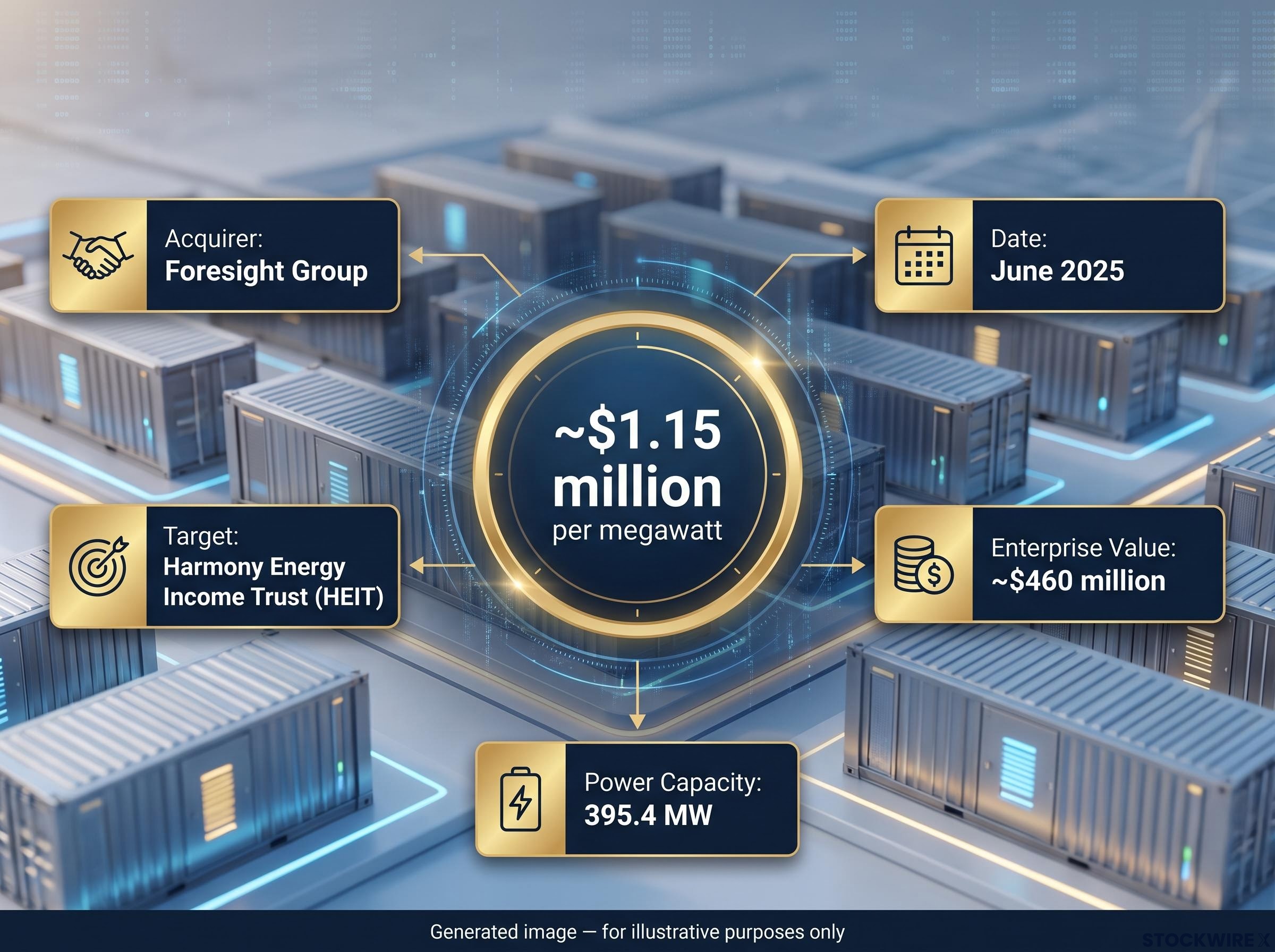
In June 2025, Foresight Group funds acquired 100% of Harmony Energy Income Trust (HEIT) through a scheme of arrangement, taking the London-listed vehicle private at 92.4 pence per share.
That price tag translated to an enterprise value of roughly $460 million for the underlying portfolio, or approximately $1.15 million per megawatt. According to JLL, which advised on the deal, this was the largest operational battery energy storage system (BESS) portfolio sale of its kind in Europe to date.
The number matters because it now functions as a reference point. Every subsequent European BESS transaction can be tested against it, which means anyone underwriting a comparable asset has a concrete floor to work from rather than a guess.
The arbitrage that created the deal
HEIT had a problem familiar to many listed infrastructure vehicles: its shares were trading at a discount to the net asset value of the physical assets it held. The public equity market was pricing the company at less than the batteries themselves were worth.
That gap was the opportunity. By taking HEIT private, Foresight could buy the physical assets on their own terms, pricing them as core infrastructure rather than as sector-exposure equity. The take-private resolved the discount by removing the listed wrapper entirely.
For infrastructure investors, the read here is direct. Physical BESS assets can carry a premium over the equity-market pricing of the funds that own them, and that gap is not always an inefficiency to wait out. Sometimes it is an invitation to reprice.
| Power Capacity | Energy Capacity | Enterprise Value | Price per MW | Operational Share at Process |
|---|---|---|---|---|
| 395.4 MW (eight two-hour projects) | 790.8 MWh | ~$460 million | ~$1.15M per MW | ~79% (312.5 MW / 625 MWh); acquirer: Foresight Group funds |
The portfolio spanned eight two-hour-duration projects, including Pillswood and Bumpers, each 98 MW / 196 MWh and among the largest BESS projects in Europe at the time. The deal later took M&A Deal of the Year at the 2026 Tamarindo Energy Storage Investment Awards.
The benchmark to remember: ~$1.15M per MW This is now the live European reference point for operational two-hour BESS portfolios. Deals announced above it without a clear revenue-stack justification warrant a closer look.
When big ASX news breaks, our subscribers know first
What Bitcoin miners and AI operators are actually buying when they acquire wind farms
Move from a financial-vehicle restructuring to a very different kind of buyer, and the same underlying value shows up in a new shape.
In February 2025, MARA (Mara Holdings) closed its acquisition of the Great Plains wind farm in Hansford County, Texas. The asset carries 114 MW of operational generation and 240 MW of interconnection capacity, and it sits in a locally congested zone of the Southwest Power Pool (SPP) grid. MARA bought it from a joint venture majority-owned by National Grid plc. The price was not disclosed.
What MARA is buying is not really the electricity. It plans to run a behind-the-meter Bitcoin mining operation directly off the site’s wind output, powering the facility only when the wind blows and treating that energy as effectively zero marginal cost.
The strategic core is escape. By taking the asset off the wholesale market, MARA sidesteps curtailment risk and wholesale price volatility in a congested transmission zone. Bloomberg framed the move against rising AI compute demand crowding crypto miners out of power markets, casting the acquisition as a structural response to competition for grid capacity rather than an opportunistic trade.
The same logic appears in April 2026, when Soluna Holdings closed its purchase of the Briscoe Wind Farm in West Texas for US$53 million, including US$12.5 million in debt financing. The asset carries 150 MW of nameplate capacity, and Soluna described the deal as “full vertical integration” for its Project Dorothy AI data centre campus.
| Buyer | Asset | Capacity & Price | Closing Date | Strategic Rationale |
|---|---|---|---|---|
| MARA | Great Plains, Texas | 114 MW gen / 240 MW interconnection; price undisclosed | ~18 Feb 2025 | Behind-the-meter Bitcoin mining; escape SPP congestion |
| Soluna | Briscoe, West Texas | 150 MW; US$53M (US$12.5M debt) | 2 Apr 2026 | Full vertical integration for AI data centre campus |
A third route exists. Canaan reportedly secured sub-US$0.03/kWh contracted power via a stake in Cipher Mining’s Texas projects, described as among the lowest disclosed rates in the US. That figure is an unverified market characterisation, but the strategy is instructive: contracted rate arbitrage rather than owning the generation outright.
What separates this wave from older industrial power ownership comes down to three features:
- Variable renewable generation (wind) rather than dispatchable thermal plant
- Behind-the-meter digital loads (Bitcoin mining, AI training) with intensive but flexible demand
- Grid congestion management as the primary value driver, not simple energy-cost reduction
The value these buyers capture is the removal of a single point of failure: congestion and curtailment risk at a specific interconnection node. That is a fundamentally different rationale than owning generation to sell into the wholesale market, and it is worth enough to justify buying physical assets even where the price advantage cannot be independently measured.
Grid connection bottlenecks are not unique to Texas or the UK; Australia recorded a roughly 20% slump in clean energy investment in 2025 caused specifically by interconnection constraints, demonstrating that the congestion-escape logic driving MARA and Soluna’s acquisitions reflects a global infrastructure gap rather than a US-specific market condition.
The investment thesis connecting these deals: power certainty as a distinct asset class
Line up the HEIT sale, the MARA and Soluna acquisitions, and the broader run of BESS M&A, and the common thread is not sector or geography. It is the characteristic being valued.
In every case, the buyer is paying for dispatchable, reliable, congestion-managed power access at a specific node. That is the asset. The generation or storage hardware is just the delivery mechanism.
This is distinct from the generation-capacity thesis that came before it. Nameplate megawatts are necessary but not sufficient. The monetisable quality is certainty of dispatch, and it commands a premium over equivalent capacity that sits exposed to congestion, curtailment, or market volatility.
The repricing evident in BESS and vertical-integration deals is consistent with a broader market reclassification: climate tech as infrastructure is no longer a framing argument but a capital-allocation reality, with global energy investment exceeding US$3 trillion in 2024 and buyers pricing assets accordingly.
Power certainty is being captured through four distinct mechanisms:
- Behind-the-meter vertical integration to escape congestion, as in the MARA and Soluna wind deals
- BESS acquisitions for dispatchable grid services and ancillary-market revenue
- Take-private arbitrage on listed infrastructure vehicles, as in HEIT
- Contracted rate arbitrage where asset ownership is not the chosen path, as in the Canaan approach
JLL, drawing on its live deal experience, frames it plainly: the addressable deal set in grid-constrained markets has broadened well past standard generation, encompassing assets that deliver flexibility and guaranteed supply, and buyers reliant on power are demonstrating willingness to pay premiums over prevailing wholesale rates to secure that guarantee.
The HEIT benchmark of roughly $1.15M per MW shows this is investable through two doors at once. You can buy the physical asset directly, or you can restructure the financial vehicle that holds it.
For an investor weighing whether this is a durable repricing or a cycle-top theme, the key distinction is where the value comes from. Power certainty derives its worth from structural grid constraints and digital-load growth, not from commodity cycles. That gives it a genuinely different risk profile than a conventional generation-capacity trade, and it changes how you should underwrite the deal.
Why this is different from industrial co-generation
Large manufacturers have long run captive on-site generation, and railroads have long built dedicated infrastructure to avoid shared-network constraints. The vertical integration logic is not new.
The modern version differs on three axes. The generation is variable renewables rather than dispatchable thermal. The load is Bitcoin and AI training workloads rather than industrial heat and power. And the specific value driver is bypassing a congested transmission node rather than lowering energy cost in the abstract. That combination is what makes power certainty at a node a newly priced characteristic.
Where the structural risks sit, and what they mean for due diligence
The tension at the centre of this theme is unresolved, and pretending otherwise would not help anyone underwriting a deal.
The power infrastructure being acquired is long-lived, with asset lives running past 20 years. The digital loads driving the acquisition rationale, Bitcoin mining and AI training, are exposed to technology cycles, regulatory change, and commodity price swings. One horizon is measured in decades. The other can shift in quarters.
There is a case for durability. Bloomberg’s read on MARA casts the move as a response to permanent competitive pressure for grid capacity, and Soluna’s multi-year integration of Briscoe into its data centre campus points to a structural commitment rather than a quick trade.
There is an equally real case for cyclicality. If Bitcoin prices fall, if regulatory pressure on mining intensifies, or if AI training workloads consolidate onto fewer nodes, the strategic rationale for above-market power valuations could weaken well before the asset reaches the end of its operational life.
The regulatory picture is unsettled but not yet hostile. No named policy initiative explicitly targeting vertically integrated power strategies by miners or AI operators in the US, UK, or EU appeared in available sources. Trade-publication debate around grid congestion and fair transmission access continues, but specific countermeasures remain unidentified.
There is also a second-order grid effect worth noting. MARA’s plan to run Great Plains behind the meter pulls renewable output away from the SPP wholesale market in an already congested region, a supply-reduction effect flagged in trade coverage but not quantified.
Three factors deserve direct attention in due diligence:
Award-to-close risk is a recurring feature of large renewable infrastructure procurement, and Victoria’s offshore wind program illustrates how an undisclosed revenue framework and an overlapping environmental review window can introduce material uncertainty between contract award and financial close, the same category of risk that due diligence on vertical-integration deals must isolate.
- Technology-cycle exposure of the digital load the asset was acquired to serve
- Regulatory and transmission-access policy risk as the debate matures
- Asset redeployability if the original strategic rationale changes
That last point separates the resilient investment from the single-use bet. The HEIT deal rested on a clear, auditable NAV-to-price arbitrage. The crypto and AI vertical integration deals rest on strategic rationale that depends on the acquirer’s digital business staying viable at scale.
The due diligence question that matters most Can the power asset be redeployed to an alternative buyer or market-participation model if the digital load it was acquired to serve changes its requirements? That optionality is what distinguishes resilient infrastructure from a bet tied to one operator.
The practical implication is a split. BESS and grid-service assets carry a power-certainty value that is buyer-independent and market-driven. Dedicated-load vertical integration deals carry value bound to the health of a specific digital-sector operator. Those are not the same investment.
Positioning ahead of the next repricing cycle in power infrastructure
The honest read is not a verdict but a map. Three variables will determine whether the power certainty premium extends further or begins to correct.
- The pace of grid congestion resolution, driven by new transmission build and interconnection reform. Faster relief weakens the case for paying up to escape congestion.
- The regulatory treatment of behind-the-meter digital loads and the grid obligations attached to them.
- The financial health and consolidation trajectory of the crypto and AI sectors driving demand.
Between the two asset categories, the storage pathway looks structurally more resilient. A BESS asset can serve multiple revenue stacks, frequency response, capacity markets, and wholesale arbitrage, regardless of which sector happens to be the marginal buyer of power. A wind farm dedicated to one operator does not have that flexibility.
The practical filter is a two-category framework.
| Asset Type | Value Driver | Benchmark | Revenue Stack Independence | Due Diligence Focus |
|---|---|---|---|---|
| BESS / grid-service | Market-validated dispatch certainty | ~$1.15M per MW (HEIT) | High: multiple revenue stacks | Pricing vs benchmark; revenue-stack logic |
| Digital-load vertical integration | Buyer-specific congestion escape | None established; prices often undisclosed | Low: tied to single operator | Operator durability; asset redeployability |
Use the HEIT figure as a live reference against comparable BESS announcements. JLL’s recognition at the 2026 Tamarindo awards, taking both Financial Advisor of the Year and M&A Deal of the Year, underlines the transaction’s status as a market benchmark rather than a one-off.
The reader who grasps that power certainty is a buyer-specific premium in vertical integration but a market-validated premium in BESS and grid-service assets can evaluate new deals with a sharper filter than the sector-level narrative offers. Assess storage against the benchmark and multi-revenue logic. Assess dedicated-load deals against operator durability and redeployability.
This article is for informational purposes only and should not be considered financial advice. Investors should conduct their own research and consult with financial professionals before making investment decisions.
Past performance does not guarantee future results. Financial projections are subject to market conditions and various risk factors. Certain figures cited are market characterisations rather than independently verified data, and are noted as such.