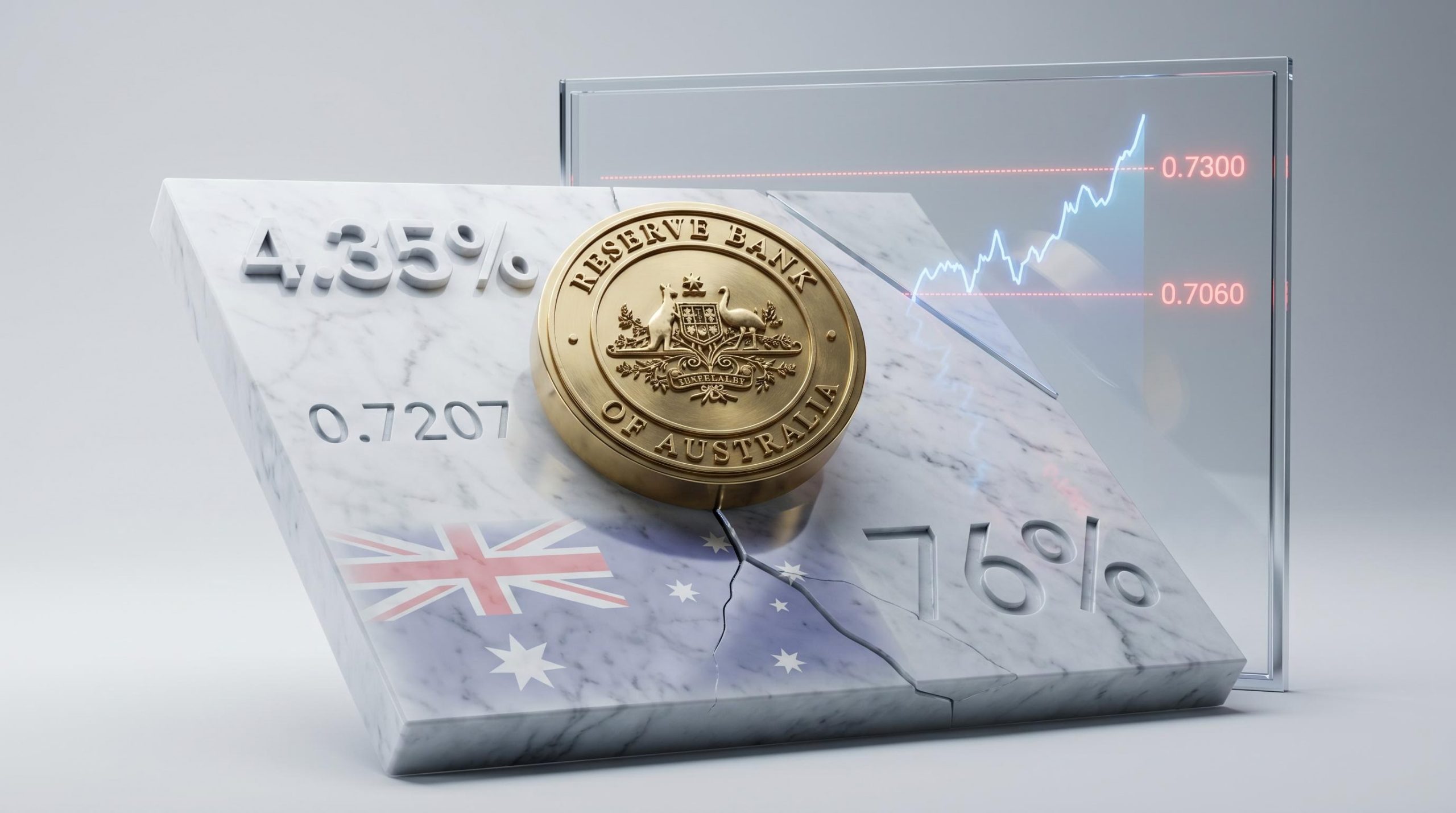
With 76% of ASX futures pricing in a 25 basis point hike tomorrow, the RBA’s rate decision is, in practical terms, already made. What is not made is the market’s next move. AUD/USD sits at 0.7207 on the eve of the 5 May 2026 meeting, holding near recent highs inside an ascending channel that has carried the pair up from a cycle low of 0.6843. The hike most participants expect would push the cash rate to 4.35% and, for the first time since 2017, place Australian policy rates above those of the US Federal Reserve. That is a significant threshold, but with the move already embedded in positioning, the real price action will be shaped by Governor Michele Bullock’s tone at her 3:30pm AEST press conference, not the 2:30pm announcement itself.
What follows maps the technical picture, walks through the inflation pressures forcing the RBA’s hand, explains why forward guidance matters more than the decision in a priced-in environment, and sets out two concrete scenarios with specific price levels to track in real time.
Why the hike alone won’t move the Australian dollar
Three data points tell the same story: the market has already moved.
- ASX 30-day interbank cash rate futures (May 2026 contract, as of 30 April 2026 close): traded at 95.74, implying a 76% probability of a 25bp hike to 4.35%
- Finder’s economist survey: 74% of surveyed economists predict a hike
- Reuters poll: a strong majority expecting +25bp
When three separate consensus measures converge this tightly, the rate decision itself is already reflected in the AUD/USD price. A hike that confirms what is priced in does not generate fresh demand for the currency; it validates demand that already arrived.
The “buy the rumour, sell the news” dynamic applies here. Markets that have positioned for an outcome often reverse on its confirmation, because the catalyst for buying has been spent. The direction after the announcement depends not on the decision but on what comes next.
That “what comes next” is Bullock’s press conference at 3:30pm AEST. With no pre-meeting public guidance issued since the March decision, markets are operating without a signposted tone. The press conference is the higher-volatility event of the two scheduled releases, and for retail forex participants, it is the one that warrants full attention.
When big ASX news breaks, our subscribers know first
Reading the chart: what the technicals say before the decision
The ascending channel that has carried AUD/USD from 0.6843 to 0.7207 remains intact, and the pair is sitting in the upper half of that structure. On the surface, the trend is constructive.
The complication is under the surface. The KDJ J-line, a momentum oscillator more sensitive to short-term price changes than the standard RSI, reads 90. That is deeply overbought territory. The RSI, by contrast, sits at 60.9, elevated but not extreme.
The overbought signal and what it means for event risk
The gap between those two readings tells its own story. The KDJ J-line’s sensitivity picks up the speed of the recent advance; the RSI’s broader sampling smooths it out. Together, they suggest that while the trend direction remains intact, the pair has consumed most of its near-term momentum. Overbought conditions do not predict a reversal, but they do indicate the pair has less room to extend gains without a fresh catalyst, precisely the kind that Bullock’s press conference could provide or fail to provide.
Support and resistance levels to anchor the trade
| Indicator | Reading | What it signals |
|---|---|---|
| Current price | 0.7207 | Upper half of ascending channel |
| KDJ J-line | 90 | Deeply overbought; limited room to extend without catalyst |
| RSI | 60.9 | Elevated but not extreme; trend still intact |
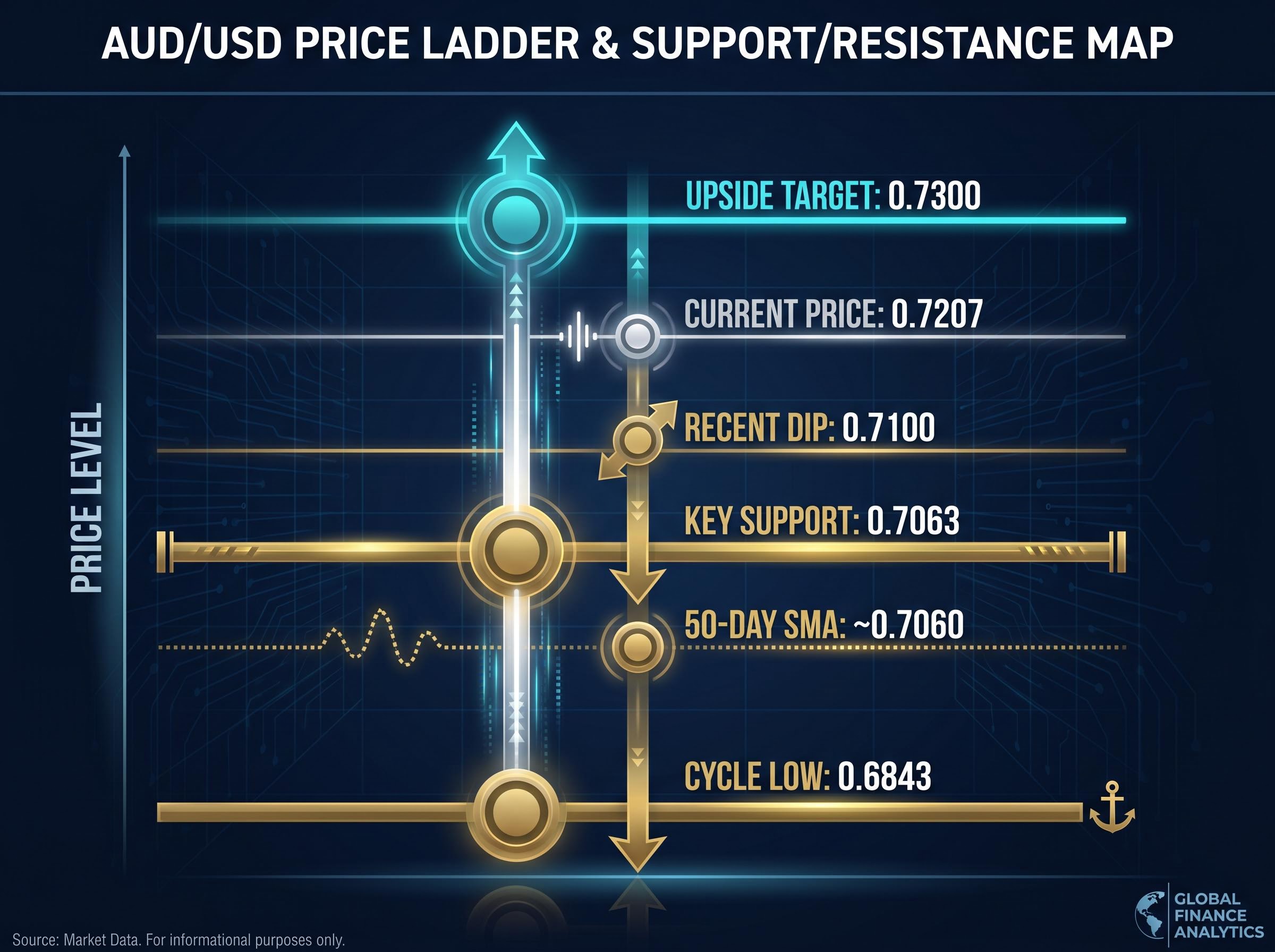
| Key support | 0.7063 | First downside level on a cautious outcome |
| 50-day SMA | ~0.7060 | Convergence with support strengthens the floor |
| Upside target | 0.7300 | Hawkish press conference destination |
The 0.7063 support level gains added significance from its near-convergence with the 50-day SMA at approximately 0.7060, creating a reinforced floor. On the upside, 0.7300 represents the target if a hawkish Bullock delivers the catalyst the momentum picture currently lacks. The AUD’s recent dip toward 0.7100 following the Fed’s unchanged rate decision tested buyer resolve at that intermediate level; the recovery to 0.7207 suggests demand remains intact above support.
The inflation picture that is forcing the RBA’s hand
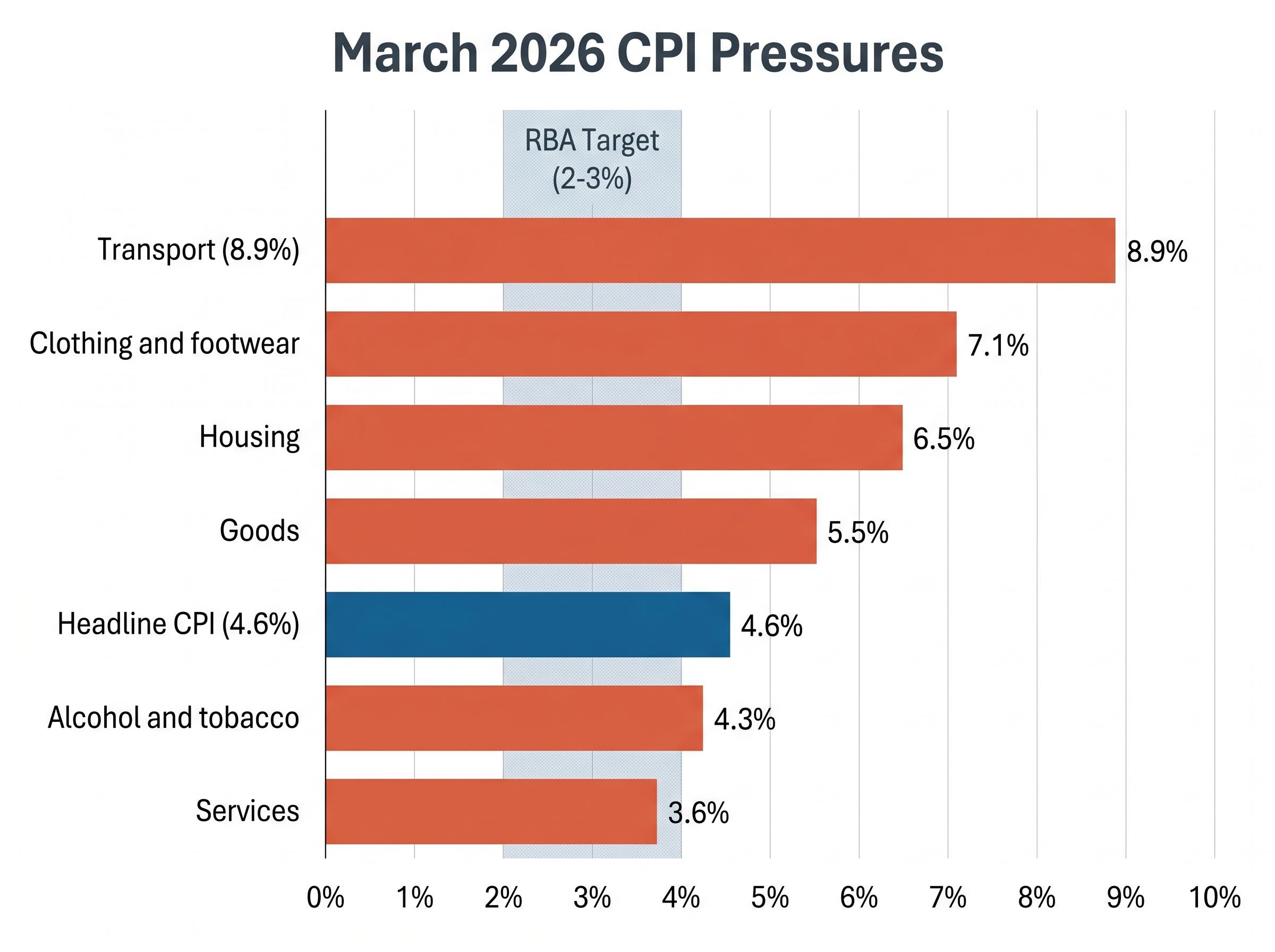
The March 2026 CPI reading came in at 4.6% year-on-year, with underlying inflation (quarterly measure) at 3.5%. The RBA’s target band is 2-3%. That gap alone makes the case for tightening, but the breadth of the inflation data makes it harder to argue this is a problem concentrated in one or two categories.
The RBA monetary policy framework sets the 2-3% inflation target as the governing constraint on cash rate decisions, meaning any sustained CPI reading above that band creates a structural obligation to tighten regardless of the growth trade-offs the board must weigh.
| Category | March 2026 rate | February 2026 rate | vs RBA target (2-3%) |
|---|---|---|---|
| Headline CPI | 4.6% | — | Above |
| Transport | 8.9% | -0.2% | Well above |
| Housing | 6.5% | — | Above |
| Clothing and footwear | 7.1% | — | Above |
| Goods | 5.5% | 3.5% | Above |
| Services | 3.6% | — | Above |
| Alcohol and tobacco | 4.3% | — | Above |
The transport figure is the most dramatic single-category swing: from -0.2% in February to 8.9% in March, driven by oil prices sustained above US$80 per barrel for three consecutive months amid Middle East conflict. Goods inflation accelerating from 3.5% to 5.5% in one month reinforces the picture of broadening price pressures rather than isolated spikes.
The transport CPI spike from -0.2% to 8.9% in a single month reflects a broader structural shift in how currency markets are pricing sovereign exposure to oil supply chains; energy self-sufficiency in forex valuation has emerged as a dominant driver in 2026, with Australia’s LNG and commodity export revenues providing a partial offset to its liquid fuel import costs.
The March board voted 5-to-4 in favour of hiking, the narrowest possible majority. That split signals the RBA itself is not unanimous on the growth-versus-inflation trade-off, and it gives Bullock’s press conference language additional weight: the tone she adopts will indicate which side of that internal divide she is reinforcing.
What “forward guidance” actually means and why it moves currencies
Forward guidance is a central bank’s communication about its likely future policy path. It is distinct from the rate decision itself. A central bank can hike rates and simultaneously signal it expects to pause, or hold rates and signal it expects to tighten. The signal about the future often moves markets more than the action in the present, because currency pricing is forward-looking by design.
- Current inflation assessment: how Bullock characterises the breadth and persistence of the 4.6% CPI reading
- Future rate path signals: whether she indicates the May hike is a standalone move or the beginning of a tightening sequence
- Acknowledgment of global growth risks: how much weight she places on slowing global conditions versus domestic inflation
No pre-meeting guidance was issued by Bullock between the March decision and 4 May, meaning markets are entering the press conference without a signposted tone. That informational vacuum amplifies the volatility potential of whatever she says.
How interest rate differentials drive currency flows
When one country’s policy rate rises relative to another’s, capital tends to flow toward the higher-yielding currency. This is the carry trade in its simplest form: investors borrow in the lower-yielding currency and park funds in the higher-yielding one, creating demand that pushes the higher-rate currency’s price up. A hike to 4.35% would place Australian rates above the US Federal Reserve’s rate for the first time since 2017.
RBA and Fed policy divergence has been a structural tailwind for the Australian dollar since late 2025, with AUD/USD rising from 0.6843 as Australian rates moved closer to and ultimately above the Fed funds rate, a dynamic that creates self-reinforcing capital inflows when the differential widens further.
Bank of America has identified this rate differential as a structural AUD tailwind, raising its Q4 2026 AUD/USD forecast to 0.73. ASX implied yield curve projections suggest the cash rate could reach approximately 4.8% by the end of 2026, implying two further hikes beyond May. Whether that trajectory materialises depends heavily on tomorrow’s forward guidance, and on a fiscal variable arriving one week later: the federal budget scheduled for 12 May 2026, with income tax cuts effective from 1 July 2026.
Two scenarios, two price paths: mapping the hawkish and cautious outcomes
| Scenario | Trigger conditions | AUD/USD direction | Key level to watch |
|---|---|---|---|
| Hawkish | Bullock signals further hikes likely; minimal acknowledgment of growth risks; emphasis on inflation persistence | Higher | 0.7300 |
| Cautious | Emphasis on data-dependency; acknowledgment of global slowdown risks or fiscal stimulus uncertainty; no commitment to further tightening | Lower | ~0.7060 (50-day SMA zone) |
The hawkish path is the cleaner trade: Bullock reinforces the inflation mandate, signals the May hike is not a standalone move, and AUD/USD pushes toward the 0.7300 level that Bank of America’s Q4 forecast implies as a destination.
The cautious path is more nuanced. Bullock hikes but frames the decision as data-dependent, acknowledges global headwinds, and references the fiscal uncertainty introduced by the 12 May budget and the 1 July income tax cuts. In that outcome, the pair likely retraces toward the 50-day SMA zone near 0.7060, where technical support converges.
The fiscal wildcard complicates both scenarios. Income tax cuts and potential energy rebates in the budget could add demand-side pressure that keeps inflation elevated, giving Bullock reason to remain cautious about declaring progress. A purely hawkish or purely cautious outcome may be less likely than a blended tone that leaves markets debating the interpretation.
Oil shock inflation cycles have historically resolved faster than the rate hikes they triggered: the 1970s Volcker-era data shows that central banks typically pivoted within 6-12 months of a shock’s peak once growth damage overtook inflation as the dominant policy concern, a pattern that creates a non-trivial probability that the RBA’s tightening sequence is shorter than the ASX forward curve implies.
The Bank of Japan’s March 2026 decision illustrates the global parallel: rates held while the growth forecast was cut from 1.0% to 0.5% and the inflation forecast was raised to 2.8%. The IMF’s April 2026 World Economic Outlook projects global growth decelerating to 3.1% in 2026 alongside rising inflation. Central banks are navigating the same tension between prices and output, and Bullock’s press conference will reveal where the RBA places itself on that spectrum.
The calendar beyond 5 May: what comes next for AUD/USD
The 5 May decision is one data point in a longer tightening narrative. ASX futures are pricing a cash rate of approximately 4.8% by year-end, implying two further hikes beyond May if the inflation trajectory holds.
The upcoming catalysts that will shape the AUD/USD path:
Second-round energy pass-through into freight, construction materials, and services costs is expected to peak in Q2 and Q3 2026, meaning the inflation readings that will determine whether Bullock signals a pause or continued tightening are still working through supply chains and were not captured in the March data.
- 5 May 2026: RBA rate decision (2:30pm AEST) and Bullock press conference (3:30pm AEST)
- 12 May 2026: Federal budget, including energy rebates, potential fuel excise reduction, and personal income tax cuts from 1 July
- 1 July 2026: Income tax cuts take effect, adding a demand-side variable to the inflation outlook
- Year-end 2026: ASX-implied cash rate target of approximately 4.8%
Bank of America’s revised 0.73 Q4 2026 forecast for AUD/USD represents the bullish case if the rate differential thesis plays out cleanly. The IMF’s 3.1% global growth projection for 2026, paired with rising inflation across developed economies, represents the risk that complicates that trajectory. The rate differential favours the Australian dollar; the global growth backdrop counsels caution about the durability of that advantage.
Bullock’s words: the real market driver on decision day
The hike is consensus. Bullock’s language is not. That asymmetry makes the 3:30pm press conference the higher-stakes moment of 5 May, and the one that will determine whether AUD/USD pushes toward 0.7300 or retraces to the 0.7060 support zone.
However tomorrow resolves, the AUD/USD trajectory for the remainder of 2026 depends on whether the RBA can sustain its rate advantage over the Fed while managing the fiscal risk introduced by the 12 May budget. The rate decision is a single move. The forward guidance is the map. Readers tracking the pair through the months ahead will find more signal in Bullock’s tone tomorrow than in the number she announces.
This article is for informational purposes only and should not be considered financial advice. Investors should conduct their own research and consult with financial professionals before making investment decisions. Forward-looking statements regarding interest rate paths and currency levels are speculative and subject to change based on market developments and policy decisions.