
A disclosure filed on 21 August 2026 shows approximately $13.5 million in new positions across two names. That number has dominated the headlines. It is also the wrong number to focus on.
The figure that actually matters is the delta, the measure of how much these positions move for every dollar the underlying stocks move. Once you account for the options contracts layered on top of the share purchases, the Pelosi household’s true directional exposure stretches well into the mid-tens of millions. The gap between the disclosed dollar figure and the actual notional exposure is where the leverage lives, and it is where the analysis should start.
The trades were executed between 24 and 28 July 2026, disclosed 45 days later under the STOCK Act’s mandatory reporting window, and they landed in a pointed stretch of the congressional calendar: immediately after the House passed a bill restricting future stock purchases by members and their families. All positions were executed by Paul Pelosi (spouse). At 86 years old, Nancy Pelosi is set to leave office in January 2027, and these filings are likely among the last of her congressional tenure.
Here is what the structure of these trades actually tells you about the strategy, why reading the disclosure as a ticker list misses what is genuinely interesting, and what the copy-trading impulse gets wrong.
What the August filing actually discloses
The filing covers two names: Bloom Energy and Intel. In both, the household paired direct share purchases with deep-in-the-money call options on the same dates, a combination that is architectural, not coincidental.
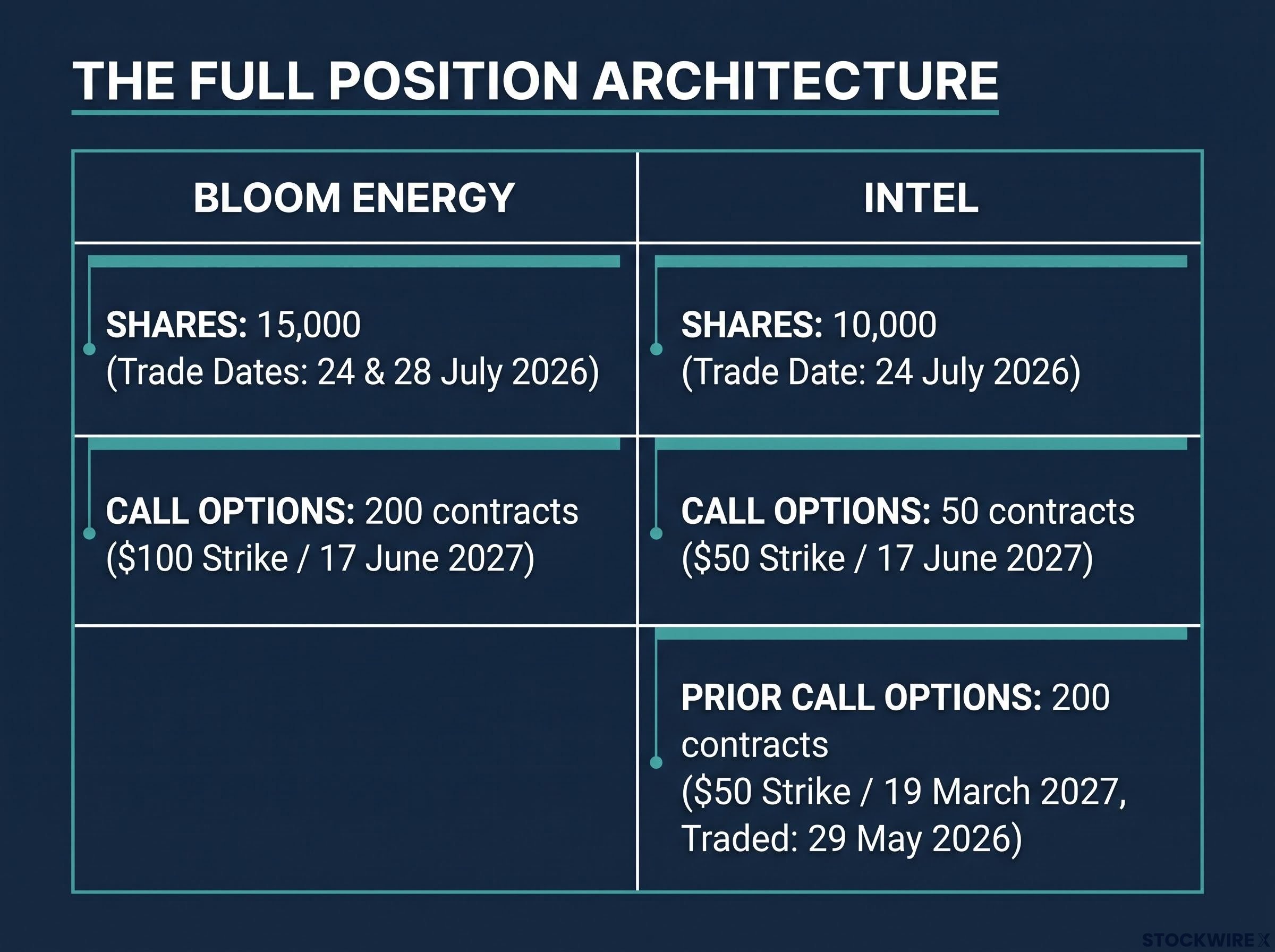
Bloom Energy is a new, first-time position. Paul Pelosi purchased 15,000 shares across two transactions on 24 July and 28 July, then added 200 call option contracts (100 on each date) at a $100 strike expiring 17 June 2027. Each contract controls 100 shares, giving exposure to an additional 20,000 shares if exercised.
Intel is an add-on. On 24 July, the household bought 10,000 shares and 50 call contracts at a $50 strike, also expiring 17 June 2027. Those contracts layer on top of an existing position: 200 Intel calls at a $50 strike with a 19 March 2027 expiration, reported in late May 2026.
The full position architecture
| Name | Instrument | Quantity | Strike / Expiration | Trade Dates |
|---|---|---|---|---|
| Bloom Energy | Shares | 15,000 | N/A | 24 & 28 July 2026 |
| Bloom Energy | Call options | 200 contracts | $100 / 17 June 2027 | 24 & 28 July 2026 |
| Intel | Shares | 10,000 | N/A | 24 July 2026 |
| Intel | Call options | 50 contracts | $50 / 17 June 2027 | 24 July 2026 |
| Intel | Call options (prior) | 200 contracts | $50 / 19 March 2027 | 29 May 2026 |
The disclosed transaction value bands cluster around $13.5 million when summed. The notional exposure, once the options contracts are included, is substantially larger. That gap is the leverage effect, and it is the single most important structural feature of the filing. Bloom Energy shares rose approximately 5-6% in early trading after the disclosure went public, a reminder of how closely these filings are tracked.
When big ASX news breaks, our subscribers know first
How deep-in-the-money LEAPs create leveraged equity exposure
When you see a call option with a strike price far below the current stock price, it looks, at first glance, like any other options trade. It is not.
A call option is “in the money” when the stock price sits above the strike price. It is “deep in the money” when the stock trades far above the strike. At that point, most of the option’s price is intrinsic value (what you would receive if you exercised immediately) rather than time value (the premium paid for future optionality). A LEAP is simply a long-dated option, typically with more than a year until expiration.
Delta in options does two jobs simultaneously: it measures how much an option’s price shifts per dollar of stock movement, and it quantifies the stock-equivalent directional exposure embedded in the contract, which is why a deep-in-the-money LEAP with a 90 delta behaves economically like owning 90 shares of stock for every contract held.
Three characteristics define a deep-in-the-money LEAP:
- High delta: The delta, which measures how much the option price moves for every dollar the stock moves, approaches 1.0. The option tracks the stock almost dollar-for-dollar.
- Intrinsic-value-dominant pricing: Because the contract is already far in the money, you are paying mostly for the stock exposure you already control, not for the speculative possibility of a future spike.
- Long-dated horizon: Expirations of a year or more give the thesis time to play out, reducing the pressure of short-term price swings.
The Bloom Energy calls carried an approximately 90 delta at the time of analysis, consistent with deep-in-the-money positioning. Economically, a deep-in-the-money LEAP behaves like owning the stock on margin, but packaged as an option contract rather than a margin loan. You put up far less capital than buying 100 shares outright, yet your exposure moves nearly one-for-one with the underlying.
Why this is not a speculative bet
Options trading is commonly associated with short-dated contracts and high-risk directional wagers. Deep-in-the-money LEAPs occupy a fundamentally different category. Both new positions carry expirations in mid-2027, meaning the Pelosi household is not positioned for a near-term price shock but rather for concentrated, leveraged directional exposure across a well-defined holding period.
The Uber trade from earlier in the household’s disclosure record illustrates the mechanics concretely.
Uber call options were purchased at a $50 strike while the stock traded near $66, already deep in the money. Uber subsequently climbed to around $79, a gain of roughly 20% in the underlying stock. Over the same move, the call options appreciated by approximately 81%. Same stock, same direction, four times the return.
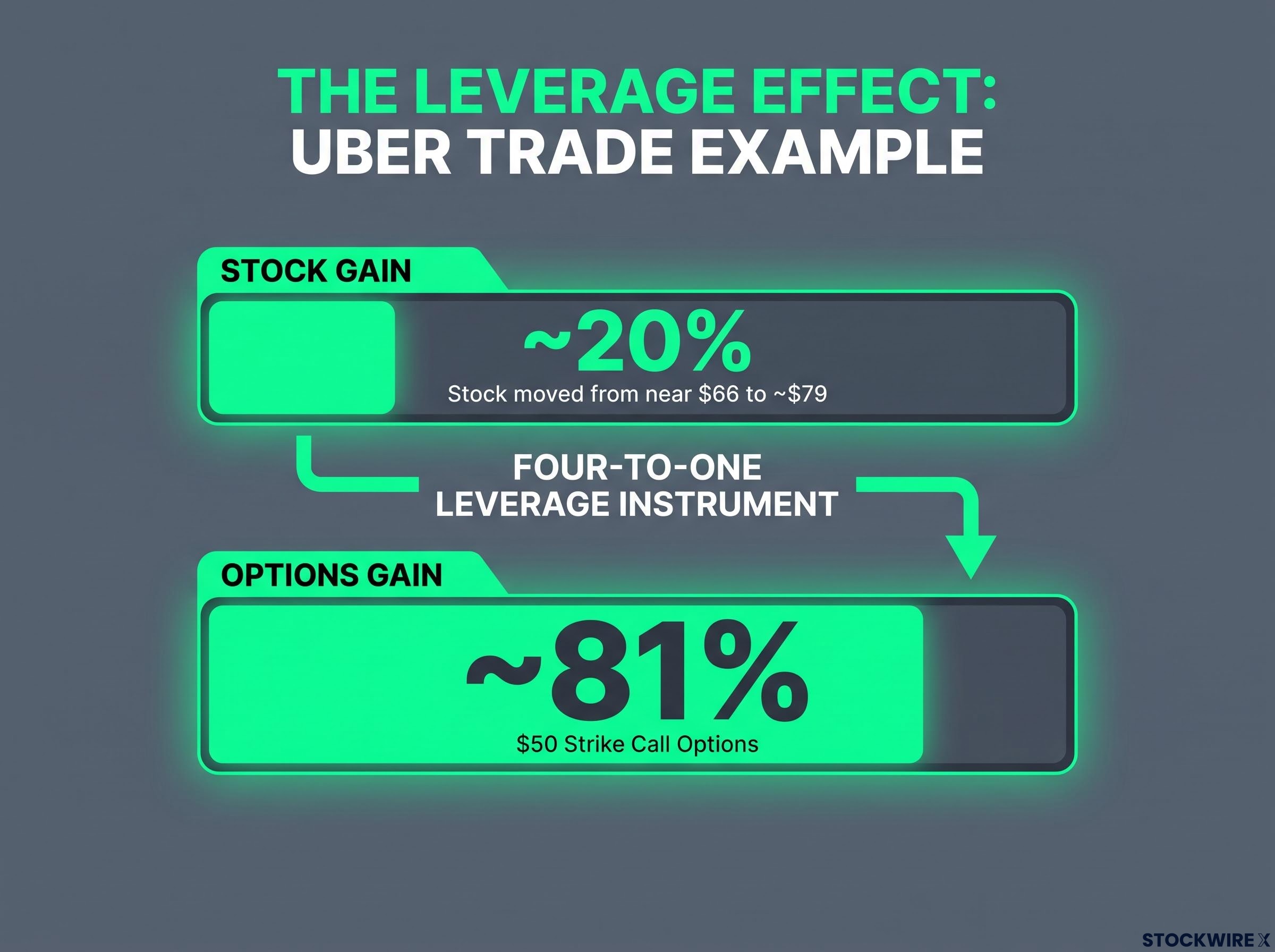
That is not a brag about performance. It is the clearest available illustration that this structure turns a stock call into something closer to a four-to-one leverage instrument. The risk is symmetrical: the same leverage that amplifies gains amplifies losses if the underlying falls materially. Anyone evaluating the Pelosi positions needs to understand that framing before assessing the risk.
The copy-trading problem: what you cannot see in the filing
The disclosed performance record is real. Independent tracking of Pelosi household trades shows cumulative returns of approximately +106% against the S&P 500’s +61.5% over the same period. Across individual years, the margin of outperformance has shifted considerably: roughly 40 percentage points ahead of the market three years prior, narrowing to around 29 percentage points two years prior, and compressing to just 1 percentage point in the most recent year.
| Period | Pelosi Household Context | Approx. Outperformance vs. Market |
|---|---|---|
| Three years prior | Concentrated leverage in bull market | ~40 percentage points |
| Two years prior | Continued options-heavy positioning | ~29 percentage points |
| Most recent year | Narrower outperformance | ~1 percentage point |
| Cumulative snapshot | Multi-year tracked period | ~+106% vs. S&P 500 +61.5% |
That variation is itself the warning. The edge is not a consistent machine; it compresses sharply in less favourable years. Retail copycats are typically entering the trade with every structural disadvantage at once, and those disadvantages compound.
Copy-trading structural disadvantages operate consistently across professional contexts: Morgan Stanley’s tracking of 62 Australian active equity funds found that mechanically replicating their top holdings produced a roughly 21% loss, while following their actual position changes returned approximately 17%, a 38-percentage-point gap from the same underlying data.
- The 45-day timing lag. Trades were executed 24-28 July. The filing dropped 21 August. By the time you read it, prices, implied volatility, and remaining time to expiration have all shifted. Bloom Energy was already up 5-6% on disclosure day alone. The “same” contract weeks later is, in economic terms, a different instrument.
- Capital scale and portfolio context. A household deploying millions across shares and LEAPs in a single name operates under a fundamentally different risk profile than a retail investor committing a significant fraction of net worth to one leveraged options position. The filing does not reveal whether these positions are hedged elsewhere, through other derivatives or sector shorts, which would materially alter the true risk profile.
- The invisible thesis and exit plan. The filing discloses what was bought and when, not why, at what target, or for how long.
The disclosure tells you the name, the size, and the structure. It does not tell you the thesis, the hedge, or the exit. Without those, you are copying the entry with no framework for the exit, and that is where outcomes diverge.
If the original account exits after a specific gain or policy milestone while copycats hold through a subsequent drawdown, results diverge sharply even when the initial ticker and strike are identical.
The policy backdrop that makes this filing different from earlier ones
The House passed a stock-trading restrictions bill in July 2026. The legislation would bar future purchases of individual securities by members of Congress and their families, while allowing retention of existing holdings and imposing additional disclosure requirements.
The trades in this filing were executed 24-28 July 2026, in the period immediately following that House vote. They were disclosed 21 August.
That sequence does not prove anything about intent. But it places this filing in a specific legislative context that earlier Pelosi disclosures did not occupy.
What the STOCK Act does and does not require
The STOCK Act mandates disclosure of trade name, size, and timing within 45 days of execution. That is legal transparency. What it does not mandate is strategic transparency:
The House Ethics Committee STOCK Act guidance specifies that Periodic Transaction Reports must be filed within the earlier of 30 days from when a member becomes aware of a transaction or 45 days from the transaction date, with required disclosure covering the asset name, transaction type, and value band but not the strategic rationale behind the trade.
- What the filing reveals: Names, sizes, structures, and dates of trades; owner code designation (SP for spouse on all positions)
- What it does not reveal: Whether positions were informed by non-public information, personal macro views, or policy analysis
- What it does not reveal: Whether these positions are hedged elsewhere
- What it does not reveal: Exit criteria, price targets, or intended holding period
This gap is structural, not unique to Pelosi. It applies to every congressional disclosure filing. Any inference of intent from the filing alone rests on speculation rather than documented fact.
Pelosi’s January 2027 retirement adds a layer that is worth holding: these positions were established by a household that will no longer have congressional information access within months. That may or may not bear on the thesis behind the trades, but it is a factual data point that changes the context from what a mid-career filing would carry.
Reading the disclosure clearly, without the noise
The August 2026 filing is best read as a document about leveraged positioning strategy and concentrated thematic conviction rather than as a stock-picking signal.
The thematic pairing is specific. Bloom Energy sits at the intersection of clean energy and data centre power demand. Intel is central to domestic semiconductor and AI infrastructure. The two are also commercially connected: Intel is a Bloom Energy customer, creating a potential internal link between the positions. Both reflect a portfolio tilt toward names that benefit from US industrial policy spending on energy and chip manufacturing.
Semiconductor sector rotation by politically connected actors has accelerated in parallel: Trump’s Q1 2026 OGE disclosure showed major new positions in NVIDIA, Broadcom, and Intel-adjacent supply chain names during the same quarter that institutional investors rotated roughly $45 billion into semiconductor and AI infrastructure names.
The multi-year outperformance is real and documented, but it has been variable. The conditions that produced the largest outperformance years, concentrated leverage in a bull market, are not replicable by most retail investors without also replicating the risk. And the year-on-year compression from 40 percentage points to 1 percentage point shows this is not a mechanical edge.
If you are building a framework for evaluating any future congressional disclosure, not just this one, four questions matter most:
- Instrument structure: Are the positions shares, options, or both? What does the delta tell you about true exposure?
- Thematic concentration: Is there a coherent investment thesis linking the names, or are they unrelated picks?
- Policy timing: Where does the filing sit relative to legislative milestones, elections, or regulatory events?
- Copy-trading barriers: Can you actually replicate the position at the same price, scale, and risk profile?
Both the Bloom Energy and Intel LEAPs expire on 17 June 2027, five months after Pelosi leaves Congress in January 2027. That expiration date is the most important number in the filing. It is the moment when the thesis either resolves or it does not, and by then the congressional information environment that shaped it will already be gone.
The most important number in this disclosure is not the $13.5 million headline. It is the June 2027 expiration date sitting five months past a retirement that closes the information window. That is where the real question lives.
This article is for informational purposes only and should not be considered financial advice. Investors should conduct their own research and consult with financial professionals before making investment decisions. Options, especially leveraged strategies using deep-in-the-money LEAPs, involve significant risk of loss and are unsuitable for many investors. Past performance does not guarantee future results.