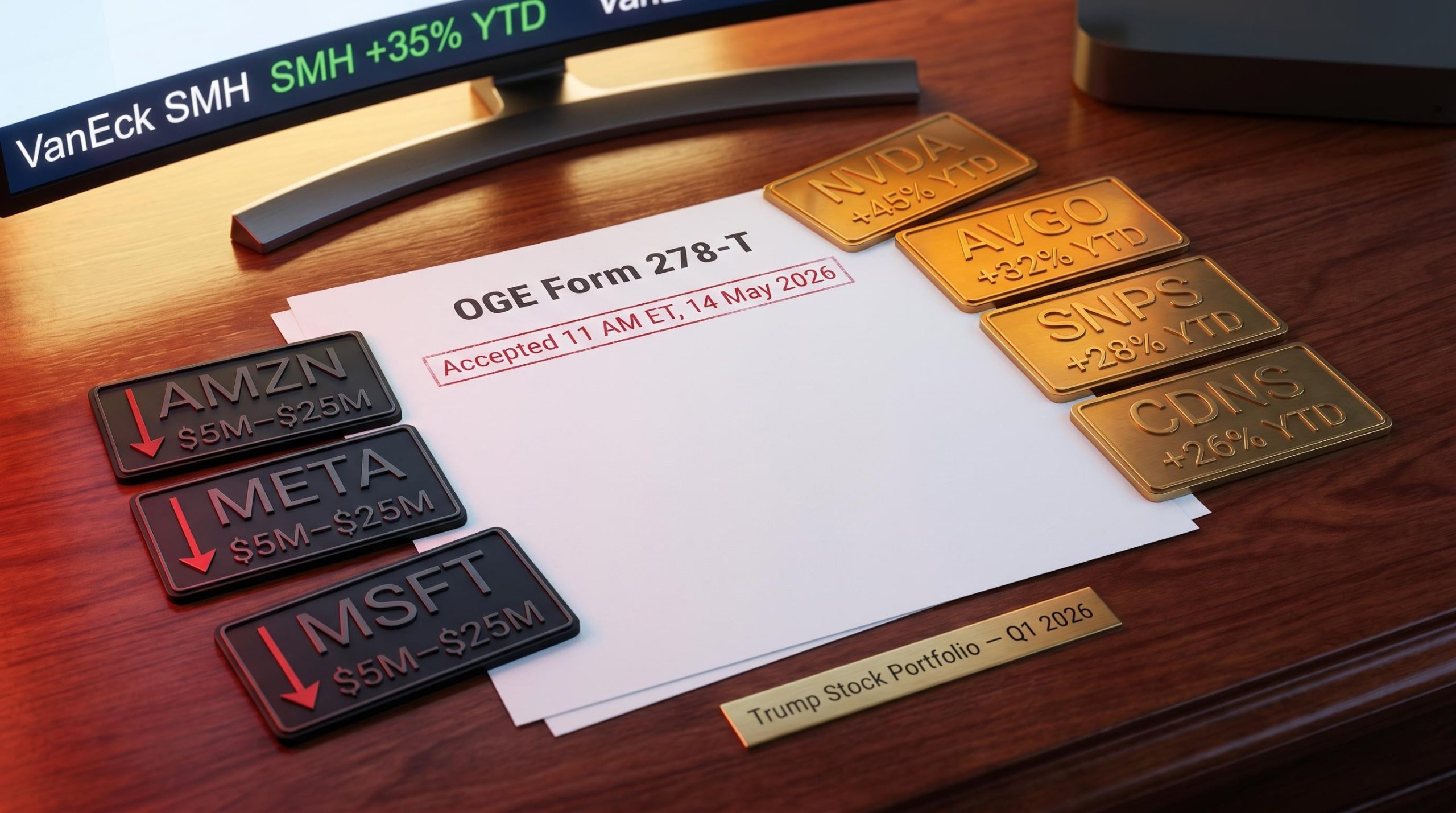
President Donald Trump’s latest financial disclosure, an OGE Form 278-T accepted at 11 AM ET on 14 May 2026, reveals a wholesale portfolio restructuring executed during the first quarter of the year. The filing shows tens of millions of dollars in Amazon, Meta, and Microsoft sales alongside fresh positions in NVIDIA, Broadcom, and four other semiconductor companies. Retail trading volume across the named stocks surged past $50 million on the day of disclosure, per TradeStation data, while congressional Democrats moved within hours to request an Office of Government Ethics investigation into the timing of one specific purchase. What follows is a breakdown of the full buy-and-sell picture, the investment logic behind the rotation, the legal scrutiny it has triggered, and what retail investors should weigh before acting on the filing.
What Trump’s Q1 2026 filing actually shows: the full buy-and-sell picture
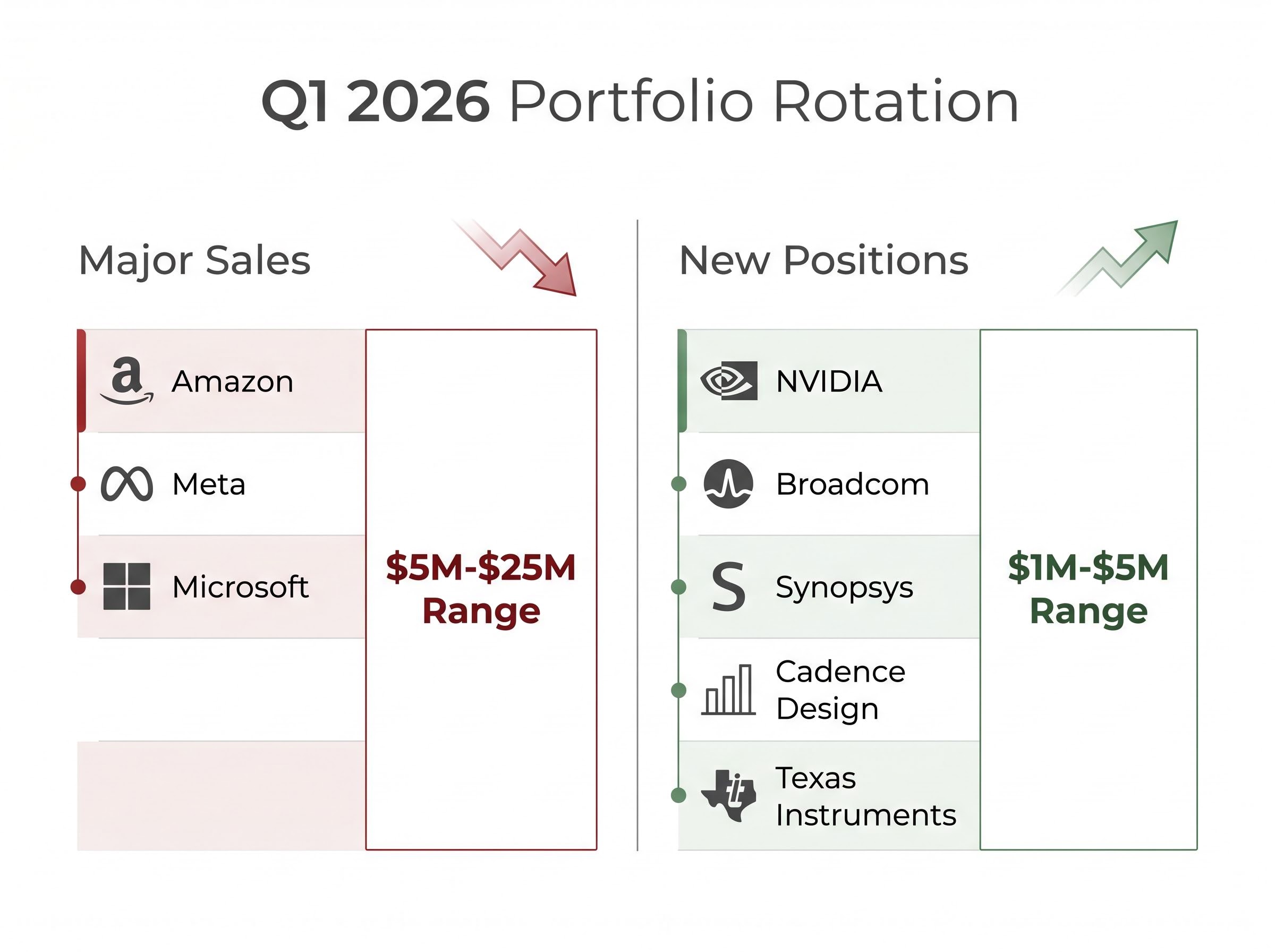
The scale of the repositioning is difficult to dismiss as routine rebalancing. Three of the largest positions in the portfolio were reduced by millions, while a parallel set of new positions was initiated across semiconductors, enterprise software, and AI infrastructure names, all within the same quarter.
The sell side: Amazon, Meta, and Microsoft
Each of the three liquidations fell within the $5 million-$25 million valuation bracket during Q1 2026. But the pattern is more nuanced than a simple exit. Trump simultaneously made smaller re-acquisitions in Meta (at the $1,001-$500,000 level), Amazon and Microsoft (each at $1,001-$5 million), and a cluster of self-directed unsolicited purchases in Apple, Microsoft, and Amazon during March 2026 at the $1 million-$5 million threshold. The partial repurchases suggest price-level conviction in these names rather than sector abandonment.
The buy side: semiconductors and AI infrastructure names
The new positions span the chip supply chain. NVIDIA, Broadcom, Synopsys, Cadence Design Systems, and Texas Instruments were each initiated in the $1 million-$5 million range. Enterprise software names including Oracle, ServiceNow, Adobe, and Workday were also established at multi-million dollar levels. The March purchases in Apple, Microsoft, and Amazon carried the “unsolicited” self-directed designation on the filing.
| Stock | Action | Disclosed Valuation Range | Period |
|---|---|---|---|
| Amazon (AMZN) | Sale (partial repurchase) | $5M-$25M | Q1 2026 |
| Meta (META) | Sale (partial repurchase) | $5M-$25M | Q1 2026 |
| Microsoft (MSFT) | Sale (partial repurchase) | $5M-$25M | Q1 2026 |
| NVIDIA (NVDA) | New position | $1M-$5M | Q1 2026 |
| Broadcom (AVGO) | New position | $1M-$5M | Q1 2026 |
| Synopsys (SNPS) | New position | $1M-$5M | Q1 2026 |
| Cadence Design (CDNS) | New position | $1M-$5M | Q1 2026 |
| Texas Instruments (TXN) | New position | $1M-$5M | Q1 2026 |
When big ASX news breaks, our subscribers know first
Why the rotation makes sense: AI infrastructure spending is reshaping the sector
AI infrastructure capital expenditure is projected to reach $200 billion in 2026, up 40% year-over-year, according to a McKinsey update published this month. That spending flows first to the companies designing and manufacturing the chips that power data centres, not to the software-layer platforms that sit on top of them. The distinction explains why capital is moving from MAG7 names toward the semiconductor supply chain.
The scale of hyperscaler AI infrastructure investment in 2026, now projected at $630-$700 billion across the five largest tech spenders, explains why capital is migrating from software-layer platforms toward the chip supply chain: approximately 75% of that spending flows into physical hardware and data centre construction, creating direct, concentrated demand for the semiconductor names Trump’s filing names.
NVIDIA, Broadcom, Synopsys, and Cadence Design Systems each sit at this value-creation layer. NVIDIA supplies the GPUs; Broadcom builds custom AI silicon; Synopsys and Cadence provide the electronic design automation (EDA) software without which those chips cannot be designed. Their year-to-date returns reflect the positioning:
- NVIDIA (NVDA): +45% YTD
- Broadcom (AVGO): +32% YTD
- Synopsys (SNPS): +28% YTD
- Cadence Design (CDNS): +26% YTD
- Texas Instruments (TXN): +12% YTD
Trump’s rotation did not lead this institutional trend. It followed it. Goldman Sachs’ Q1 2026 flows report showed Vanguard and BlackRock rotated approximately $45 billion out of Microsoft, Amazon, and Meta into AI semiconductor names, while State Street added $3 billion in Texas Instruments alone. The VanEck Semiconductor ETF (SMH) is up 35% YTD, compared with the Nasdaq’s 18%.
“Broad rotation underway; 60% of hedge funds increasing AI pure-plays. Trump’s moves align with Big Tech’s $100B+ data centre spend.” JPMorgan, 14 May 2026 note
Understanding OGE Form 278-T: what this disclosure is and what it cannot tell you
OGE Form 278-T is the periodic transaction report required of senior executive branch officials. It mandates disclosure of asset transactions above a $1,000 reporting threshold within 30-45 days of execution. The filing was accepted by the Office of Government Ethics portal at 11 AM ET on 14 May 2026, certified compliant. An amended January 2026 letter referenced in the filing carried no flags.
The valuation brackets are mandated band disclosures, not exact figures. A position listed at $1 million-$5 million could sit anywhere within that range. The true scale of any single trade is unknown from the filing alone.
Three things OGE Form 278-T tells you:
- Which assets were bought and sold during the reporting period
- The broad valuation bracket of each transaction
- Whether the filing passed OGE procedural compliance review
Two things it cannot tell you:
- The exact dollar amount of any individual trade
- The investment rationale or timing logic behind each transaction
The “accepted” status does not equate to an OGE endorsement of the trades themselves. It confirms procedural compliance only. Most retail coverage of presidential disclosures treats the valuation brackets as precise figures; understanding they are bands prevents significantly overstating or understating the positions involved.
The Dell timeline: why the February purchase and May endorsement are under scrutiny
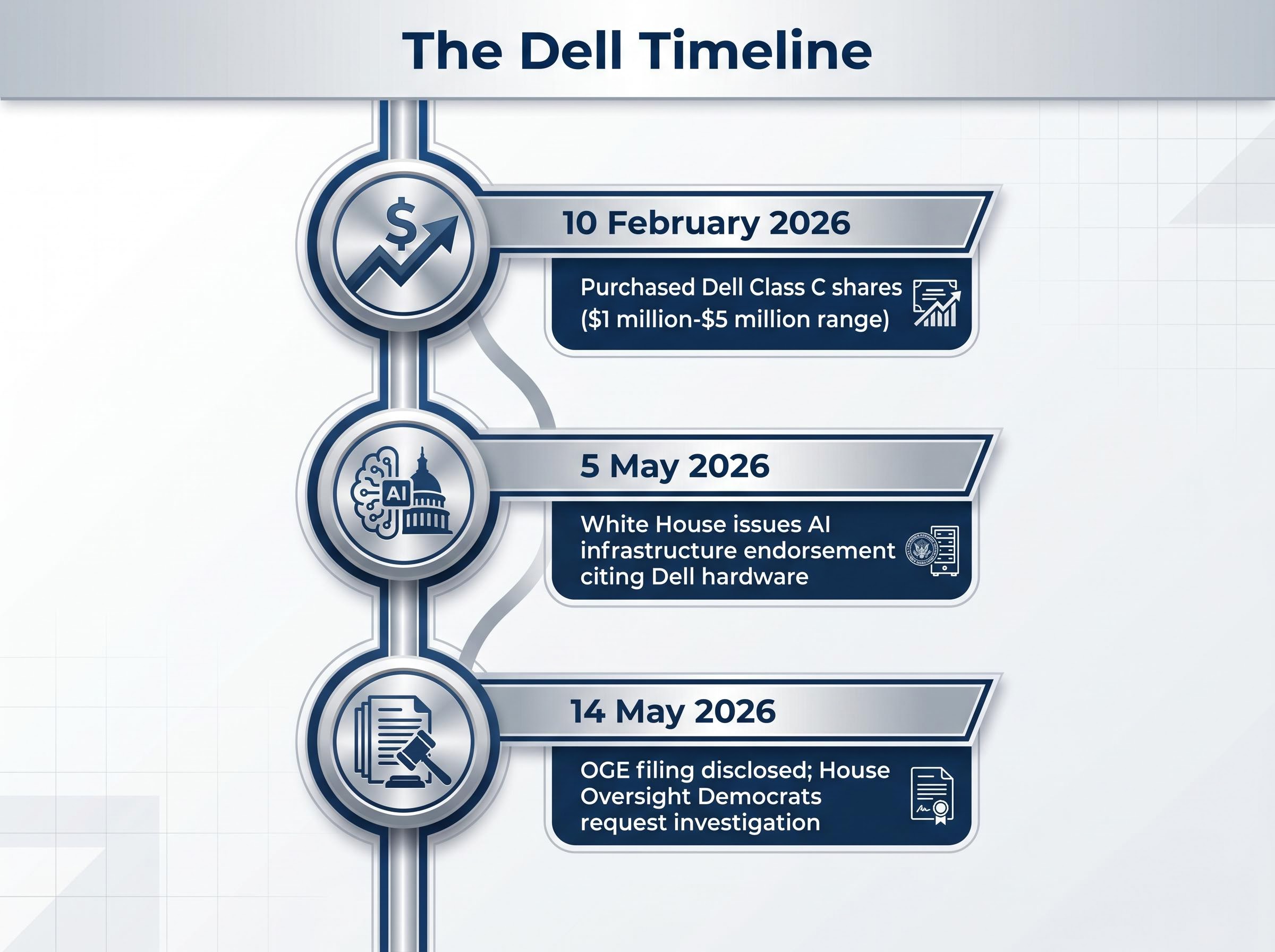
The chronology is precise, and the gap between purchase and policy action is where the scrutiny centres.
- 10 February 2026: Trump purchased Dell Class C shares in the $1 million-$5 million range
- 5 May 2026: The White House issued an AI infrastructure endorsement specifically citing Dell hardware
- 14 May 2026: The OGE filing disclosing the February purchase was accepted and made public
- 14 May 2026: House Oversight Democrats (Rep. Jamie Raskin) formally requested an OGE investigation
Dell stock rose 12% on the endorsement day and is up 18% year-to-date, with Trump’s stake now estimated above $5 million. Rep. Raskin’s request also flagged Intel, where purchases commenced in early March 2026 following a U.S. government equity stake decision in late 2025.
The 18 U.S.C. § 208 conflict of interest statute prohibits executive branch officials from participating in any official matter in which they hold a direct or indirect financial interest, making the sequence of a pre-endorsement purchase followed by a policy action the precise factual pattern the statute is designed to address.
“Timeline raises red flags under 18 U.S.C. § 208 conflict rules. Pre-endorsement buy precedes policy boost; OGE probe warranted.” Citizens for Responsibility and Ethics in Washington (CREW), 14 May 2026 press release
The Campaign Legal Center characterised the situation as “not illegal per se, but optics terrible,” noting Dell’s year-to-date gain and Trump’s estimated stake. Senator Rand Paul offered a contrasting view on X: “Disclosure transparency wins; media overreach.” The Senate Ethics Committee has not commented; prior 2025 probes closed without action.
Whether or not an investigation proceeds, the Dell pattern illustrates a recurring tension in presidential finance disclosures: the gap between legal compliance and the appearance of conflict is wide enough to sustain both market and political attention.
The Dell pattern is not unique to presidential finance: conflict-of-interest scrutiny has become a recurring feature of AI-era investment disclosures, with congressional investigators simultaneously examining whether OpenAI CEO Sam Altman directed company resources toward firms in which he holds personal stakes, a probe that illustrates how the gap between legal compliance and the appearance of self-dealing is generating political risk across the AI sector.
What retail investors are doing with this information, and what they should know before copying the trades
The enthusiasm is real. Retail volume across the named stocks exceeded $50 million on 14 May, with #TrumpTrades trending at 65% positive sentiment on StockTwits and Truth Social. A top r/wallstreetbets thread accumulated over 15,000 upvotes, with approximately 70% bullish sentiment. Analysts attributed roughly 10-15% of the day’s volume spikes to retail momentum.
The timing gap is the risk most of that enthusiasm ignores. NVIDIA had already climbed 45% year-to-date and traded at approximately 55x forward price-to-earnings at the time of disclosure. Copying a Q1 purchase in May means buying at a materially higher price than the filing reflects. CNBC Fast Money’s Melissa Lee warned on air against chasing already-elevated prices, while Jim Cramer characterised the broader portfolio shift as a “defensive rebalance” and questioned whether the tech liquidations amounted to “missing the AI wave.”
Bloomberg noted Trump’s track record of +28% annualised returns since 2025 disclosures, while cautioning investors to follow “at own peril.”
Three concrete risks for retail investors using presidential disclosures as buy signals:
- Timing gap: Trades were executed weeks or months before disclosure; prices have moved since
- Valuation run-up: Semiconductor names have already priced in significant AI infrastructure spending
- Policy reversal risk: Ethics scrutiny or policy shifts could create headline-driven sell-offs in the same names
The disclosure that confirms a trend already in motion, and what comes next
Trump’s portfolio rotation aligns with, rather than leads, the largest institutional reallocation of Q1 2026. Seven out of ten recent analyst notes cited the disclosed trades as “institutional confirmation” of the AI semiconductor thesis, per FactSet and Bloomberg data. Goldman Sachs consensus price targets for the core semiconductor positions remain above current levels: NVIDIA at $145 average (Goldman $160), Broadcom at $195 average (JPMorgan $210), Synopsys at $620 average (BofA $650), and Cadence at $310 average (Deutsche Bank $330).
The semiconductor supercycle framing that underpins analyst consensus on NVIDIA, Broadcom, and the EDA names is grounded in a structural argument: agentic AI workloads running continuously 24/7 are converting episodic chip demand into permanent baseline consumption, a shift that AMD procurement data suggests could expand the server CPU market to above $120 billion by 2030.
The rotation is also broadening beyond GPU makers into analog and EDA names, driven by post-CHIPS Act supply chain diversification policy.
Three forward-looking catalysts investors should monitor:
- OGE probe status: No formal probe has been announced as of the 14 May close, but the Raskin request creates a timeline for potential action
- Next quarterly disclosure window: The subsequent filing will reveal whether the semiconductor positions were held, expanded, or trimmed
- Intel-related policy announcements: Any further government equity stake decisions or domestic chip agenda updates could affect both Intel and the broader semiconductor cohort
For investors already positioned in AI semiconductors, the disclosure is directional confirmation. For those considering entry now, the combination of valuation stretch at 55x forward P/E on NVIDIA and ongoing ethics headline risk makes the calculus more complex than the filing alone suggests.
For investors weighing entry into any of the disclosed positions now, our dedicated guide to semiconductor stock valuation in 2026 applies three distinct valuation frameworks across the sector: PEG ratio analysis for hypergrowth names like NVIDIA, EV/EBITDA for cyclical recovery names, and cycle-adjusted forward estimates for memory names, with specific forward P/E data showing where individual stocks sit relative to dot-com-era peaks.
This article is for informational purposes only and should not be considered financial advice. Investors should conduct their own research and consult with financial professionals before making investment decisions. Past performance does not guarantee future results. Financial projections are subject to market conditions and various risk factors.