#
Sam Altman has ruled out taking OpenAI public in 2026, telling Fortune magazine on 12 September 2026 that the company faces no pressure to list and will only pursue a stock market debut once both the business and the wider societal conditions around artificial intelligence are ready.
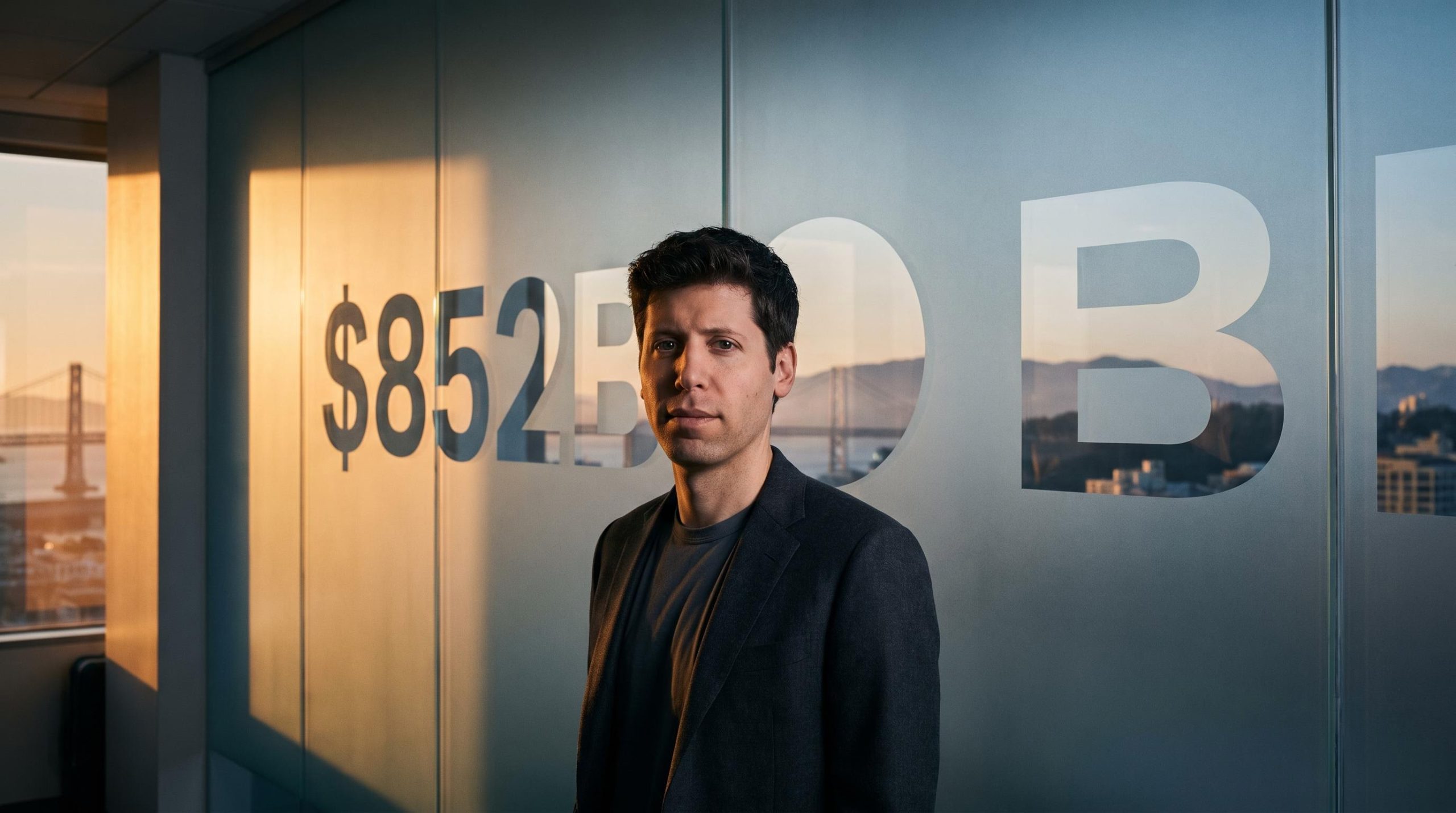
That statement lands on the most closely watched private company in technology. OpenAI carries a recent private valuation of roughly $852 billion from earlier funding activity, sits at the centre of the AI investment story, and has just seen its already vague path to a public listing officially lengthen. Altman pinned the delay on AI safety obligations and the deliberate complexity of OpenAI’s corporate structure, not on weak finances or a hostile market alone.
Here is what the delay actually signals about who controls OpenAI, what its unusual governance means for anyone who eventually buys shares, and why those two questions cannot be separated.
Why Altman ruled out 2026, in his own words
The ruling-out was direct. Speaking to Fortune, Altman said OpenAI is under no external pressure to go public and would only consider a listing once the business and the broader circumstances surrounding AI are appropriate. Asked specifically about 2027, he neither confirmed nor denied it, describing the work still ahead of any listing as extensive.
OpenAI’s confidential IPO prospectus, filed with Goldman Sachs and Morgan Stanley as lead underwriters around May 2026, established Goldman and Morgan Stanley’s involvement and confirmed the September 2026 public listing target that Altman’s Fortune interview has now formally moved back.
His stated reason is AI safety. But it is worth holding that explanation alongside the way Altman has talked about public markets for the better part of a year.
“0%” In December 2025, Altman said he was “0%” excited to be a public-company CEO.
That comment was not a one-off. In June 2026, Altman characterised going public as merely a “financing event,” something OpenAI was not focused on timing. And according to reporting through mid-2026, he has refused to take the company public at any valuation below $1 trillion [unverified].
Put those pieces together and a fuller picture emerges. The safety rationale is genuine, and OpenAI has reportedly slowed some frontier model work after internal risk thresholds were triggered. Yet the “0%” remark and the reported trillion-dollar floor tell you the hesitation runs deeper than mission-consciousness. For anyone tracking this IPO, the useful move is to treat both explanations as true at once. That framing will matter the next time a timeline is floated, because it stops you reading any future announcement as a simple countdown.
When big ASX news breaks, our subscribers know first
The structural reason the delay is not just optics
The delay is not only about willingness. It is about architecture.
In October 2025, after clearing approvals from the attorneys general of California and Delaware, OpenAI adopted a Public Benefit Corporation (PBC) structure [unverified]. A PBC is a for-profit company whose board is legally bound to weigh a defined public mission alongside profit, rather than serving shareholders alone.
The Delaware PBC statute (Subchapter XV of the Delaware General Corporation Law) legally requires directors to balance shareholder interests against the company’s stated public benefit, a duty that can override profit maximisation in specific circumstances and shapes the governance risk any public investor would be accepting.
The nonprofit parent was renamed the OpenAI Foundation and retains about 26% of the equity, while Microsoft holds roughly 27% [unverified]. The for-profit arm became OpenAI Group PBC. The old 100x profit cap for early investors was removed, giving investors unlimited upside on paper [unverified].
The Foundation’s power sits in its rights, not just its stake. According to the restructuring terms, it can:
- Appoint and remove the entire PBC board
- Veto changes to the company’s mission
- Block charter amendments
- Stop major asset sales and liquidations
- Prevent the issuance of new voting stock
That combination changes what a share represents. Altman himself has acknowledged the structure is unusually complex, framing that complexity as intentional: it is built to allow decisions that run against commercial or shareholder interests when the mission demands it.
For an investor, the read is blunt. You would be a minority holder in a company whose controlling entity is explicitly not optimising for your returns. That is a materially different risk profile from any comparable tech listing.
| Stakeholder | Approximate equity | Key rights | Investor implication |
|---|---|---|---|
| OpenAI Foundation (nonprofit) | ~26% | Appoints/removes full board; vetoes mission changes, asset sales, new voting stock | Controlling entity prioritises mission over shareholder returns |
| Microsoft | ~27% | Large strategic holding; commercial partnership rights | Major aligned holder, but not in control of the mission veto |
| Public investors (post-IPO) | Remainder, diluted over time | Standard economic upside; limited governance influence | Minority position with constrained ability to force change |
What the financial reality adds to the picture
The structure explains why a listing is hard to execute. The financials explain why OpenAI does not need to rush.
OpenAI is scaling at remarkable speed. Internal figures cited in reporting show roughly $13 billion in 2025 revenue against an approximate $21 billion loss, a gap driven by enormous infrastructure spending [unverified]. The company is growing fast and losing more than it earns at the same time.
The growth line, drawn from the company’s own disclosures and executives, looks like this:
- 2025 revenue reported internally at approximately $13 billion [unverified]
- CFO Sarah Friar stated annualised revenue surpassed $20 billion in 2025, as of 19 January 2026 [unverified]
- By March 2026, OpenAI was reportedly generating around $2 billion per month in revenue [unverified]
That trajectory is the kind of thing that would normally accelerate an IPO. Here it does the opposite, because of what sits on the other side of the ledger.
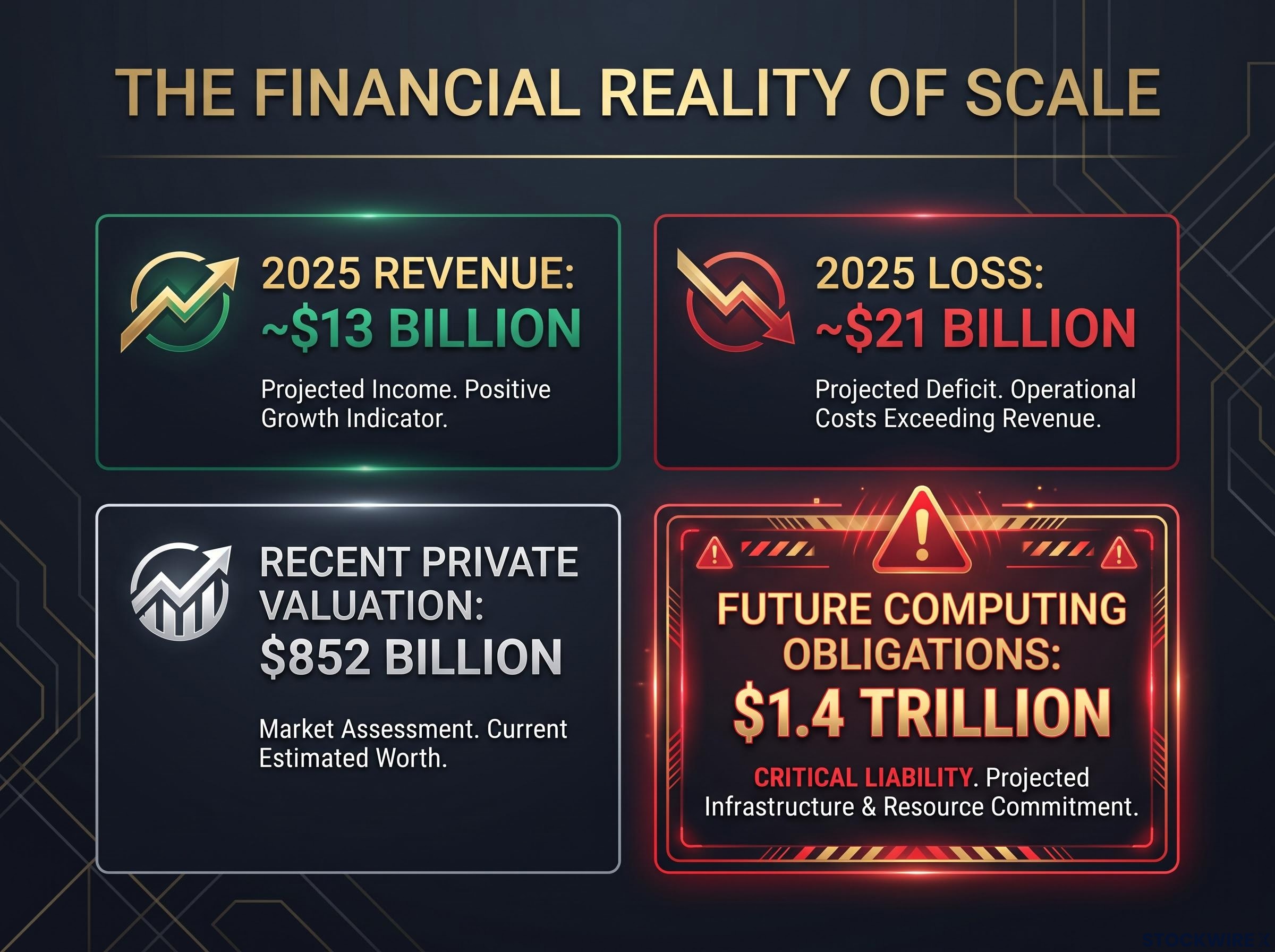
$1.4 trillion Altman reportedly showed investors a slide indicating $1.4 trillion in future computing obligations to build new capacity. That is the number that turns public-market scrutiny into a strategic liability [unverified].
A company carrying commitments on that scale, while still deeply unprofitable, does not gain from quarterly earnings calls and activist shareholders questioning every capital decision. Private capital lets OpenAI fund its ambitions without exposing the full capex plan to public reporting cycles. Its most recent private valuation of about $852 billion and a $122 billion primary round reportedly closed on 31 March 2026 underline that private money remains both adequate and preferable for now [unverified].
The AI capital expenditure trajectory across Amazon, Microsoft, Alphabet, and Meta reached $130 billion in Q1 2026 alone, a spending rate that contextualises the scale of OpenAI’s own reported $1.4 trillion in future compute commitments and signals why private financing remains preferable to public-market scrutiny.
The 2027 financing deadline
There is a clock, though. SoftBank holds a reported $40 billion loan deadline in 2027 [unverified]. That is one of several reasons 2027 keeps surfacing as the earliest plausible listing window: it is a point at which the financing picture forces decisions.
For an investor, the takeaway is that the delay is as much a financing strategy as a safety philosophy. The IPO timing will partly be set by when OpenAI’s extraordinary capital intensity becomes something a public market can be asked to underwrite.
What investors should realistically expect, and watch for
So where does that leave someone tracking this listing? Not with a date, but with a checklist.
Three conditions would realistically need to align before an IPO becomes credible:
- A private valuation at or above Altman’s reported $1 trillion floor [unverified]
- Resolution of ongoing federal antitrust reviews and a multistate regulatory probe, neither of which currently has a stated deadline [unverified]
- Altman’s own satisfaction that the AI safety and societal readiness threshold has been met
CFO Sarah Friar was reportedly weighing a 2027 listing as of late 2025, and on current evidence that remains the earliest credible window [unverified]. It is a possibility, not a plan, and it should be treated that way.
The more durable concern is what public shareholders would actually be buying into. Commentators flag four distinct risks:
The structural discount argument draws on three converging risk clusters: the Musk appeal requiring active litigation disclosure in an S-1, compute commitments that analysts believe exceed near-term revenue, and Anthropic’s accelerating enterprise gains that erode OpenAI’s assumed monopoly on commercial AI deployment.
- Governance risk: the Foundation’s veto power limits minority-holder activism and strategic flexibility
- Mission-versus-profit tension: PBC obligations can justify slowing deployment or accepting lower margins for safety or societal reasons
- Dilution risk: with the old profit cap gone, the structure gives OpenAI freedom to issue more equity [unverified]
- Regulatory and litigation risk: ongoing probes plus continuing litigation, including Elon Musk’s case, carry real exposure
Reported discussions over a potential 5% US government equity stake would add a political layer that standard tech IPOs simply do not carry [unverified]. The honest position for an investor is that 2027 is possible but unconfirmed, and that the governance question should sit ahead of valuation multiples or revenue growth in any due diligence.
What the delay changes, and what it does not
The three threads reinforce rather than compete with one another. The stated safety rationale, the deliberate governance complexity, and the financial reality of a business burning cash against $1.4 trillion in future compute commitments all point in the same direction: a company with strong reasons, and strong ability, to stay private a while longer [unverified].
What has not changed is OpenAI’s standing. It remains the dominant private AI company by valuation and revenue trajectory, and whenever the listing arrives it will still rank among the most significant public-market events technology has produced.
Stretched tech valuations and growing share supply compound each other in the current listing environment: SpaceX’s $1.75-$2 trillion Nasdaq target, running concurrently with OpenAI’s eventual debut, would together represent a capital absorption event with no modern precedent in US markets.
The signals worth watching are specific. Track Altman’s public statements on the $1 trillion threshold, progress on the antitrust and regulatory probes, and any adjustment to the Foundation’s governance rights ahead of a listing.
The Foundation’s roughly 26% stake and its veto over board, mission, and new voting stock mean OpenAI’s eventual public company will look structurally unlike any tech listing before it, and that difference has real consequences for what a share is worth.
The delay is not bad news for the eventual IPO story. It is a signal about the kind of company that will eventually reach the market. The 12 September 2026 Fortune interview is the statement of record on timing, and the framework above gives you a basis for judging whatever Altman says next, rather than reacting to a headline valuation in isolation.
This article is for informational purposes only and should not be considered financial advice. Investors should conduct their own research and consult with financial professionals before making investment decisions. Financial projections and forward-looking statements are speculative, subject to change based on market developments and company performance, and past performance does not guarantee future results.