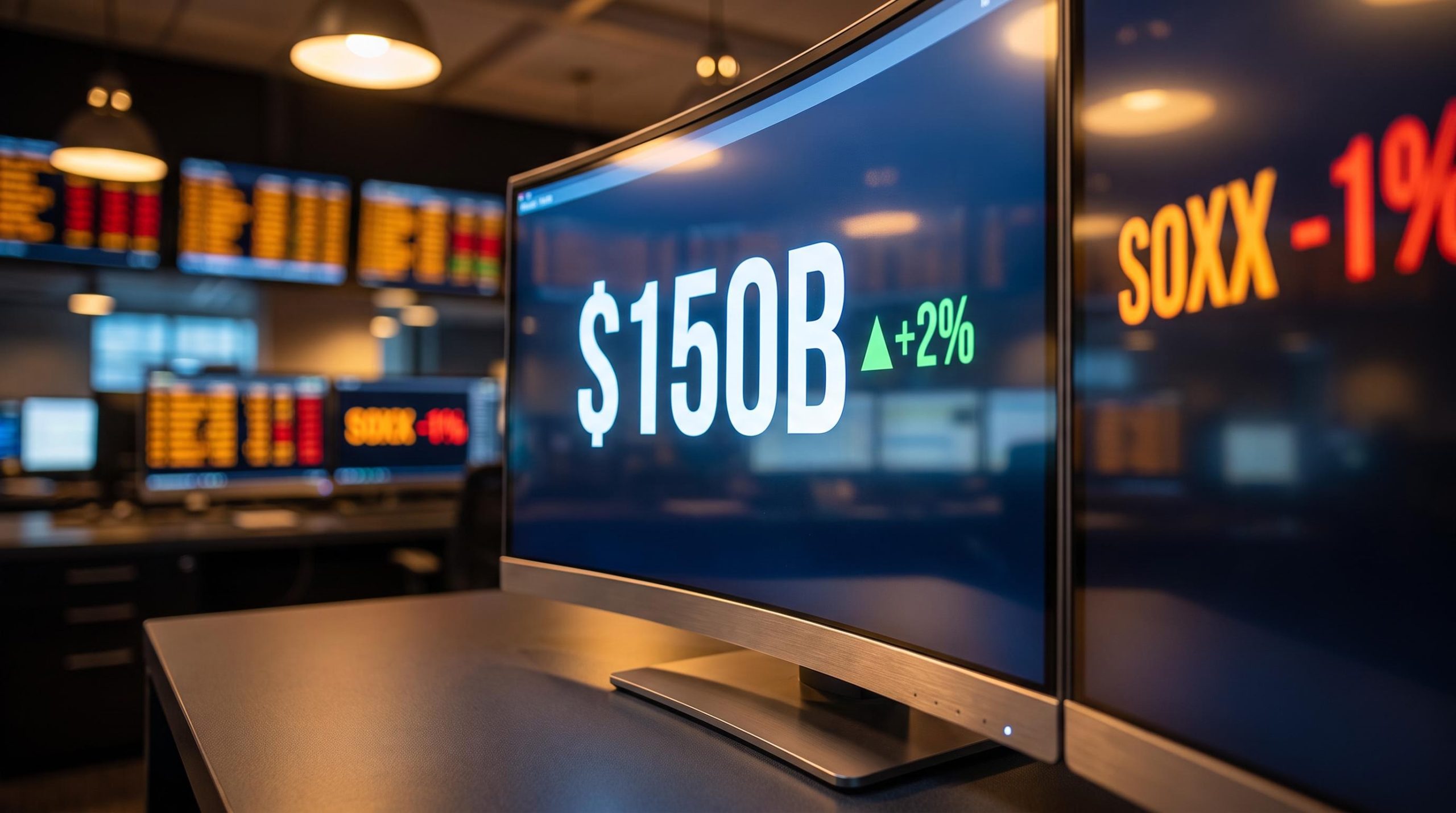
The largest corporate share buyback ever recorded, $150 billion, moved Nvidia’s stock approximately 2% on the day it was announced. On that same day, the iShares Semiconductor ETF fell roughly 1%.
Under a conventional reading of market mechanics, that is not how it is supposed to work. A record capital return is meant to signal strong management conviction, lift the stock, and warm sentiment across the sector. On 28 September 2026, it did none of those things at anything close to the scale the record would suggest.
That gap is a genuine finance puzzle, and it is worth understanding. What follows unpacks what actually drives the market response to buybacks, and what Nvidia’s record announcement reveals about where the semiconductor sector stands right now. By the time you finish this, you will read a buyback announcement not as a binary good-or-bad signal but as a layered piece of evidence about valuation, competition, and sector conditions.
What $150 billion actually buys a company’s shareholders
A share repurchase authorization is simpler than the headline number makes it sound. The board approves a ceiling on how much the company may spend buying its own shares back from the open market. Fewer shares outstanding means each remaining share represents a slightly larger slice of the same profits.
That produces three distinct effects:
- Share count reduction. Buying shares off the market shrinks the total number outstanding.
- Earnings per share accretion. The same net income divided across fewer shares lifts reported earnings per share, even if the underlying business has not grown.
- A management confidence signal. Spending cash on your own stock tells the market that the people who know the company best consider it worth owning at the current price.
Worth remembering: buybacks were illegal in the United States until the early 1980s. Once the rules changed, corporations went on to repurchase trillions of dollars of their own shares, and buybacks became a permanent fixture of how American companies return capital. That history matters because it explains why a record authorization is treated as headline news rather than routine housekeeping.
The shareholder primacy doctrine explains why a board committing $150 billion to repurchases faces almost no internal governance friction: executive compensation structures, activist fund dynamics, and buyback-driven EPS management have made capital returns the default mode for cash-generative U.S. corporations since the early 1980s.
The 2023 benchmark Nvidia set for itself
Here is why the muted 2026 reaction is analytically interesting: Nvidia has done this before, and it went very differently.
On 24 August 2023, Nvidia announced a $25 billion repurchase alongside quarterly earnings that far exceeded expectations. According to Reuters, shares surged as much as 6% to a then-record high. Even then, some shareholders called the authorization “a head-scratcher,” questioning whether repurchases were the best use of capital after the stock had already more than tripled that year.
Shareholders cheered blockbuster earnings while quietly labelling the $25 billion buyback “a head-scratcher,” an early sign of investor ambivalence toward large repurchases.
Now hold the two side by side. The 2026 authorization is six times larger and produced roughly one-third of the price move. The lesson is that buyback size alone does not move markets. What moves them is whether the buyback arrives alongside new positive information about the business. In 2023, it did. In 2026, it emphatically did not.
When big ASX news breaks, our subscribers know first
Three reasons a record authorization moved the needle by only 2%
If size is not the driver, what is? Three explanations were advanced across coverage, and each is independently sufficient to dent the reaction. Operating together, they explain the full size of the gap.
- Valuation was already rich. The buyback confirmed management’s view without giving the market new grounds to pay more.
- AI-chip competition is intensifying. A repurchase does nothing to address the competitive threat investors actually care about.
- The sector was selling off. The buyback was fighting a current rather than surfing one.
On valuation, Jordan Klein, a technology, media and telecom specialist at Mizuho, offered the sharpest sell-side framing. He noted the authorization “may not re-rate the stock,” and that Nvidia “sees own stock at 13-14x as a very attractive asset.” Management thinks the shares are cheap. The market already knew that story, so confirming it changed little.
The clearest evidence for the sector argument is in the tape itself. Look at what happened across the market on the same day.
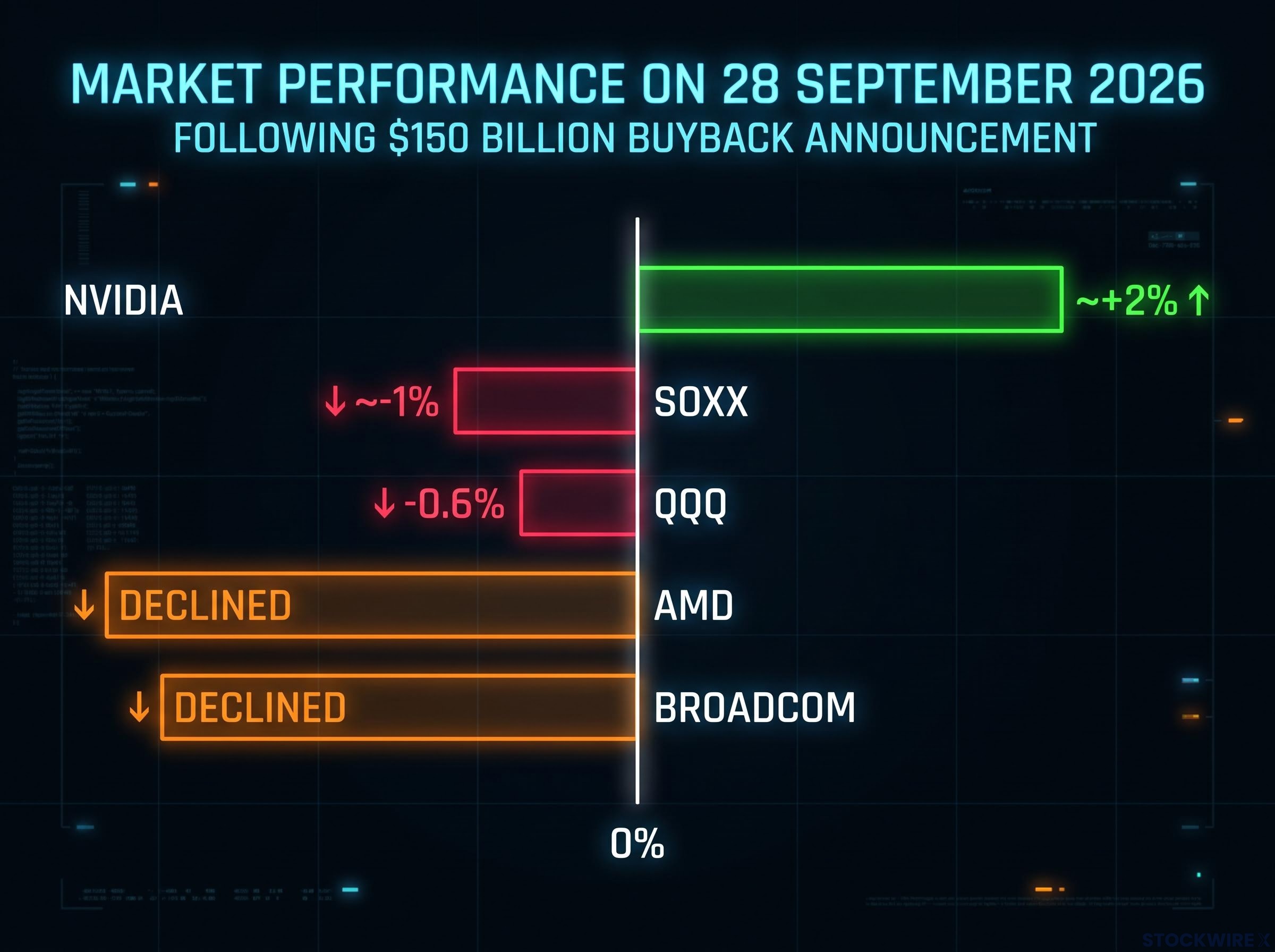
| Instrument | Direction | Approx. Move | Asset Type | Interpretation |
|---|---|---|---|---|
| Nvidia | Up | ~+2% | Single stock | Buyback signal absorbed |
| SOXX | Down | ~-1% | Semiconductor ETF | Sector-wide weakness |
| QQQ | Down | -0.6% | Large-cap tech ETF | Broad tech risk-off |
| AMD | Down | Declined | Single stock | No peer sympathy rally |
| Broadcom | Down | Declined | Single stock | No peer sympathy rally |
Nvidia rose while SOXX fell about 1%, QQQ dropped 0.6%, and both AMD and Broadcom declined. That tells you the announcement was landing in a market moving the other way. A buyback can produce a durable move when conditions cooperate; when they do not, its signal gets absorbed rather than amplified.
Reuters framed the 2026 authorization as Nvidia “making a big bet on its own stock” at a moment when intensifying AI-chip competition is weighing on its performance relative to peers. A repurchase does not answer the question investors are actually asking, which is whether Nvidia can defend its lead.
The custom silicon threat from Alphabet, Amazon, and Microsoft is the specific competitive pressure the buyback does nothing to answer: each hyperscaler is deploying billions in AI capex that simultaneously funds Nvidia’s order book and the inference-optimised chip programmes designed to reduce dependence on Nvidia GPUs over the 2027-2030 horizon.
Put the three together and the read is straightforward. Rich valuation, competitive uncertainty, and sector-wide selling meant the buyback was noted but not enough. For you, that is the practical takeaway: before assuming a buyback will lift a stock, ask where valuation sits relative to history, what the competitive backdrop looks like, and what the wider sector is doing on the day.
The split verdict: confidence signal or defensive move?
Here is what makes this event genuinely interesting rather than simply disappointing. Two sophisticated investors can look at the same announcement and reach opposite conclusions, and both readings are coherent.
The bullish case:
- Committing roughly $235 billion in total remaining authorization to repurchases is a serious statement.
- Doing so at 13-14x earnings signals management conviction that the stock is genuinely cheap.
- It reflects confidence that AI-driven cash generation will sustain at scale through fiscal year 2028.
The bearish case:
- A buyback this large may signal that Nvidia sees fewer high-return places to reinvest than its growth narrative implies.
- Reuters noted that competition is weighing on performance relative to peers, which reframes the buyback as partly defensive.
- Critics, in reactions aggregated by Digg, went further, calling it a sign of limited reinvestment vision.
Critics quoted via Digg labelled the $150 billion authorization “EPS manipulation,” lacking vision, and ethically questionable given the scale of cash committed.
That pull quote is worth sitting with, because it challenges the default assumption that buybacks are automatically shareholder-friendly. At this scale, the same cash could have gone toward AI infrastructure or competitive defence instead.
Not everyone treated the announcement itself as the story. Tim Knight at tastylive pointed to the broader sector dislocation visible on the day as the more actionable signal, expressing interest in semiconductor positions with international exposure. In that reading, the buyback was a sideshow to a sector-wide move.
The most useful thing here is what the ambiguity itself tells you. When the same announcement supports both a bullish and a bearish story, buybacks at this scale carry genuinely ambiguous information. The market’s 2% verdict was itself a decision: it saw both sides, and neither won.
For investors wanting the full programme mechanics behind the headline, our full explainer on Nvidia’s $235 billion authorization covers the three escalating board approvals across 13 months, UBS analyst Timothy Arcuri’s repurchase pace model, and the specific cash flow assumptions the FY2028 execution schedule depends on.
What would confirm each reading
The right response is not to pick a side today but to watch which conditions confirm one over the coming quarters.
Bullish confirmation: sustained AI chip demand, Nvidia executing repurchases at pace through fiscal year 2028 without slowing capital expenditure, and the stock recovering toward and through its all-time high, set on 14 May.
Bearish confirmation: visible erosion of Nvidia’s market share or margin from AI-chip rivals, a slowing buyback pace, and semiconductor ETFs continuing to underperform despite company-level capital returns.
What Apple’s record and Nvidia’s record actually have in common
The comparison everyone reached for was Apple, and it is more than a trophy stat. Apple held the previous record with a $110 billion authorization in 2024, a program that has been a defining feature of its mature-phase capital return, not a growth-phase signal.
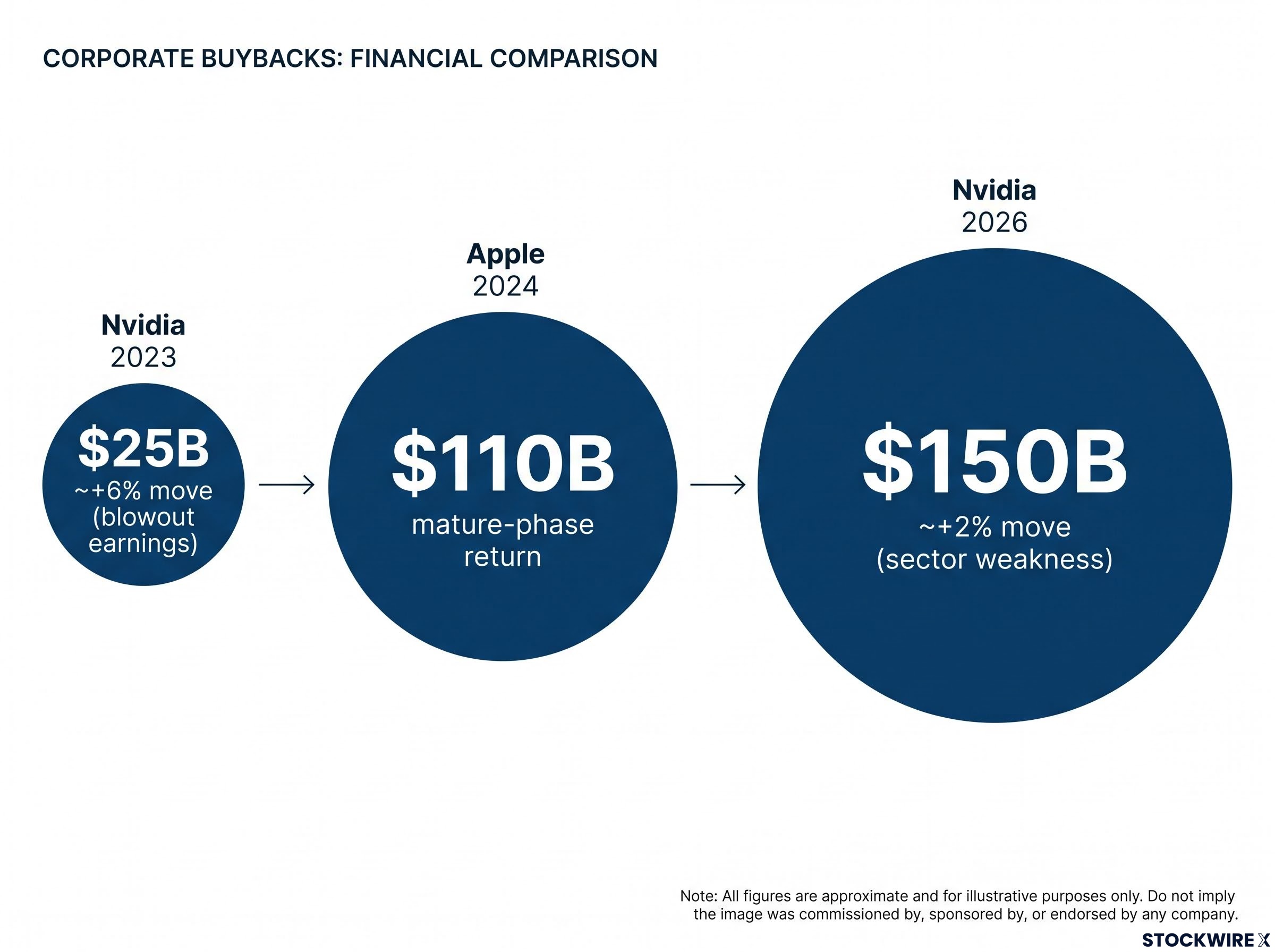
That is the structural link worth noticing. Both companies are returning capital at record scale because their businesses now generate cash faster than high-return internal projects can absorb it. That is a marker of maturity, and it does not automatically imply continued hypergrowth.
The contrast with broader buyback allocation across Big Tech sharpens the Nvidia read: hyperscaler repurchase spending has dropped from 27% to 15% of total cash outlay since 2022 as AI capex absorbs the difference, meaning Nvidia’s record authorization runs against the sector-wide trend of redirecting cash toward infrastructure rather than returning it.
| Company | Year | Authorization | Same-Day Move | Sector Backdrop |
|---|---|---|---|---|
| Apple | 2024 | $110B | Not the focus | Mature-phase return |
| Nvidia | 2023 | $25B | ~+6% | Blowout earnings |
| Nvidia | 2026 | $150B | ~+2% | Sector weakness |
The 2023 row is the anchor. Then, $25 billion plus an earnings surprise generated a 6% move. In 2026, $150 billion on its own generated 2%, because the market had already priced in Nvidia’s capacity to generate cash. Jordan Klein’s 13-14x framing is management’s valuation anchor, but the market did not treat it as new.
So the right questions to ask before treating any buyback as bullish are:
- How large is it relative to the company’s market capitalisation?
- Is there a fundamental catalyst arriving alongside it, or is it standing alone?
- What is the sector and macro backdrop doing on the day?
- Does the scale signal a growth-phase deployment or a maturity-phase return?
Applied to Nvidia, the Apple comparison reframes the record. It is less proof of exceptional health and more a signal of transition, from a company deploying capital aggressively into growth toward one beginning to return surplus cash at scale. For you, that transition carries different implications than the headline number implies.
Reading the next buyback announcement with clearer eyes
The core lesson is simple to state and easy to forget: buybacks are signals, not catalysts. Their price impact depends on three interacting variables, and Nvidia’s 28 September 2026 announcement put all three on display in a single event.
Those variables are the valuation context (13-14x earnings), the presence or absence of a fundamental catalyst (there was none, unlike in 2023), and the sector backdrop (SOXX down 1%, QQQ down 0.6% on the day). Run any large capital return through those three filters and you will ask sharper questions than the majority of investors who treat headline size as the signal.
One variable stays genuinely open. Whether the muted reaction proves the market’s correct read on a maturing growth company, or whether Nvidia’s AI earnings trajectory through fiscal year 2028 vindicates management’s conviction and makes the $235 billion authorization look prescient, will only become clear with time. Because 2026 lacked an earnings catalyst, execution pace becomes the key forward signal.
Watch three things from here:
- Nvidia’s actual repurchase pace against its authorization.
- Whether semiconductor sector ETFs recover or keep underperforming.
- Whether AI-chip competitive dynamics shift the earnings multiple the market is willing to assign.
Jordan Klein of Mizuho offered the most precise summary of the market’s 2% verdict: the program signals management conviction, but “may not re-rate the stock.”
This article is for informational purposes only and should not be considered financial advice. Investors should conduct their own research and consult with financial professionals before making investment decisions. Past performance does not guarantee future results, and forward-looking statements are speculative and subject to change based on market developments and company performance.