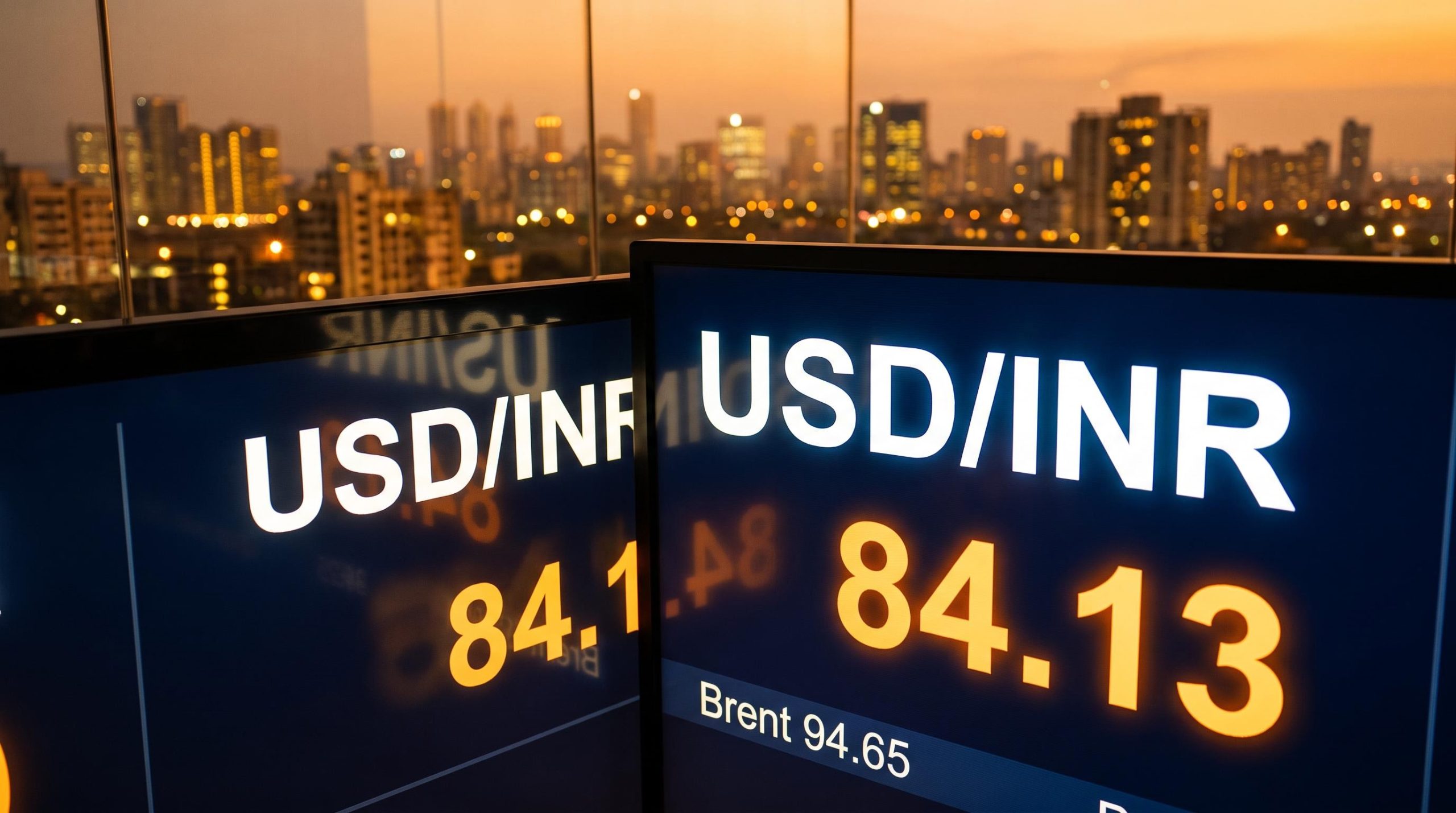
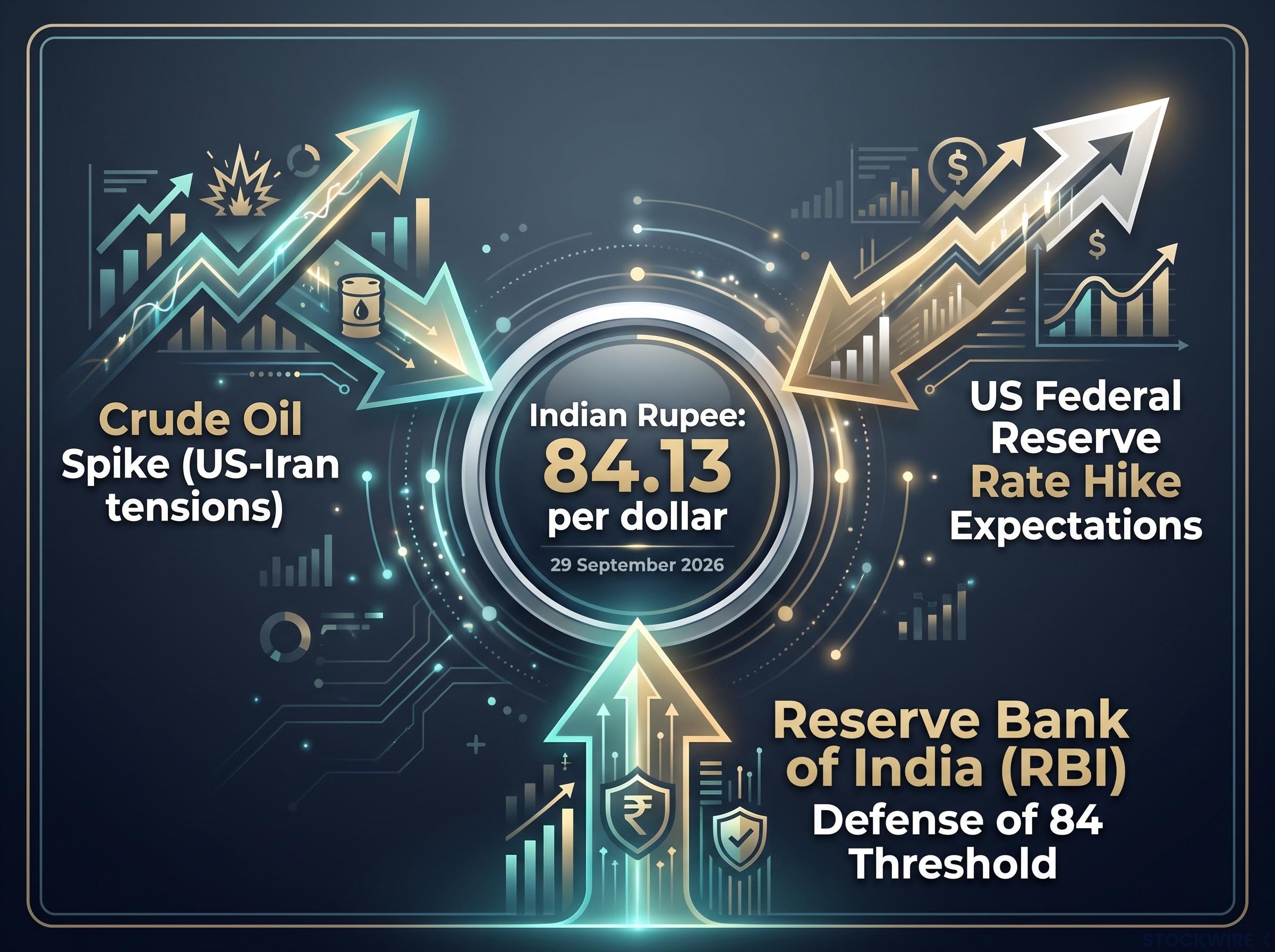
The Indian rupee sat at roughly 84.13 per dollar on 29 September 2026, a two-month low, and it did not get there by accident. It arrived at that number because three separate forces met at the same moment: a crude oil spike tied to US-Iran tensions, hardening expectations of another US Federal Reserve rate hike, and a Reserve Bank of India (RBI) determined to slow the slide.
Those three forces rarely converge together. India is structurally exposed on every one of them, sitting between a geopolitical oil shock and a tightening US monetary cycle with no natural hedge on either side. The 84-per-dollar level itself is no coincidence: it is the threshold the RBI has publicly signalled it will defend, turning the currency pair into a live contest between market pressure and central bank resolve.
This piece maps each force on its own, then shows how they compound. After reading it, you will know which variable to check first when the next rupee headline lands, and why the currency moves the way it does when oil prices or Fed language shift, rather than just what today’s number happens to be.
India’s oil problem: why a crude spike hits the rupee harder than almost any other Asian currency
India is one of Asia’s largest net oil importers, and that single fact does more to explain the rupee’s behaviour than any policy decision the RBI has ever made.
When crude prices rise, India’s import bill rises with them, almost mechanically. A larger bill means Indian buyers need more US dollars to pay for the same barrels, and that extra demand for dollars pushes USD/INR higher. This is a flow story, not a sentiment story. The dollars have to be bought regardless of what traders feel about India.
You saw the transmission live on 29 September 2026, when MCX Crude Oil futures for the 19 October expiry climbed roughly 2% to about Rs. 9,020, according to FXStreet. On the global benchmarks, Brent settled at 94.65 USD per barrel and WTI at 90.22 USD per barrel on 1 September 2026 per Reuters, with a later TradingEconomics reading placing Brent near 107.83 USD per barrel on 28 September 2026 (that higher figure is unverified and should be treated with caution).
The relationship runs so tightly that when oil eases, the rupee is expected to firm.
The rupee sensitivity to crude prices has a quantified mechanical dimension that sits beneath the flow story: IJRPR research estimates every $1 rise in Brent depreciates the rupee by approximately 0.28 rupee, a coefficient that operates independently of RBI intervention or Fed action and explains why the import-bill arithmetic is so difficult to offset with policy tools alone.
Brecorder observed on 22 September 2026 that when oil prices slipped, the rupee was expected to “edge higher,” with substantial foreign exchange inflows helping cap bearish bets. That near-one-to-one link is exactly what sets the rupee apart from its regional peers.
Contrast India with an Asian energy exporter or a more balanced energy economy. Those currencies often gain something when oil rises, because their export revenues climb. India gets the downside of expensive oil with none of that offsetting upside. There are three structural reasons this asymmetry bites so hard:
- Current-account deterioration: higher crude widens India’s trade gap, forcing it to attract more capital or draw down reserves.
- Inflation and monetary trade-offs: pricier fuel feeds domestic inflation, pressuring the RBI to tighten even when growth is fragile. Natixis analysts, cited by Brecorder, expect the RBI to need roughly 50 basis points of rate hikes by end-2026 as a downstream consequence.
- Reliance on portfolio inflows with no oil-revenue hedge: India funds part of its deficit with foreign money that turns fickle exactly when oil and rates rise together.
Here is what that means for you as a reader of rupee headlines. Every meaningful rise in Brent is, for the rupee, the equivalent of a tightening in external financial conditions. Oil news is always rupee news, no matter what else is happening in global markets.
When big ASX news breaks, our subscribers know first
The Iran factor: how a diplomatic denial in Washington moved the rupee in Mumbai
The rupee’s move on 29 September 2026 did not begin in Mumbai. It began with a report in Washington and a post on a US President’s social media account, which is a strange chain until you see how each link connects.
The sequence unfolded like this:
- A report attributed to Axios suggested Washington had agreed to ease sanctions on Iran and unfreeze Iranian assets in exchange for nuclear-programme concessions.
- Oil prices initially softened on the prospect of more Iranian crude returning to the market.
- US President Donald Trump denied any such deal via Truth.Social, dismissing the report as false.
- Crude spiked on the denial, as the market repriced the odds of sanctions relief back down.
- The rupee weakened to about 84.13, its two-month low, per FXStreet.
The distance travelled is striking. Brent had fallen to 73.74 USD per barrel on 24 June 2026 after the US initially authorised Iranian oil sales, per Reuters, against the later unverified TradingEconomics reading near 107.83 USD per barrel on 28 September 2026. CNBC framed crude as up roughly 30% since the Iran conflict began, though that figure is also unverified.
Hormuz shipping data tells a starker story than diplomatic statements suggest: commercial transits have collapsed to just 3-14 vessels per day against a pre-war baseline of 120-140, and war-risk insurance premiums running at roughly 30 times normal rates mean a ceasefire declaration alone cannot restore commercial flows or the oil-price stability the rupee depends on.
Why the Strait of Hormuz is the rupee’s most watched geopolitical chokepoint
A significant share of the world’s oil supply passes through the Strait of Hormuz. That share is what converts a regional diplomatic signal into a global price event.
Any threat to the strait’s openness lifts the price every importer pays, and India, buying the bulk of its crude from abroad, feels it directly through the import bill and therefore through USD/INR. So a headline about Hormuz is not background noise for the rupee. It is front-page currency risk.
The diplomatic outlook is genuinely unsettled rather than just tense for show.
Iran’s Foreign Minister Abbas Araghchi confirmed that talks on reopening the Strait of Hormuz and reaching full peace with the US are being routed through Qatari mediators, and said conditions set by Iran’s Supreme Leader must be met before the strait can reopen.
For you, the lesson is that the rupee’s sensitivity to US-Iran diplomacy is a direct transmission, not a side effect. Any development touching Hormuz passage or Iranian sanctions relief reads through to USD/INR almost immediately, because India’s oil dependence hardwires the link.
The Fed dimension: how US rate expectations drain capital from emerging markets
Suppose Iran resolved tomorrow and oil settled back down. The rupee would still be under pressure, because a second, entirely separate channel is pulling on it: the US Federal Reserve.
The mechanism is arithmetic, not mood. When markets expect higher US rates, US yields rise and the dollar strengthens broadly. That makes rupee-denominated assets less attractive by comparison, and global investors rotate capital back into US fixed income. Money leaves emerging markets like India regardless of anything happening inside India itself.
India is unusually exposed here too, because it funds part of its current-account deficit with foreign portfolio investment, and that money is highly sensitive to US rate expectations. Higher expected Fed rates tighten global financial conditions and thin out risk appetite, which hits deficit countries reliant on inflows first.
Market pricing repriced fast in the second half of September, which is why the near-term catalyst mattered so much.
| Date | October hike probability | December cumulative probability | Analyst forecast |
|---|---|---|---|
| 17 September 2026 | ~50% | ~88.5% (additional 25 bp) | BofA: 2 hikes, 50 bp total |
| 29 September 2026 | ~70% | Not specified in sources | BofA: 2 hikes, 50 bp total |
The CME FedWatch October hike probability jumped from roughly 50% on 17 September 2026 (per TheStreet) to nearly 70% by 29 September 2026 (per FXStreet), while BofA Global Research had already forecast two more hikes totalling 50 basis points across October and December in a mid-September Reuters broker survey.
That is why a US labour report becomes a rupee event. The JOLTS Job Openings report for August 2026, due at 14:00 GMT on 29 September 2026, was forecast at roughly 7.23 million against 7.271 million in July (the actual figure was not available in source materials). A stronger reading would firm the case for an October hike, and pressure on the rupee with it.
Natixis argues the RBI will likely need to raise rates by around 50 basis points by end-2026 to preserve a real-rate differential against the Fed, meaning intervention alone will not carry the currency.
What this tells you is simple. When US yields rise, the mathematical case for holding rupee assets weakens, and capital moves accordingly. You should treat major US data releases as rupee events, not just American ones.
The RBI’s defence of 84: what central bank intervention can and cannot do
The RBI is not letting the rupee fall freely, but it is not holding a fixed peg either. Understanding the difference is the whole game.
The mechanism is straightforward. The RBI sells US dollars into the spot market, usually through public sector banks, to absorb the excess dollar demand that oil imports and capital outflows create. It draws on foreign exchange reserves, a buffer it has recently rebuilt partly through Foreign Currency Non-Resident (FCNR) deposit inflows, which are deposits held in India by non-resident Indians in foreign currency. Market participants told Reuters the RBI has been an almost daily presence in currency markets.
The case for defending, and the limits of it
There is a real argument for active defence. Selling dollars smooths volatility, anchors inflation expectations, and prevents the kind of disorderly depreciation spiral that can destabilise domestic markets, especially when the shock is external (oil, geopolitics, the Fed) rather than home-grown.
But leaning on intervention alone has costs. Natixis warns that FX sales are not enough and that rate hikes will ultimately be needed. Defending a visible level invites speculators to test it, forcing larger and more frequent interventions. Reserves buy time; they do not fix a currency that is misaligned with fundamentals.
The RBI reserve buffer is smaller in practice than the headline figure implies: forward and swap obligations reduce usable reserves meaningfully below the $740 billion reported level, and domestic brokerage Systematix estimates the rupee sits on a structural depreciation path of around 6.5% per year without aggressive ongoing intervention.
History shows the recurring pattern:
- 2013 Taper Tantrum: the RBI combined dollar sales with rate hikes and macro-prudential measures as US yields spiked and capital fled emerging markets.
- 2018 oil-driven EM sell-off: a simultaneous oil spike and Fed tightening exposed the rupee’s particular sensitivity to that exact combination.
- 2023 defence of 83.29: Reuters reported the RBI selling dollars via public sector banks to hold the then-record low, after which DBS moved to a managed 83-85 band forecast rather than a fixed line.
What history says about how long rupee defences hold
Each episode leaves one lesson. The 2013 experience shows credible early action matters, because decisive signalling calms expectations before panic sets in. The 2018 sell-off shows reserves buy time but cannot fix fundamentals when oil and the Fed push together. The 2023 defence shows a managed band proves more durable than a rigid line in the sand.
Read against the current episode, those precedents suggest the RBI will manage the pace of depreciation rather than reverse it. You should interpret the 84 level as a brake on the slide, not a floor beneath it.
What the next move looks like: three variables the rupee is watching
The rupee’s next leg depends on three variables, and monitoring any one alone gives you an incomplete picture. The real work is watching whether they pull together or partly cancel each other out.
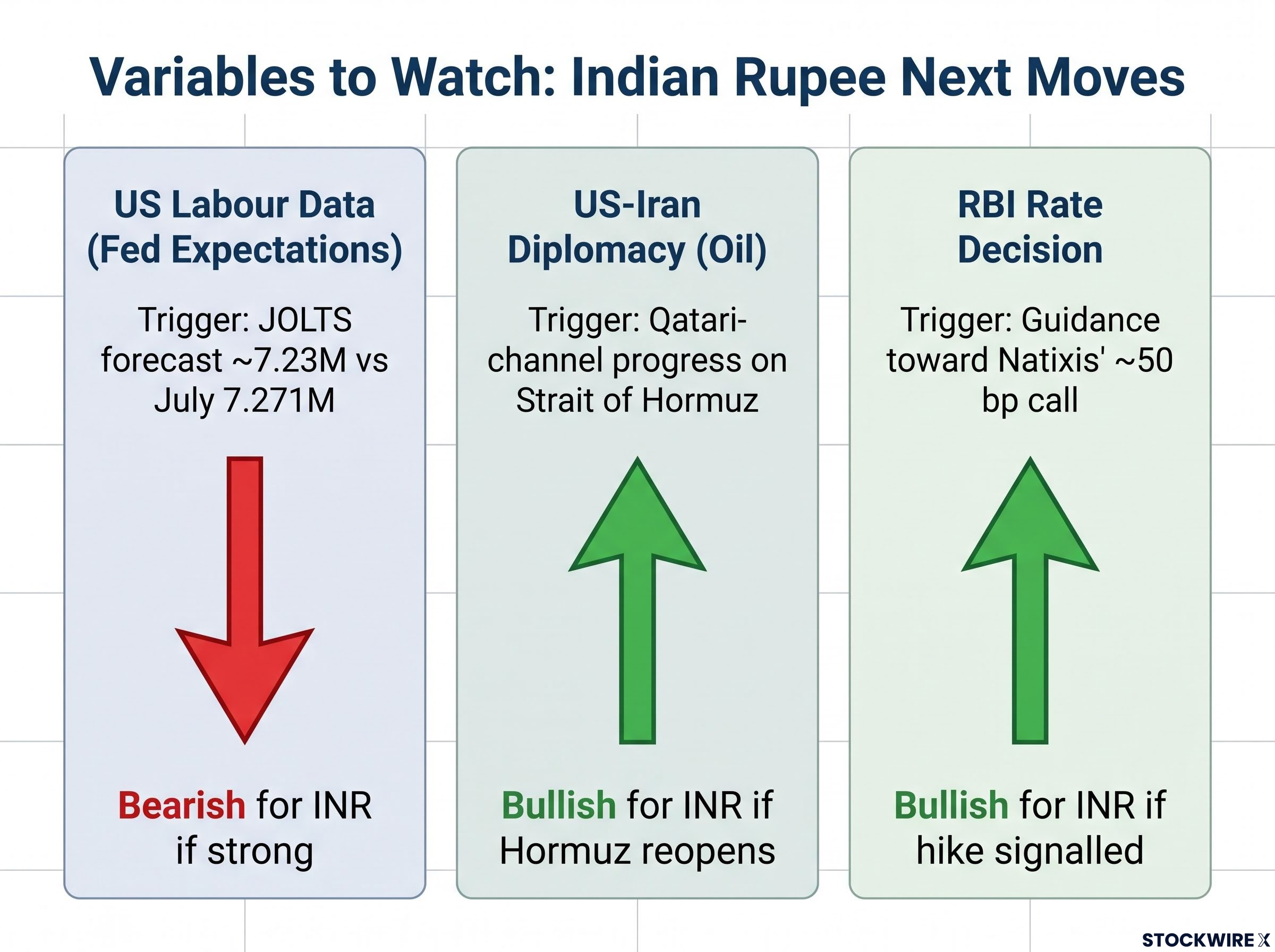
| Variable | Direction of pressure for INR | Trigger event to watch |
|---|---|---|
| US labour data (Fed expectations) | Bearish if strong | JOLTS release, then subsequent labour prints |
| US-Iran diplomacy (oil) | Bullish if Hormuz reopens | Qatari-channel progress on sanctions and Hormuz |
| RBI rate decision (domestic policy) | Bullish if hike signalled | RBI guidance toward Natixis’ ~50 bp call |
The most immediate is US labour data. The JOLTS forecast of roughly 7.23 million against a prior 7.271 million sets the near-term test, with market pricing already at a 70% October hike probability. A strong print pushes that probability higher and weighs on the rupee.
The ongoing variable is the US-Iran diplomatic channel through Qatar. Araghchi’s framing that Hormuz reopening requires Supreme Leader-level conditions tells you this one is likely to stay live rather than resolve quickly. Progress that reopens the strait would ease oil and relieve the rupee.
The domestic variable is the RBI’s own rate timeline. A signalled hike toward Natixis’ 50-basis-point call would support the currency by narrowing the real-rate gap with the US.
An RBI tightening pivot, if it materialises, would create a counterintuitive dynamic: higher domestic inflation, typically bearish for any currency, becomes net-positive for the rupee if it forces a credible rate response that narrows the real-rate gap with the Fed, which is precisely the mechanism Commerzbank and DBS Group Research argue has been underpriced by the market.
Note one data uncertainty: the JOLTS actual figure was not available at publication. Its release at 14:00 GMT on 29 September 2026 is the most immediate market-moving event on the calendar.
One housekeeping point on the number itself. Sources conflict, with FXStreet at 84.13 and TradingEconomics at 96.22. This piece uses 84.13, which is consistent with the RBI’s own framing around the 84 threshold.
Managing the rupee’s crosscurrents: what a convergence of pressures means for the road ahead
Read individually, oil, the Fed, and the RBI look like three separate stories. Read together, they are one system, and the rupee’s direction depends on which force shifts first.
Oil and geopolitics set the flow pressure through India’s import bill. Fed expectations set the capital-flow pressure through yield differentials. RBI intervention sets the pace at which the rupee is allowed to absorb both. Right now, all three lean in the same direction, which is why USD/INR sits at 84.13.
The two analytical goalposts frame the policy environment neatly: BofA’s forecast of two Fed hikes totalling 50 basis points, and Natixis’ call for roughly 50 basis points of RBI hikes by end-2026 to keep the real-rate differential intact.
The takeaway is that 84 is best understood as a managed threshold, not a guarantee. The RBI’s historical playbook is tactical intervention followed by policy adjustment when external pressure persists, and nothing about this episode suggests a departure from it.
The rupee is not in freefall. But the conditions sustaining the pressure are unresolved, and the RBI’s tools are real yet limited. Resolution of any single variable, a Hormuz breakthrough, a soft JOLTS surprise, or firm RBI rate guidance, could materially shift the picture.
This article is for informational purposes only and should not be considered financial advice. Investors should conduct their own research and consult with financial professionals before making investment decisions. Past performance does not guarantee future results, and forward-looking statements are speculative and subject to change based on market developments.