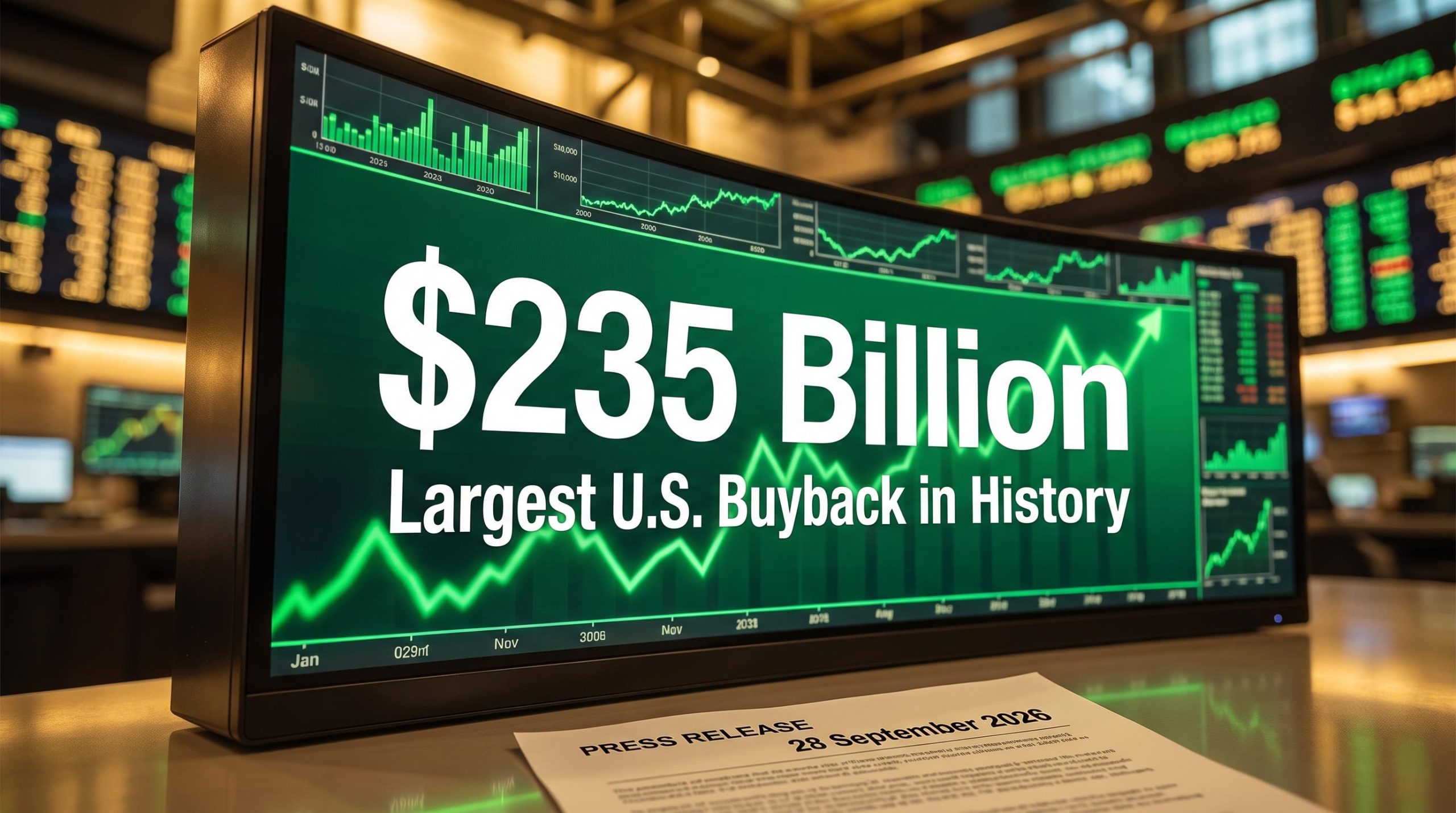
Nvidia’s board has approved $150 billion in additional share repurchases, lifting the company’s total remaining buyback authorisation to roughly $235 billion, a figure confirmed by Bloomberg-compiled data as the largest such programme in U.S. history.
The approval landed on 28 September 2026, and the market read it as more than routine housekeeping. Shares climbed roughly 1.7% to 1.9% in premarket trading on the news, with CEO Jensen Huang explicitly tying the decision to a generational shift toward AI and accelerated computing.
That framing matters, because a buyback this size is not a passive cash-return gesture. It is a statement about how durable Nvidia’s board believes its AI-driven cash flows will be through the end of the decade.
Here is what the authorisation actually means for shareholders already holding the stock, why its scale sits outside anything U.S. markets have seen before, and the capital-allocation trade-offs the headline number quietly leaves unanswered.
Nvidia’s board approves $150 billion more in buybacks, setting a U.S. record
Nvidia’s board approved a $150 billion increase to its existing share repurchase authorisation on 28 September 2026, according to the company’s official press release and confirmed in its SEC filings. That brings the total remaining buyback capacity to approximately $235 billion, and Nvidia expects to deploy the full amount through fiscal year 2028.
The key detail the headline number hides is the cadence that produced it. This is the third authorisation increase in roughly 13 months, and each one has been larger than the last.
Nvidia’s Q1 FY2027 earnings delivered $81.62 billion in revenue with an accompanying $80 billion buyback authorisation, making the September escalation to $235 billion the third step in a sequence that has tracked the company’s cash generation curve upward quarter by quarter.
That escalating pace is the real signal. It tells you the board is not issuing a one-off confidence gesture; it is actively sizing its capital-return programme upward as its cash generation grows, which changes how you should read any future authorisation Nvidia announces.
Here is how the sequence built to the record:
| Event | Date | Amount Added | Remaining Total |
|---|---|---|---|
| Authorisation increase | 26 August 2025 | $60B | Approx. $58.5B (as of Jan 2026 filing) |
| Authorisation increase (no expiration) | 18 May 2026 | $80B | $38.5B at Q1 FY2027 end |
| Remaining at Q2 FY2027 end | 26 July 2026 | N/A | $99.3B |
| Authorisation increase | 28 September 2026 | $150B | $235B |
The $60 billion added in August 2025 and the $80 billion added in May 2026 already put Nvidia in rare company. As of the end of Q2 FY2027 on 26 July 2026, roughly $99.3 billion remained under the programme, per SEC filings.
The $150 billion approved this week is not a standalone decision, then. It is an acceleration layered on top of an authorisation that was already among the largest ever recorded, and the $235 billion total now stands, per Bloomberg-compiled data cited by Seeking Alpha, as the biggest buyback authorisation in U.S. history.
When big ASX news breaks, our subscribers know first
What a $235 billion buyback authorisation actually means for shareholders
A buyback works by reducing the number of shares outstanding. When a company buys back its own stock, the same total earnings are divided across fewer shares, which lifts earnings per share (EPS) for everyone still holding.
At Nvidia’s scale, three mechanics matter for existing holders:
- Float reduction: Fewer shares in circulation means each remaining share represents a larger slice of the company.
- EPS accretion: With profits spread across a smaller share count, per-share earnings rise even if total earnings stay flat.
- Value accretion: When repurchases happen below a company’s estimated intrinsic value, remaining shareholders effectively buy the business back at an attractive implied return.
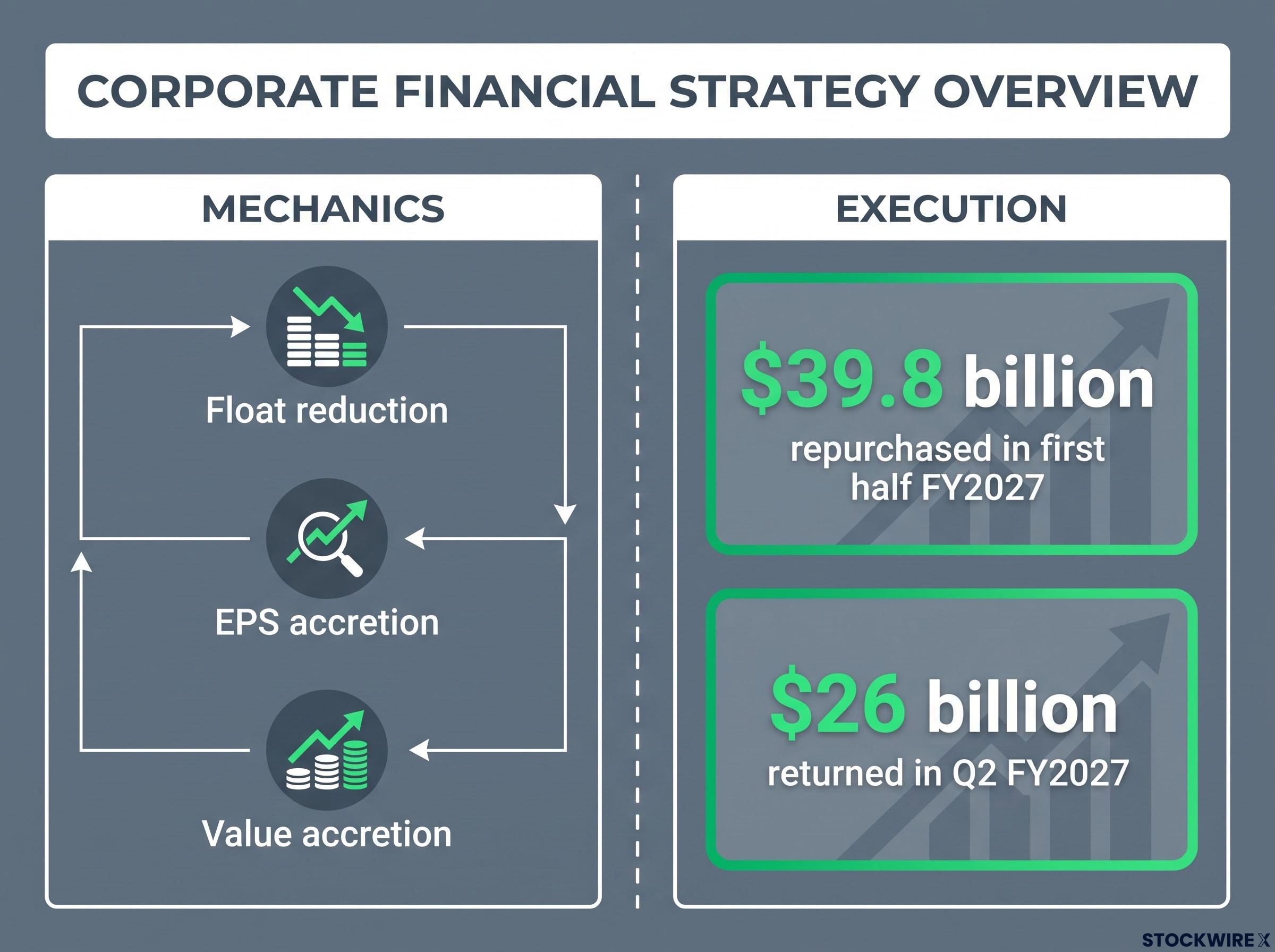
The theory only matters if the execution is real, and Nvidia’s is. The company repurchased approximately $39.8 billion of stock in the first half of FY2027, per SEC filings, and returned more than $26 billion to shareholders in Q2 FY2027 alone through buybacks and dividends combined.
Share dilution through stock-based compensation runs in the opposite direction to buyback accretion, and at technology companies where SBC is stripped from non-GAAP figures, the net per-share effect of a repurchase programme can be substantially smaller than the headline authorisation implies.
The scale of actual execution Nvidia returned over $26 billion to shareholders in a single quarter (Q2 FY2027) through buybacks and dividends. That is the pace the $235 billion authorisation is layered on top of.
Ahead of the announcement, UBS analyst Timothy Arcuri modelled that Nvidia would need to repurchase roughly $69 billion of stock over three fiscal quarters to hit its stated target of returning about 50% of free cash flow to investors this year.
Here is the distinction that protects you from over-reading the headline. The $235 billion is a ceiling the board has approved, not a fixed spending schedule. The gap between that authorisation and Nvidia’s actual quarterly pace is optionality, which gives the board flexibility but also means you should not treat the full figure as guaranteed near-term EPS accretion. Track the quarterly execution reports, not the authorisation number.
Jensen Huang frames the buyback as a bet on AI’s generational trajectory
Huang tied the expansion directly to what he described as a generational shift toward AI and accelerated computing. That framing is the interpretive key to the size of the decision.
Jensen Huang’s framing The authorisation reflects a generational shift toward AI and accelerated computing, positioning Nvidia’s capital return capacity as a function of sustained AI-driven revenue expansion rather than a one-time cash windfall.
The business logic follows from there. Nvidia has built a franchise in AI accelerators, systems, and software that analysts treat as the primary infrastructure layer for enterprise and hyperscale AI adoption, and that revenue base is now generating cash flows large enough to fund aggressive growth investment and a record-scale buyback at the same time.
This is not the start of the trajectory, either. MarketWatch, citing Birinyi Associates data, had already described Nvidia’s $80 billion May 2026 authorisation as the largest buyback authorisation for any U.S. company other than Apple as of April.
The September move extends that pattern rather than opening it. Analysis from Tikr interprets the sequence of escalating authorisations as a signal that Nvidia expects sustained AI demand and monetisation through 2026 and beyond, not a short-lived surge.
What Huang’s framing tells you is specific: the board is not treating current AI demand as cyclical or uncertain. It is sizing a multi-year capital-return programme against a multi-year revenue durability thesis, and your job as a shareholder is to weigh that conviction against your own view of how long AI infrastructure spending holds up.
The trade-offs that $235 billion in buybacks does not answer
Every dollar committed to buybacks is a dollar that cannot fund something else. At this magnitude, the programme competes directly with three other uses of Nvidia’s cash:
The hyperscaler buyback retreat since 2022, with repurchase allocation dropping from 27% to 15% of cash spending across major tech firms, sets the context for why Nvidia’s decision to scale repurchases upward while simultaneously funding AI infrastructure growth reads as structurally unusual rather than routine.
- R&D and compute expansion: Money spent on repurchases is money not invested in new architectures, software stacks, manufacturing capacity, or partnerships that could extend Nvidia’s technological lead.
- Strategic acquisitions: Buying AI software firms, networking companies, or data-centre infrastructure providers could compound Nvidia’s platform advantages, and that cash is now earmarked elsewhere.
- Balance-sheet resilience: Very large repurchases draw down cash reserves, reducing the cushion available if AI demand or pricing softens.
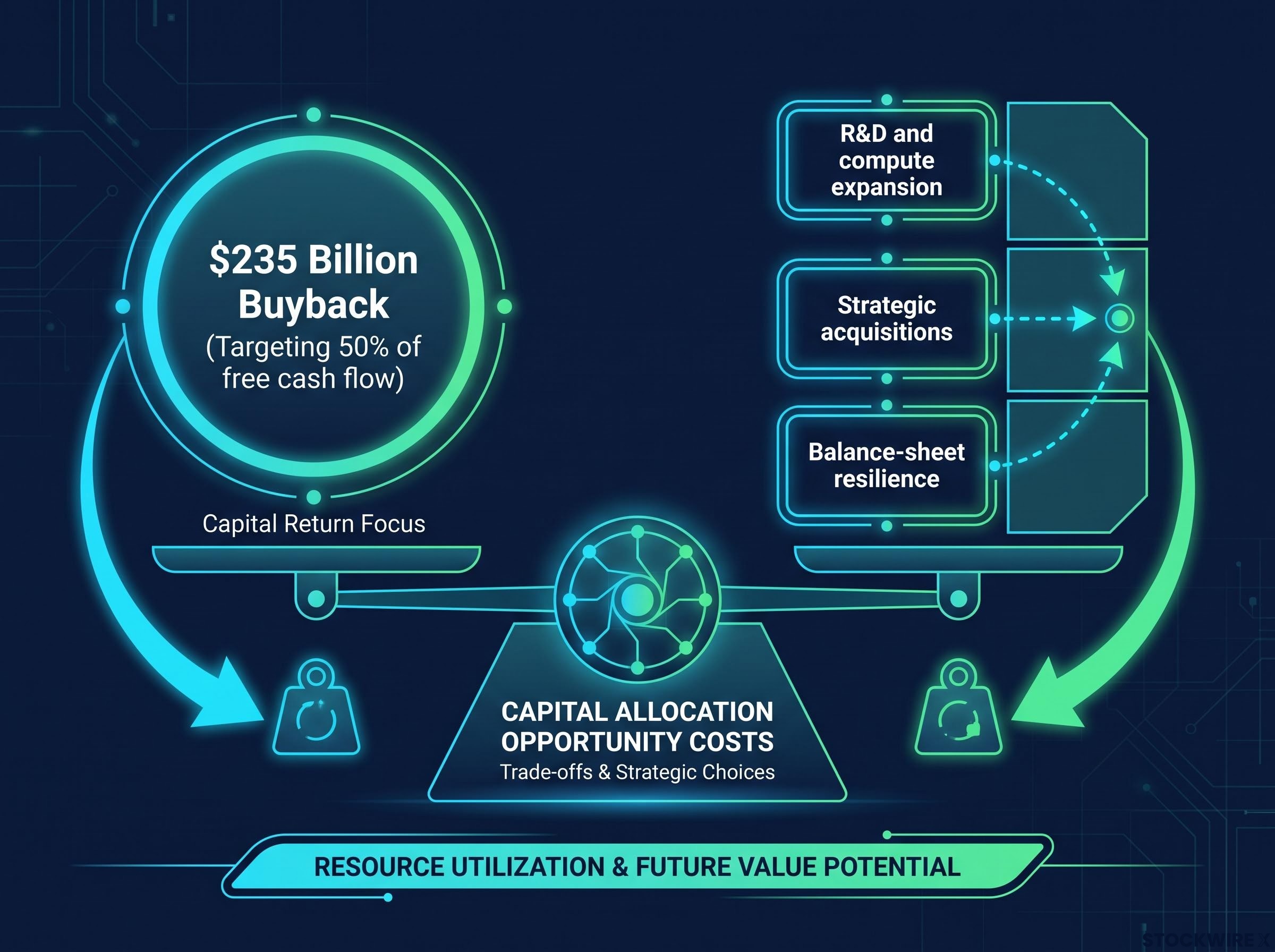
The skeptical case has been made publicly. After the $80 billion authorisation, MarketWatch questioned whether buybacks were the optimal deployment of Nvidia’s growing cash, framing the concern around opportunity cost relative to capacity expansion and acquisitions, and suggesting the programme, even at that size, “may not be enough.”
The counterargument runs in the opposite direction. Some commentators argue that beyond a certain reinvestment threshold, incremental cash delivers higher risk-adjusted returns through buybacks than through rushed or overpriced expansion, particularly for a company already funding growth at scale.
Others want Nvidia to go much further.
Jim Cramer’s proposal CNBC’s Jim Cramer suggested Nvidia pursue an “Apple-style” programme worth up to $500 billion, repurchasing roughly 10% of its shares. Nvidia has not authorised any such programme, and the current authorisation stands at $235 billion.
The honest position is that this trade-off has no clean answer yet. The 50% of free cash flow return target frames the programme’s scale, but whether that split maximises long-term value over the FY2028 horizon depends on outcomes no one can confirm today. Read the authorisation as strong evidence of board confidence, not as proof that buybacks are the value-maximising use of Nvidia’s cash.
What Nvidia’s capital return trajectory signals about the years ahead
Step back and the authorisation reads less like a single event and more like the latest data point in a clear directional story. Three increasingly large authorisations in roughly 13 months, culminating in the largest programme in U.S. history, amount to a sustained expression of board conviction that compounding AI infrastructure demand will generate the cash flows needed to execute through FY2028.
That conviction rests on two variables that could change the picture. A meaningful deceleration in AI infrastructure spending by hyperscalers and enterprises would undercut the cash generation the programme depends on, as would a competitive shift that compresses Nvidia’s accelerator margins.
For anyone already holding the stock, the authorisation is a forward commitment by the board to prioritise your ownership percentage. But the value of that commitment depends entirely on whether AI demand holds through the execution window, which makes it the single most important variable to watch.
For investors wanting to stress-test the board’s AI demand conviction against Nvidia’s current valuation, our deep-dive into Nvidia’s compressed forward multiple examines how the supply-constrained moat, hyperscaler concentration risk, and 18-month competitive window interact with the capital return thesis.
In practical terms, here is what to monitor from here:
- Quarterly repurchase execution against the $235 billion authorisation, since actual spend is what moves your EPS, not the headline ceiling.
- Free cash flow margins, which are the ultimate constraint on how much of the programme Nvidia can realistically deploy.
- Forward guidance on the sustainability of the 50% free cash flow return target, particularly any commentary that signals a change in that split.
This article is for informational purposes only and should not be considered financial advice. Investors should conduct their own research and consult with financial professionals before making investment decisions. Past performance does not guarantee future results. Financial projections are subject to market conditions and various risk factors, and forward-looking statements are speculative and subject to change based on market developments and company performance.