Kao Data has appointed Bruce Claassen as its new Chief Financial Officer, effective 1 October 2026, in a hire announced 29 September 2026 at a moment when the company is committing capital across three UK sites at once.
The timing is not incidental. Kao Data is simultaneously advancing data centre projects at Harlow in Essex, Stockport in Greater Manchester, and a newly acquired site in Park Royal, West London. That West London acquisition alone was completed in March 2026, carries a ready-for-service target of 2029, and is still working its way through staged planning.
In other words, the financial complexity the incoming CFO inherits is already live. It is not a plan on a slide.
Claassen’s track record is the clue to what happens next. His background is built around capital investment, refinancing, and business transformation, the exact disciplines a private equity-backed operator needs when it is trying to fund a multi-site expansion through a capital-intensive stretch. What that background says about Kao Data’s likely direction on its capital structure is the more revealing part of this announcement.
A hire built for a capital-intensive moment
Kao Data confirmed on 29 September 2026 that Bruce Claassen would take up the CFO role on 1 October 2026. The company operates and develops data centre infrastructure built for AI and advanced computing workloads, and Claassen steps into that context directly.
The remit tells you more than the title does. Kao Data has framed the role around working alongside the chief executive, senior leadership, the Board, and investors.
That last word matters.
An investor-facing remit is not the description of an internal controls appointment. It is the description of a hire meant to sit at the interface between the company and the capital markets that fund it.
Here are the core facts of the appointment:
- Role: Chief Financial Officer
- Start date: 1 October 2026
- Announcement date: 29 September 2026
- Stated remit: collaboration with the CEO, senior leadership, the Board, and investors
- Operating context: AI and advanced computing data centre infrastructure
Put the remit next to the pipeline and a clearer read emerges. A CFO brought in specifically to face the Board and investors, at a company running a three-site UK expansion, is a signal that Kao Data is preparing its finance function to support external fundraising or refinancing activity rather than routine reporting.
For anyone watching the company, that is the practical takeaway. Kao Data’s leadership appears to believe its next phase demands a finance leader with genuine capital market relationships, not simply someone to keep the books. That is a statement about growth ambition, and about the financing activity likely to follow.
When big ASX news breaks, our subscribers know first
Twenty years of data centres, fintech, and private equity finance
To understand why this hire fits, it helps to read Claassen’s career backwards from where he has just been.
His most recent role was at Global Switch, a data centre developer and operator, where he spent roughly four years. He served first as Group Finance Director before stepping up to CFO, overseeing finance operations across European and Asia-Pacific regions. Crucially, he also managed refinancing programmes during that time.
That single detail is the most directly relevant data point in his CV. Claassen has already run the financing complexity of a major cross-continental data centre portfolio, refinancing included. That is not a learning curve Kao Data will have to pay for.
Before Global Switch, his path ran through several sectors. He held senior finance roles at Towergate, Worldpay, and RAC, spanning insurance, payments, and roadside services.
The pattern in that career is worth noticing. Claassen started out at international publicly listed firms, then spent roughly the last decade at private equity-backed businesses. That decade in PE-backed environments maps directly onto Kao Data’s own ownership structure and financing approach.
His core areas of expertise sit at the centre of what this appointment is about:
- Capital investment
- Refinancing
- Business transformation
Over 20 years of senior finance leadership across multinational, multisector organisations, most recently as CFO of a European and Asia-Pacific data centre portfolio.
Taken together, the picture is coherent rather than assembled. A decade inside private equity-backed businesses gives Claassen the capital-structure discipline and investor-relations rhythm this kind of company runs on. His Global Switch years give him the specific muscle memory of data centre financing at scale. Kao Data has not hired a generalist and hoped for the best.
From architecture to accountancy: an unconventional path to data centre finance
There is a human wrinkle in the profile. Claassen was born and raised in South Africa, where his first degree was in architecture, not finance.
He later relocated to the United Kingdom and qualified as a Chartered Accountant in London, holding the designation of Fellow of the Institute of Chartered Accountants in England and Wales (FCA, ICAEW). A background in designing buildings before financing them is an unusual route into data centre finance, and a neat fit for an industry that is, at heart, about putting up physical infrastructure.
Three sites, one pipeline, and the financing challenge ahead
The scale of what Claassen is inheriting becomes clear once you lay out the pipeline. Kao Data is not planning three UK data centres. It is actively progressing three at once.
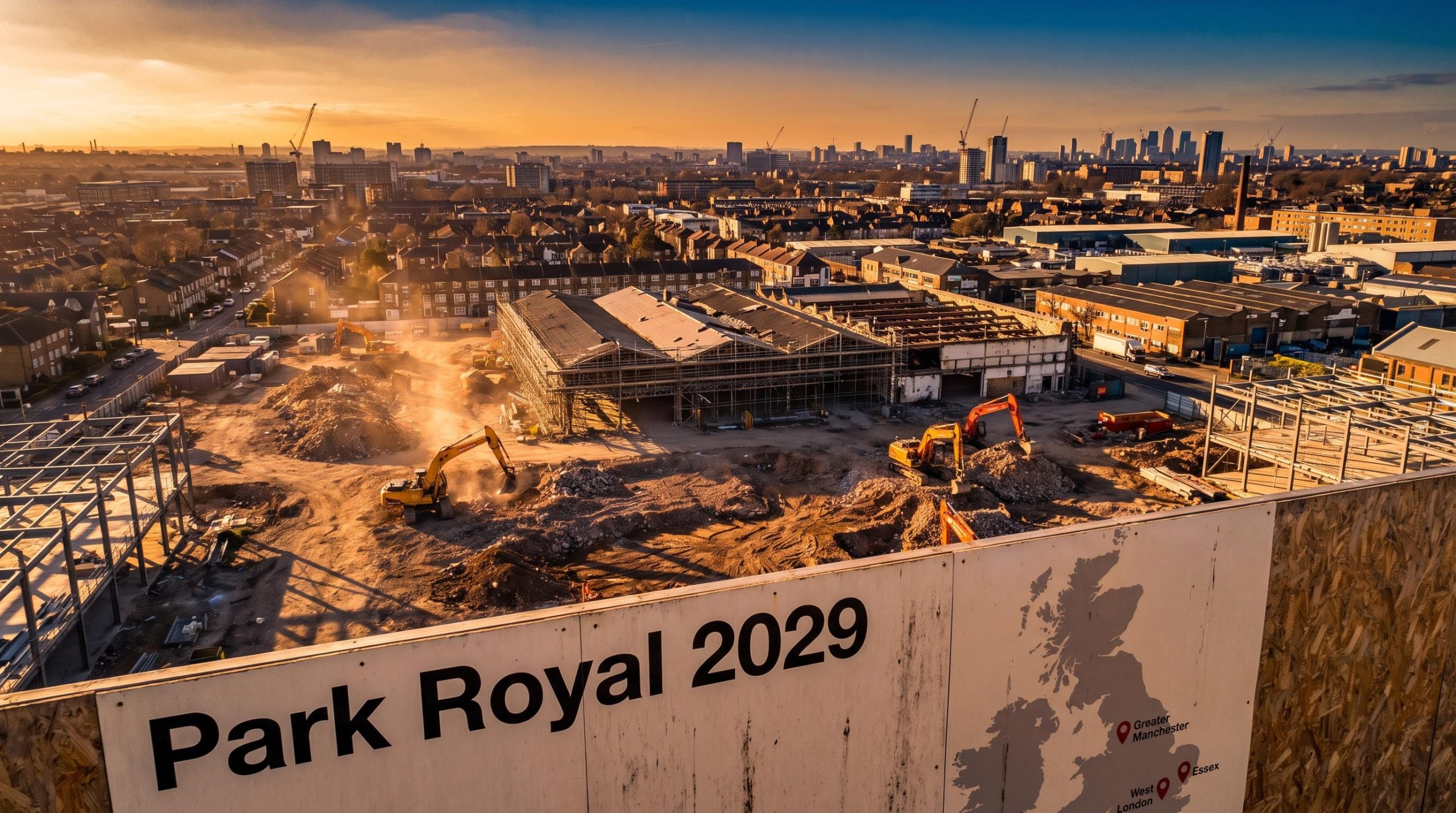
The most documented of the three is Park Royal in West London. Kao Data announced on 12 May 2026 that it had acquired a 4.7-acre brownfield site on the former Frogmore Industrial Estate, a 107,000 sq ft ex-industrial property, from Reassure Limited, a Legal & General business, with the deal completed in March 2026.
Kao Data has described the Park Royal site as sitting within “one of the UK and Europe’s most sought after cloud computing regions.”
The Park Royal timeline is where the financing challenge sharpens. The company has said the facility is expected to be ready for service in 2029, and it anticipates bringing forward three separate planning applications: one to demolish existing buildings, one for enabling works, and a full application for the data centre itself. A public consultation was staged in summer 2026, with an update published in August 2026.
Planning complexity and regulatory risk have moved from background concern to active constraint in several major markets, with New York’s statewide moratorium on hyperscale construction and Texas’s 474 GW interconnection queue freeze illustrating how quickly permitting conditions can shift for operators whose multi-year build programmes depend on stable approvals.
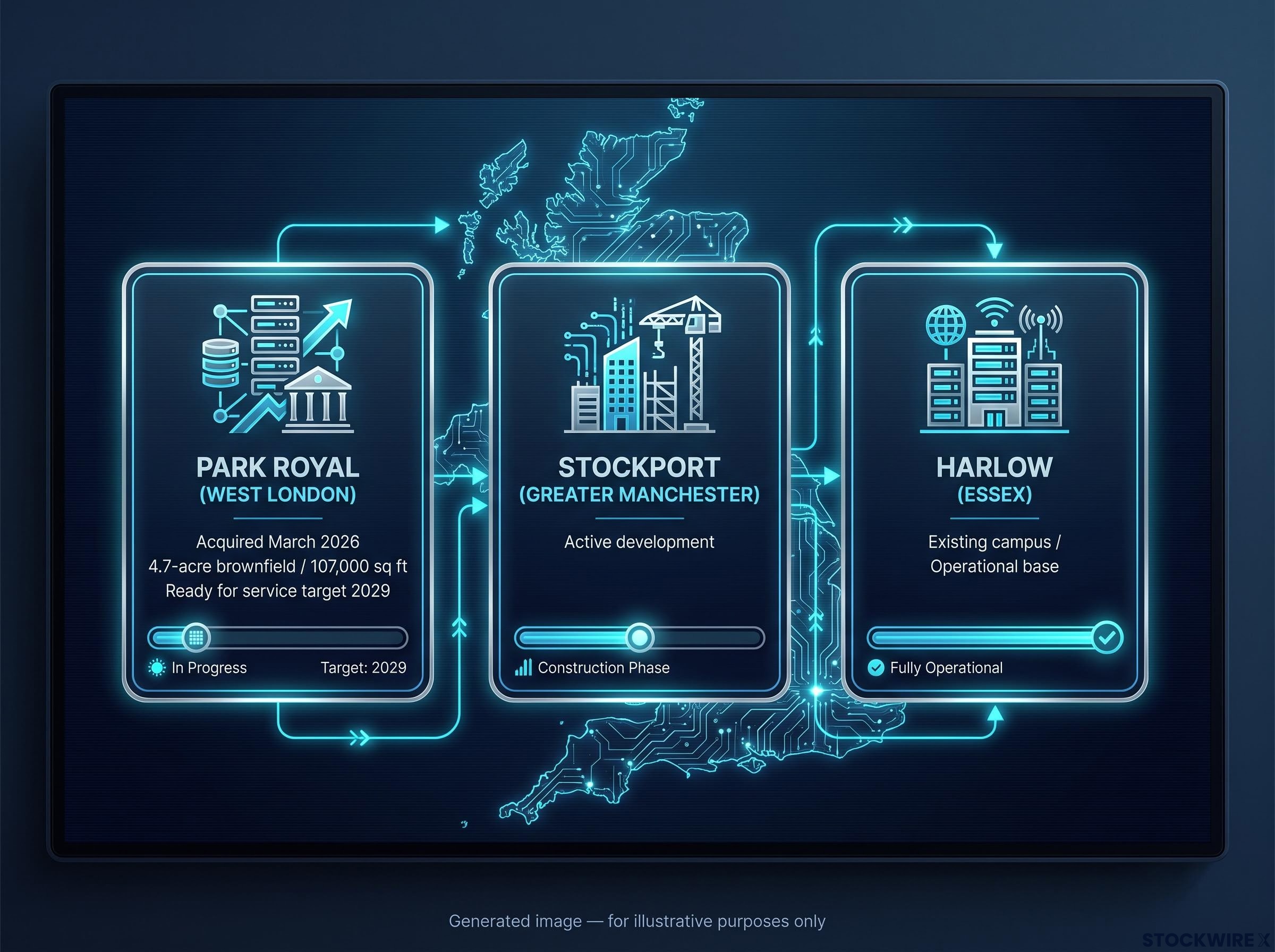
Here is how the three sites sit today:
| Site | Location | Status | Key milestone or target |
|---|---|---|---|
| Park Royal | West London | Acquired March 2026, planning in progress | Ready for service target 2029 |
| Stockport | Greater Manchester | Active development underway | Referenced in May 2026 market reporting |
| Harlow | Essex | Existing campus | Operational base |
That sequencing is the real inheritance. Three concurrent workstreams, staged planning applications, community consultation, and multi-year construction horizons all carry capital-sequencing implications.
For Claassen, it means capital must be committed across years before the newest asset earns anything, since Park Royal will not reach service until 2029. That is a financing profile demanding disciplined debt management and steady investor communication from the first day, not the maintenance of a status quo.
The market Claassen is walking into
Step back from Kao Data and the same pressures reappear across the entire UK sector. The financing and grid complexity Claassen will manage is not a quirk of one company. It is the defining condition of UK AI data centres right now.
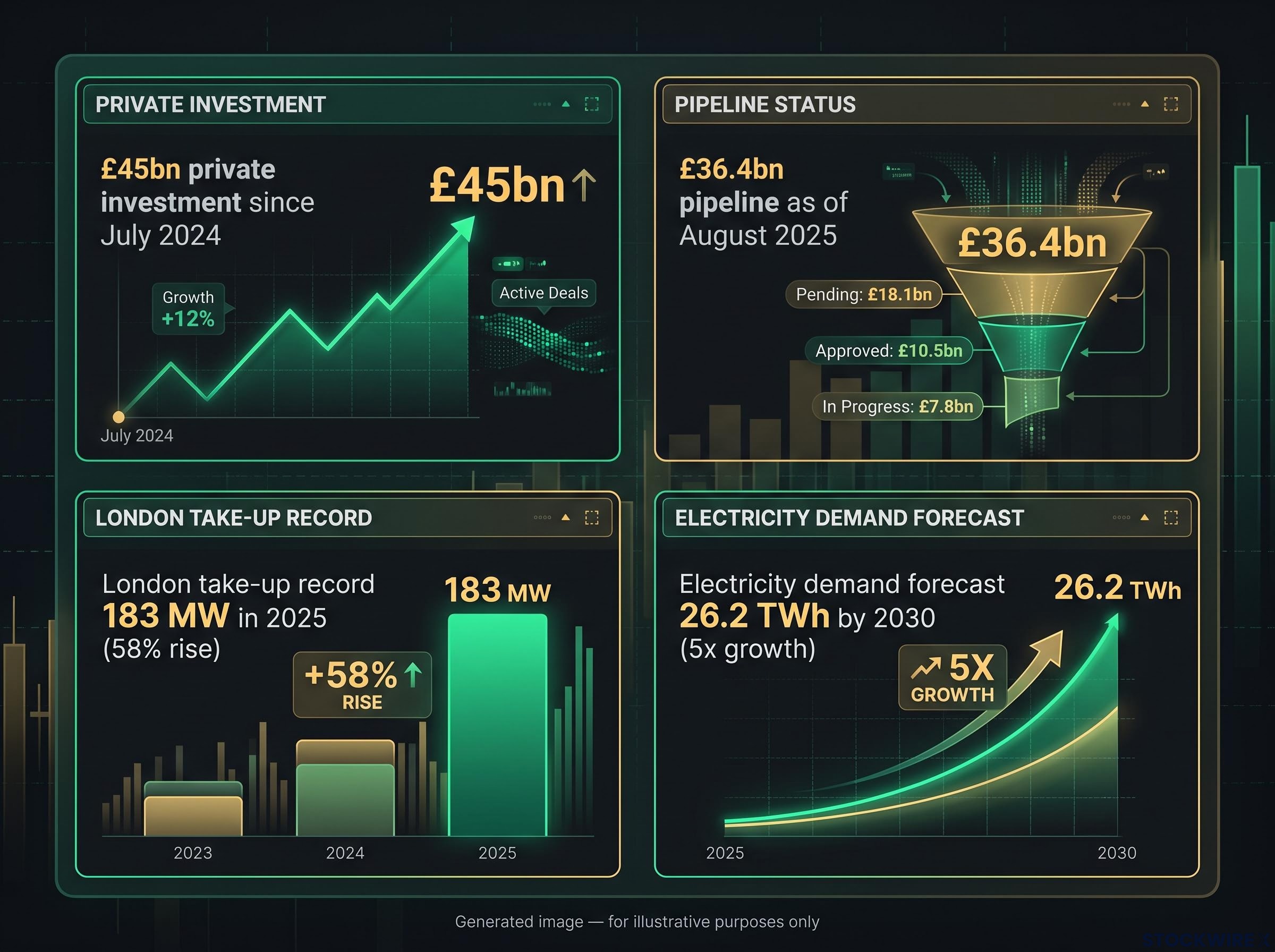
The headline number frames the opportunity. According to techUK’s January 2026 programme review, citing government statements, £45bn of private investment has been committed to UK data centres since July 2024, with a pipeline worth roughly £36.4bn as of August 2025 covering nearly 100 developments nationwide.
Private capital flows into AI infrastructure have accelerated sharply in 2026, with Blackstone’s $69 billion Q1 inflow and a $25 billion Pennsylvania data centre commitment illustrating the scale at which institutional investors are now underwriting physical compute capacity alongside software and model stakes.
Demand is climbing just as fast. CBRE’s mid-year 2025 review reported that London take-up is set to reach a record 183 MW in 2025, a 58% rise on 2024 and double the 2021 total.
UK data centre electricity demand could grow more than fivefold by 2030 to reach 26.2 TWh, according to the Nuclear Industry Association.
The money, in short, is abundant. The constraints are not. techUK flags electricity pricing, grid capacity, planning complexity, and environmental scrutiny as the growing brakes on delivery, with the grid-connection pipeline having already risen to around 2.2 GW by early 2025, up from 1.3 GW previously, per SSEN Distribution data.
The key figures worth holding in mind:
- UK data centre pipeline worth approximately £36.4bn as of August 2025 (techUK)
- London take-up of a record 183 MW in 2025 (CBRE)
- Annual UK data centre spend of £1.75bn the prior year, with £2.38bn forecast for 2025 (Reuters, citing Barbour ABI)
- Electricity demand forecast to grow more than fivefold to 26.2 TWh by 2030 (Nuclear Industry Association)
The direction of travel is steep. KPMG’s December 2025 analysis projects global data centre capacity growing at a 29% compound annual growth rate through 2030 as AI workloads become the main driver of new build.
KPMG’s global data centre CapEx benchmarking analysis, published in May 2026, provides the wider context for those growth projections, detailing how AI-driven demand is reshaping capital allocation decisions across data centre portfolios and compressing the margin for error in multi-site financing programmes.
For a CFO joining a private equity-backed operator with three sites in motion, the read is direct. Abundant capital, constrained grid access, and rising construction costs mean the capital allocation calls made over the next 12 to 18 months will decide whether Kao Data catches this cycle or misses it. Refinancing and capital investment experience is precisely the premium the sector is paying for.
What Claassen’s appointment signals for Kao Data’s next move
Line up the three threads and the story writes itself. A CFO hired for capital investment and refinancing, a company running three live sites with a 2029 horizon on its newest, and a UK sector in the middle of a £45bn investment surge.
That combination points one way. Claassen is almost certainly there to structure the financing that turns Kao Data’s pipeline into operating assets, and the investor-facing remit suggests external financing activity is being readied rather than deferred.
Debt management and refinancing pressures across the broader private credit market have intensified in 2026, with BDC discounts of 17-26% to stated NAV and rising direct lending default rate projections creating a more selective environment for operators seeking to refinance or extend facilities tied to long-duration infrastructure assets.
The private equity context sharpens the reading further. With roughly the last decade of his career at PE-backed businesses, Claassen understands how to manage a capital structure toward both expansion and eventual exit-readiness, a dual discipline that matters when finite fund lives meet long-duration infrastructure assets.
The timing is the final piece. He joins as the UK AI data centre sector shifts from early momentum to large-scale capital commitment, and his remit will likely be defined by how well Kao Data finances its way through that transition.
What the appointment signals in short:
- Kao Data is moving from expansion planning into expansion execution
- The finance function is being positioned for external fundraising or refinancing, not just reporting
- The hire matches the steepest part of the UK AI data centre investment curve
For prospective customers, suppliers, and industry observers alike, that directional signal is the most actionable takeaway in this announcement.
This article is for informational purposes only and should not be considered financial advice. Investors should conduct their own research and consult with financial professionals before making investment decisions. These statements are speculative and subject to change based on market developments and company performance.