The S&P 500 rose 0.3% overnight. On the same session, South Korean AI supplier Elice fell 32% on its Seoul debut and CoreWeave shares dropped 20% as its bond yields climbed. That split is the signal behind MUFG’s latest FX positioning for 2027: calm headline indexes can hide real stress inside the AI supply chain.
MUFG Asia strategist Michael Wan argued in a note on 21 October 2026 that risk sentiment has steadied for now. His concern is the year ahead, which he expects to be tougher for risk assets as doubts about the AI trade build and Asian export growth starts to slow.
The currency consequences differ sharply across Asia. Chip-heavy currencies sit on one side of his call, and domestically driven ones sit on the other.
Here is how MUFG links AI doubts, export data and US politics to specific currency calls, and where that logic could break down.
Why does a steady market still point to a harder 2027?
Strong data, weaker momentum
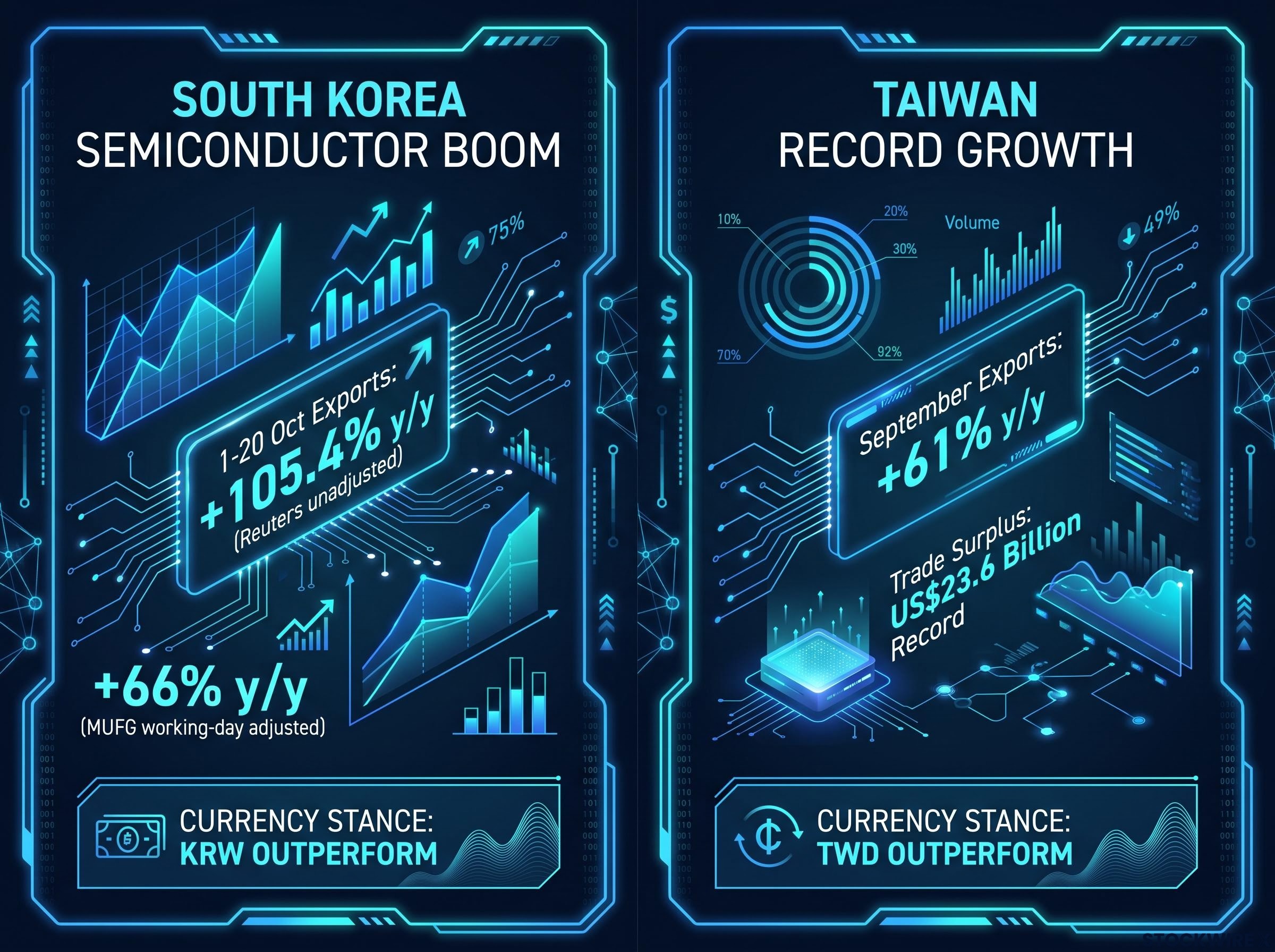
Asia’s trade numbers do not look like a region in trouble. Reuters reported South Korean exports up 105.4% year on year for 1-20 October on unadjusted customs data, driven by record semiconductor sales. MUFG puts the gain at 66% after adjusting for the number of working days, which explains the gap between the two figures.
Taiwan’s September exports rose 61%, and its monthly trade surplus hit a record US$23.6 billion.
Wan’s point is about direction rather than level. His preferred lead indicators suggest Asia’s export growth is “rolling off” into 2027, though he stresses implied growth stays healthy, just below recent highs.
| Indicator | Figure | Source | Basis |
|---|---|---|---|
| South Korea exports, 1-20 Oct | +105.4% y/y | Reuters | Unadjusted customs data |
| South Korea exports, 1-20 Oct | +66% y/y | MUFG | Working-day adjusted |
| Taiwan exports, September | +61% y/y | MUFG | Monthly |
| Taiwan trade surplus, September | US$23.6B | Reuters | Monthly record |
Markets price what comes next, not what already happened. When growth is running at peak strength, it only needs to slow to disappoint. Strong data therefore does not make your Asian exposure safe; it raises the bar for staying ahead.
Where the AI trade shows strain
The stress shows up in financing. MUFG cited a Wall Street Journal report that Anthropic could spend US$750 billion on extra computing power in coming years while recording an US$81 billion net loss in the first half of 2026. CoreWeave’s rising bond yields point the same way: lenders are demanding more to fund AI infrastructure.
The strain in AI financing traces back to hyperscaler capex funding, where free cash flow is compressing and bond issuance is rising, and where a large share of AI revenue depends on two loss-making labs.
Reuters has warned of a possible “messy AI unwind”, flagging the large cross-border imbalances built by chip and tech investment.
Michael Wan, MUFG “Our best guess looking ahead is that 2027 could prove somewhat more challenging for risk assets.”
When big ASX news breaks, our subscribers know first
How could the US midterms change the risk backdrop?
The second leg of Wan’s view runs through Washington. Forecasters broadly agree Democrats are likely to win the House on 3 November. The Senate is far less settled.
| Source | House view | Senate view | Date |
|---|---|---|---|
| Decision Desk HQ | 77% Democratic | 56% Democratic | 19 Oct |
| Silver Bulletin FLIPR | 93.6% Democratic | 75% Democratic | 19 Oct |
| Cook Political Report | Democratic gain of 9-19 seats | Democratic gain of 2-6 seats (four needed) | October |
| Pew Research Center | 55% of adults expect Democrats to win | 48% expect Republicans, 46% Democrats | 15 Oct |
The result matters less than what follows it. In MUFG’s scenario, Democrats taking control of the House and the Senate together might usher in tighter rules on AI and a more polarised, party-driven stance on fiscal policy. Either would raise the risk premium, meaning the extra return investors demand for holding riskier assets, on US tech and the Asian supply chain that feeds it.
That remains a scenario, not a forecast. No specific new AI-regulation or fiscal proposals tied to a Democratic takeover have been published.
The spread in Senate odds, from 56% to 75%, tells you the political leg is the least certain part of MUFG’s call. Size it as a tail hedge, not a base case.
Why do KRW and TWD sit apart from INR and IDR in FX positioning for 2027?
What ties a currency to the chip cycle
Start with the plumbing. When Korea and Taiwan sell more chips, exporters earn US dollars and convert them home, widening trade surpluses and lifting manufacturing profits. Foreign investors then buy local equities, which adds further demand for the Korean won (KRW) and Taiwan dollar (TWD).
Beyond trade surpluses, export repatriation flows give the won a sturdier support structure, because exporters converting record dollar revenues follow corporate cash cycles and are harder to reverse on a single headline.
The Chinese yuan (CNY) benefits more indirectly through China’s manufacturing chain, and its value is closely managed by Beijing. MUFG expects contained volatility there if authorities keep a stable stance and trade tensions do not escalate.
The Indian rupee (INR) and Indonesian rupiah (IDR) answer to domestic forces. India’s currency is sensitive to its imported oil bill, inflation and interest-rate differentials. Indonesia faces uncertainty around Bank Indonesia’s policy decision and a potential MSCI proposal to downgrade the country to standalone-market status, a move that could reduce passive foreign investment.
| Currency | Key driver | MUFG stance | Latest level (vs USD) |
|---|---|---|---|
| KRW | Semiconductor exports | Outperform | 1,324.30 |
| TWD | Semiconductor exports, record surplus | Outperform | 32.51 |
| CNY/CNH | Policy management, indirect tech link | Outperform; long CNH as hedge | 6.6890 (CNH) |
| INR | Energy imports, inflation, rates | Underperform | 94.5912 |
| IDR | Central bank policy, MSCI review | Underperform | 17,978 |
| JPY | Safe-haven demand | Long as hedge | 158.12 |
The defensive overlay
On top of that relative view sits a hedge. Wan expects more frequent risk-off episodes, when investors sell riskier assets and buy safer ones, with safe havens such as the Japanese yen (JPY) and Swiss franc (CHF) outperforming.
Michael Wan, MUFG “Going long the Dollar, JPY, or CNH against higher beta currencies may make sense moving forward.”
Higher-beta currencies are those that swing more sharply with global risk appetite. CNH is the offshore version of the yuan, which trades more freely outside mainland China. The 2024 yen carry-trade unwind shows the template: as volatility spiked, investors who had borrowed cheap yen to buy higher-yielding assets rushed to repay, and JPY rallied while riskier currencies fell.
MUFG is running two layers at once. You need to know whether you are expressing the relative bet within Asia or the defensive hedge against the whole risk complex, because they can pay off in different conditions.
What could undermine a defensive FX stance?
The hedge has plenty of ways to go wrong. Hot US inflation fed the 15 October emerging-market selloff by lifting expectations of Federal Reserve (Fed) tightening; a later US slowdown would push the other way, weakening the dollar.
Japan carries its own risk. A more hawkish Bank of Japan (BoJ) could lift the yen regardless of sentiment, while delayed tightening could weaken it. The People’s Bank of China (PBoC) can also steer CNH through daily fixings and liquidity, in either direction.
The AI bull case is still credible. In notes on 22 September and 9 October, MUFG itself argued AI infrastructure demand could run into 2027 and beyond as spending shifts toward inference and consumer applications. Taiwan’s record surplus and Korea’s chip strength create steady demand for TWD and KRW that can cap their downside.
Politics can override fundamentals too, as the 2025 tariff volatility showed when trade-sensitive Asian currencies weakened despite solid export data. Some evidence is also missing: comparable figures for China’s export growth, Nvidia and the Philadelphia Semiconductor Index were not available.
Watch these five triggers:
- Hotter US inflation: supports USD, pressures high-beta Asian currencies.
- Fed easing or US slowdown: weakens USD, revives KRW and TWD.
- Hawkish BoJ surprise: strengthens JPY independent of risk sentiment.
- Volatility spike in AI credit: carry unwinds, favours JPY and USD.
- Falling volatility and firm chip demand: carry rebuilds, higher-yielding Asian currencies outperform.
Because the same carry and volatility dynamics can favour either side, treat this as a conditional hedge with defined exit triggers, not a standing bet.
For readers wanting to size a JPY hedge, our deep-dive into yen carry trade panic offers a three-question framework separating real systemic risk from headline noise.
Weighing the hedge: what to watch as 2027 approaches
MUFG is not calling a collapse. Its case rests on slowing momentum, rising risk premia in AI financing and a political calendar that could add regulatory and fiscal friction.
That produces two layers: a preference for KRW, TWD and CNY over INR and IDR, plus a defensive long position in USD, JPY or CNH against higher-beta currencies.
To judge your own exposure, track:
- The 3 November Senate result, the least certain political variable.
- Korean and Taiwanese export growth rates, for confirmation of the roll-off.
- AI infrastructure credit, including CoreWeave’s bond yields.
- US inflation and Fed expectations, the fastest route to a dollar move.
If all four turn against risk together, the hedge earns its keep. If they diverge, conviction should scale down accordingly.
This article is for informational purposes only and should not be considered financial advice. Investors should conduct their own research and consult with financial professionals before making investment decisions. Past performance does not guarantee future results. Financial projections are subject to market conditions and various risk factors.
—