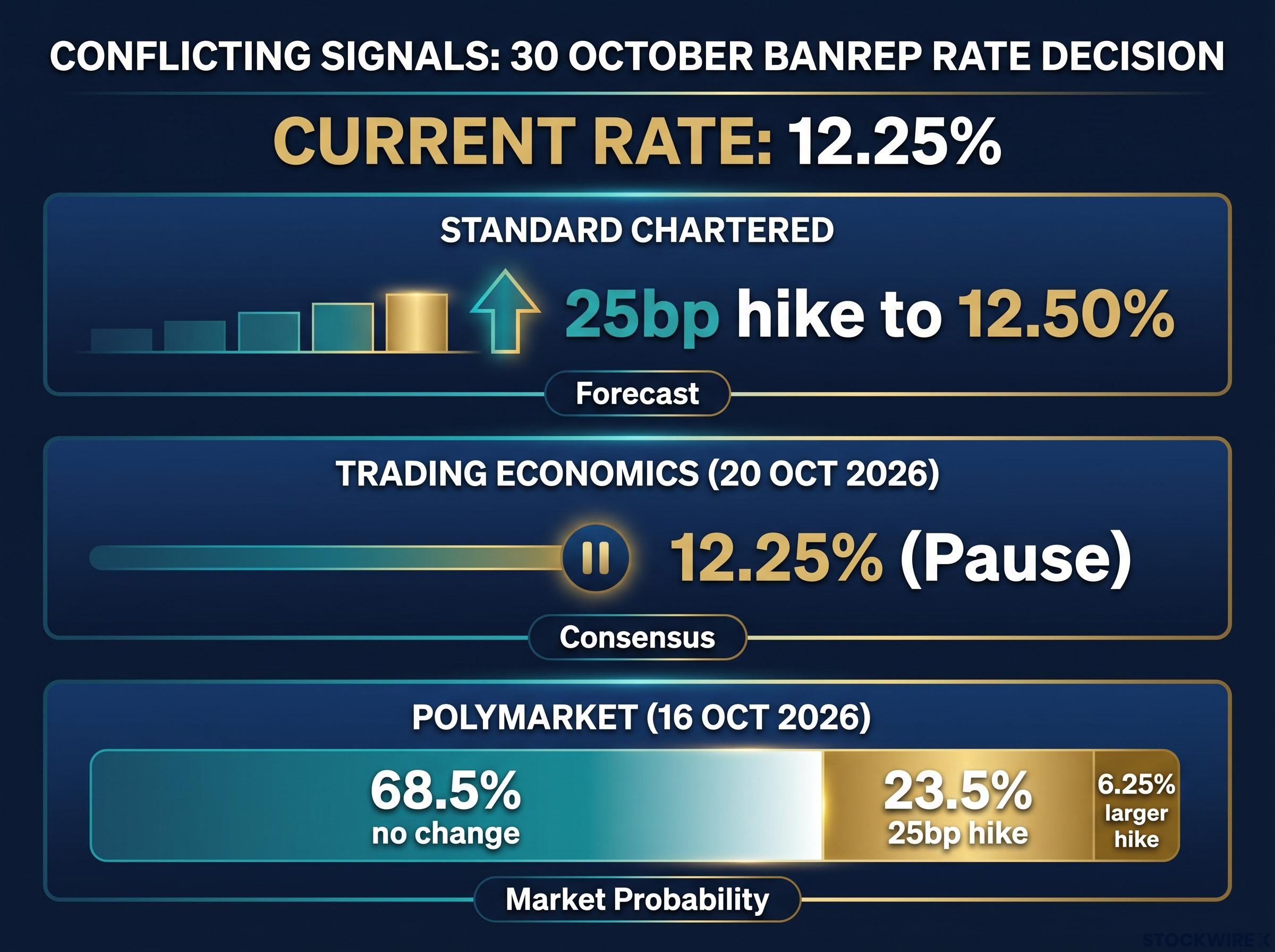
Standard Chartered’s Dan Pan, writing via FXStreet, expects Colombia’s central bank to deliver one final 25-basis-point hike on 30 October, lifting the policy rate to 12.50%. Prediction markets lean the other way. That disagreement over the coming Colombia central bank rate decision is where the real uncertainty sits.
Banco de la República (BanRep) enters the meeting with its policy rate at 12.25% after two consecutive increases. Inflation sits well above target, yet the board also faces record-wide trade deficits and an economy that has started to stall.
The meeting matters beyond Colombia because it tests whether an inflation-first central bank will keep tightening when currency moves and the external balance argue for caution.
Here is a practical way to weigh the decision against peso and external-balance considerations, and to judge which outcome would genuinely surprise the market.
Where the board stands: two hikes, a split vote and conflicting signals
The board has not been timid. Its last two decisions both pushed rates higher:
- July: a 25bp increase to 12.25%, with four directors voting for +25bps and three for +50bps
- September: another 25bp increase, with the rate of 12.25% effective 1 October 2026, according to BanRep’s policy-rate page
One secondary source described July as a pause. BanRep’s own published record shows a hike, and that is the version used here.
The July vote deserves more attention than the headline move. Three of seven directors wanted a larger increase, which tells you the hawkish wing is close to a majority, not a fringe.
That is what makes the gap between forecast and pricing so striking.
A similar forecaster split is playing out elsewhere in emerging markets, where Turkey’s central bank decision pits a priced-in cut against credibility and reserve concerns, another test of how far policymakers lean on currency considerations.
| Source | View | Date |
|---|---|---|
| Standard Chartered (Dan Pan, via FXStreet) | 25bp hike to 12.50%, described as the last | October 2026 |
| Market pricing (per Standard Chartered) | About 25bps of hikes priced over three months, not fully priced for October | October 2026 |
| Polymarket (via Rio Times) | 68.5% no change; 23.5% 25bp hike; 6.25% larger hike | 16 October 2026 |
| Trading Economics consensus | 12.25% before and after, implying a pause | Updated 20 October 2026 |
Nobody in this table disputes that inflation is a problem. What separates them is how much weight the board will give the currency and the trade gap, and that is the variable you should be watching.
When big ASX news breaks, our subscribers know first
The case for one more hike: inflation, expectations and external risks
Start with the inflation data, because that is where the hawkish argument draws its strength.
| Measure | Figure | Source |
|---|---|---|
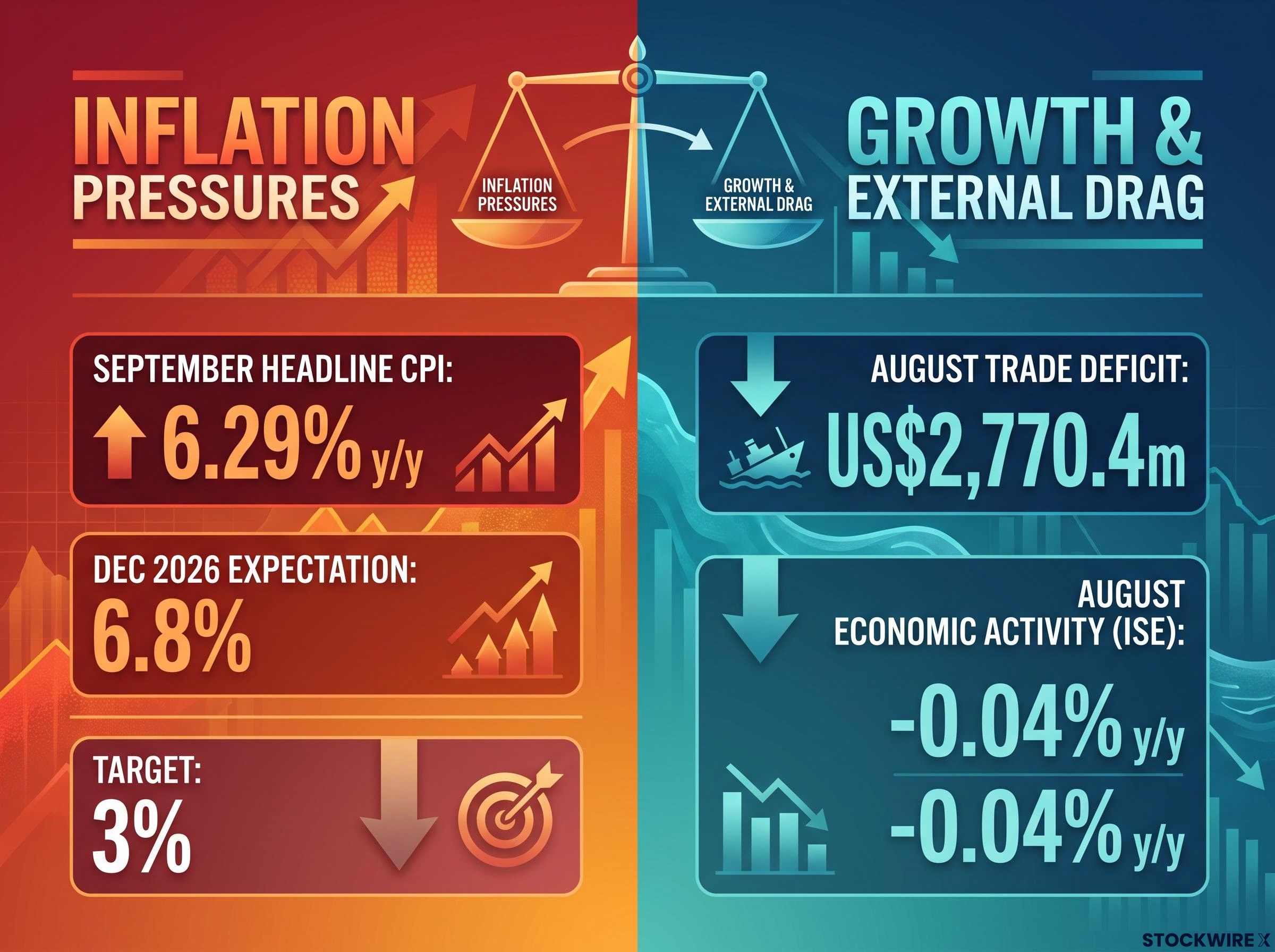
| Headline CPI, September | 6.29% y/y; 0.37% m/m | DANE via La República |
| Core inflation (ex food and regulated items), August | 6.1% y/y, a one-year high | BanRep September decision |
| Analysts’ December 2026 expectation | 6.8% | BanRep September survey |
| Two-year expectation | 4.0% | BanRep September survey |
BanRep’s inflation page shows 11.4% for September and 8.6% for the average of core measures, figures that conflict with DANE’s and may reflect a differently defined series, so the 6.29% headline is the safer anchor.
Dan Pan’s case stacks several pressures on top of that data: a positive output gap (the economy running above its sustainable capacity), elevated oil prices, the risk of a strong El Niño weather pattern, persistent inflation and high expectations.
Standard Chartered’s read on the currency Pan suggests BanRep may choose to focus on domestic demand imbalances rather than react to short-lived peso moves driven by rate differentials.
That framing matters. If currency swings are temporary, the board can look past them and keep its sights on spending at home.
The International Monetary Fund (IMF) supports the broad stance. Its Article IV review calls for continued tight monetary policy alongside fiscal consolidation to bring inflation back to the 3% target, with IMF-related reporting putting the primary deficit near 3.5% of GDP and public debt near 60%. Loose fiscal policy keeps demand warm, which forces the central bank to stay tighter for longer.
The number that ties this together is the 6.8% December expectation, more than double the target. Read that way, another hike is insurance against expectations drifting further, not a reaction to a single month of data.
The hawkish wing’s push for larger moves echoes currency defence hikes elsewhere, and Bank Indonesia’s 50bp surprise shows how quickly dollar strength and energy costs can drag emerging market central banks into tightening cycles.
The case for a pause: a stronger peso, record deficits and softening activity
The hawkish logic looks tidy until the external and growth data arrive.
Trade deficits
Colombia posted a goods deficit of US$2,797.8m in July, then US$2,770.4m in August, according to DANE. August imports reached US$7,226.6m against exports of just US$4,456.2m, and the deficit was 68% wider than a year earlier.
Reuters on the August data Imports surged “in the midst of” peso strength, widening the gap.
Even Standard Chartered concedes that excessive peso strength and record-wide July and August deficits could lead the board majority to pause. The forecaster is effectively flagging the main threat to its own call.
Activity and the currency
Growth is also losing momentum, according to DANE figures:
- August economic activity (ISE): -0.04% y/y
- January to August ISE: +2.27% y/y
- August manufacturing: -3.7% y/y
- Primary activities: -3.19%; secondary activities: -4.17%
Part of August’s weakness has been attributed to an earthquake, but no named source has quantified that effect, so treat the explanation with caution. The IMF expects growth of about 2.2% in 2026, down from 2.6% in 2025.
The currency story is also messier than a simple “strong peso” headline. Standard Chartered puts the peso about 3% weaker than before July, and USD/COP traded near 3,358 on 19 October, up from about 3,170 on 16 October.
Flat activity at a 12.25% policy rate suggests restrictive policy is already biting. The question you should ask is whether another hike buys more inflation control or simply adds growth cost.
How rate decisions move the peso, imports and the external balance
Here is the puzzle. A hike tends to support the peso, yet a strong peso helps feed the trade deficit. Both camps are reading the same chain.
A hike tends to support the peso, but the currency’s reaction also depends on how US yields and dollar strength are pressuring emerging market currencies more broadly, which can blunt or amplify whatever BanRep delivers.
The transmission chain
- Yields attract capital. Higher Colombian rates draw foreign money, supporting the peso.
- Import prices fall. A firmer peso makes foreign goods cheaper in local terms, easing tradable-goods inflation.
- Import demand rises. Cheaper machinery, inputs and consumer goods encourage more buying abroad.
- Exports lose ground. Colombian goods get pricier for foreign buyers, and exporters earn fewer pesos per dollar.
- The deficit widens. Strong demand plus weaker exports can stretch the trade and current-account gaps.
Each lens stresses a different link.
| Lens | Core argument | Points to | Key risk |
|---|---|---|---|
| Inflation-first | Currency moves are partly temporary; re-anchor expectations | Hike | Over-tightening a slowing economy |
| External-balance | Appreciation deepens import dependence and hurts competitiveness | Pause | Expectations drift higher |
| Growth | High real rates are already suppressing output | Pause | El Niño or oil reignite inflation |
The IMF’s view sits closest to the first lens: flexible exchange rates absorb shocks, and policy should target expectations rather than manage the currency.
A framework for weighing the call
Four questions help you judge this decision, or any similar emerging-market call:
- Are expectations anchored? At 6.8% for December, Colombia’s are not.
- Is the output gap closing? Flat August activity suggests it may be.
- Is the external balance deteriorating? Two deficits near US$2.8bn say yes.
- What is already priced? Standard Chartered notes some hikes are priced but not fully for October, so peso upside from a hike may be limited.
Swing factors cut both ways. Higher oil lifts fuel and transport costs but may boost export and fiscal revenue, while a severe El Niño could push up food, electricity and energy prices. No comparable current precedent in Brazil, Mexico or Chile was found, so Colombia’s own July split is the best guide.
The peso’s reaction depends on surprise versus pricing, so a half-priced hike may move the currency less than the headline suggests.
What a hike or a pause on 30 October would change, and what it would not
A hike would confirm the inflation-first stance and, if expectations ease, likely mark the end of the cycle. A pause would signal that external and growth concerns now carry equal weight with inflation. Neither outcome resolves the underlying tension.
Three variables deserve your attention afterwards:
- The peso’s move relative to what markets had priced
- The next round of trade and activity data
- Any shift in El Niño or oil risk
Watch the vote as closely as the result. After July’s 4-3 split, a narrow margin either way tells you how fragile the board’s direction is, and how quickly your read on the peso may need to change.
This article is for informational purposes only and should not be considered financial advice. Investors should conduct their own research and consult with financial professionals before making investment decisions. Forecasts and forward-looking statements are speculative and subject to change based on market developments.